

Have you ever felt like you need a secret decoder ring just to understand your own apprenticeship paperwork? Between the various government bodies and service providers, it's easy to feel lost in a sea of acronyms. If you are asking who manages apprentice training contracts in NSW, you aren't alone. It’s a common frustration for both employers and students who just want to focus on the work itself rather than the red tape. We understand that the legal side of training can feel intimidating, but it doesn't have to be a barrier to your success.
In this guide, we'll simplify the entire process so you can navigate your journey with ease. You'll discover the key organisations responsible for overseeing, registering, and supporting your training contract. We'll explain the specific roles of Apprentice Connect Australia Providers (ACAPs), which replaced the old AASN system in 2024, alongside Training Services NSW and your Registered Training Organisation (RTO). By the end of this article, you'll have a clear understanding of the tripartite relationship and the confidence to choose the right RTO for your needs. We're here to act as your expert guide, turning confusion into a clear, manageable path toward your professional goals.
Key Takeaways
- Identify the distinct roles of Training Services NSW and the Commissioner for Vocational Training in overseeing the legal integrity of your apprenticeship.
- Clarify who manages apprentice training contracts in NSW by distinguishing between the administrative support of ACAPs and the regulatory authority of the state.
- Recognise the shared responsibilities within the tripartite agreement to ensure both the employer and apprentice meet their legal and educational obligations.
- Understand how your Registered Training Organisation (RTO) develops the essential Training Plan, which must be finalised within 12 weeks of contract approval.
- Explore how to access fee-free training through the NSW Smart and Skilled programme to reduce the financial burden of gaining your qualification.
The Governing Authorities: Training Services NSW and the State Training Authority
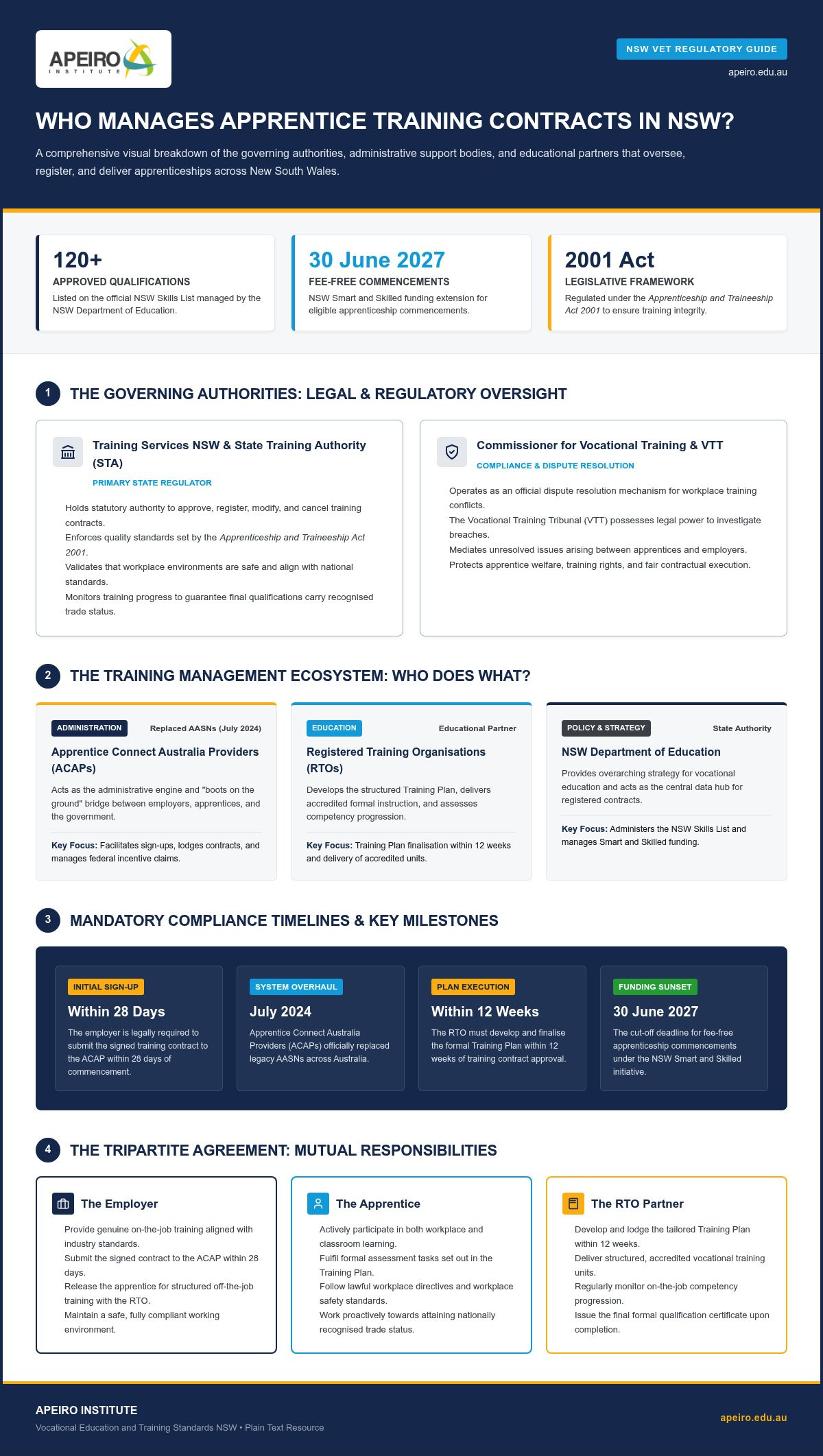
Understanding exactly who manages apprentice training contracts in NSW is the first step toward a successful career or a compliant workplace. Training Services NSW, a key division of the NSW Department of Education, acts as the primary regulator for all vocational training across the state. They ensure that every apprenticeship meets the high standards required by the Apprenticeship and Traineeship Act 2001. This isn't just about bureaucracy; it's about protecting your rights and ensuring the quality of the training you receive. By providing a clear set of rules, they create a secure environment where both students and employers can thrive.
The State Training Authority (STA) holds the legal power to approve, register, and even cancel training contracts. When you sign that document, you're entering a legally binding agreement that the STA must validate. Their oversight ensures that workplaces are safe and that the training provided aligns with national industry standards. By maintaining this strict level of control, the STA guarantees that a qualification earned in NSW carries real weight in the job market. They act as a silent partner in your success, making sure the "on-the-job" part of your learning is just as rigorous as the classroom component.
The Role of the NSW Department of Education
The NSW Department of Education provides the overarching strategy for the state's vocational education and training (VET) sector. They manage the registration of every single training contract, acting as the central hub for vocational data. This department also builds the legislative framework that protects both parties. For example, they manage the NSW Skills List, which currently includes over 120 approved qualifications. Their work ensures that the system is fair, accessible, and focused on the skills our economy needs most. They also oversee the funding for programmes like Smart and Skilled, which has been extended to provide fee-free training for commencements up to 30 June 2027.
Regulatory Compliance and Dispute Resolution
Training Services NSW doesn't just register your contract and walk away. They actively monitor your progress to ensure the training is actually happening. If a conflict arises that you can't resolve on the workshop floor, Training Services NSW provides a path forward. The Commissioner for Vocational Training and the Vocational Training Tribunal (VTT) have the authority to investigate breaches or help mediate disputes. This safety net is essential for maintaining a healthy training environment. When asking who manages apprentice training contracts in NSW, it’s important to remember that these authorities provide the legal backbone for your entire career journey. Without a valid, registered training contract, you won't be able to claim your final certificate or your nationally recognised trade status.
The Administrative Engine: Apprentice Connect Australia Providers (AASNs)
Who manages apprentice training contracts in NSW? While Training Services NSW holds the legal authority, the day-to-day administrative heavy lifting is done by Apprentice Connect Australia Providers (ACAPs). You might still hear people call them Australian Apprenticeship Support Networks (AASNs), but as of July 2024, ACAPs are the official "boots on the ground". They don't provide the actual teaching. Instead, they act as the essential bridge between you, your employer, and the government, ensuring all the paperwork is in order so the training can actually happen. They are your guides through the technical side of the apprenticeship system.
When asking who manages apprentice training contracts in NSW, it’s helpful to view the ACAP as your administrative help desk. They ensure the legal contract is lodged correctly and that all parties understand their commitments. Because they handle the federal side of the equation, they are also the ones who make sure the financial incentives reach the right people at the right time. Their involvement provides a layer of security, ensuring that your apprenticeship is recognised both at a state and national level.
Facilitating the Training Contract Sign-up
The journey begins with an ACAP representative visiting your workplace to facilitate the sign-up. This meeting must happen quickly; an employer is legally required to submit the signed contract within 28 days of the apprentice starting work. The provider checks that everyone is eligible, looking at residency status and the suitability of the workplace. They also help you select the most appropriate qualification for your career goals. For those entering the technical trades, this might involve choosing a high-demand course like the UEE30920 Certificate III in Electronics and Communications. Once the paperwork is signed, the ACAP lodges it with Training Services NSW for formal registration.
Ongoing Administrative Support
After the contract is active, your ACAP remains your primary point of contact for anything administrative. If you need to change your working hours, suspend the contract for a period, or extend the completion date, they manage these variations. They are also responsible for the money side of things. They process claims for federal incentives, such as the $5,000 available to employers in priority trades under the Key Apprenticeship Program (KAP). For apprentices, they help manage the Australian Apprentice Support Loan, which can provide up to $27,048 in support for the 2026-27 financial year. If you're an experienced worker looking to formalise your skills without a full four-year term, it's worth exploring Trade Pathways for Experienced Workers (TPEW) to see how your existing knowledge can be recognised. By handling these complex tasks, ACAPs let you focus on mastering your trade.
The Parties Involved: Responsibilities Within the Legal Contract
A training contract is more than just a piece of paper; it is a tripartite agreement that forms the foundation of a successful career. This means it involves three distinct parties: the employer, the apprentice, and the Registered Training Organisation (RTO). If the apprentice is under 18 years of age, a parent or guardian also signs the document to provide consent and support. Understanding who manages apprentice training contracts in NSW involves looking at how these parties interact to meet their legal and educational duties. Each person has a specific role to play, and if one link in the chain fails, the entire apprenticeship can be put at risk.
Determining who manages apprentice training contracts in NSW is easier when you view it as a partnership where every participant has a job to do. While the government provides the framework, the actual success of the training happens on the workshop floor and in the classroom. This shared responsibility ensures that the apprentice gains the skills they need while the employer benefits from a more capable workforce. It's a balanced system designed to protect everyone involved.
Employer Obligations in NSW
Employers carry a significant responsibility to mentor the next generation of tradespeople. They must provide a safe work environment and ensure that a qualified tradesperson provides appropriate supervision at all times. This isn't just about safety; it's about the quality of the "on-the-job" learning. Employers are also legally required to allow the apprentice to attend their "off-the-job" training sessions with their chosen RTO. This time must be paid, and the apprentice should be encouraged to apply their classroom theory to real-world tasks. Finally, the employer must ensure the apprentice is paid correctly according to the relevant award or enterprise agreement.
Apprentice Commitments and Progress
The apprentice is expected to be an active participant in their own professional growth. Their primary duty is to follow lawful instructions and work diligently toward their qualification goals. This involves more than just showing up for work; it requires a commitment to completing all assessments and attending every scheduled session with the RTO. In many industries, such as those covered by the AUR30620 Certificate III in Light Vehicle Mechanical Technology, maintaining an accurate logbook is essential for proving competency. If personal circumstances change, such as a change of address or a desire to suspend training, the apprentice must notify their ACAP or Training Services NSW immediately to keep the contract valid.
The Educational Partner: How RTOs Manage the Training Plan
Who manages apprentice training contracts in NSW? The ACAP handles the paperwork, but the Registered Training Organisation (RTO) manages the actual education. You can't have a valid training contract without a negotiated Training Plan. This document is the roadmap for your entire apprenticeship. It details what you'll learn, how you'll be assessed, and when your training sessions will happen. At Apeiro Institute, we don't just hand you a generic syllabus. We work closely with employers to customise the training so it fits the specific needs of their workshop. This ensures the skills you're learning are immediately useful on the job.
It's vital to choose a provider that offers Smart and Skilled funded courses NSW. For most apprentices in the state, this means your training is fee-free, saving you and your employer significant costs. We act as your educational mentor, bridging the gap between theory and the practical demands of the trade.
Developing and Monitoring the Training Plan
The RTO must finalise the comprehensive Training Plan within 12 weeks of the contract being approved by Training Services NSW. This process often starts with Recognition of Prior Learning (RPL). If you've already spent time on the tools or have previous experience, we can assess those skills so you don't have to repeat things you already know. Once the plan is active, our trainers visit the workplace to verify that you're becoming competent in your tasks. We report this progress to state authorities regularly. This reporting is what keeps your training contract active and ensures you stay on track for completion.
Certification and Completion
The RTO's final duty is the most rewarding: issuing your Nationally Recognised Qualification. Once you've successfully completed all units of competency, we notify Training Services NSW that the requirements have been met. This triggers the finalisation of your training contract. It's the moment you transition from being an apprentice to a fully qualified tradesperson. We take pride in this role, ensuring that every student we graduate has the confidence and expertise to succeed. When people ask who manages apprentice training contracts in NSW, they often overlook the RTO, but we're the ones ensuring the quality of your professional future.
Learn more about our Trade Pathways for Experienced Workers
Navigating NSW Smart and Skilled Funding for Your Contract
Many people focus on the legal side of the agreement, but the registered training contract is also your golden ticket to government funding. In New South Wales, the primary vehicle for this support is the Smart and Skilled programme. This initiative is designed to remove financial barriers, ensuring that the next generation of tradespeople can qualify without a heavy debt burden. While asking who manages apprentice training contracts in NSW is essential for legal compliance, it's also the key to unlocking these subsidies. The funding is linked directly to your registered contract; without that legal registration, the funding cannot flow.
The best news for current students is that most NSW apprentices are eligible for fee-free training. This scheme has been officially extended for commencements up to 30 June 2027. This means that instead of paying a standard qualification fee, the NSW Government covers the full cost. By choosing a provider like Apeiro Institute, you're partnering with an organisation that knows how to ensure your contract is correctly coded from day one so you don't miss out on these benefits. We act as your partner in success, making sure you get every bit of support you're entitled to.
Eligibility Criteria for NSW Funding
To access Smart and Skilled funding, you need to meet a few basic requirements. You must be an Australian citizen, a permanent resident, a New Zealand citizen, or a humanitarian visa holder. You also need to live or work in NSW and be at least 15 years old. During your enrolment at Apeiro Institute, we'll help you verify these details. We take a student-centered approach, guiding you through the evidence needed to confirm your eligibility so the process feels supportive rather than stressful. It's our job to make sure the paperwork matches the reality of your situation, providing you with a sense of security as you start your journey.
Steps to Secure Fee-Free Training
Securing your funding is a methodical process that requires coordination between all parties. Follow these steps to ensure a smooth start:
- Confirm your offer: Ensure you have a firm apprenticeship offer from an employer who is committed to your long-term training.
- Contact an ACAP: Meet with an Apprentice Connect Australia Provider to sign the formal training contract. This is the moment the legal process begins.
- Choose an approved RTO: Select a provider like Apeiro Institute that is authorised to deliver Smart and Skilled funded courses.
- Provide your TCID: Once Training Services NSW registers your contract, you'll receive a Training Contract ID (TCID). You must give this to us so we can trigger the funding in the state system.
By following this logical progression, you can move toward your career goals with the confidence that your education is both high-quality and financially supported. We are here to guide you through every step, turning a complex system into a clear pathway to your trade qualification.
Take the Next Step Toward Your Trade Career
You now have a clear picture of the organisations involved in your professional development. From the regulatory oversight of Training Services NSW to the administrative support of ACAPs, the system is designed to protect your interests. Understanding who manages apprentice training contracts in NSW is the first step toward a secure and successful apprenticeship. By identifying the specific roles of each partner, you can focus on mastering your skills while the authorities ensure your training remains high-quality and legally compliant.
As a nationally recognised RTO 45394 and an approved NSW Smart and Skilled provider, Apeiro Institute is here to act as your expert guide. We specialise in Trade Pathways for Experienced Workers (TPEW) and provide the dedicated support you need to manage your training plan effectively. Whether you're just starting out or looking to formalise years of experience, we're invested in your personal growth and professional success.
Explore NSW Smart and Skilled Apprenticeships with Apeiro Institute
Your future in the trades is within reach, and we're ready to help you build it with confidence. Let's work together to turn your career goals into a reality.
Frequently Asked Questions
Who is the main point of contact for a training contract in NSW?
Your primary point of contact for administrative matters is your Apprentice Connect Australia Provider (ACAP). They act as the liaison between you, your employer, and the state government. If you are wondering who manages apprentice training contracts in NSW on a daily basis, it's these providers who facilitate paperwork and incentive claims. For educational or curriculum questions, you should speak directly with your Registered Training Organisation (RTO) like Apeiro Institute.
Can I change my RTO once the training contract has started?
You can change your RTO, but it involves a formal variation to your training contract. Both you and your employer must agree to the move. Once you've selected a new provider, you must notify your ACAP to update the legal records. It's important to ensure your new RTO is also an approved Smart and Skilled provider so your funding remains continuous and your progress is recorded correctly in the state system.
What happens to the training contract if I lose my job?
If you lose your job, your training contract cannot remain active without a host employer. You must notify your ACAP or Training Services NSW immediately. The contract may be suspended while you look for a new workplace. Training Services NSW offers the Continuing Apprentices and Trainees Placement Service (CAPS) to help you find another employer so you can resume your studies and complete your qualification without starting from scratch.
How do I check if my training contract has been registered?
You'll know your contract is registered when you receive an official letter or email from Training Services NSW containing your Training Contract ID (TCID). This usually happens after your ACAP lodges the signed paperwork. If you haven't received this within a few weeks of your sign-up meeting, you should contact your provider. Having this ID is essential because it allows your RTO to trigger your Smart and Skilled funding and begin your formal training plan.
Is there a difference between an apprenticeship and a traineeship contract?
While both involve a legal agreement, the main difference lies in the duration and the industry. Apprenticeships generally cover traditional trades and last three to four years. Traineeships are usually shorter, often one to two years, and cover a wider range of vocational areas. Despite these differences, both are registered through the same state authority, and the question of who manages apprentice training contracts in NSW applies equally to both pathways.
Who pays for the RTO training fees in a NSW apprenticeship?
In New South Wales, the government currently covers the cost for most apprentices through the Smart and Skilled fee-free initiative. This programme has been officially extended for commencements up to 30 June 2027. If you don't qualify for fee-free training, the responsibility for fees is usually determined by your industrial award or agreement. In many cases, the employer is required to pay these costs, but you should check your specific award for clarification.
How do I cancel my apprenticeship contract if I want to change careers?
During your initial probation period, either party can cancel the contract by providing notice. Once probation ends, cancelling the agreement requires mutual consent from both the apprentice and the employer. You must submit a formal request to Training Services NSW via your ACAP. If there's a dispute or one party doesn't agree, the Commissioner for Vocational Training may need to intervene to resolve the matter and finalise the cancellation of the legal agreement.
What is the role of Training Services NSW in my day-to-day training?
Training Services NSW acts as the regulator rather than your daily teacher. They don't oversee your practical lessons; that's the job of your employer and your RTO. Instead, they monitor the overall integrity of the system and ensure all parties are meeting their legal obligations under the Act. They also manage the registration of your contract and provide a safety net through dispute resolution services if issues arise that cannot be settled in the workplace.

Disclaimer
The information provided on this blog is for general informational and educational purposes only. While every effort is made to ensure the accuracy and reliability of the content, the author makes no representations or warranties of any kind, express or implied, about the completeness, accuracy, suitability, or availability of the information contained on this blog.
The views and opinions expressed in blog posts are those of the individual author and do not necessarily reflect the official policy or position of any organization, company, or employer.
This blog may contain links to external websites or third-party content. These links are provided for convenience only, and the author has no control over and assumes no responsibility for the content, privacy policies, or practices of any third-party sites.
Nothing on this blog constitutes professional advice (legal, financial, medical, or otherwise). Readers are encouraged to seek appropriate professional guidance before making any decisions based on the information provided here.
By using this blog, you acknowledge that any reliance on the information is at your own risk.


