

According to the National Centre for Vocational Education Research (NCVER), 17.2% of trade apprentices drop out within their very first year, and over 40% never complete their training. If you are wondering how to stop apprentices from dropping out, you already know the frustration behind those numbers. Watching a promising second- or third-year apprentice pack their tools and walk away hurts your productivity, spikes onboarding expenses, and leaves your senior tradespeople carrying an unfair load.
Keeping your team intact doesn't mean lowering workplace standards or walking on eggshells around younger workers. It comes down to closing the gap between daily workshop demands and modern learning pathways. In this guide, you will discover the evidence-based strategies and supportive training models that keep apprentices motivated through to their trade qualification. We will break down how structured mentorship, clear progression milestones, and smart skills recognition can protect your training investment and help you build a reliable, skilled workforce.
Key Takeaways
- Understand the critical warning signs behind early contract cancellations and how a structured 90-day onboarding framework secures your training investment.
- Learn how to stop apprentices from dropping out by shifting from traditional command-style supervision to proactive mentorship that builds long-term loyalty.
- Prevent workplace stagnation for mature or capable staff by leveraging Trade Pathways for Experienced Workers (TPEW) and Recognition of Prior Learning (RPL).
- Align on-site task allocation directly with formal training milestones through a collaborative RTO partnership that supports learners through to qualification.
The Apprentice Completion Crisis: Understanding the 2026 Landscape
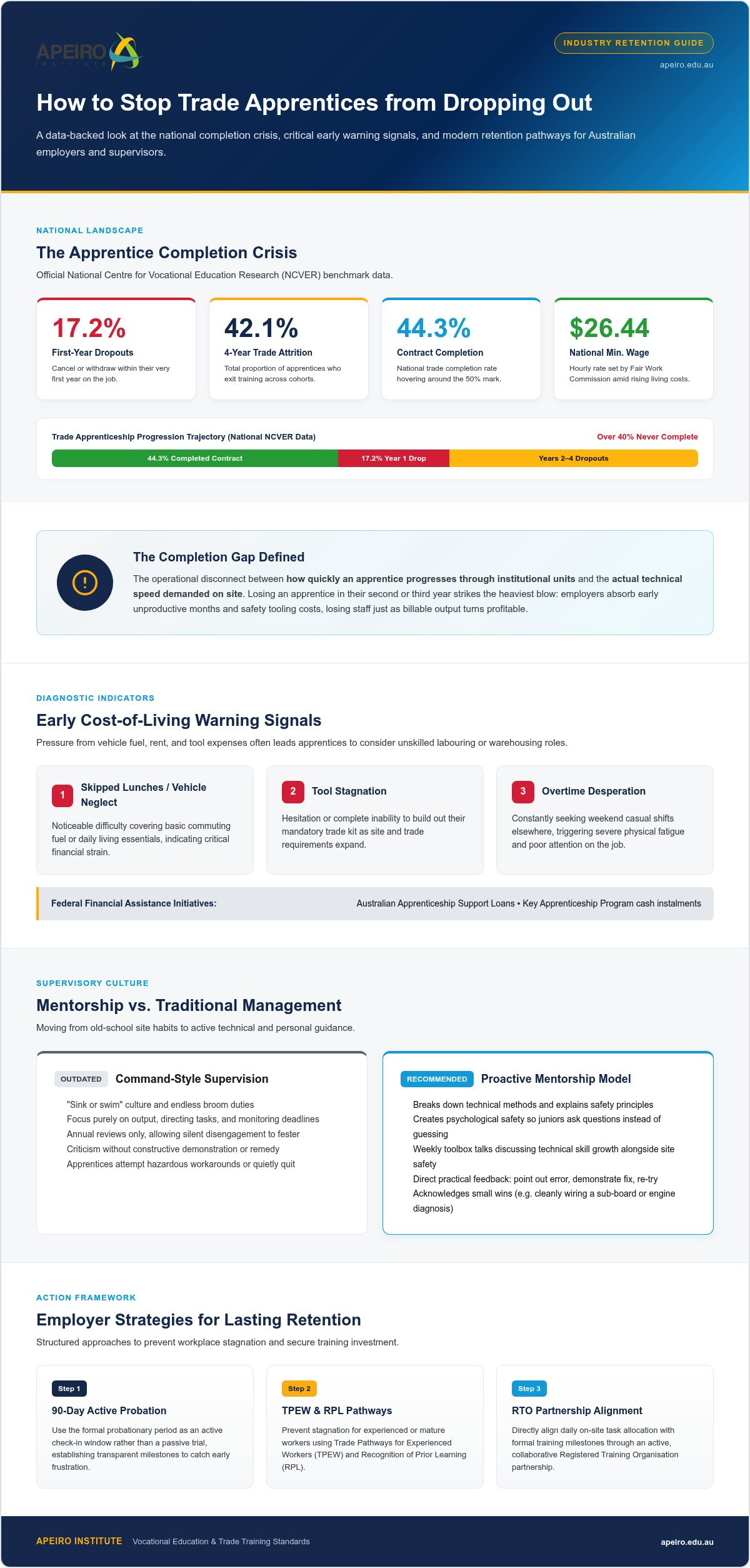
Australia faces a persistent trade shortage, yet national trade completion rates still hover around the 50% mark. According to NCVER data, 4-year trade attrition reached 42.1% for recent cohorts, with contract completion dropping to 44.3%. To understand how to stop apprentices from dropping out, businesses must first separate a casual departure from a formal cancellation. A cancellation officially dissolves the training contract, often after months of disengagement, whereas an informal dropout happens when an apprentice mentally checks out long before signing withdrawal papers. Losing a second-year apprentice strikes a particularly severe financial blow: you have already absorbed their least productive months, funded basic safety inductions, and provided foundation toolkits, only to lose them right when their billable output begins to turn a profit.
The Completion Gap refers to the operational disconnect between how quickly an apprentice progresses through institutional units and the actual technical speed demanded on site.
Why the First 12 Months Are Critical
NCVER figures show that 17.2% of all trade apprentices cancel or withdraw during their first year of training. For many school-leavers, the transition into a structured apprenticeship model introduces genuine culture shock. Early starts, physical fatigue, and complex workplace safety demands can quickly overwhelm an unprepared recruit. Using the formal probationary period as an active check-in window, rather than a passive trial, allows supervisors to set transparent milestones and catch early signs of frustration before a contract falls apart.
The 2026 Cost-of-Living Factor
Economic pressures have intensified the strain on entry-level trade workers. Even with recent modern award adjustments and the Fair Work Commission lifting the National Minimum Wage to $26.44 per hour, the cost of vehicle fuel, rent, and trade tools pushes apprentices to eye unskilled labouring or warehousing roles that pay more immediate cash.
- Skipped lunches or vehicle neglect: Noticeable difficulty covering basic commuting fuel or daily living essentials.
- Tool stagnation: Hesitation or inability to build out their mandatory trade kit as site requirements expand.
- Overtime desperation: Constantly seeking weekend casual shifts elsewhere, leading to fatigue and poor attention on the job.
Working out how to stop apprentices from dropping out under these financial conditions requires proactive communication. Connecting eligible workers to support initiatives, such as the federal Key Apprenticeship Program cash instalments or Australian Apprenticeship Support Loans, provides immediate financial breathing room while reinforcing their long-term career outlook.
Mentorship vs. Management: Building a Workplace Culture That Sticks
Old-school site habits like "sink or swim" or handing out endless broom duties drive modern starters away faster than any physical challenge. When employers ask how to stop apprentices from dropping out, the real fix often begins with daily interpersonal habits. A standard supervisor focuses purely on output, directing tasks and checking deadlines. A dedicated mentor, by contrast, breaks down technical methods, explains why certain safety precautions exist, and helps workers navigate practical hurdles like long commutes or regional travel costs. Building that level of psychological safety means juniors will ask questions when they get stuck instead of attempting hazardous workarounds or quietly leaving the trade altogether.
Creating an inclusive workplace also means welcoming people of varied ages, genders, and life experiences into the crew. Consulting official Australian Apprenticeships employer support guidelines offers clear frameworks for establishing these supervisory standards on the ground.
The Feedback Loop: Beyond the Annual Review
Waiting for an annual review to discuss an apprentice's progress leaves too much room for silent disengagement. Instead, use weekly toolbox talks to discuss technical skill growth alongside site safety. Break criticism down using direct, practical solutions: point out the specific error, demonstrate the correct technique immediately, and let them retry the task. Acknowledging small wins, such as cleanly wiring an electrical sub-board or diagnosing an engine issue without assistance, reinforces steady momentum throughout multi-year contracts.
Professional Growth and Career Mapping
Apprentices need to see that four years of hard work lead to genuine career mobility. Connect their routine site tasks directly to their qualification units so they recognise how repetitive groundwork builds technical mastery. Beyond immediate trade outcomes, map out future supervisory or community management pathways, including qualifications such as the Diploma of Community Services for those looking toward broader leadership or case coordination roles across regional projects.
Workplace Retention Checklist:
- Daily check-ins: Spend two minutes reviewing today's learning objectives before unpacking tools.
- Direct demonstration: Show the process twice, watch them do it once, and offer immediate feedback.
- Clear career pathways: Outline post-qualification opportunities early so long-term progression feels tangible.
If you want to strengthen how your senior trades handle workplace mentoring, partner with dedicated vocational specialists like Apeiro Institute to align on-site coaching with formal curriculum benchmarks.
Modern Pathways: Using TPEW and RPL to Prevent Stagnation
Locking an experienced site hand into an entry-level beginner class is a fast track to disengagement. Older, mature-age workers often fall into the "Experience Trap" when forced to sit through introductory modules on tools they have handled safely for years. When trade businesses evaluate how to stop apprentices from dropping out, reassessing training duration is critical. A standard four-year term is not the only pathway to a trade qualification. By conducting thorough upfront assessments through Recognition of Prior Learning (RPL), employers can validate existing skills, trim redundant classroom hours, and keep experienced talent engaged on site.
Recent NCVER apprentice completion and attrition data highlights that frustration with slow training delivery contributes heavily to early exits. Shortening the time-to-trade gives mature learners a clear horizon, transforming potential dropouts into qualified tradespeople who stay loyal to your business.
Transitioning from Labourer to Apprentice
Many of your most reliable future tradespeople already work on your jobsites as trade assistants or labourers. For eligible workers aged 21 and over with at least three years of trade experience, TPEW (Trade Pathways for Experienced Workers) provides a modern alternative to traditional indentured contracts. Instead of starting from scratch, workers target formal competencies through RPL combined with focused gap training. In automotive workshops, an experienced assistant undertaking the Certificate III in Light Vehicle Mechanical Technology can fast-track basic servicing and brake modules, concentrating instead on modern electronic diagnosis.
Traditional Apprenticeship vs. Skills-Recognition Pathway:
- Traditional route: Fixed 3 to 4-year indenture; linear classroom delivery; high risk of boredom for experienced workers.
- RPL & TPEW route: Assesses current competency; targets actual skill gaps; accelerates qualification milestones significantly.
Smart and Skilled Funding as a Retention Tool
Financial strain remains a central catalyst for apprentice attrition. In New South Wales, government-subsidised initiatives such as NSW Smart and Skilled help alleviate fee burdens for eligible candidates and employers alike. Accessing fee-free training pathways removes substantial upfront course expenses from household budgets. For an employer exploring how to stop apprentices from dropping out, aligning your crew with funded vocational programs provides immediate financial relief, allowing your team to focus on mastering their trade rather than worrying about training debt.
The Retention Framework: A 5-Step Strategy for Employers
Stopping apprentice attrition requires an intentional plan rather than guesswork. The first 90 days establish habits that dictate whether a recruit finishes their trade or walks away early. By building a clear roadmap that syncs real workshop tasks with classroom requirements, you give your team the clarity they need to succeed. If you want to know how to stop apprentices from dropping out, embedding a structured, five-step retention framework turns routine supervision into an active pathway for career longevity.
Step 1: The Pre-Start Alignment
Retention begins well before day one. Be transparent about physical demands, early site starts, and workshop conditions during the interview process so candidates arrive with realistic expectations. Establish direct boundaries regarding mobile phone use, safety compliance, and punctuality. Reviewing the formal training calendar and RTO obligations early helps prevent unexpected roster clashes once off-the-job training begins.
Step 2: The Structured Onboarding
Relegating a new starter to weeks of cleaning floors crushes enthusiasm fast. Introduce practical, meaningful tasks during week one, such as sorting diagnostic parts, inspecting basic assemblies, or prepping work areas alongside a senior tradie. Introduce the recruit to the whole crew immediately, and pair them with a dedicated fourth-year apprentice or mentor under an internal buddy system. Providing a basic starter kit or tool allowance signals that you are genuinely invested in their trade journey.
Step 3: The Monthly Progress Check
Set aside time each month to inspect logbooks and confirm training units match the practical jobs handled on site. Open communication catches small frustrations before they escalate into resignations. In fact, many industry employers find that an informal, 15-minute monthly chat can reduce early apprentice turnover by nearly 30% simply by resolving minor site issues early.
Steps 4 and 5: RTO Synchronisation and Milestones
Step four centres on regular communication with your training provider. Touching base with their trainer ensures skills taught in the classroom reinforce the work happening on your shop floor. Step five closes the loop by celebrating tangible progression. Formally acknowledging when an apprentice finishes their first year or gains autonomy on complex machinery gives them pride in their work and drives them toward final trade qualification.
Understanding how to stop apprentices from dropping out comes down to deliberate structure, steady communication, and genuine pastoral support across every stage of their indenture.
Partnering with the Right RTO: How Apeiro Institute Supports Retention
Your choice of training provider directly influences your retention rates. When a Registered Training Organisation (RTO) treats apprentices like numbers on a spreadsheet, disengagement quickly sets in. Choosing a training partner that acts as an active mentor-partner, rather than a passive certificate mill, transforms the entire learning journey. Apeiro Institute (RTO 45394) takes a nationally focused, student-centred approach to nationally recognised training, delivering practical competencies that directly reflect workshop realities. Flexible delivery models ensure apprentices don't fall behind when jobsite schedules shift, giving both local learners and international students the individual support needed to stay enrolled.
Specialised Training for Modern Trades
Quality vocational delivery must reflect the technological demands of modern industry. Apeiro delivers forward-looking technical programs designed to build lasting career confidence, including high-demand pathways in Electronics and Communications. The same structured, supportive approach extends to community care, offering tailored progression in Aged Care and Individual Support pathways. When curriculum units directly match current workplace standards, apprentices find real purpose in their weekly coursework.
A Collaborative Approach to Success
Maintaining clear communication between the employer, the apprentice, and the trainer is a cornerstone of how to stop apprentices from dropping out. Apeiro collaborates closely with site supervisors to review logbook progress and track competency achievements before minor study hurdles turn into complete disengagement. In our training spaces, a diverse learning community representing over 38 nationalities brings varied perspectives to hands-on problem solving, fostering an inclusive environment that values every individual's contribution.
Building a resilient, fully qualified workforce starts with the right educational alliance. Contact Apeiro Institute to discuss your training needs and see how structured, industry-aligned training pathways keep your apprentices motivated from day one.
Build a Resilient Trade Team for the Long Term
Securing your workforce pipeline requires shifting away from outdated sink-or-swim customs toward active, structured mentorship. When you support junior workers through early financial hurdles, align daily site duties with formal training, and recognise existing capability through skills assessment, you remove the common roadblocks to completion. Mastering how to stop apprentices from dropping out protects your recruitment investment, boosts workshop morale, and positions your business as an employer of choice across the trade sector.
As a national provider of Nationally Recognised Training (RTO 45394), specialists in Trade Pathways for Experienced Workers (TPEW), and an expert NSW Smart and Skilled provider, Apeiro Institute helps bridge on-site practical experience with formal qualifications.
Get your team trade qualified with Apeiro Institute’s specialised pathways
With structured guidance and genuine collaboration, your apprentices won't just complete their trade contracts. They will build long-term careers that power your business forward.
Frequently Asked Questions
What is the main reason apprentices drop out in Australia?
Financial pressure and workplace culture are the two primary causes of apprentice attrition according to national NCVER research. Low starting wages make living expenses difficult to manage, while poor site supervision or interpersonal conflict accelerates early exits. Apprentices who feel unsupported or undervalued often leave for immediate cash in unskilled roles. Learning how to stop apprentices from dropping out requires addressing both site culture and economic reality early.
How much does it cost an employer when an apprentice quits?
Losing an apprentice costs an employer thousands of dollars in wasted recruitment fees, lost site productivity, and unrecovered training hours. The greatest financial setback occurs when second- or third-year apprentices walk away. By that stage, you have absorbed their initial low-productivity months, paid for safety gear, and invested supervisory hours, right when their independent output was set to generate a healthy return on investment.
Can I fast-track an apprentice who already has industry experience?
Yes, you can significantly accelerate qualification timelines through Recognition of Prior Learning (RPL) and targeted initiatives like Trade Pathways for Experienced Workers (TPEW). Eligible workers aged 21 and older with substantial on-site experience can bypass introductory training modules. Rather than repeating tasks they already perform safely, candidates complete tailored gap assessments to achieve their formal trade certification in a fraction of the usual time.
What government incentives are available to help with apprentice retention?
The Australian Government provides targeted financial support programs, including the Key Apprenticeship Program (KAP) and priority hiring incentives for employers. Eligible apprentices working in priority trade occupations can access direct cash payments across their training milestones to offset living costs. In addition, interest-free Australian Apprenticeship Support Loans help workers purchase tools and manage living expenses, reducing financial pressure during their training contracts.
Is it better to hire a direct apprentice or go through a Group Training Organisation (GTO)?
Direct hiring builds long-term loyalty and cultural alignment, whereas a Group Training Organisation reduces administrative burden and employment risk. Employing directly allows you to shape the apprentice around your exact workshop systems and client standards from day one. Alternatively, GTOs handle payroll, host placements, and formal training administration, which works well for businesses with fluctuating project pipelines that cannot commit to four years.
How often should I review my apprentice’s training progress?
You should review logbooks and practical coursework progress at least once a month. Setting aside fifteen minutes for an informal catch-up ensures classroom units stay aligned with actual workshop duties. These regular check-ins create an open feedback channel where apprentices can raise technical questions, address personal concerns, and stay accountable to their training schedule before minor frustrations spiral into formal cancellations.
What role does the RTO play in stopping an apprentice from dropping out?
A responsive RTO acts as a collaborative mentor-partner rather than an administrative hurdle. High-quality training organisations maintain active communication with employers, track student attendance, and step in with pastoral support when learning difficulties emerge. Figuring out how to stop apprentices from dropping out often starts with choosing an RTO that provides flexible learning delivery, relevant practical workshops, and ongoing student support.
Are there specific strategies for retaining mature-age apprentices?
Retaining mature-age apprentices requires respecting their existing life experience, family responsibilities, and practical competencies. Mature workers struggle when treated like school-leavers or forced to repeat basic tasks they have performed for years. Fast-tracking their journey through upfront skills recognition, providing opportunities for technical autonomy on jobsites, and maintaining transparent communication around career progression will keep experienced workers engaged and loyal to your business.

Disclaimer
The information provided on this blog is for general informational and educational purposes only. While every effort is made to ensure the accuracy and reliability of the content, the author makes no representations or warranties of any kind, express or implied, about the completeness, accuracy, suitability, or availability of the information contained on this blog.
The views and opinions expressed in blog posts are those of the individual author and do not necessarily reflect the official policy or position of any organization, company, or employer.
This blog may contain links to external websites or third-party content. These links are provided for convenience only, and the author has no control over and assumes no responsibility for the content, privacy policies, or practices of any third-party sites.
Nothing on this blog constitutes professional advice (legal, financial, medical, or otherwise). Readers are encouraged to seek appropriate professional guidance before making any decisions based on the information provided here.
By using this blog, you acknowledge that any reliance on the information is at your own risk.


