

What if you could swap the financial stress of full-time study for a weekly pay packet while still gaining your qualification? Many aspiring carers feel stuck between the need for an income and the desire to help others, often worrying that classroom learning won't prepare them for the real world. A disability support traineeship CHC33021 changes that equation entirely. It's a practical pathway where you're employed from the start, learning the ropes in a real community setting while you study.
We understand that navigating NDIS requirements and new 2026 regulations can feel overwhelming. You want to feel confident and capable, not confused by paperwork. This guide explains how to launch your career through a supported traineeship that values your personal growth. We'll explore the benefits of earning while you learn, how to achieve a nationally recognised qualification, and the steps to becoming a vital part of Australia's disability sector. By the end, you'll see how easy it is to transition into a role where you provide genuine, person-centred care every single day.
Key Takeaways
- Learn how a disability support traineeship CHC33021 allows you to earn a competitive wage while gaining a nationally recognised qualification on the job.
- Understand the flexible three-way partnership model that balances your work, study, and personal life over a 12 to 24-month period.
- Discover the diverse career pathways waiting for you in 2026, including immediate roles in group homes, day centres, and community support.
- Identify the clear steps to secure your spot, from meeting basic entry requirements to finding an employer that matches your career goals.
- Explore the benefits of training with expert mentors in a supportive, multicultural environment that prioritises your personal and professional success.
What is a Disability Support Traineeship CHC33021?
A disability support traineeship CHC33021 is a work-based training programme designed to help you start a career while you're actually on the job. Unlike a traditional classroom course, this model combines practical employment with formal study to ensure you graduate with real-world skills. You aren't just reading about care. You're providing it. This qualification leads to a Certificate III in Individual Support, which is the gold standard for entry-level roles in Australia's booming community services sector.
Choosing to start in 2026 is a smart move for your future. The National Disability Insurance Scheme (NDIS) is undergoing significant updates, including mandatory registration for Supported Independent Living (SIL) providers starting in July 2026. These changes mean that employers are looking for professionals who hold a nationally recognised qualification. Australia is currently facing a significant shortfall of carers, with projections suggesting a gap of 400,000 workers by 2050. Securing a disability support traineeship CHC33021 means you're stepping into a secure industry with long-term growth potential. This certificate is respected in every state, from the suburbs of Perth to the heart of Sydney, giving you the freedom to take your career anywhere in the country.
Understanding the CHC33021 Qualification
The CHC33021 Certificate III in Individual Support focuses on three pillars: empathy, safety, and person-centred care. While the course covers broader care needs, specialising in the disability stream allows you to master specific skills like supporting community participation and implementing individualised plans. You'll learn how to follow established support plans while respecting the autonomy and dignity of the people you assist. As a Registered Training Organisation (RTO 45394), Apeiro Institute ensures your training meets strict national standards. We act as your educational partner, checking in regularly to make sure your workplace experience aligns with your learning goals.
Why Choose a Traineeship Over Standard Study?
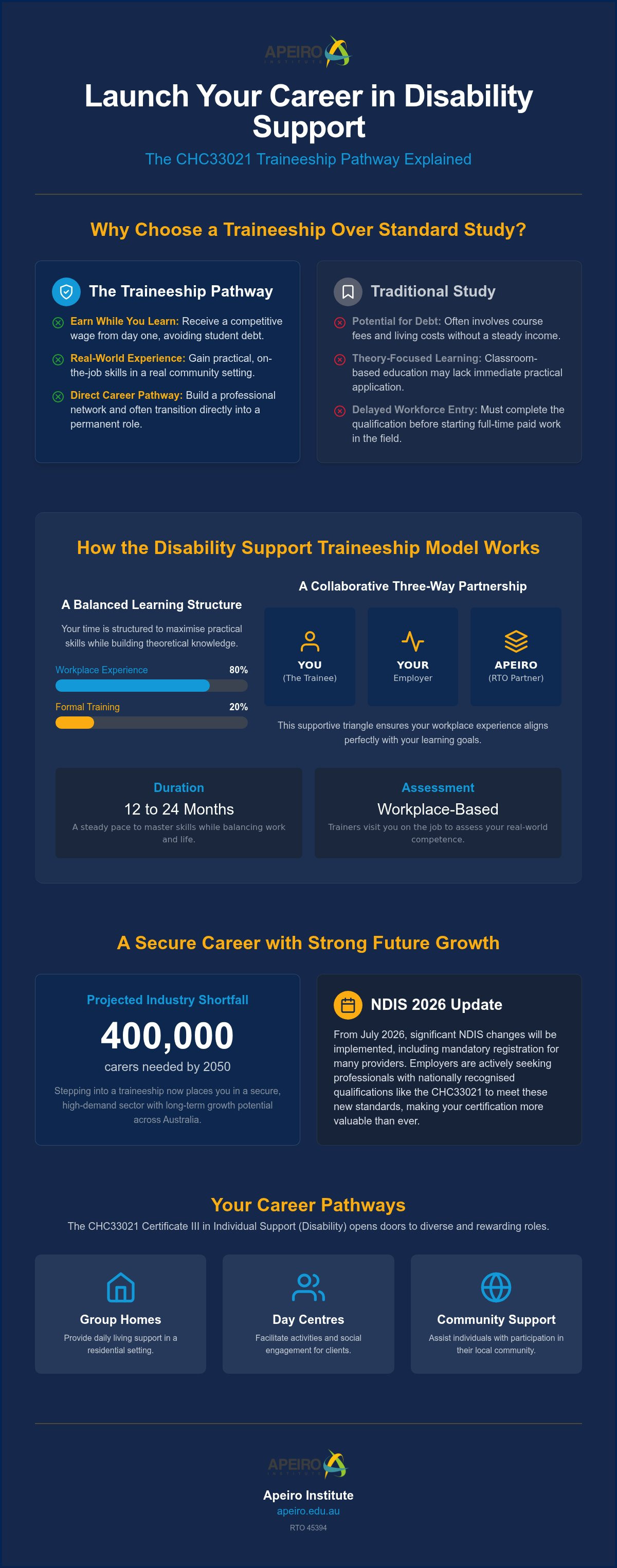
The biggest advantage of this pathway is the "earn while you learn" model. You'll receive a legal wage from your employer while you work toward your qualification, effectively avoiding the student debt that often comes with full-time study. It's a system that mirrors the Supported Employment Model, where the focus is on long-term career success through active participation. You build a professional network and gain industry immersion from your very first day on the job. This direct connection to the workforce often leads to permanent positions once your training is complete.
The structure is designed for balance and efficiency. A typical traineeship model consists of approximately 80% workplace experience and 20% formal training with your RTO. This ratio ensures you spend most of your time gaining the hands-on confidence that only a real-world setting can provide.
How the Disability Support Traineeship Model Works
A disability support traineeship CHC33021 operates through a collaborative three-way partnership. This team includes you, your employer, and the experts here at Apeiro Institute. It's a supportive triangle designed to ensure you never feel lost during your journey. Your employer provides the workplace and the hours, while we provide the curriculum and the formal assessments. This structure ensures that what you learn in a theory session can be applied in the community on the very same day.
Most traineeships run for a duration of 12 to 24 months. This timeframe is ideal because it allows you to absorb complex care standards at a steady pace while maintaining your personal life. You aren't expected to be an expert overnight. Instead, you'll grow into the role with the security of a regular income. A significant benefit of this model is workplace-based assessment. Rather than sitting in a hall for a three-hour exam, your trainer visits you at work. They observe you performing daily tasks, turning your professional competence into credits toward your qualification. We offer a flexible learning mix that includes online resources and face-to-face support, making it easier to manage your studies around your shift work.
Your Roles and Responsibilities as a Trainee
As a trainee, your primary role is providing direct care. This involves assisting clients with daily living tasks and encouraging social participation. A typical day might involve helping someone prepare a meal or supporting them as they attend a local community group. These practical tasks are vital components of Career Pathways for Disability Support Workers, as they build the hands-on empathy that textbooks alone cannot provide. You will also learn the essential 'paperwork' of the sector, such as documentation and reporting. This ensures that every action you take aligns with a client's individualised care plan and meets NDIS safety standards.
The Role of Your Training Provider
Apeiro Institute acts as your mentor and guide throughout the process. We don't just provide materials; we provide a connection. Our trainers conduct regular check-ins at your place of employment to offer feedback and encouragement. We also hold formal workshops to deep-dive into complex topics, including the legal and ethical frameworks of the disability sector. Our student-centred approach is particularly helpful for those returning to study after a long break or for learners from diverse backgrounds. If you're ready to see how this fits into your current schedule, you can explore the full details of our CHC33021 Certificate III in Individual Support to find a pathway that works for you.
Career Pathways and Opportunities in 2026
The beauty of a disability support traineeship CHC33021 is that your career begins the moment you sign your contract. You don't have to wait until your final assessment to start making a difference. In 2026, the sector isn't just growing; it's evolving to meet more complex needs. This creates a massive job market for trainees who are ready to hit the ground running. You could find yourself working in specialised group homes, bustling day centres, or providing one-on-one assistance in community settings. Employers value trainees because they are learning the most current, NDIS-aligned standards from day one.
Long-term growth in this field is remarkably steady. Many support workers find that their initial role serves as a springboard into leadership positions, such as becoming a team leader or service coordinator. As you gain experience, you might look toward a Diploma of Community Services Australia to step into management or case coordination. The foundation you build during your traineeship provides the practical context needed for higher-level studies. It's a career where your professional development never truly stops.
Common Job Titles for Graduates
Once you complete your CHC33021 Certificate III in Individual Support, several doors open immediately. As a Disability Support Worker, you'll be on the frontline, providing essential community care. If you prefer residential settings, you might work as a Personal Care Assistant (PCA), focusing on home-based support. For those who enjoy social engagement, the role of a Community Access Officer is ideal. In this position, you'll help clients engage with the world around them, from attending events to pursuing hobbies, ensuring they live a full and inclusive life.
Advancing Your Qualifications
This qualification is a versatile tool in the Australian vocational system. You can easily pivot to a Certificate IV in Ageing Support if you want to develop dual-sector expertise. For those coming from other industries, we offer support through Trade Pathways for Experienced Workers. This helps mature-age learners transition their existing skills into a new, rewarding context. We believe in the value of lifelong learning. Whether you're upgrading your skills or specialising in a new area, the pathways are clear and attainable. Your journey doesn't end with a certificate; it's just the beginning of a lifelong professional adventure.
Steps to Securing Your CHC33021 Traineeship
Securing a disability support traineeship CHC33021 is a straightforward journey when you have the right guidance. It starts with finding an employer who is willing to take on a trainee and a Registered Training Organisation (RTO) like Apeiro Institute to provide the academic framework. Many local disability service providers are looking for fresh talent, so researching eligible employers in your area is the first vital step. You'll generally need a Year 10 equivalent or be of mature age with relevant life experience to be considered for these roles.
Once you've found a potential employer, you'll undergo a Language, Literacy, and Numeracy (LLN) assessment. This isn't a scary exam. It's a supportive tool used to ensure you are ready for the course load and to identify if you need any extra help during your studies. After this, you'll formalise a training contract with your employer and the government. This legal document outlines the responsibilities of all parties and protects your rights as a worker and a student. Finally, you'll commence your first unit and undergo a workplace orientation to learn the specific safety protocols of your new environment.
Essential Requirements and Checks
Safety and trust are the foundations of the disability sector. Because of this, a National Police Check and an NDIS Worker Screening Check are non-negotiable entry requirements. If your role involves youth disability support, you'll also need a Working with Children Check (WWCC). These checks ensure the safety of the vulnerable people you'll be supporting. Physical fitness is also a practical consideration. You'll need to be capable of performing manual handling tasks safely, such as assisting clients with mobility or using specialised equipment, to protect both yourself and your clients.
Funding and Financial Support
Many traineeships in 2026 are fully subsidised for eligible local students. In New South Wales, you can often access Smart and Skilled funded courses NSW, which may provide fee-free training options. Regarding your income, you'll be paid according to Fair Work standards for adult or junior trainees. This means you'll have the security of a legal wage while you work toward your qualification. It's an excellent way to transition into a new career without the financial burden of unpaid placements or high tuition fees.
Enquire about our CHC33021 traineeship pathways and funding eligibility
Why Study with Apeiro Institute?
Choosing where to complete your disability support traineeship CHC33021 is a decision that shapes your entire professional outlook. At Apeiro Institute, we don't just teach the curriculum; we share the lived experience of the sector. Our trainers bring years of hands-on disability support work into the classroom, ensuring you're learning from people who've actually been there. This practical, outcome-focused approach is designed to make you 'work-ready' from your very first shift, giving you the confidence to handle real-world challenges with grace and skill.
We specialise in seamless integration with government initiatives to help you get started without the stress of high upfront costs. As a NSW Smart and Skilled provider, we help eligible students navigate subsidised training pathways. This means your traineeship could be fully funded, effectively removing the financial barriers to your professional growth. We take the confusion out of the application process by guiding you through current eligibility criteria, ensuring you understand exactly how to access the support available to you. It's about making a career in care attainable for everyone.
Our campus isn't just a place of study; it's a vibrant, inclusive community that celebrates over 38 nationalities. This multicultural environment is one of our greatest strengths. It mirrors the beautiful diversity of the Australian community you'll be serving as a support worker. By learning alongside people from all walks of life, you develop the cultural sensitivity and communication skills that are vital for providing person-centred care. We act as an empowering mentor, helping you turn your personal background and unique perspective into a professional asset.
Our Commitment to Your Success
We keep class sizes small because we know that individualised attention makes a world of difference. During our workshops, you'll have the space to ask questions and practice skills in modern facilities that mirror real-world care environments. This ensures that when you step into your workplace, the equipment and protocols feel familiar and manageable. You can see the full breakdown of core units and elective options on our Certificate III in Individual Support (Ageing and Disability) course page.
Ready to Start Your Career?
Registering your interest for our next intake is a simple, supportive process. We understand both local Australian requirements and the unique needs of international learners, making us a versatile partner in your success. Whether you're a local school leaver or looking for a mid-career change, we're here to help you bridge the gap between your current circumstances and your future career. Our goal is to provide a sense of security through expert guidance, ensuring you feel backed every step of the way.
Take the Next Step Toward Your Career in Care
Starting your journey in the disability sector is about more than just finding a job. It's about securing a role where you can truly make a difference while building a stable, long-term career. By choosing a disability support traineeship CHC33021, you're opting for a pathway that values your time and your dedication. You'll benefit from Nationally Recognised Training (RTO 45394) that is respected across Australia, ensuring your skills stay in high demand as the NDIS continues to evolve.
We've looked at how the traineeship model allows you to balance work and study without financial pressure. With Smart and Skilled funding available for eligible students, your education could be fully subsidised. Our industry-experienced trainers at Apeiro Institute are ready to guide you through every workplace challenge and academic milestone. You'll gain the confidence to provide high-quality, person-centred care in a sector that needs your unique perspective and passion.
Your future in community service is waiting. We're here to act as your mentor and help you turn that ambition into a reality. We look forward to welcoming you into our supportive, multicultural learning community and helping you achieve your professional goals.
Frequently Asked Questions
Can I do a disability support traineeship if I have no previous experience?
Yes, you can absolutely start a traineeship with zero industry experience. These programmes are specifically designed as entry-level pathways for people with the right attitude and a genuine desire to help others. Employers often value your personal qualities, such as empathy and reliability, over your previous job titles. You'll receive all the necessary training on the job while you work toward your qualification.
How much do disability support trainees get paid in Australia?
Your wages are governed by the Social, Community, Home Care and Disability Services (SCHADS) Award. As of July 2026, a Level 2, Pay Point 1 permanent worker earns approximately $36.22 per hour. If you're working as a casual trainee, this rate increases to about $45.28 per hour to include casual loading. These rates ensure you're fairly compensated while you gain your professional skills.
Is the CHC33021 Certificate III in Individual Support a nationally recognised qualification?
Yes, the CHC33021 is the current, nationally recognised standard for individual support in Australia. It replaced the older CHC33015 code to better align with modern NDIS requirements and industry expectations. Because it's a national qualification, your skills will be recognised by employers in every state and territory, providing you with excellent career mobility across the country.
What is the difference between a traineeship and an apprenticeship in the care sector?
In the Australian care sector, the term "traineeship" is the standard way to describe this earn-while-you-learn model. While apprenticeships are traditionally associated with trades like plumbing or electrical work, both systems operate similarly. They both combine paid employment with structured training. A disability support traineeship CHC33021 specifically focuses on community services and individual care rather than manual trades.
Can I study the CHC33021 traineeship part-time?
Yes, many employers offer part-time traineeships to suit different lifestyles and family commitments. You'll still need to meet a minimum number of work hours each week to ensure you're gaining enough practical experience. This flexibility makes a disability support traineeship CHC33021 an ideal option for parents or those transitioning from other careers who can't commit to a full-time study load.
What happens if I change employers during my traineeship?
If you change employers, your training contract can often be transferred to your new workplace if they are willing to support your traineeship. If a transfer isn't possible, any units of competency you've already completed remain valid. You'll receive a Statement of Attainment for those units, which you can take to any other Registered Training Organisation to continue your studies without starting from scratch.
Are there government subsidies available for the CHC33021 course in 2026?
Yes, significant government subsidies are available for eligible students through the Smart and Skilled programme in NSW. Fee-free places are currently available for students who commence their training before June 30, 2026. These subsidies are designed to address the critical worker shortage in the care sector, making it more affordable than ever to gain your qualification and start your new career.

Disclaimer
The information provided on this blog is for general informational and educational purposes only. While every effort is made to ensure the accuracy and reliability of the content, the author makes no representations or warranties of any kind, express or implied, about the completeness, accuracy, suitability, or availability of the information contained on this blog.
The views and opinions expressed in blog posts are those of the individual author and do not necessarily reflect the official policy or position of any organization, company, or employer.
This blog may contain links to external websites or third-party content. These links are provided for convenience only, and the author has no control over and assumes no responsibility for the content, privacy policies, or practices of any third-party sites.
Nothing on this blog constitutes professional advice (legal, financial, medical, or otherwise). Readers are encouraged to seek appropriate professional guidance before making any decisions based on the information provided here.
By using this blog, you acknowledge that any reliance on the information is at your own risk.


