

What if you could stop choosing between paying your weekly bills and pursuing a career that actually makes a difference? Many Australians feel trapped in unfulfilling roles because they simply can't afford to take time off for unpaid study or lengthy placements. It's a common worry that starting fresh means starting from zero financially, but a paid aged care traineeship allows you to flip the script by earning a full wage from day one.
We understand that the transition into the care sector can feel overwhelming, especially when you're unsure which qualification is the right fit or if you have enough experience to be noticed by employers. This guide is designed to clear up that confusion and show you a direct path to professional growth. You'll discover how to gain your CHC33021 Certificate III in Individual Support while securing a stable role in an industry that's looking for dedicated people just like you. We'll walk you through the practical steps to get started, the financial benefits of training on the job, and how this first step leads to a rewarding long-term career.
Key Takeaways
- Learn how a paid aged care traineeship allows you to earn a full wage while you study, removing the financial stress of unpaid work placements.
- Understand why the CHC33021 Certificate III in Individual Support (Ageing and Disability) is the essential qualification for a versatile career.
- Discover the unique benefits of the "earn while you learn" model, including hands-on mentorship from experienced industry professionals.
- Get a clear, step-by-step roadmap for finding the right training partner and preparing a resume that highlights your soft skills.
- Explore future growth opportunities that lead from entry-level roles to specialised positions like Lifestyle Coordinators or Dementia Specialists.
What is a Paid Aged Care Traineeship? The "Earn While You Learn" Model
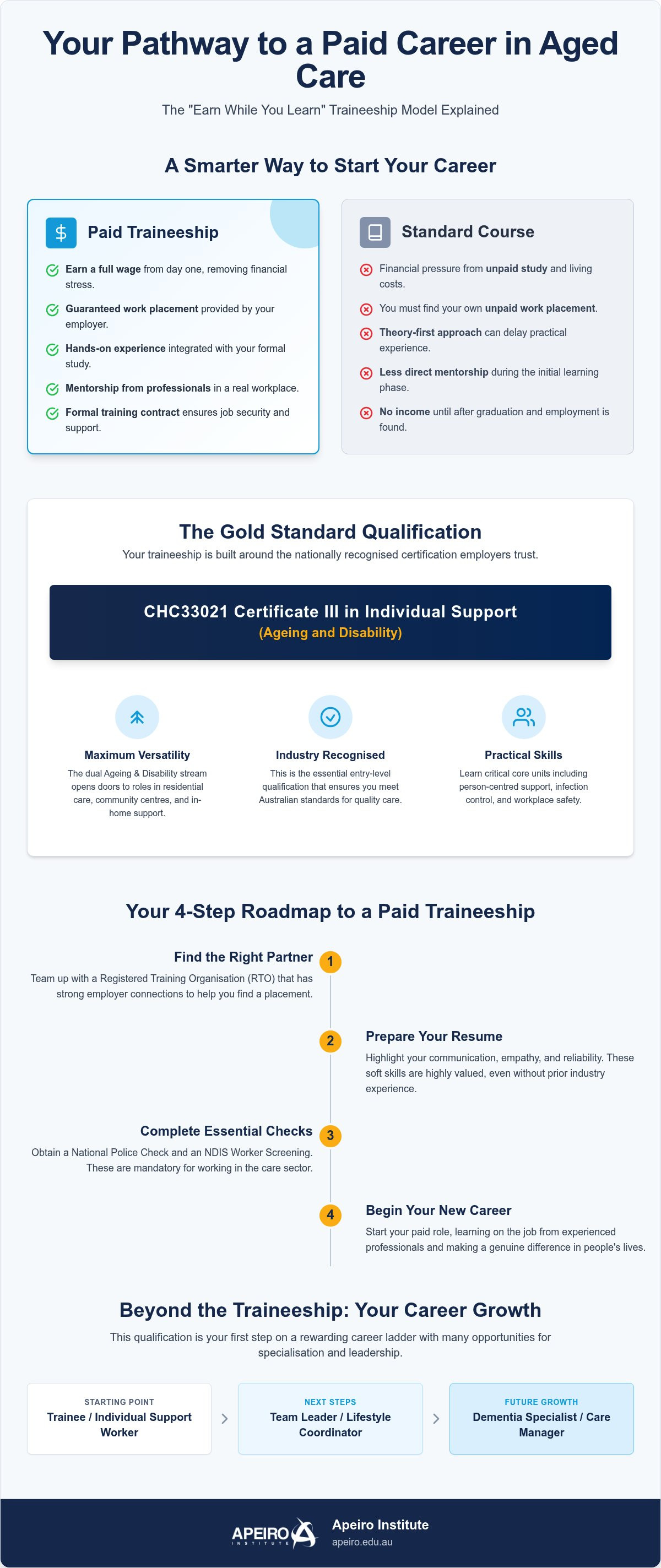
A paid aged care traineeship is a formal, legally binding training contract between you, your employer, and a Registered Training Organisation (RTO). Unlike traditional study where you might spend months in a classroom before ever setting foot in a care facility, this model integrates your education directly into your workday. It's a structured pathway designed to build your confidence while you provide essential care to older Australians. You aren't just a student; you're a valued member of a professional team from your very first shift.
This arrangement functions as a three-way partnership. Your employer provides the workplace and a consistent wage; the RTO delivers the formal CHC33021 Certificate III in Individual Support; and you commit to learning the skills required to become a qualified professional. Because you're an employee from day one, the financial barrier of unpaid study is completely removed. You don't have to wait until graduation to start your career. You're already in it, gaining experience and building a professional reputation while your peers might still be stuck behind a desk.
The aged care sector is currently one of Australia's most secure employment markets. Our ageing population means the demand for skilled carers is rising every year. Choosing a paid aged care traineeship means entering an industry where your skills will always be needed. It offers a level of job security and stability that many other sectors simply can't match. It's a smart move for anyone looking for a long-term career with genuine growth potential.
The Difference Between a Traineeship and a Standard Course
In a standard course, you often have to find your own work placement, which is usually unpaid. A traineeship flips this around. You apply classroom theory to real residents immediately, often being paid for both your hours on the floor and your dedicated study time. It's about practical application. You'll also benefit from formal contractual security under Australian law, ensuring you receive the correct entitlements, wages, and support throughout your entire journey.
Who is Eligible for a Paid Traineeship in Australia?
Traineeships are open to a wide range of people. Whether you're a school leaver looking for your first role or a mature-age worker seeking a fresh start, there's a place for you. International students may also be eligible depending on their specific visa conditions and work rights. To get started, you'll generally need to pass a National Police Check and obtain an NDIS Worker Screening. These are standard industry requirements that ensure the safety and wellbeing of the vulnerable people you'll be supporting every day.
The Qualification: CHC33021 Certificate III in Individual Support (Ageing and Disability)
The CHC33021 Certificate III in Individual Support is the gold standard for anyone entering the Australian care sector. It's the essential entry-level qualification that employers recognise and trust. It ensures you have a consistent foundation in both technical skills and the emotional intelligence required for the role. When you embark on a paid aged care traineeship, this qualification isn't just a side project; it's the backbone of your professional development. You don't just read about person-centred care in a textbook. You practice it every day while supporting residents with their unique routines.
Opting for the combined Ageing and Disability stream is a smart, strategic move. This dual focus provides the most versatile career options available. It allows you to work in residential aged care facilities, community centres, or in-home disability support. This flexibility is vital in a shifting job market. Your training covers critical core units, such as infection prevention and control, which is a non-negotiable skill in modern healthcare. You'll also dive deep into person-centred support, ensuring the dignity and preferences of every individual remain at the heart of your work.
During your traineeship, the delivery of this course is highly practical. Your Registered Training Organisation (RTO) works closely with your employer to ensure your study modules align with your shifts. This means you can immediately apply what you've learned in the classroom to real-world scenarios. It's a supportive environment where theory and practice meet, helping you feel capable and confident much faster than a standard student would.
Core Competencies You Will Master
Success in this field requires a blend of practical ability and clear communication. You'll master the skills needed to support independence, helping older Australians maintain their quality of life and well-being. Effective communication is another pillar of your training. You'll learn how to navigate complex health environments and interact professionally with families and medical teams. You'll also gain a firm grasp of how to work legally and ethically within the Australian aged care framework, ensuring you're always providing safe and high-quality care.
Elective Streams: Tailoring Your Training
Electives allow you to customise your career path. Specialising in Dementia care or Palliative support can make you an invaluable asset to your team, as these areas require specific, high-level expertise. Including disability support units further increases your employability across the broader community services sector. It's often best to align your electives with your employer’s specific needs, which can lead to faster promotions. If you're curious about how these units fit together, you can view the full unit list here to see which specialisations interest you most. This tailored approach ensures your paid aged care traineeship prepares you for the exact challenges the industry faces today.
The Benefits: Why a Traineeship is the Smartest Way to Start
Choosing a paid aged care traineeship is about more than just finding immediate work. It's a strategic career move that sets you up for long-term success without the weight of student debt. While many students graduate with significant loans, you'll be finishing your qualification with a healthy bank balance and a year of professional experience already on your resume. This financial head start is one of the most compelling reasons to choose this pathway. It's a complete game changer for anyone worried about the cost of living.
Mentorship is another massive advantage that sets this model apart. You aren't left to figure things out on your own. Instead, you'll work alongside experienced carers who have seen it all. They provide the real-world context that textbooks often miss. You'll learn the small nuances of resident care that make a big difference in someone's day. Plus, the conversion rates are incredibly high. Most facilities view their trainees as the future of their workforce. It's very common for a trainee to move straight into a permanent role as a qualified Personal Care Worker once they finish. You're building a professional network from your very first shift.
Financial Incentives and Support
Your income isn't static during your training. Trainee wage scales are designed to increase as you hit specific milestones in your course. This rewards your growing expertise and keeps you motivated. There's also significant government support available to help manage costs. For example, you might be eligible for Smart and Skilled funded courses NSW, which can greatly reduce or even eliminate your tuition fees. These initiatives are part of a broader effort to support new workers in priority sectors, making 2026 an ideal time to start your journey.
Soft Skills and Professional Development
The technical side of care is only half the story. A paid aged care traineeship helps you develop the soft skills that are essential for the role. You'll build deep empathy and patience through daily interactions with residents. Resilience becomes second nature as you navigate the challenges of a busy healthcare environment. Balancing your work shifts with study modules also teaches you exceptional time management. These aren't just job skills; they're life skills that will serve you well in any future role. The confidence you gain from hands-on clinical experience is something you simply can't replicate in a simulated classroom setting.
How to Secure a Paid Traineeship: A Step-by-Step Guide
Securing a paid aged care traineeship might seem like a complex process, but it's actually quite straightforward when you break it down. The Australian government and local providers are eager to welcome new talent, so the support systems are already in place to help you succeed. You don't need a background in healthcare to start. You just need the right attitude and a clear plan of action.
- Step 1: Research Registered Training Organisations (RTOs). Start by looking for RTOs that specialise in community services and have strong industry links. A good RTO will help bridge the gap between your study and the workplace.
- Step 2: Prepare your resume. Focus on your transferable soft skills. Reliability, communication, and empathy are often more important to aged care managers than technical experience.
- Step 3: Reach out to local providers. Don't wait for a job ad to appear. Contact local aged care facilities directly or check the Australian Apprenticeships website for current vacancies.
- Step 4: Formalise your enrolment. Once you've found an employer, you'll need to enrol with an RTO like Apeiro Institute to begin your formal training for the CHC33021 qualification.
- Step 5: Sign your training contract. This final step makes everything official. Once the paperwork is signed by you, your employer, and the RTO, your on-the-job journey officially begins.
Fast-Tracking with Recognition of Prior Learning (RPL)
If you've spent years caring for family members or volunteering in your community, you might not need to start from scratch. Recognition of Prior Learning (RPL) allows your existing experience to count toward your certificate. This is particularly beneficial for mature-age entrants who want to reduce their study load. By proving your current industry competencies, you can fast-track your way to becoming a qualified professional. The Trade Pathways for Experienced Workers model is specifically designed to help people transition their life skills into a formal career without unnecessary repetition.
Explore our Trade Pathways for Experienced Workers
Tips for a Successful Application
When applying for a paid aged care traineeship, small details can make a big impact. If you already have a First Aid certificate, make sure it's prominent on your resume. During the interview, focus on your genuine passion for supporting the elderly. Managers look for a "can-do" attitude and a willingness to learn in a fast-paced environment. Show them that you're reliable and ready to contribute to the well-being of their residents from day one. It's about showing that you're someone they can count on.
Beyond the Traineeship: Career Progression and Future Growth
Completing your paid aged care traineeship is a significant milestone, but it's really just the beginning of your professional story. Once you've earned your CHC33021 qualification, you'll transition from a trainee to a fully qualified Personal Care Worker (PCW). In this role, you'll have the autonomy and recognised expertise to take on more responsibility. Many graduates find that the hands-on nature of their training makes this transition feel natural and seamless. You've already built the relationships and the routine; now you have the credentials to match.
As you gain experience, you might find yourself drawn to specific areas of care. You could move into specialised roles like a Lifestyle Coordinator, where you'll design and lead activities that keep residents socially engaged. Or perhaps you'll become a Dementia Specialist, focusing on the complex needs of residents with cognitive decline. If your goals involve higher-level coordination, the Diploma of Community Services is an excellent next step. This qualification opens doors to case management roles, allowing you to advocate for clients and coordinate their care plans on a broader scale.
Advancing into Leadership and Management
If you enjoy mentoring others, a path into leadership might be your calling. Moving from a PCW to a Team Leader often involves stepping up into the CHC43015 Certificate IV in Ageing Support. This level of training focuses on the supervisory skills needed to manage a small team and ensure high standards of care across a facility. For those looking even further ahead, a Diploma of Business Australia can provide the administrative and operational knowledge required for facility management. The Australian care sector has a growing demand for qualified managers who understand both the clinical and business sides of the industry.
Expanding into Community Services
Your skills aren't limited to residential facilities. Many professionals use their paid aged care traineeship as a foundation to move into community-based case work. This often involves working within the NDIS landscape, helping individuals with disabilities live more independently in their own homes. The transition is often very smooth because the core principles of person-centred care remain the same. If you're studying as an overseas resident, you can continue your education through various vocational courses for international students in Australia. This allows you to keep building your expertise while contributing to a sector that values diversity and global experience. Your career can be as flexible and expansive as you choose to make it.
Take Your First Step Toward a Meaningful Career
Starting a career in the care sector doesn't have to mean sacrificing your financial stability. A paid aged care traineeship provides the perfect balance of practical experience and academic growth. You'll finish your training with a nationally recognised CHC33021 Certificate III in Individual Support, a year of industry experience, and no student debt. This pathway isn't just about getting a job. It's about building a foundation for long-term growth into leadership or specialised care roles.
At Apeiro Institute, we act as a bridge to your future goals. As a nationally recognised RTO (45394) and CRICOS provider (03703M), we offer industry-focused training delivered by experts who truly understand the Australian healthcare landscape. We're here to guide you through every step, ensuring you feel supported and confident as you transition into this vital industry.
Start your journey into aged care with Apeiro Institute today
Your future in the care industry is waiting. Take that first step today and discover how rewarding it is to make a real difference in the lives of others while you grow professionally.
Frequently Asked Questions
How much do you get paid during an aged care traineeship in 2026?
Your wages are determined by the Social, Community, Home Care and Disability Services Industry Award. In 2026, the specific rate depends on your age, whether you've finished school, and how far you've progressed in your course. These rates are designed to increase as you gain more skills and move through your modules. You're paid for every hour you work, and often for your formal study time too. It's best to check the Fair Work Ombudsman website for the most current figures.
Do I need any previous experience to start a paid aged care traineeship?
You don't need any prior background in healthcare to begin a paid aged care traineeship. Employers are primarily looking for people with the right soft skills, such as empathy, patience, and a strong sense of reliability. The program is specifically built to teach you everything from the ground up. While any previous volunteer work or family care experience is a great bonus on your resume, it's certainly not a mandatory requirement for your application to be successful.
How long does it take to complete a Certificate III in Individual Support through a traineeship?
Most trainees complete their CHC33021 Certificate III in Individual Support in approximately 12 months. This duration allows for a steady balance between your practical shifts at the facility and your theoretical study. If you have relevant previous experience, you might be able to finish sooner through Recognition of Prior Learning (RPL). The goal is to ensure you're fully confident in your clinical skills before you transition into a permanent, qualified role.
Can I do a paid aged care traineeship if I am an international student?
International students can often apply for a paid aged care traineeship if their visa conditions allow for both study and work. You'll need to ensure your specific visa subclass permits the required work hours and that your training provider is a registered CRICOS provider. It's a fantastic way to gain local Australian work experience while earning a wage. Always verify your current work rights with the Department of Home Affairs before signing a training contract.
Is the CHC33021 Certificate III in Individual Support recognised across all of Australia?
Yes, this qualification is part of the national training package and is recognised in every state and territory. Whether you're training in a major city or a regional town, your certificate carries the same weight with employers nationwide. This national recognition gives you incredible career mobility. You'll have the peace of mind knowing your hard-earned skills are valid no matter where your life or career might take you across the country.
What happens if I don’t finish my traineeship?
If you're unable to finish the full program, you'll still receive a Statement of Attainment for any units you've successfully completed. These credits are yours to keep and can be used toward future study if you decide to return to the sector later. Your progress isn't lost. You should always talk to your employer and RTO first if you're struggling. There're often flexible options or support systems available to help you get back on track.
Can I do my aged care traineeship part-time?
Part-time traineeships are a very common option for those who need to balance work with family or other commitments. You'll still receive the same high-quality training and support, though the total duration of the course will be extended. Most aged care providers are happy to discuss flexible rosters that suit your lifestyle. This makes the sector much more accessible for people who can't commit to a full-time schedule but still want a rewarding career.
What is the difference between a traineeship and an apprenticeship in aged care?
The main difference lies in the industry and the duration of the training contract. In Australia, "apprenticeship" usually refers to traditional trades like plumbing or electrical work which can take four years. "Traineeship" is the term used for vocational roles in service industries like aged care, which typically take about one year to complete. Both models use the same "learn while you earn" philosophy. They both provide a legally binding contract that protects your rights as a worker and a student.

Disclaimer
The information provided on this blog is for general informational and educational purposes only. While every effort is made to ensure the accuracy and reliability of the content, the author makes no representations or warranties of any kind, express or implied, about the completeness, accuracy, suitability, or availability of the information contained on this blog.
The views and opinions expressed in blog posts are those of the individual author and do not necessarily reflect the official policy or position of any organization, company, or employer.
This blog may contain links to external websites or third-party content. These links are provided for convenience only, and the author has no control over and assumes no responsibility for the content, privacy policies, or practices of any third-party sites.
Nothing on this blog constitutes professional advice (legal, financial, medical, or otherwise). Readers are encouraged to seek appropriate professional guidance before making any decisions based on the information provided here.
By using this blog, you acknowledge that any reliance on the information is at your own risk.


