

What if you could stop choosing between paying your weekly bills and getting the qualification you need to start a meaningful career? Many people feel stuck because they can't afford to stop working to study full-time, even though they're desperate to move into a high-demand sector like aged care or disability support. A CHC33021 traineeship offers a practical solution to this dilemma. It allows you to enter the workforce immediately, earning a competitive wage while you work towards a nationally recognised qualification.
We understand that the process can feel a bit overwhelming at first. You might be unsure how to find a supportive employer or confused about whether the ageing or disability stream is right for your goals. In this guide, we'll simplify the journey for you. You'll discover how to secure a position in this essential industry, explore government-funded training options, and see how Apeiro Institute acts as your partner in success. It's time to turn your passion for helping others into a secure, professional future without the financial stress.
Key Takeaways
- Learn how the "earn while you learn" model allows you to receive a legal wage while gaining your qualification in a real-world setting.
- Explore the different specialisation streams available, including Ageing and Disability, to tailor your skills to your professional interests.
- Find out if you are eligible for government-subsidised training through a CHC33021 traineeship under the Smart and Skilled program.
- Understand the advantages of immediate industry immersion and how it helps you build a professional network from day one.
- Get a clear, step-by-step plan for finding an employer and starting your enrolment process with a supportive partner like Apeiro Institute.
Understanding the CHC33021 Traineeship Model in Australia
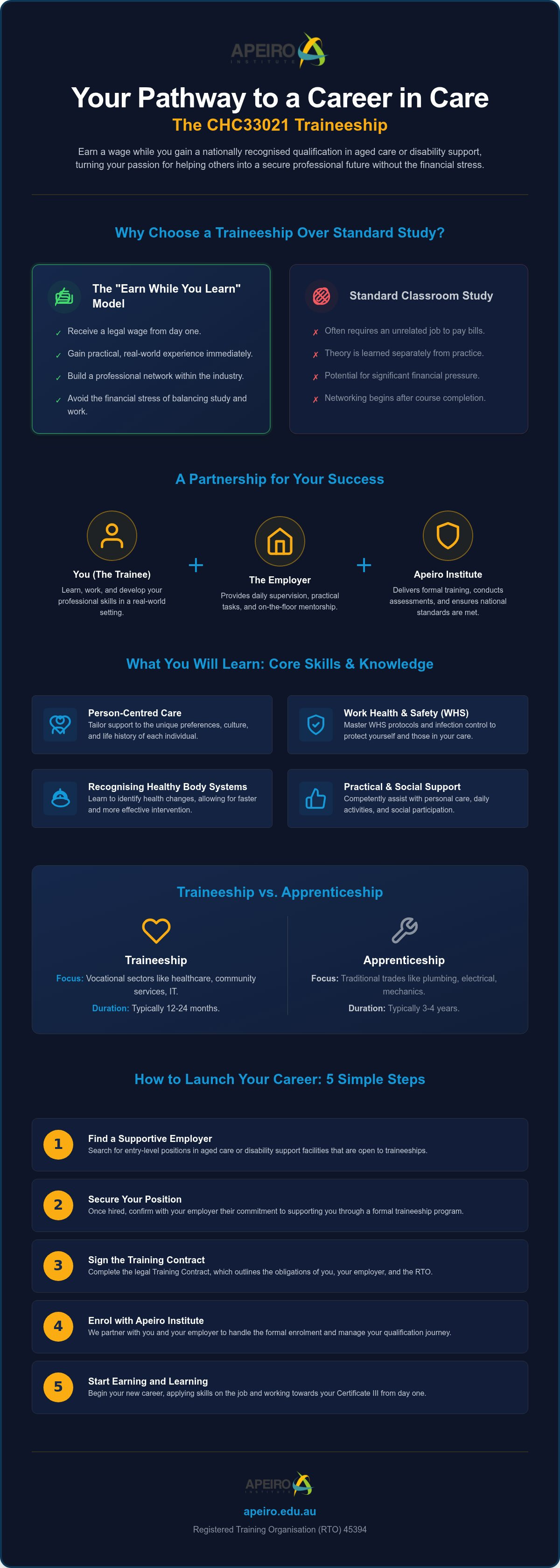
A CHC33021 traineeship is built on a simple, effective foundation. It is a formal, three-way partnership between you, your employer, and a Registered Training Organisation (RTO) like Apeiro Institute (RTO 45394). This model is designed to bridge the gap between theory and practice. Instead of spending your days in a lecture theatre and your nights working an unrelated job to pay the rent, you combine your career and education into one streamlined path. You work in a real healthcare environment, earn a legal wage, and gain your qualification simultaneously.
The "earn while you learn" advantage is perhaps the most significant benefit for many students. As a trainee, you are a paid employee from day one. You'll receive a wage while you develop the skills needed to support some of the most vulnerable members of our community. This financial stability means you can focus on your professional growth without the stress of balancing full-time study with external work. It's a practical approach that respects your time and your financial commitments.
Workplace-based learning is the heartbeat of this program. Your daily tasks at work aren't just chores; they are opportunities to demonstrate your skills. Many of the activities you perform, such as assisting with personal care or supporting social participation, count directly toward your unit assessments. Apeiro Institute provides the structured training and expert mentorship needed to ensure you meet national standards. Our trainers visit you in the workplace to conduct assessments, ensuring your learning is relevant to the specific needs of your facility and its residents.
The Difference Between a Traineeship and an Apprenticeship
While people often use these terms interchangeably, there are key differences. Apprenticeships usually focus on traditional trades like plumbing or automotive mechanics. In contrast, traineeships apply to vocational sectors like healthcare and community services. Completing a CHC33021 traineeship generally involves a commitment of 12 to 24 months. During this time, you are protected by a formal Training Contract. This legal document outlines your rights, your employer's obligations, and the training plan we will follow together to achieve your Certificate III in Individual Support.
How the Employer-RTO Partnership Works
Success in this model depends on collaboration. Your employer provides the physical environment and daily supervision, acting as your primary mentor on the floor. Apeiro Institute handles the off-the-job training. We deliver the theoretical components and formal assessments through a mix of digital resources and face-to-face support. We conduct regular progress check-ins to ensure you are hitting both your work milestones and your academic goals. This constant communication between you, your manager, and our trainers ensures you never feel lost or unsupported during your journey.
What You Will Learn: The CHC33021 Certificate III in Individual Support
The CHC33021 qualification is more than just a certificate; it is a comprehensive toolkit for providing compassionate, professional care. When you embark on a CHC33021 traineeship, you aren't just memorising textbooks in a vacuum. You're learning how to directly improve the quality of life for individuals who rely on your support every day. The curriculum is designed to be holistic, covering the physical, emotional, and social wellbeing of clients to ensure they live with dignity and independence.
Because you are training on the job, you see these concepts come to life immediately. For instance, learning about manual handling in a classroom is one thing, but applying those techniques to safely assist a resident in your facility makes the knowledge stick. This practical skill acquisition is a core pillar of the program. You will become competent in everything from infection control and basic clinical support to assisting people with complex needs, all while guided by experienced mentors in your workplace.
Core Units and Industry Standards
At the heart of the CHC33021 qualification is the concept of person-centred care. This means you learn to tailor your support to the unique preferences, culture, and life history of each individual. You'll also dive into essential medical knowledge, such as recognising healthy body systems. This helps you identify subtle changes when a client's health might be declining, allowing for faster intervention. Safety is paramount, so you will study rigorous Work Health and Safety (WHS) protocols to protect both yourself and those in your care. This structured learning aligns with the national standards managed through Australian Apprenticeships, ensuring your skills are recognised by employers across the country.
Specialising in Ageing or Disability
One of the best parts of this course is the ability to choose a path that resonates with your personal values. The Ageing stream prepares you for the specific rewards of supporting older Australians, focusing on dementia care and clinical support in residential or home care settings. Alternatively, the Disability stream is about empowerment. You'll learn how to support individuals with disabilities to achieve their personal goals and maintain their independence within the community. Many students find that a dual specialisation in the Certificate III in Individual Support (Ageing and Disability) offers the broadest range of career opportunities in the current market.
If you're eager to start building these essential skills in a real-world environment, you can explore our course specialisations to see which pathway aligns best with your career aspirations.
Why Choose a Traineeship Over Standard Classroom Study?
Deciding how to gain your qualification is a big step. While traditional classroom study has its place, a CHC33021 traineeship offers a distinct advantage for those who want to hit the ground running. In a standard course, you might spend months learning theory before ever stepping foot in a care facility. Through a traineeship, you are immersed in the industry from day one. This immediate exposure helps you build a professional network and a reputation within your workplace long before you graduate. You aren't just a student; you're a valued member of a healthcare team.
Financial stability is often the deciding factor for many of our learners. Choosing a traineeship eliminates the need to juggle a separate part-time job just to make ends meet while you study. Because you are earning a legal wage for your hours on the floor, your education becomes your career. Additionally, many of these positions are supported by employer-funded training or government initiatives, meaning you can often complete your studies with little to no out-of-pocket tuition costs. It's a financially savvy way to secure your future in a high-growth sector.
Practical Experience vs. Theoretical Simulation
There is a significant difference between a classroom roleplay and the reality of a busy aged care or disability support environment. Real-world challenges, such as managing the unpredictability of a client's changing needs, can't be perfectly replicated in a simulated lab. By applying the CHC33021 qualification details to actual clinical scenarios, you retain skills at a much higher rate. You develop essential soft skills, like building genuine rapport and empathy with clients, which are just as vital as your technical abilities. This hands-on mastery ensures you graduate with a year of solid work experience already on your CV, giving you a massive head start over other applicants.
Career Readiness and Job Security
The healthcare and social assistance sector is currently Australia's largest employer, accounting for over 17% of the total workforce. With the industry growing by an average of 6.5% per year between 2021 and 2026, job security is exceptionally high. Most trainees find that the transition to a permanent role is seamless; employers often prefer to keep the staff they have personally mentored and trained. If you are already working in a related field and want to formalise your skills, you might also consider exploring Trade Pathways for Experienced Workers (TPEW) to see how your existing experience can be recognised. Whether you are starting fresh or looking to advance, the traineeship pathway provides a clear, secure route into a rewarding profession.
Eligibility and Funding: Navigating Smart and Skilled Options
One of the biggest hurdles to starting a new career is the cost of education. However, for those entering the care sector, the NSW Government’s Smart and Skilled program provides a significant boost. This initiative ensures that vocational training is accessible and affordable by providing government-subsidised places for priority qualifications. Because the CHC33021 traineeship addresses a critical worker shortage in our community, it is often eligible for fee-free status. Eligible students who commence their training before June 30, 2026, can often access these fee-free places, though they are limited and highly sought after.
Employers are also highly motivated to support you. In 2026, the demand for qualified support workers is so high that businesses receive various government incentives to take on and train new staff. This creates a win-win situation where your employer invests in your professional growth while you gain a nationally recognised qualification with little to no out-of-pocket tuition costs. It's a practical way to bypass the financial stress of traditional study while securing your place in a high-demand industry.
How to Check Your Eligibility
To access a funded place, you generally need to meet a few basic requirements. You must be an Australian citizen, a permanent resident, or a humanitarian visa holder. You also need to live or work in NSW and be at least 15 years old. It's also worth looking into how your previous study history might affect your funding, as the "First Qualification" rule can sometimes impact the level of subsidy you receive. For a deeper dive into these specific requirements, you can read our Smart and Skilled Funded Courses NSW: Your 2026 Guide.
The Application Process for Funded Training
Once you've secured a position with an employer, the enrolment process is relatively straightforward. You will need to provide documentation such as proof of identity, residency, and your employment details. Apeiro Institute acts as your guide throughout this stage. We assess your eligibility and handle the heavy lifting of the enrolment paperwork to ensure you're ready to go. It's best to start this process as soon as your employment is confirmed to ensure your training plan aligns with your start date. We'll work closely with you and your manager to make sure every milestone is clear and attainable.
Check your eligibility for a funded CHC33021 traineeship today
Launching Your Career: How to Secure a Traineeship with Apeiro Institute
Taking the first step toward a new career is an exciting moment. Finding an employer is your first major milestone in this process. You can approach local aged care facilities or disability service providers directly to enquire about vacancies. Alternatively, working with a Group Training Organisation (GTO) is an excellent strategy. GTOs employ you and then find "host" employers where you'll perform your daily work. This often takes the pressure off the initial job hunt and provides an extra layer of support for your CHC33021 traineeship journey.
Once you've found a workplace, contact us at Apeiro Institute to discuss your training plan. We'll sit down with you and your manager to map out exactly how your studies will fit into your work schedule. This plan ensures that the units you complete are relevant to your specific workplace tasks. After the training plan is agreed upon, you'll sign a formal Training Contract. This document officially marks the start of your dual role as a paid employee and a dedicated student. Over the next 12 to 24 months, our expert trainers will provide continuous mentorship and conduct assessments right there in your workplace.
Preparing for Your First Interview
Employers in the care sector value specific personality traits as much as technical potential. During your interview, focus on highlighting your transferable skills, such as empathy, clear communication, and reliability. Show your passion for the sector by explaining why you want to support older Australians or individuals with disabilities. A commitment to long-term professional development is highly attractive to employers. They want to know that they're investing in someone who is truly dedicated to growing within the healthcare community.
Long-term Career Pathways
Completing your Certificate III is just the beginning of a potentially lifelong career. Many of our graduates choose to advance their qualifications by moving into a Diploma or Advanced Diploma. These higher-level courses open doors to specialised roles, such as case management or facility coordination. If you're interested in how your career might evolve, you can explore the Diploma of Community Services Australia: The 2026 Career Guide for more information. Whether you stay in direct care or move into leadership, the foundation you build during your CHC33021 traineeship will serve as a permanent bridge to professional success.
Take the Next Step Toward Your Career in Care
Starting a career in aged care or disability support doesn't have to mean putting your financial life on hold. By choosing a CHC33021 traineeship, you're opting for a pathway that respects your need for a steady income while providing the hands-on experience that employers value most. You'll move beyond the theoretical simulations of a classroom to develop genuine connections with clients, all while gaining a nationally recognised qualification that opens doors across the healthcare sector.
As a nationally recognised RTO (45394), Apeiro Institute is here to act as your expert guide. We pride ourselves on offering supportive, mentor-style training that bridges the gap between your current circumstances and your future goals. With Smart and Skilled funding available for eligible learners, your transition into this essential, high-demand industry is more attainable than you might think.
Start your CHC33021 Traineeship with Apeiro Institute today
It's time to turn your natural empathy into a professional career that offers both long-term job security and deep personal fulfilment. We're ready to partner with you on this rewarding journey.
Frequently Asked Questions
What is the difference between a CHC33021 traineeship and a standard course?
A CHC33021 traineeship is a work-based pathway where you are a paid employee from day one, whereas a standard course is typically based in a classroom or simulated lab. In a standard course, you must complete a separate 120-hour work placement to graduate. In a traineeship, your daily work hours count toward your practical experience, allowing you to apply every unit of competency directly to your job under the guidance of a workplace mentor.
How much do CHC33021 trainees get paid in Australia?
Trainee wages are determined by the relevant modern award, such as the Social, Community, Home Care and Disability Services Industry (SCHADS) Award. Your specific rate depends on your age and previous experience, but it's important to know that the industry is seeing strong wage growth. As of May 2026, the minimum wage for a qualified Certificate III aged care worker is $32.21 per hour. As a trainee, you'll receive a legal wage for all hours worked, including the time you spend on structured training.
Can I do a CHC33021 traineeship if I have never worked in healthcare before?
You don't need any prior healthcare experience to start this journey. This qualification is designed specifically as an entry-level gateway into the industry. Employers are primarily looking for personal traits like empathy, reliability, and a genuine desire to help others. We provide the technical training and support you need to feel confident on the floor, helping you build your skills from the ground up in a real-world environment.
Is the Certificate III in Individual Support fee-free in 2026?
Yes, many students can access fee-free training in 2026 through various government initiatives. In New South Wales, this qualification is a priority under the Smart and Skilled program, which often covers the full cost of tuition for eligible trainees. Similarly, Western Australia offers fee-free pathways for new students entering the aged care sector. Eligibility criteria regarding your citizenship, age, and residency apply, so we recommend checking your status with our team during enrolment.
How many hours a week do I need to work as a trainee?
Traineeships are flexible and can be undertaken on either a full-time or part-time basis. Typically, part-time trainees need to work a minimum of 15 to 20 hours per week to ensure they have enough on-the-job time to practice their skills and meet the requirements of their training plan. Your specific roster will be organised directly with your employer to suit the needs of the facility and your study schedule.
What happens if I change employers during my traineeship?
You can change employers, but your training contract must be officially transferred to your new workplace to continue your CHC33021 traineeship. This process requires the consent of the new employer and the relevant state training authority. Apeiro Institute helps facilitate this transition, ensuring that the units you've already completed are recognised and that your progress toward your qualification remains uninterrupted during the move.
Do I need a police check or Working with Children Check to start?
Yes, you will need several mandatory clearances before you can begin working with vulnerable people. A National Police Check is a standard requirement for all individual support roles in Australia. Additionally, you must obtain an NDIS Worker Screening Check if your role involves supporting people with disabilities. Depending on your specific workplace and the clients you support, some employers may also require a Working with Children Check.
Can I specialise in both aged care and disability support?
You certainly can specialise in both areas, and it is often recommended. Completing a dual specialisation in Ageing and Disability is a smart move because it significantly increases your employment opportunities across the broader care sector. This flexibility allows you to work in residential aged care facilities, community centres, or as a one-on-one support worker for NDIS participants, making you a highly versatile professional.

Disclaimer
The information provided on this blog is for general informational and educational purposes only. While every effort is made to ensure the accuracy and reliability of the content, the author makes no representations or warranties of any kind, express or implied, about the completeness, accuracy, suitability, or availability of the information contained on this blog.
The views and opinions expressed in blog posts are those of the individual author and do not necessarily reflect the official policy or position of any organization, company, or employer.
This blog may contain links to external websites or third-party content. These links are provided for convenience only, and the author has no control over and assumes no responsibility for the content, privacy policies, or practices of any third-party sites.
Nothing on this blog constitutes professional advice (legal, financial, medical, or otherwise). Readers are encouraged to seek appropriate professional guidance before making any decisions based on the information provided here.
By using this blog, you acknowledge that any reliance on the information is at your own risk.


