

Did you know that the Australian automotive industry is currently facing a shortage of 28,000 skilled technicians? With over 30% of roles taking more than three months to fill, the demand for qualified light vehicle mechanics is incredibly high. If you're currently working in a workshop and asking yourself, "How much will I earn in AUR30620?" you're in a powerful position to negotiate your worth.
It's common to feel stuck on stagnant wages without a formal trade qualification, or to feel confused about the gap between apprentice pay and full tradesperson rates. We understand that you want a clear roadmap to financial security and respect in your trade. This guide will show you exactly what the 2026 salary benchmarks look like and how to maximise your income in the Australian market. We'll explore the latest earnings data, the impact of the 12% superannuation guarantee, and how Recognition of Prior Learning (RPL) can help you secure your trade papers and a higher salary without starting from scratch.
Key Takeaways
- Discover the latest 2026 salary benchmarks to answer the question, "How much will I earn in AUR30620" at every stage of your career.
- Understand the massive "step up" in earnings you'll achieve the moment you transition from apprentice rates to a fully trade-qualified mechanic.
- Learn how the current shortage of 28,000 skilled technicians across the country gives you the leverage to negotiate a better pay package.
- Explore how Recognition of Prior Learning (RPL) can fast-track your certification, allowing you to bypass unnecessary training and start earning tradesperson rates sooner.
- Identify the career pathways, including workshop management and EV specialisation, that can push your annual income toward the six-figure mark.
Understanding the AUR30620 Salary Landscape in Australia
The AUR30620 Certificate III in Light Vehicle Mechanical Technology is the essential benchmark for anyone serious about a career under the bonnet. In the current Australian automotive industry, this qualification acts as your professional passport. It's the legal requirement that allows you to sign off on logbook servicing, ensuring vehicles remain under warranty and workshops stay compliant. Without it, your earning potential is capped, and your responsibilities are strictly limited to basic tasks under supervision.
Australia is currently facing a massive shortage of 28,000 skilled technicians. Because of this, the gap between "award rates" and "market rates" has widened significantly. While the Fair Work Commission sets the legal minimum, most workshops now pay market rates to attract and keep reliable staff. If you've been asking, "How much will I earn in AUR30620?" you'll find that the current shortage gives you significant leverage during salary negotiations. Employers are desperate for qualified tradespeople who can hit the ground running.
Average Earning Benchmarks for 2026
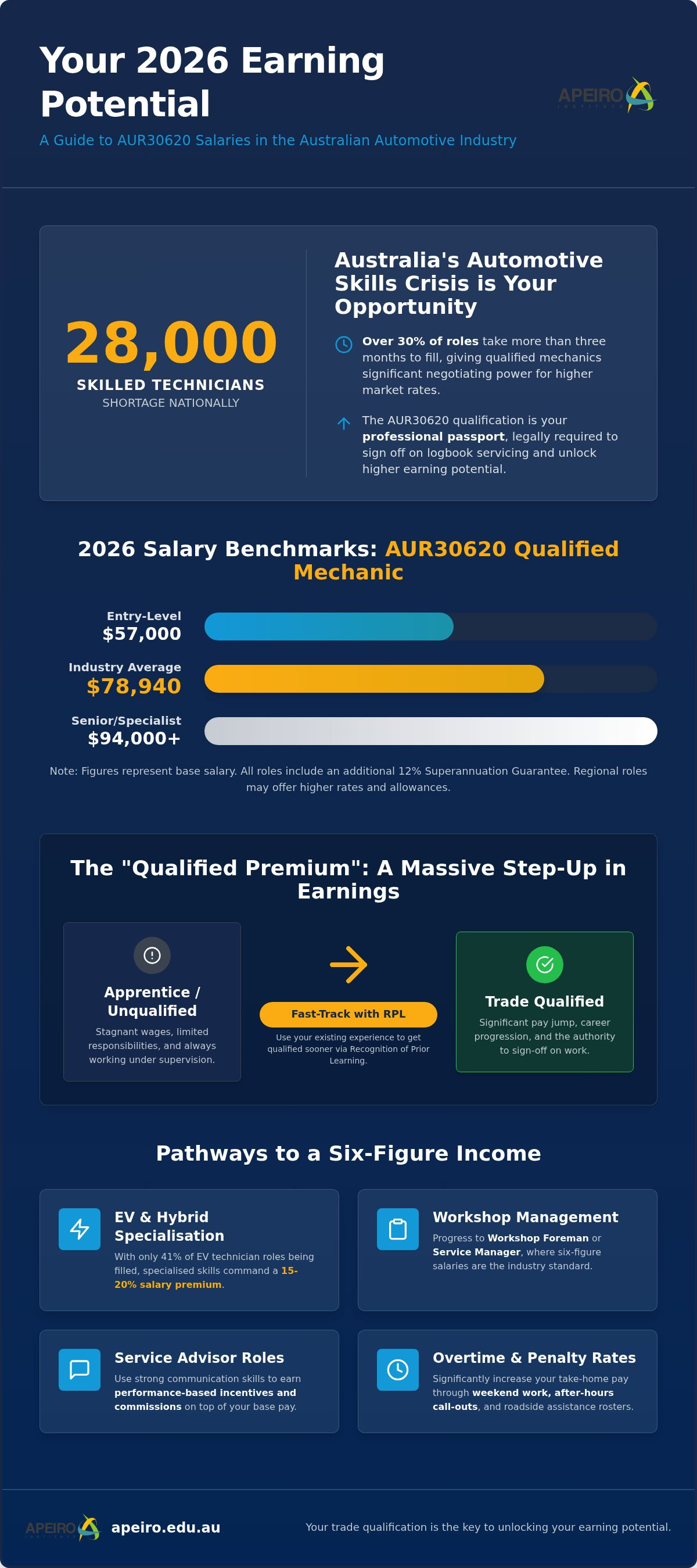
Industry data for 2026 indicates that a trade-qualified mechanic holding an AUR30620 qualification earns an average annual salary of $78,940. While entry-level technicians typically start around $57,000, senior-level mechanics often see their pay packets reach $94,000 or more. Your location plays a huge role in these figures. While metropolitan centres offer plenty of work, regional workshops in mining or agricultural hubs frequently offer higher base rates or additional allowances to offset the skills gap in those areas. It's not uncommon for regional roles to include relocation assistance or housing subsidies on top of the base pay.
The Financial Value of Being Trade Qualified
The "Qualified Premium" is the immediate pay jump you receive once you move from being an assistant or an apprentice to a fully recognised tradesperson. This isn't just a small bump; it's a significant shift in your lifetime earnings trajectory. By completing your AUR30620 Certificate III in Light Vehicle Mechanical Technology, you open doors to higher-tier roles. You could move into positions like Workshop Foreman or Service Manager, where six-figure salaries are the industry standard. The Fair Work Commission ensures a safety net through the Vehicle Repair, Services and Retail Award, but your true value lies in the specialised diagnostic skills that only a qualified professional can provide.
Key Factors That Influence Your Mechanical Trade Earnings
Your base rate is just the foundation of your financial package. To truly understand "How much will I earn in AUR30620," you must consider how you structure your working week and where you apply your skills. Overtime remains a staple in the Australian automotive trade. Many technicians earn a significant portion of their income through weekend penalty rates or after-hours call-out fees. If you're willing to join a roadside assistance roster or work a rotating Saturday shift, your take-home pay can quickly climb well above the industry average.
Soft skills also play a vital role in your financial growth. Mechanics who transition into service advisor roles often benefit from performance-based incentives and commissions. Being able to translate complex technical jargon into clear advice for a customer is a high-value skill that workshops are willing to pay for. According to the Your Career government website, strong communication and problem-solving abilities are essential for progressing into these higher-paying leadership and customer-facing positions.
Specialisation: EVs, Hybrids, and Diagnostics
The fastest way to secure a pay rise in 2026 is through technical specialisation. As electric vehicle adoption grows, the demand for technicians who understand high-voltage systems has reached a fever pitch. Currently, only about 41% of EV technician roles are being filled. This massive gap means that qualified mechanics with EV diagnostic skills can command a 15-20% premium over their peers. Completing your AUR30620 provides the essential baseline you need before moving into these advanced diagnostic certifications. Mastering specialised scan tools doesn't just make you more accurate; it increases your billable efficiency, which is a key metric during salary reviews.
Industry Sector and Workshop Type
Where you choose to work matters just as much as what you know. Prestige dealerships for European brands often offer structured career paths and high-end facilities, though they may have stricter performance targets. In contrast, independent workshops might offer a broader variety of work and a closer-knit team environment. If you're looking for the highest possible earnings, consider support roles in the mining or heavy industry sectors. Light vehicle mechanics are vital for maintaining site fleets, and these roles often come with significant site allowances and travel perks. If you've already spent years in the workshop and want to formalise your skills for better pay, exploring Trade Pathways for Experienced Workers can be a game-changer for your career.
Salary Comparison: Apprentice vs. Trade Qualified Mechanic
The journey from apprentice to tradesperson is more than just a change in title; it's a massive shift in your financial reality. If you're currently slogging through your training and wondering, "How much will I earn in AUR30620," the answer lies in the significant "step up" that happens the moment you're signed off. In 2026, a fourth-year junior apprentice typically earns approximately $25.91 per hour, whereas a newly qualified tradesperson jumps immediately to a rate closer to $39.95 per hour. This jump reflects your ability to work independently and take full responsibility for the safety of the vehicles leaving your bay.
Adult apprenticeships offer a slightly different pathway for career changers over the age of 21. While junior rates start lower to account for the training investment, adult apprentices begin on a higher base rate that aligns more closely with the national minimum wage. For example, as of July 2026, an adult apprentice in their first year earns $895.28 per week, providing a more sustainable income for those with existing financial commitments like mortgages or families. Regardless of your starting point, the goal remains the same: reaching that trade-qualified status where your earning floor rises permanently.
The Apprentice Progression Scale
Apprentice wages in Australia generally follow a percentage-of-trade-rate model. As you move from Year 1 to Year 4, your pay packet increases as you hit specific training milestones. Competency-based progression is a fantastic tool here. If you're a fast learner and can demonstrate your skills early, you might be able to move up the pay scale sooner than the traditional four-year timeline. You should also be aware of changes to government support. From 1 January 2026, the Australian Apprentice Training Support Payment has been reduced to $2,500, making it even more important to focus on reaching full qualification quickly to maximise your primary income.
The Qualified Tradesperson Jump
Once you hold your trade papers, you move into the Trade Level 1 pay bracket. This is where you'll see the median weekly earnings for motor mechanics reach approximately $1,405 per week. This higher pay isn't just for your technical ability; it's for your capacity to mentor juniors and manage complex diagnostic tasks without supervision. Completing your Certificate III in Light Vehicle Mechanical Technology is the key that unlocks this level. It transforms you from a supervised learner into a valuable asset who can justify a higher market rate through efficiency and expertise.
How to Maximise Your Income After Completing Your AUR30620
To truly maximise what you bring home, you've got to look beyond the base award. If you're wondering, "How much will I earn in AUR30620" over the long term, you should consider the various pathways to higher-tier earnings. Moving into management roles is one of the most reliable ways to push your income into the six-figure range. Roles like Workshop Foreman or Service Manager require a mix of technical mastery and leadership skills. These positions often come with higher base salaries and performance bonuses based on the workshop's overall efficiency.
For those with an entrepreneurial spirit, starting a mobile mechanic business or an independent workshop offers the highest potential for financial independence. While it involves more risk, the ability to set your own rates and keep the profits can significantly increase your annual take-home pay. Staying informed through the latest vocational courses ensures you remain competitive as vehicle technology continues to evolve.
Fast-Tracking with RPL and TPEW
If you have years of experience but never finished your formal training, you don't have to start from the bottom. Trade Pathways for Experienced Workers (TPEW) allows you to have your current skills assessed and recognised. This process, known as Recognition of Prior Learning (RPL), is the most effective way to answer the question, "How much will I earn in AUR30620?" by moving you straight to a tradesperson's pay bracket. Instead of spending four years as an apprentice, you can collect evidence of your competency and achieve your qualification in a fraction of the time. The return on investment is immediate. You'll stop earning apprentice rates and start negotiating based on your actual workshop value.
Upskilling into Higher Pay Brackets
Formal certification isn't a dead end. It's a foundation for further growth. Many mechanics choose to transition from light vehicles to heavy diesel or plant mechanics to take advantage of the higher wages in the mining and construction industries. Alternatively, you can specialise further by pursuing a Certificate IV in Automotive Mechanical Diagnosis. This qualification turns you into a specialist diagnostic technician, a role that workshops are desperate to fill. For a deeper look at these options, check out our guide on Trade Pathways for Experienced Workers to see how you can map out your future.
Fast-track your mechanical trade qualification through RPL
Fast-Track Your Career with Apeiro Institute’s Trade Pathways
Choosing the right training provider is just as important as the trade itself. At Apeiro Institute, we've built a reputation as the preferred choice for automotive professionals because we understand the real-world demands of the Australian workshop. We don't just teach theory. Instead, we focus on the practical, industry-aligned skills that employers are actively looking for in 2026. Whether you're a local apprentice starting out or an international student looking to establish a career, our support systems are designed to help you succeed.
When you ask yourself, "How much will I earn in AUR30620," the answer depends heavily on the quality of your training and how quickly you can apply it. We bridge the gap between being a learner and becoming a high-earning tradesperson. Our status as a nationally recognised RTO 45394 ensures that your qualification is respected across every state and territory. This gives you the mobility to chase the best pay rates in the country, from metropolitan dealerships to high-paying regional hubs.
Flexible Learning for Working Mechanics
We know that life in a workshop is busy. That's why our programs are designed with flexibility in mind, allowing you to balance your studies with your current job. You'll have access to expert trainers who've spent years in the Australian automotive market. They understand the specific challenges you face on the floor. Our campuses feature modern training facilities designed for hands-on outcomes. This means you spend less time in a classroom and more time mastering the diagnostics and repair techniques that drive your market value up.
Next Steps: Get Your Free Skills Check
Taking the next step in your career shouldn't be a guessing game. We offer a straightforward skills assessment process to help you understand exactly where you stand and what you need to do to become trade qualified. Our team provides a personalised career and salary pathway, helping you map out a journey toward senior technician or workshop management roles. Don't let your income plateau because you lack formal papers. We're here to help you turn your existing workshop experience into a recognised qualification.
Ready to earn what you’re worth? Explore our AUR30620 course today.
Secure Your Worth in the Australian Automotive Trade
The Australian automotive industry is changing fast, and the current shortage of 28,000 technicians means your skills have never been more valuable. The right qualification bridges the gap between stagnant wages and a thriving career with long-term security. If you've been wondering, "How much will I earn in AUR30620," the data for 2026 shows that trade-qualified mechanics are in a prime position to negotiate better packages and pursue leadership roles in the workshop.
Apeiro Institute acts as your mentor in this journey. As a nationally recognised training provider (RTO 45394), we specialise in Trade Pathways for Experienced Workers and industry-focused training. We focus on the practical skills that modern workshops need, ensuring you're ready for the diagnostic challenges of today's vehicle technology. You've already got the workshop experience; now it's time to get the formal recognition that unlocks your true earning potential.
Get Trade Qualified and Boost Your Earnings with Apeiro Institute
Your future in the trade is full of potential. We're here to provide the support and expert guidance you need to reach your professional goals with confidence. Take the first step today and start building the rewarding career you deserve.
Frequently Asked Questions
How much does a light vehicle mechanic earn per hour in Australia in 2026?
A trade-qualified light vehicle mechanic earns an average of $37.95 per hour in 2026. While entry-level technicians might start closer to $27.50 per hour; senior mechanics with diagnostic expertise can command rates well above $45.00. When asking "How much will I earn in AUR30620," remember that many workshops pay above the minimum award to attract staff during the current skills shortage.
Can I get my AUR30620 if I already have years of experience but no papers?
Yes; you can formalise your skills through Recognition of Prior Learning (RPL) or Trade Pathways for Experienced Workers. This process assesses your existing workshop experience against national standards; allowing you to achieve your qualification without completing a four-year apprenticeship. It is the fastest way to move from an assistant's wage to a full tradesperson's salary.
Does the AUR30620 qualify me to work on electric vehicles (EVs)?
The AUR30620 provides the essential foundation for all light vehicle work; but specialised high-voltage training is usually required for EV servicing. Because only 41% of EV technician roles are currently filled; having your Certificate III is the necessary first step before upskilling to earn the 15-20% pay premium often offered to EV specialists.
What is the difference in pay between a light vehicle and a heavy vehicle mechanic?
Heavy vehicle mechanics often earn a higher base salary due to the specialised nature of the equipment and high demand in the mining and transport sectors. While a light vehicle mechanic averages about $78,940 per year; heavy diesel technicians can often reach six-figure sums when site allowances and regional bonuses are factored into the package.
Is the Certificate III in Light Vehicle Mechanical Technology a nationally recognised qualification?
Yes; it is a nationally recognised qualification under the Australian Qualifications Framework. This ensures that your trade papers are respected by employers in every state and territory. This national recognition is vital for your career mobility; allowing you to move to regions where pay rates might be higher due to local demand.
How long does it take to finish the AUR30620 through RPL?
Completing your qualification through RPL is significantly faster than a traditional apprenticeship. Depending on how quickly you can gather evidence of your competency; the process can often be finalised in a matter of weeks or months. This allows you to answer the question "How much will I earn in AUR30620" much sooner by stepping into a qualified role immediately.
Are there government subsidies available for the AUR30620 in 2026?
Yes; there are several incentives available in 2026; including the Australian Apprentice Training Support Payment and the Priority Hiring Incentive for employers. Depending on your location and eligibility; you may also be able to access Smart & Skilled funded courses to help reduce the cost of your vocational training.
Can I work as a mechanic in Australia without a Certificate III?
You can work in a workshop as an assistant or an apprentice; but you cannot legally sign off on logbook servicing or work without supervision. Without a Certificate III; your earning potential is strictly capped at lower award rates. Obtaining your trade qualification is the only way to access the higher market rates and professional responsibilities of a tradesperson.

Disclaimer
The information provided on this blog is for general informational and educational purposes only. While every effort is made to ensure the accuracy and reliability of the content, the author makes no representations or warranties of any kind, express or implied, about the completeness, accuracy, suitability, or availability of the information contained on this blog.
The views and opinions expressed in blog posts are those of the individual author and do not necessarily reflect the official policy or position of any organization, company, or employer.
This blog may contain links to external websites or third-party content. These links are provided for convenience only, and the author has no control over and assumes no responsibility for the content, privacy policies, or practices of any third-party sites.
Nothing on this blog constitutes professional advice (legal, financial, medical, or otherwise). Readers are encouraged to seek appropriate professional guidance before making any decisions based on the information provided here.
By using this blog, you acknowledge that any reliance on the information is at your own risk.


