

Did you know that as of January 2026, the minimum hourly rate for a qualified aged care worker has risen to $32.21 per hour? This reflects a massive government investment to support those entering this vital sector. If you’re considering a career change, you probably have one main question: how much will I earn in CHC33021 qualified roles? It’s common to feel confused by the gap between base rates and the actual money that hits your account after a busy week of shift work. You want to know that your hard work will be fairly rewarded and that there is room to grow.
We’ve put together this guide to give you a clear, honest look at the financial side of individual support. You’ll discover the latest 2026 salary data for both aged care and disability sectors, including how the 12% superannuation rate and 25% casual loading impact your earnings. We’ll also show you how to maximise your income through penalty rates and plan a roadmap toward senior roles that can reach six figures. Let’s explore how this qualification can secure your financial future while you make a real difference in your community.
Key Takeaways
- Get a clear breakdown of the 2026 SCHADS and Aged Care Award rates to understand exactly how much will I earn in CHC33021 roles from day one.
- Discover how to significantly increase your weekly income by mastering the system of penalty rates, casual loading, and special allowances.
- Compare the earning potential between residential aged care and disability support to see which sector aligns with your financial and lifestyle needs.
- Map out your long-term career progression and see the potential salary jump when you upskill to leadership positions like a care coordinator.
- Learn how your previous experience and the type of organisation you join can impact your starting level and future pay rises.
Understanding the Earning Potential of CHC33021 in 2026
Starting a career in community care is a rewarding decision that offers both emotional fulfilment and genuine job security. The CHC33021 Certificate III in Individual Support (Ageing and Disability) serves as the essential gateway qualification for this sector. It provides the nationally recognised skills you need to support older Australians and people living with disabilities. Because this qualification is standardised across the country, it ensures you're ready to step into high-demand roles immediately upon graduation.
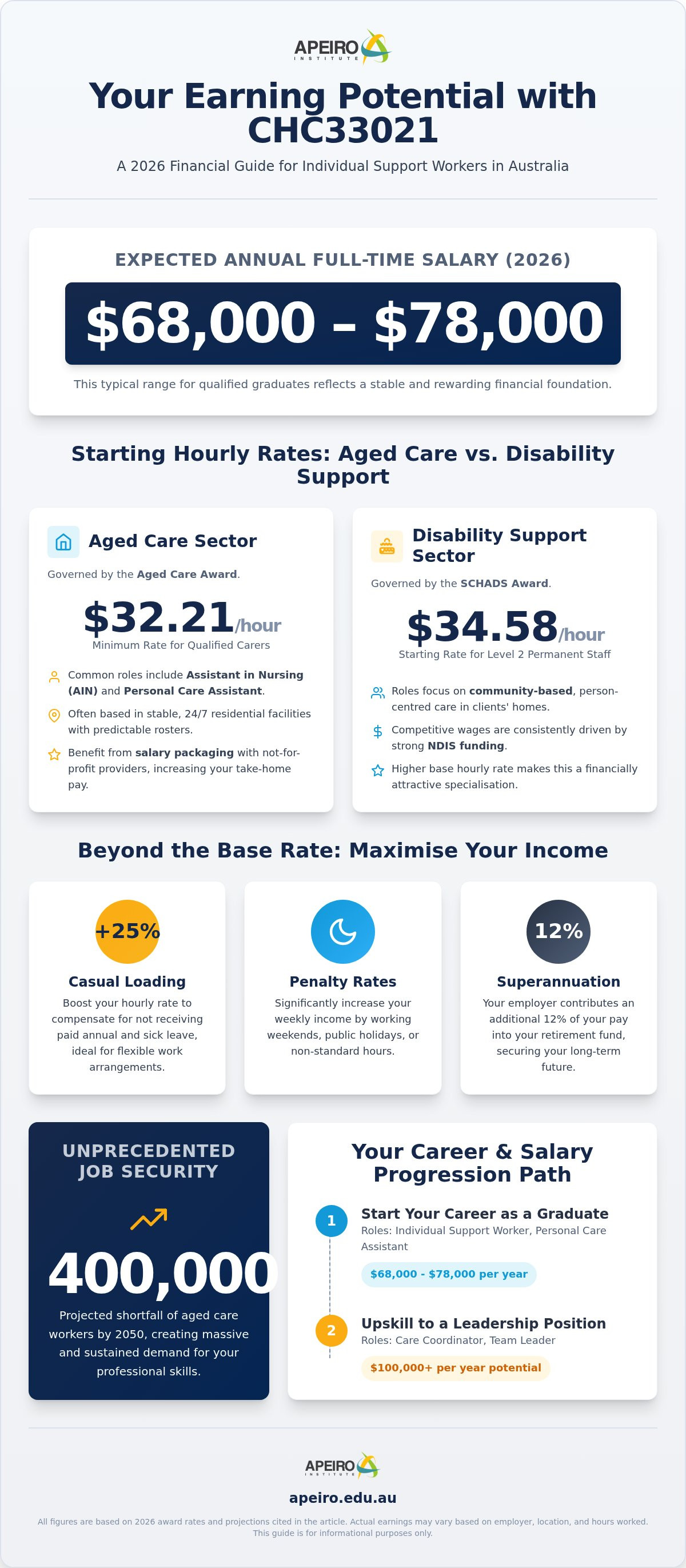
A common question for those entering the field is: how much will I earn in CHC33021 qualified roles? In 2026, a full-time worker can expect a broad annual salary range between $68,000 and $78,000. This figure can vary based on whether you work in residential facilities or community-based settings. Your specific employment structure also plays a huge part in your take-home pay. Full-time and part-time roles provide the stability of guaranteed hours and paid leave. In contrast, casual employment offers a higher hourly rate through a 25% loading, which many workers use to boost their immediate earnings while maintaining a flexible schedule.
The 2026 Industry Outlook for Individual Support
Australia is currently navigating a significant demographic shift. Our ageing population means that the demand for skilled carers is at an all-time high. In fact, Aged care in Australia is now one of the nation's largest employers, with a projected shortfall of 400,000 workers by 2050. This massive demand creates incredible job security for you. Additionally, consistent NDIS funding continues to drive competitive wages in disability support, ensuring that your skills remain valued and well-compensated in a growing market.
Starting Rates for Cert III Graduates
For a new graduate, entry-level pay is significantly higher than in many other vocational sectors. As of early 2026, the minimum hourly rate for a qualified aged care worker is $32.21 under the Aged Care Award. If you're working in disability support under the SCHADS Award, a Level 2 permanent employee starts at $34.58 per hour. It's heartening to see that these rates aren't "trainee" wages; they're professional base rates that recognise your qualification. The base rate is the legal minimum requirement, ensuring you're fairly paid from your very first shift after finishing your studies.
By choosing this path, you're entering a sector that finally reflects the true value of care work. Whether you're looking for a steady full-time career or a flexible casual role, the financial foundation for CHC33021 graduates in 2026 is stronger than ever before. This stability allows you to focus on what really matters: providing high-quality support to those who need it most.
Breaking Down Salaries by Role: Aged Care vs. Disability Support
The CHC33021 qualification is essentially a dual-purpose key. It opens doors to two distinct sectors: residential aged care and disability support. While your core skills in empathy and personal care remain the same, the way your pay is calculated can differ based on which path you take. When prospective students ask, "How much will I earn in CHC33021 qualified roles?", they usually find that the answer changes depending on the complexity of the care provided and the specific award coverage.
Residential Aged Care and Nursing Assistant Roles
In a residential facility, you'll often be titled an Assistant in Nursing (AIN) or a Personal Care Assistant. Your day involves supporting residents with daily living, mobility, and social engagement. One of the biggest draws here is roster stability. Facilities operate 24/7, so you can often secure permanent part-time or full-time contracts with predictable hours. Many of these providers are not-for-profit organisations. This is a major advantage because they often offer salary packaging. This allows you to receive a portion of your wages tax-free to pay for expenses like your mortgage or groceries, effectively putting more money in your pocket than a higher base salary might.
Disability Support and Community Work
Disability support is increasingly focused on community-based, person-centred care. You might work in a client's home or help them access the community. The Disability Services Industry Award, often referred to as the SCHADS Award, typically governs these roles. Because NDIS funding is tied to specific client needs, roles involving complex care or high-intensity support often attract higher hourly rates. If you enjoy variety and working one-on-one, this sector offers high growth. Some workers even choose to work through digital platforms as independent contractors, which can offer even higher hourly rates, though you'll need to manage your own tax and insurance.
Home care is another booming area. It offers the flexibility to travel between clients, often with paid travel time or vehicle allowances. Whether you prefer the structured environment of a nursing home or the independence of community work, starting your journey with a nationally recognised Certificate III is the smartest way to access these diverse roles. When you consider how much will I earn in CHC33021 positions, remember to look at the total package, including tax benefits and allowances, rather than just the hourly figure on the page.
Beyond the Base Rate: Penalty Rates, Casual Loading, and Allowances
If you only look at the base hourly rate, you're only seeing half the story. The real strength of the Australian award system lies in its additional protections and loadings. When you ask "how much will I earn in CHC33021", the answer depends heavily on when you work and the type of contract you sign. These extras can transform a modest base rate into a very competitive take-home pay cheque.
The most significant boost for many is casual loading. In Australia, casual employees receive a 25% loading on top of their base hourly rate. This is designed to compensate for the lack of paid annual leave and sick leave. For many new graduates, this extra cash flow is a massive advantage while they're establishing their careers. Beyond loading, you'll also find a range of standard allowances that add up over a fortnight. These include:
- Travel Allowance: Crucial for home care workers who use their own vehicles between clients.
- Uniform and Laundry Allowance: Small daily amounts to cover the cost of maintaining your work attire.
- Meal Allowances: Provided if you're required to work through a break or perform overtime.
Maximising Your Income Through Shift Work
Shift work is where your earning potential truly scales. Under the relevant awards, working outside standard business hours triggers penalty rates. For example, a Saturday shift typically pays 150% (time and a half) of your base rate. Sunday shifts are even more lucrative, often paying 200% (double time). If you work on a public holiday, that rate can jump to 250%. In home care, you might encounter "broken shifts" where you see one client in the morning and another in the late afternoon. While these require a gap in your day, they often come with a specific allowance to compensate for the inconvenience. It's a great way to boost your income, provided you balance these hours with your own wellbeing and rest.
The Pros and Cons of Casual Employment
Many students start their journey in casual roles. The immediate 25% pay bump is incredibly helpful for managing cost-of-living pressures. It also offers the flexibility to choose shifts that fit around your family or further study. However, it's a trade-off. Casuals don't have guaranteed hours or paid time off. If you're seeking long-term financial security, such as applying for a home loan, you might eventually prefer a permanent part-time or full-time role. Most facilities and agencies are eager to move reliable casuals into permanent positions, giving you a clear path to job security once you've found an employer that feels like the right fit.
By understanding these layers of pay, you can strategically plan your roster to meet your financial goals. Whether you're chasing the higher immediate cash of casual weekend work or the steady security of a permanent weekday role, the CHC33021 qualification provides the foundation you need to start earning.
Key Factors That Impact Your Pay Cheque in Individual Support
Your base rate is just the starting point. When asking "how much will I earn in CHC33021", you need to consider the specific variables that move you up the pay scale. Your starting offer often depends on the type of organisation you join. Large residential facilities might offer different benefits compared to smaller, specialised NDIS providers. The funding model of your employer, whether they're a private company or a government-funded non-profit, also dictates the allowances and salary packaging options available to you.
Your mandatory 120 hours of work placement is perhaps the most critical factor for a new graduate. It isn't just a hurdle to clear; it's a direct pathway to employment. Students who demonstrate high levels of initiative and empathy during placement often receive job offers before they've even finished their course. This gives you a massive advantage. Performing well during this time allows you to negotiate from a position of strength, potentially starting at a higher pay point than a candidate without a proven track record in a real-world setting.
Experience and Levels in the SCHADS Award
Pay progression in the community sector is structured through clear levels. As a Certificate III holder, you'll typically move from Level 1 toward Level 3 as you gain experience and take on more responsibility. Each level increase reflects your growing expertise and the complexity of the care you provide. If you already have years of experience in a related field or have worked in care overseas, you might be eligible for Recognition of Prior Learning. Check out our TPEW page to see how your existing skills can fast-track your career and help you secure a higher starting level from day one.
The Value of Specialisation
Specialised skills are in high demand across Australia. Carers who focus on dementia care, palliative care, or complex behavioural support are often more attractive to employers. These high-needs areas require a deeper level of expertise, which can lead to more consistent shifts and higher-level classifications. Beyond technical skills, your ability to communicate clearly and build trust with clients is a significant asset. These soft skills often separate top-tier support workers from the rest of the field, making you a "preferred carer" for many families and organisations.
Enrol in CHC33021 and start your care career
Upskilling for Higher Earnings: From Certificate III to Leadership
Your first role after graduation is just the beginning. The care sector offers a clear, structured ladder for those who want to take on more responsibility. While you might start by asking "how much will I earn in CHC33021", it's equally important to look at where that qualification can take you in the future. It serves as the bedrock for a career that grows as you gain confidence and expertise. Many professionals find that once they've mastered the fundamentals of individual support, they're naturally drawn to leadership positions where they can mentor others.
When you first start, you'll likely focus on how much will I earn in CHC33021 roles as a newcomer. However, the true value of this qualification is the foundation it provides for long-term growth. This isn't just a job; it's a professional identity that you can build upon year after year. The Australian healthcare landscape is designed to reward those who continue to learn and adapt to the changing needs of our community.
Moving into Leadership with Certificate IV
Once you've gained experience on the floor, the logical next step is the CHC43015 Certificate IV in Ageing Support. This qualification prepares you for the role of a Senior Personal Care Assistant or Team Leader. In these positions, your focus shifts. You'll spend less time on direct personal care and more time supervising staff, managing rosters, and ensuring care plans are followed correctly. This transition usually comes with a significant pay rise. Industry data for 2026 suggests that team leaders and care coordinators can see their annual earnings reach between $95,000 and $115,000. This reflects the added accountability and specialised knowledge required to manage a care team.
The Diploma Pathway: Case Management and Coordination
For those who enjoy the organisational side of care, the Diploma of Community Services is an excellent long-term goal. This opens doors to case management and high-level community coordination. As a Case Manager, you'll work with families and healthcare professionals to design comprehensive support programmes. It's a role that requires high-level empathy combined with strong administrative skills. You can find more detail on this progression in our Diploma of Community Services Australia guide. These roles offer a different kind of fulfilment, allowing you to influence the quality of care on a much larger scale while enjoying the financial rewards of a senior professional position.
Choosing to study the Cert III is a strategic move. It gives you the immediate skills to enter a high-demand workforce while keeping your options open for the future. Whether you stay in direct care or move into management, your initial training ensures you understand the heartbeat of the industry. By starting with a solid foundation, you're securing your place in a sector that values your contribution and offers a clear path to success.
Secure Your Future in the Australian Care Sector
You now have a clear roadmap of the financial landscape for 2026. From the high demand for skilled workers to the significant impact of weekend penalties and casual loading, the earning potential in this field is stronger than ever. When you evaluate how much will I earn in CHC33021 qualified roles, remember that this qualification is more than just a certificate. It is the foundation for a career that offers genuine job security and a pathway into leadership positions that can reach six figures.
Apeiro Institute (RTO 45394) is dedicated to providing industry-focused training that prepares you for real-world jobs. With campuses in Perth and Sydney serving students nationally, we provide the supportive environment you need to succeed during your studies and your mandatory work placement. We are here to act as your expert guide through every step of this rewarding professional journey.
Start your career in Individual Support with Apeiro Institute today
Your journey toward a stable and fulfilling career starts with a single step. We look forward to welcoming you into our community and helping you achieve your professional goals.
Frequently Asked Questions
What is the average hourly rate for a CHC33021 graduate in 2026?
As of early 2026, a qualified aged care worker earns a minimum of $32.21 per hour under the Aged Care Award. If you choose to work in disability support, the starting rate for a Level 2 permanent employee is $34.58 per hour. These rates represent the legal base pay, ensuring you are fairly compensated for your skills from the moment you begin your professional career.
How much extra do I earn for working on a Sunday in aged care?
Working a Sunday shift typically pays double time, which is 200% of your standard hourly rate. This means a base rate of $32.21 jumps to over $64 per hour for that shift. It is one of the most effective ways to boost your weekly take-home pay while providing essential care during the weekend.
Is there a difference in pay between aged care and disability support?
Yes, there is a slight difference because the two sectors operate under different national awards. Aged care is covered by the Aged Care Award; meanwhile, disability support usually falls under the SCHADS Award. When people ask, "how much will I earn in CHC33021", we point out that disability support often offers a slightly higher starting base rate of $34.58 compared to $32.21 in residential aged care.
Can I earn more if I work as a casual employee?
You certainly can, as casual employees receive a 25% loading on top of their base hourly rate. This loading is paid instead of leave entitlements like sick pay or annual leave. For many, this extra cash in each pay cheque is a great way to manage daily expenses while enjoying a flexible work schedule that fits their lifestyle.
Does the NDIS affect how much I get paid as a support worker?
The NDIS funding model directly impacts disability support wages by tying pay to the complexity of a client's needs. Roles that require specialised skills or high-intensity care often attract higher hourly rates. This system ensures that support workers are rewarded for taking on more challenging and responsible care duties within the community.
What is salary packaging and how does it help care workers?
Salary packaging allows you to pay for certain living expenses, such as your mortgage, rent, or groceries, using your income before it is taxed. This benefit is common in not-for-profit aged care and disability organisations. By reducing your taxable income, you effectively increase your take-home pay without needing a higher base salary.
How long does it take to move up to a higher pay level?
Progression to a higher pay level usually happens after twelve months of continuous service or once you have completed a specific number of hours. Each level increase in the award reflects your growing experience and competency on the job. It provides a steady, predictable way to increase your earnings as you become a more seasoned professional.
Will my salary increase if I complete a Certificate IV in Ageing Support?
Completing a Certificate IV in Ageing Support is a proven way to increase your earning potential significantly. This qualification allows you to move into senior or team leader roles, where salaries in 2026 can range from $95,000 to $115,000. It marks the transition from providing direct care to managing teams and coordinating complex services.

Disclaimer
The information provided on this blog is for general informational and educational purposes only. While every effort is made to ensure the accuracy and reliability of the content, the author makes no representations or warranties of any kind, express or implied, about the completeness, accuracy, suitability, or availability of the information contained on this blog.
The views and opinions expressed in blog posts are those of the individual author and do not necessarily reflect the official policy or position of any organization, company, or employer.
This blog may contain links to external websites or third-party content. These links are provided for convenience only, and the author has no control over and assumes no responsibility for the content, privacy policies, or practices of any third-party sites.
Nothing on this blog constitutes professional advice (legal, financial, medical, or otherwise). Readers are encouraged to seek appropriate professional guidance before making any decisions based on the information provided here.
By using this blog, you acknowledge that any reliance on the information is at your own risk.


