

What if the gap between a modest entry-level wage and a professional salary of A$95,000 per year was simply a matter of holding the right qualification? Many dedicated workers in the care sector feel stuck at the bottom of the pay scale, worrying that their passion for helping others comes at the cost of their own financial security. You are likely asking, "How much will I earn in CHC52025?" and whether moving into a Diploma-level role actually makes a tangible difference to your weekly pay packet.
We understand that navigating the complexities of the SCHADS Award and industry pay tiers can be confusing. That's why we have put together this guide to help you see the real earning potential of the CHC52025 Diploma of Community Services. You will discover exactly how to transition from award-minimum support roles into higher-paying coordination and management positions. We will cover the latest 2026 salary ranges, explain how recent Fair Work Commission increases impact your take-home pay, and map out the career pathways that offer both professional fulfilment and financial stability.
Key Takeaways
- Understand the transition from entry-level wages to professional coordination salaries and find the answer to the critical question: how much will I earn in CHC52025?
- Discover how this qualification typically maps to Level 4 or 5 of the SCHADS Award, ensuring you understand your legal minimum pay entitlements in the Australian care sector.
- Identify the specific high-demand roles, such as Case Manager or Program Coordinator, that offer significantly higher earning potential than front-line support work.
- Learn how to maximise your income by selecting the right specialisations and leveraging your existing industry experience through Recognition of Prior Learning (RPL) pathways.
What is the Earning Potential for CHC52025 Graduates in 2026?
The CHC52025 Diploma of Community Services is the recognised professional standard for those looking to lead within the Australian community sector. While many believe the myth that working in care means accepting a low income, the reality in 2026 is quite different. The sector has undergone significant professionalisation, shifting roles from generalist support toward specialised management and coordination. This evolution has brought about a more competitive salary landscape for those with the right qualifications.
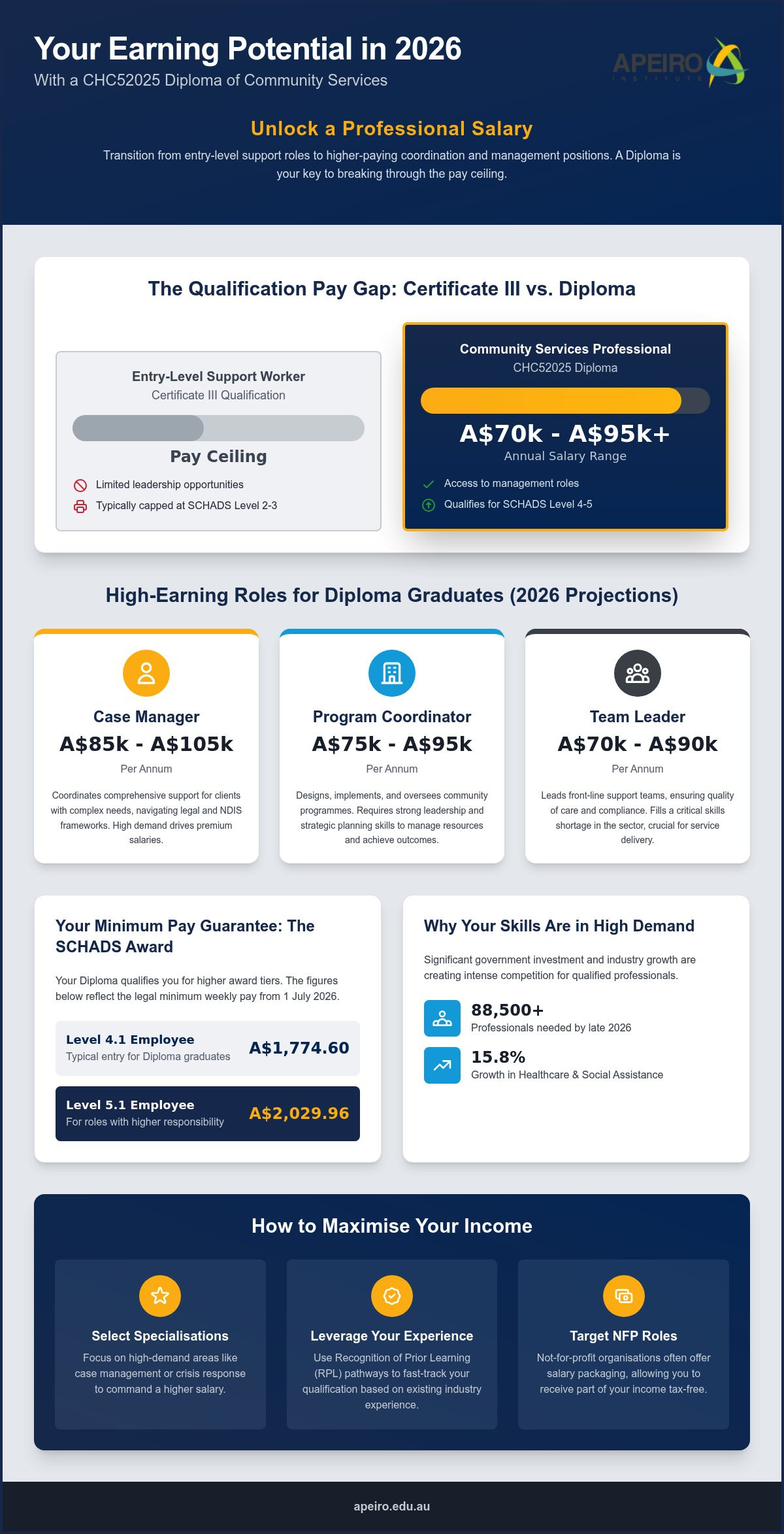
If you're asking, "How much will I earn in CHC52025?" the answer often depends on your specific work setting. While the Social, Community, Home Care and Disability Services (SCHADS) Award provides a solid legal floor, many private and non-profit organisations offer packages that exceed these minimums to attract top talent. Typically, a Diploma graduate in 2026 can expect to earn between A$70,000 and A$95,000 annually. This range reflects the high level of responsibility graduates take on when managing complex cases or leading community programmes.
The ROI of a Diploma vs. Certificate III
Choosing to progress from a Certificate III to a Diploma is a strategic financial move. Entry-level support workers often find themselves capped at SCHADS Level 2 or 3 wages. Without a higher qualification, you face a "pay ceiling" that limits your ability to move into leadership. A Diploma holder, however, moves into Level 4 or 5 territory. From 1 July 2026, the minimum weekly wage for a Level 4.1 employee is A$1,774.60, while a Level 5.1 role reaches A$2,029.96.
This transition involves a shift toward person-centred service management. You aren't just providing care; you're designing and overseeing it. This increased responsibility is exactly why the weekly pay packet sees such a noticeable jump. Investing in your education now removes the barriers to these higher salary brackets.
Industry Demand and Pay Pressure in 2026
The Australian government continues to invest heavily in the care economy. The sector is projected to employ over 88,500 professionals by late 2026. This growth, combined with a 15.8% increase in the broader healthcare and social assistance industry, has created intense competition for skilled staff. Within the Social work profession, there is a particular shortage of qualified Case Managers and Team Leaders.
This scarcity is driving up salaries, especially in the private sector where employers pay a premium for expertise in crisis response and ethical compliance. Enrolling in a Diploma of Community Services positions you perfectly to fill these high-demand gaps. When you consider "How much will I earn in CHC52025", remember that your specialised skills make you a valuable asset in a market that is currently short on leadership talent.
Salary Breakdown: Specific Roles You Can Land with CHC52025
Not all roles in community services are created equal. While many people begin their careers in front-line support, the CHC52025 Diploma of Community Services is specifically designed to propel you into coordination and management. These positions carry significantly more weight in terms of both responsibility and remuneration. It's the difference between delivering a service and designing the system that makes that service possible. When you look at the question, "How much will I earn in CHC52025", you must look beyond the entry-level support worker roles.
Many of these higher-tier positions are found within the not-for-profit sector. This is a significant advantage because these organisations often provide access to salary packaging. This benefit allows you to receive a portion of your income tax-free, effectively boosting your take-home pay beyond the base figure. In 2026, a Case Manager serves as a primary high-earning outcome for graduates, acting as a professional coordinator who assesses complex client needs and organises comprehensive support systems to ensure sustainable life improvements.
Case Management and Coordination
Case Managers in Australia can expect a salary range between A$85,000 and A$105,000 per annum in 2026. These roles command a premium because they require complex problem-solving and strict adherence to legal compliance frameworks. You aren't just helping an individual; you're navigating a web of social, legal, and financial requirements. Much of this demand is driven by the National Disability Insurance Scheme (NDIS), where specialised coordination is vital for participants with high-care needs. Employers rely on the SCHADS Award minimum pay guarantee as a baseline, but they often pay well above this for professionals who can manage the intricate NDIS landscape effectively.
Community Centre and Program Management
If you move into Program Coordination or Community Centre Management, the earning potential increases further. These roles typically offer salaries ranging from A$90,000 to A$115,000 per year. These positions involve managing staff teams, overseeing significant budgets, and driving community outreach initiatives. Success in these roles requires more than just empathy. It demands the leadership skills and strategic thinking embedded in the CHC52025 Diploma of Community Services curriculum. You will be responsible for the "big picture" of community health and well-being, ensuring that programmes remain funded and effective. If you are ready to lead a team and make a broader impact, you might consider how Recognition of Prior Learning can help you reach these management tiers faster by acknowledging your existing industry experience.
The SCHADS Award: Understanding Your Minimum Pay Guarantee
Your income in Australia's community sector is protected by a specific legal framework. This is known as the Social, Community, Home Care and Disability Services (SCHADS) Industry Award. It's the safety net that ensures every worker receives fair compensation for their expertise and time. When you sit down to calculate your budget and ask, "How much will I earn in CHC52025", you are essentially looking at where you sit on this award scale. For graduates of a Diploma-level qualification, the industry standard typically begins at Level 4 or Level 5.
Within each level of the award, you'll find "Pay Points". Think of these as incremental rungs on a ladder. As you gain more years of service or take on more complex duties, you move up these pay points automatically. This system rewards loyalty and experience, ensuring your salary doesn't stay stagnant. Beyond your base rate, your take-home pay is often boosted by shift loadings. If you work afternoon, night, or weekend shifts, you'll receive penalty rates that can add a significant margin to your weekly earnings. Official Community Worker salary data confirms that this sector is one of the fastest-growing in Australia, with wages reflecting the increased demand for skilled coordinators.
Moving from Level 2 to Level 5
The financial jump from a Certificate III role to a Diploma-qualified position is substantial. A worker at Level 2.1 earns a minimum of A$1,376.36 per week. However, stepping into a Level 4.1 role as a Diploma graduate increases that minimum to A$1,774.60. If you progress to Level 5.1, the weekly minimum reaches A$2,029.96. Experience is valuable, but it has a limit. Without the Diploma, you'll eventually hit a pay ceiling that you can't cross. For those already working in the field, our Trade Pathways for Experienced Workers (TPEW) programme is designed to help you bridge this gap quickly by formalising your existing skills.
Salary Packaging: The "Hidden" Pay Rise
Most roles available to CHC52025 graduates are within Not-For-Profit (NFP) organisations. This brings a major financial perk: salary packaging. Because NFPs have certain tax exemptions, they can allow you to pay for everyday expenses—like your mortgage, rent, or even groceries—using pre-tax income. This reduces your taxable salary, meaning you pay less tax and keep more of your hard-earned money. It's effectively a "hidden" pay rise that makes a community services salary much more competitive than a similar figure in a standard corporate environment.
Factors That Will Maximise Your CHC52025 Earning Potential
Earning top-tier wages in community services isn't just about finishing your course. It's about how you position yourself within the industry. Your choice of specialisation plays a massive role. If you focus on high-demand areas like Mental Health or Responding to Family Violence, you become a specialist rather than a generalist. Specialists often command higher market loadings because their skills are harder to find. When you ask yourself, "How much will I earn in CHC52025", remember that your specific niche can push you toward the higher end of the A$70,000 to A$95,000 bracket.
Soft skills are equally important for your bank balance. Technical knowledge gets you the job, but leadership and conflict resolution skills get you the promotion. Employers look for coordinators who can manage team dynamics and de-escalate crisis situations. Training with a reputable Registered Training Organisation (RTO) like Apeiro Institute ensures your qualification is respected by major employers. Our focus on practical, industry-aligned training means you graduate with the confidence to lead. Additionally, the mandatory 100 hours of work based training isn't just a requirement. It is a prime networking opportunity. Many high-paying vacancies are never advertised; they're filled by students who proved their value during placement.
Sector Choice: Government vs. Private vs. NFP
Where you work is as important as what you do. Government roles offer unmatched stability and structured pay rises. Private organisations, however, are increasingly entering the community services space. These companies often offer performance-based bonuses or market loadings to secure the best Case Managers. While we've discussed the tax benefits of Not-For-Profits (NFPs), the private sector is seeing a rise in consultancy roles. When planning your career and asking "How much will I earn in CHC52025", you should look at the rise of private consultancy. Experienced Diploma holders often work as independent contractors, providing specialised NDIS coordination or housing assessments at premium hourly rates.
Continuous Professional Development (CPD)
Think of your Diploma as a foundation, not a finish line. It serves as a perfect bridge to a Bachelor of Social Work or Human Services. By continuing your education, you can eventually target Senior Executive roles where salaries often exceed A$130,000 per year. If you want to move into high-level management sooner, consider broadening your expertise. Pairing your community service knowledge with a Diploma of Business gives you the financial and operational skills needed to run entire facilities or large-scale community programmes. This combination makes you a dual-threat professional in a competitive market.
Enrol in the CHC52025 Diploma and start your journey to a management salary today
Getting Qualified with Apeiro Institute: Your Path to a Professional Salary
Apeiro Institute acts as your professional partner in navigating the Australian care sector. We know that choosing to study is a big decision. When you consider "How much will I earn in CHC52025", you are really asking about the value of your future. Our status as a nationally recognised RTO (45394) means your qualification carries weight with every major employer in Australia. This recognition is your ticket to the stable, high-paying coordination roles that define the modern community services landscape.
Flexibility is at the heart of our training delivery. We have designed our courses to fit around your existing commitments, allowing you to keep working while you upgrade your skills. This means you don't have to choose between a weekly wage and your long-term career goals. For our international students, we offer specialised guidance to help you navigate Australian workplace regulations and expectations. We are here to ensure you aren't just getting a certificate, but a genuine pathway into the local workforce with the confidence to succeed.
Trade Pathways for Experienced Workers (TPEW)
Many professionals have years of "on-the-job" knowledge but lack the formal paper to prove it. Our TPEW pathways are specifically designed for you. Through Recognition of Prior Learning (RPL), we can often accelerate your graduation by acknowledging the skills you already use every day. This has a direct impact on your bank account. In the care sector, the gap between being unqualified and holding a Diploma can be thousands of dollars per year. By formalising your skills, you move from a support worker bracket into a management tier almost overnight.
Enrolment and Next Steps for 2026
Applying for the 2026 intake is a streamlined process for both local and international applicants. We employ trainers who are active in the industry. They provide the real-world context that textbooks often miss. You will gain insights into current crisis response techniques and ethical leadership that are vital for high-paying roles. If you want to know "How much will I earn in CHC52025", the answer is tied to the quality of your training and the mentors you choose. Start your journey toward a professional salary today by connecting with our admissions team and securing your place in the next intake.
Take the Next Step Toward Your Professional Career Goals
Transitioning from front-line support to a coordination role is one of the most rewarding moves you can make in the Australian community services sector. By understanding the SCHADS Award levels and the value of specialised expertise, you can move beyond entry-level pay ceilings. You no longer have to wonder, "How much will I earn in CHC52025", because the pathway to a professional salary between A$70,000 and A$95,000 is now clearly mapped out for you.
Apeiro Institute is here to act as your mentor, providing nationally recognised training (RTO 45394) that is specifically tailored to the 2026 job market. Our expert trainers bring deep industry connections and practical insights into every lesson, ensuring you graduate ready to lead. Whether you are formalising years of experience or starting a fresh journey, we provide the support you need to secure a stable and prosperous future.
Enrol in the CHC52025 Diploma of Community Services and boost your earning potential today
Your passion for helping others deserves to be matched by a career that supports your own growth and financial security. We look forward to helping you reach your full potential in this vital industry.
Frequently Asked Questions
What is the average starting salary for a CHC52025 graduate in 2026?
Most graduates can expect an initial salary between A$70,000 and A$85,000 per year. When asking "How much will I earn in CHC52025", it's important to consider that your specific role, such as a junior Case Manager or Team Leader, will influence this figure. Larger organisations often have more structured pay scales that reflect these professional responsibilities.
Does the Diploma of Community Services pay more than the Certificate III?
Yes, the Diploma typically leads to a much higher salary bracket. While a Certificate III is perfect for entry-level support work, the CHC52025 Diploma qualifies you for coordination and management roles. This shift usually moves you from SCHADS Level 2 or 3 up to Level 4 or 5, which can increase your weekly base pay by over A$400.
Can I work while studying the CHC52025 Diploma of Community Services?
You can definitely maintain employment while you study. Apeiro Institute offers flexible training delivery that is designed to support students who are already working in the care sector. Many of our students continue in support worker roles while they complete their qualification, allowing them to gain practical experience while they learn.
What are the highest-paying roles in community services?
Program Coordinators and Community Centre Managers are currently among the highest-paid professionals in the sector. In 2026, these management positions can command salaries of up to A$115,000 per year. Senior Case Managers who specialise in complex areas like mental health or NDIS coordination also earn at the top of the Diploma pay scale.
How does the SCHADS Award affect my pay with a Diploma?
The SCHADS Award sets the legal minimum wage you must be paid based on your qualification and role. For Diploma holders, the award typically starts at Level 4. Following the 1 July 2026 award increase, these rates ensure that your professional expertise is fairly compensated across the entire Australian community services industry.
Is there a difference in pay between government and non-government community roles?
Government positions often provide excellent stability and structured increments. Non-government organisations (NGOs), however, often provide competitive total packages through salary packaging benefits. Private providers might also offer higher base salaries or market loadings to attract specialists in high-growth areas like disability services or youth work.
Will my previous work experience count toward a higher salary bracket?
Your existing industry experience is a significant asset. It can help you move up the "Pay Points" within your SCHADS Award level more quickly than a new entrant. If you have extensive experience, our Recognition of Prior Learning pathways can help you get qualified faster, allowing you to access higher management salaries sooner.
Are there salary packaging benefits for CHC52025 roles in Australia?
Salary packaging is a common financial benefit for roles in the Not-For-Profit sector. It allows you to pay for certain living expenses from your pre-tax income, which reduces your overall tax bill. This is a vital factor when calculating "How much will I earn in CHC52025", as it significantly increases your actual take-home pay compared to corporate roles.

Disclaimer
The information provided on this blog is for general informational and educational purposes only. While every effort is made to ensure the accuracy and reliability of the content, the author makes no representations or warranties of any kind, express or implied, about the completeness, accuracy, suitability, or availability of the information contained on this blog.
The views and opinions expressed in blog posts are those of the individual author and do not necessarily reflect the official policy or position of any organization, company, or employer.
This blog may contain links to external websites or third-party content. These links are provided for convenience only, and the author has no control over and assumes no responsibility for the content, privacy policies, or practices of any third-party sites.
Nothing on this blog constitutes professional advice (legal, financial, medical, or otherwise). Readers are encouraged to seek appropriate professional guidance before making any decisions based on the information provided here.
By using this blog, you acknowledge that any reliance on the information is at your own risk.


