
What if the qualification you're considering could set you up for a stable, well-paying career in one of Australia's most in-demand technical fields? If you've been asking yourself "how much will I earn in UEE30920," you're not alone. It's one of the first questions prospective students want answered before committing to a new qualification, and it's a completely fair one to ask.
Thinking carefully about your return on investment shows good judgement. You want to know that the time and effort you put into earning a Certificate III in Electronics and Communications will translate into real career opportunities and competitive pay. That uncertainty is understandable, and it deserves a clear, honest answer.
This guide is here to give you exactly that. You'll discover what graduates typically earn across different roles and experience levels, which career paths the UEE30920 qualification opens up, and how you can position yourself to earn more as your skills grow. Whether you're just starting out or looking to formalise your existing experience, you'll leave with a much clearer picture of what this qualification can do for your future.
Key Takeaways
- If you've been wondering "how much will I earn in UEE30920," this guide breaks down realistic salary ranges across entry-level and experienced roles in Australia's electronics and communications sector.
- Your earning potential doesn't stop at graduation - discover practical strategies for leveraging your qualification to secure higher pay and faster career progression.
- Recognition of Prior Learning (RPL) could significantly reduce the time it takes to earn your UEE30920, making it a smart option if you already have hands-on industry experience.
- Emerging technologies are reshaping the electronics field, and understanding these trends now can help you position yourself for the most in-demand - and best-paid - roles of the future.
- Apeiro Institute delivers nationally recognised, industry-focused UEE30920 training designed to translate directly into real-world career outcomes.
Understanding Salary Expectations with UEE30920
The UEE30920 Certificate III in Electronics and Communications is a nationally recognised vocational qualification that prepares graduates for technical roles across Australia's electronics, communications, and electrical services industries. It's a practical, industry-focused credential, and the career doors it opens are genuine. So if you've been asking "how much will I earn in UEE30920," the honest answer is that your earnings will depend on several intersecting factors, but the baseline is competitive and the ceiling grows with experience.
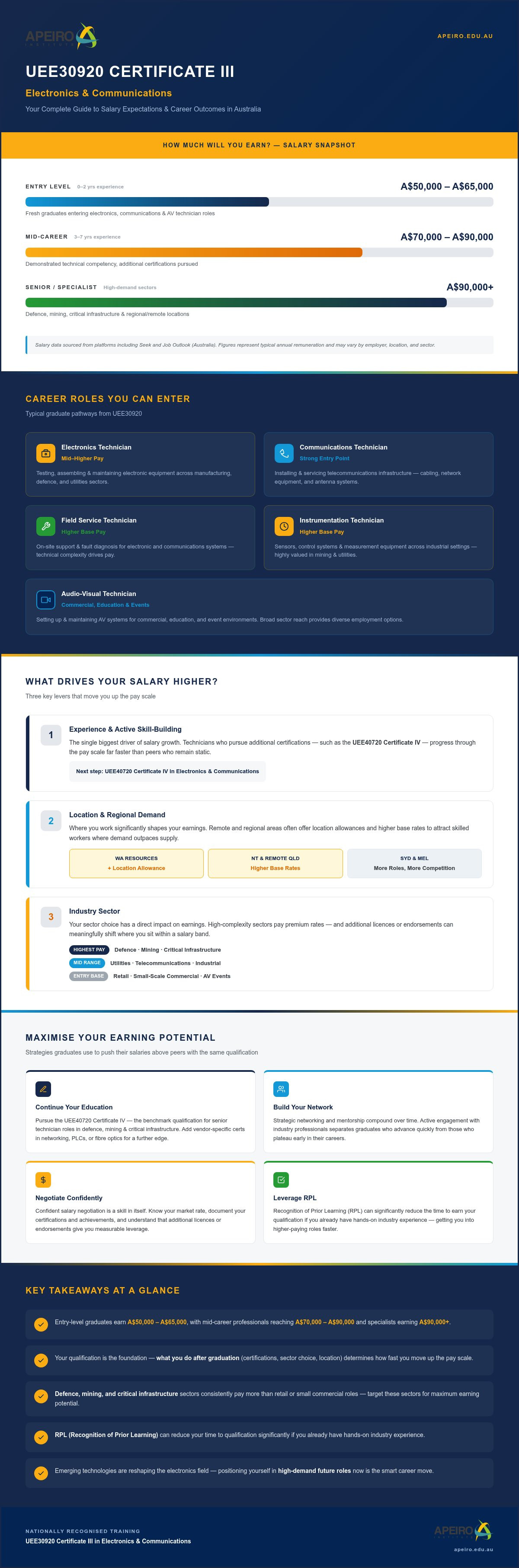
Entry-level roles for UEE30920 graduates in Australia typically attract salaries in the range of A$50,000 to A$65,000 per year, according to data published on platforms such as Seek and Job Outlook. With a few years of experience and demonstrated technical competency, that range climbs considerably, with mid-career professionals in electronics and communications roles often earning between A$70,000 and A$90,000 annually. Specialists working in high-demand sectors or regional areas with skill shortages can earn beyond that range.
What Roles Can You Expect to Enter?
Graduates of the UEE30920 qualification typically move into roles such as:
- Electronics Technician - testing, assembling, and maintaining electronic equipment across manufacturing, defence, and utilities sectors
- Communications Technician - installing and servicing telecommunications infrastructure, including cabling, network equipment, and antenna systems
- Field Service Technician - providing on-site support and fault diagnosis for electronic and communications systems
- Audio-Visual Technician - setting up and maintaining AV systems for commercial, education, and event environments
- Instrumentation Technician - working with sensors, control systems, and measurement equipment across industrial settings
Each of these roles carries different salary expectations. Field service and instrumentation roles often attract higher base pay due to the technical complexity involved, while entry-level technician positions in communications provide a strong starting point with clear pathways upward.
Factors Influencing Earnings in Electronics
Experience is the single biggest driver of salary growth in this field. A technician who actively builds their skills on the job and pursues additional certifications, such as the UEE40720 Certificate IV in Electronics and Communications, will progress through the pay scale much faster than someone who remains static.
Location matters too. Technicians working in Western Australia's resources sector, the Northern Territory, or remote Queensland often receive location allowances and higher base rates to attract skilled workers to areas where demand outpaces supply. Metropolitan roles in Sydney and Melbourne tend to offer more positions overall, but the competition is also greater.
Industry sector plays a significant role as well. Defence, mining, and critical infrastructure typically pay more than retail or small-scale commercial work. Holding additional licences or endorsements relevant to your sector can meaningfully shift where you sit within a salary band.
Maximising Your Earning Potential After UEE30920
Earning your qualification is the starting point, not the finish line. The graduates who move through the pay scale fastest are the ones who treat their UEE30920 as a foundation to build on, not a box to tick. If you're still asking "how much will I earn in UEE30920," the more useful question is: what are you prepared to do after graduation to push that number higher?
There are several levers you can pull. Continuing education, strategic networking, mentorship, and confident salary negotiation all compound over time. Used together, they can meaningfully separate your earnings from those of peers who hold the same qualification but take a more passive approach to their careers.
Continuing Education and Professional Development
The most direct route to higher pay is expanding what you can do technically. The UEE40720 Certificate IV in Electronics and Communications is the natural next step for UEE30920 graduates, and employers in defence, mining, and critical infrastructure sectors often use it as a benchmark when assessing candidates for senior technician roles. Beyond that, vendor-specific certifications in areas like network infrastructure, programmable logic controllers, or fibre optic systems can give you a measurable edge in salary negotiations.
When choosing what to study next, align your learning with the sector you want to work in rather than pursuing credentials at random. A technician targeting the resources sector will benefit from different endorsements than one building a career in audio-visual or broadcast communications. Purposeful upskilling signals to employers that you're serious about your craft, and that translates directly into stronger offers.
Networking and Building Industry Connections
Many of the best-paying roles in electronics and communications are never advertised publicly. They're filled through referrals, word of mouth, and relationships built over time. That's why your professional network is genuinely one of your most valuable career assets.
Practical ways to build connections in this field include:
- Joining professional associations such as Engineers Australia or the Australian Electronics Industry Association to access events, job boards, and peer communities
- Attending industry expos and trade events where you'll meet employers, suppliers, and fellow technicians working across different sectors
- Engaging on LinkedIn by sharing insights, commenting on industry discussions, and connecting with hiring managers in your target sector
- Seeking mentorship from experienced technicians or supervisors who can offer guidance, introductions, and honest feedback on your career trajectory
A good mentor won't just open doors; they'll help you understand which doors are worth walking through. Many experienced professionals are genuinely willing to support those coming up in the trade, especially when you show initiative and a clear sense of direction.
On the topic of salary negotiation: don't wait for your employer to recognise your value. Document your achievements, track the complexity of projects you've handled, and research current market rates before any performance review. Coming to that conversation prepared, with evidence, puts you in a far stronger position than simply asking for a raise and hoping for the best.
If you're ready to build the skills that support this kind of career momentum, explore UEE30920 training at Apeiro Institute and take the first step toward a qualification that works as hard as you do.
The Role of Recognition of Prior Learning (RPL)
If you've spent years working in electronics, communications, or a related technical trade, you may already possess a significant portion of the skills the UEE30920 qualification assesses. Recognition of Prior Learning is the formal process that converts that real-world experience into an accredited credential, without requiring you to sit through training you've effectively already completed on the job.
RPL works by evaluating your existing competencies against the units of the UEE30920 qualification. Where your skills and knowledge meet the required standard, those units are granted. You only complete formal training for the gaps that remain. The result is a faster, more cost-effective path to a nationally recognised qualification, and for many experienced workers, it's the most practical route available.
The financial upside is real. A full UEE30920 enrolment takes considerably longer to complete than an RPL pathway for someone who already has relevant experience. Reducing your study time means less time away from paid work and lower overall training costs. For those still wondering "how much will I earn in UEE30920," RPL can accelerate the timeline to that first qualified-rate salary considerably.
How to Apply for RPL
The RPL process is more straightforward than many people expect. Here's how it typically unfolds:
- Initial consultation: You speak with a trainer or RPL assessor who reviews your work history and identifies which UEE30920 units your experience is likely to cover.
- Evidence gathering: You compile documentation that demonstrates your competency. This commonly includes employment records, payslips, references from supervisors, photos or logs of completed work, and any prior certificates or licences you hold.
- Competency assessment: The assessor reviews your evidence and may conduct a practical demonstration or structured conversation to confirm your skills meet the required standard.
- Gap training: Any units not covered by your RPL evidence are completed through targeted training, keeping your overall study load manageable.
- Qualification issued: Once all units are satisfied, your UEE30920 is awarded through the registered training organisation.
The most common challenge applicants face is underestimating how much evidence they actually have. Many experienced technicians don't realise that site photos, job sheets, and even informal references from long-term employers all count. An assessor at Apeiro Institute can help you identify what's usable before you begin compiling your portfolio.
Success Stories: RPL in Action
Consider a technician who has spent several years installing and servicing communications infrastructure for a regional contractor. Without a formal qualification, they've hit a ceiling on their pay rate and can't access roles that require a Certificate III. Through RPL, they gain credit for the majority of their UEE30920 units based on documented site work and supervisor references, completing only a handful of gap units before receiving their qualification. Within months, they're applying for senior field technician roles with a salary range that reflects their actual experience rather than their paper credentials.
This pattern is common. Experienced workers who complete UEE30920 through RPL often find that their salary progression is faster than those who enter the field fresh from training, because they're not starting at the bottom of the experience curve. They're entering the qualified workforce at a level that reflects years of practical competency, and employers recognise that.
If you have hands-on experience in electronics or communications and have been asking "how much will I earn in UEE30920," RPL could be the most direct path to finding out. Explore the Trade Pathways for Experienced Workers programme at Apeiro Institute to understand how your existing skills could count toward your qualification.
Future Trends in Electronics Careers
The electronics and communications industry is changing faster than at any point in recent memory. For UEE30920 graduates, that's not a threat - it's an opportunity. The technicians who understand where the industry is heading, and who actively build skills aligned with those directions, are the ones who'll command the strongest salaries and the most interesting work over the next decade.
The Impact of Technology on Job Roles
Automation and artificial intelligence are reshaping the electronics field in ways that are already visible on the ground. Repetitive diagnostic tasks that once occupied hours of a technician's day are increasingly handled by automated testing platforms and AI-assisted fault detection systems. Rather than eliminating skilled roles, this shift is elevating them. Employers need technicians who can configure, calibrate, and interpret the outputs of these systems - not just operate them.
Several technology areas are generating strong and growing demand for qualified electronics and communications professionals in Australia:
- Internet of Things (IoT) infrastructure - the rollout of connected sensors and smart systems across industrial, agricultural, and commercial environments requires technicians who understand both electronics and network integration
- Renewable energy systems - solar, battery storage, and grid management technologies rely heavily on electronics expertise, and Australia's energy transition is accelerating this demand
- 5G and fibre network expansion - ongoing infrastructure investment across metropolitan and regional Australia is creating sustained demand for communications technicians
- Defence and critical infrastructure - government investment in sovereign capability is driving demand for security-cleared electronics technicians with advanced diagnostic skills
- Building automation and smart systems - commercial construction increasingly integrates building management systems that require ongoing technical support
Technicians who develop competency in even one or two of these areas position themselves for roles that attract considerably higher salaries than general electronics work. If you've been asking "how much will I earn in UEE30920," the honest answer is that specialisation in a growth technology area can push your ceiling well beyond the mid-career averages covered earlier in this guide.
Preparing for the Future Job Market
Adaptability is the skill that underpins all others in a rapidly evolving field. That means staying curious, keeping across industry publications and standards updates, and being willing to learn new platforms and systems as they emerge. Technicians who treat their UEE30920 as the beginning of a learning journey - rather than its conclusion - consistently outpace peers who stop developing once they're qualified.
Practical steps that position you well for what's coming include pursuing vendor-specific training in growth technology areas, engaging with industry bodies that publish skills forecasts, and volunteering for technically complex projects at work that stretch your existing capabilities. Leadership skills matter too. As automation handles more routine tasks, employers increasingly value technicians who can mentor others, manage project scopes, and communicate technical findings to non-technical stakeholders. Those capabilities tend to reflect in pay packets.
The graduates who'll thrive in this industry aren't necessarily the ones who know the most right now. They're the ones who've built the habit of staying current - and who chose a qualification from a training provider focused on real industry outcomes.
Why Choose Apeiro Institute for Your UEE30920 Qualification?
Choosing where to study matters just as much as choosing what to study. The training provider you select will shape the quality of your learning experience, the relevance of your skills to employers, and the support you receive when things get challenging. Apeiro Institute delivers the UEE30920 Certificate III in Electronics and Communications as a nationally recognised qualification through a registered training organisation, with an approach built around practical outcomes rather than theoretical box-ticking.
The Apeiro Advantage
What sets Apeiro apart isn't just the qualification itself - it's the way the training is structured around your actual career goals. From your first point of contact, you'll receive personalised guidance to help you understand which pathway suits your situation, whether that's a standard enrolment, an RPL assessment, or the Trade Pathways for Experienced Workers programme. That individual attention continues throughout your studies, so you're never left trying to navigate the process alone.
The curriculum is designed to reflect what employers in electronics and communications actually need from their technicians. That means the skills you develop translate directly into workplace competency, not just assessment outcomes. Apeiro also maintains strong connections with industry partners, which supports students in building the kind of professional exposure that accelerates career entry and progression.
The student community at Apeiro is genuinely diverse. You'll learn alongside people from different professional backgrounds, experience levels, and life stages, which enriches the learning environment and often leads to the kind of professional connections that prove valuable well beyond graduation. If you've been asking "how much will I earn in UEE30920," the network you build during training is one factor that can meaningfully influence that answer over time.
Getting Started with UEE30920
Enrolling is straightforward. The process typically involves:
- An initial consultation to discuss your background, goals, and the most suitable study pathway for your circumstances
- Enrolment and induction where you'll be introduced to the course structure, assessment requirements, and available support resources
- Structured training that builds your technical competencies progressively, with practical components that reflect real industry conditions
- Ongoing access to trainer support throughout your studies, so questions get answered and challenges don't stall your progress
Once qualified, the UEE30920 also serves as a direct pathway to the UEE40720 Certificate IV in Electronics and Communications, giving you a clear route to continued professional growth.
If you're ready to take the next step, explore the Trade Pathways for Experienced Workers programme at Apeiro Institute and find out how your existing skills and experience could count toward your qualification today.
Your Next Step Towards a Rewarding Electronics Career
If you've been asking "how much will I earn in UEE30920," this guide has shown you that the answer is genuinely promising. Entry-level roles offer competitive starting salaries, experienced technicians earn considerably more, and specialists in high-demand sectors can push well beyond mid-career averages. The qualification opens real doors, and the ceiling rises with every skill you add.
Three things will shape how quickly you get there: choosing a nationally recognised qualification from a provider that prioritises practical outcomes, building on your credential through purposeful upskilling, and staying ahead of the technology trends reshaping the industry. Apeiro Institute's industry-focused training and experienced instructors are designed to give you exactly that foundation.
Your career in electronics and communications doesn't start after you finish studying. It starts the moment you decide to take action.
Start your journey towards earning with UEE30920 today!
Frequently Asked Questions
What are the job prospects like after completing UEE30920?
Job prospects for UEE30920 graduates are strong across Australia, particularly as demand for skilled electronics and communications technicians continues to grow. The qualification opens doors across multiple sectors including telecommunications, defence, manufacturing, and building automation. Australia's ongoing infrastructure investment, particularly in 5G networks, renewable energy, and smart systems, means employers are actively seeking qualified technicians with practical, industry-relevant skills.
The breadth of roles available is a genuine advantage. Graduates aren't locked into one career path. Whether you're drawn to field service work, instrumentation, audio-visual systems, or communications infrastructure, the UEE30920 provides a recognised foundation that employers across these areas respect.
How does the UEE30920 qualification compare to other electronics courses?
The UEE30920 Certificate III in Electronics and Communications is a nationally accredited vocational qualification delivered through registered training organisations, which distinguishes it from short courses or non-accredited training programmes. It sits within Australia's official qualifications framework, meaning employers and licensing bodies recognise it consistently across every state and territory. Many unaccredited courses don't carry that same weight in hiring decisions.
It also serves as a structured stepping stone. Graduates can progress directly into the UEE40720 Certificate IV in Electronics and Communications, creating a clear pathway toward senior technical roles rather than leaving career development to chance.
Can I earn a higher salary with additional certifications?
Yes, and the difference can be meaningful. If you've been asking "how much will I earn in UEE30920," the honest answer is that your earning potential grows significantly when you pair the qualification with additional credentials. Vendor-specific certifications in areas like fibre optics, programmable logic controllers, or network infrastructure signal to employers that you bring specialist capability, not just general competency.
Completing the UEE40720 Certificate IV in Electronics and Communications is the most direct next step for UEE30920 graduates seeking higher pay. Senior technician and specialist roles in defence, mining, and critical infrastructure frequently use it as a benchmark when assessing candidates for positions at the upper end of the salary scale.
What industries hire UEE30920 graduates?
UEE30920 graduates are sought across a wide range of industries. Telecommunications companies, defence contractors, mining and resources businesses, utilities, building services firms, and audio-visual integrators all regularly hire qualified electronics and communications technicians. The qualification's practical focus means graduates can move between sectors as their career interests evolve.
Some of the strongest hiring activity is currently seen in renewable energy, IoT infrastructure, and 5G rollout projects. These are growth areas where qualified technicians are in shorter supply than demand warrants, which tends to support competitive pay rates and genuine job security.
How do I apply for Recognition of Prior Learning?
The RPL process at Apeiro Institute starts with an initial consultation where a trainer reviews your work history and identifies which UEE30920 units your existing experience is likely to cover. From there, you gather evidence such as employment records, job sheets, supervisor references, and any prior licences or certificates. Your assessor reviews this documentation and may conduct a practical demonstration or structured conversation to confirm your competency.
Any units not covered by your RPL evidence are completed through targeted gap training, keeping your overall study commitment manageable. Many applicants are surprised by how much of their existing experience qualifies. To find out where you stand, explore the Trade Pathways for Experienced Workers programme at Apeiro Institute.
What support does Apeiro Institute provide for students?
Apeiro Institute takes a genuinely personalised approach to student support. From your first enquiry, you'll receive guidance tailored to your background and goals, helping you identify the most suitable study pathway before you enrol. That support continues throughout your training, with ongoing access to trainer assistance so questions get answered and challenges don't derail your progress.
The learning environment at Apeiro is designed to be inclusive and community-focused. You'll study alongside people from diverse professional backgrounds and experience levels, which enriches the learning experience and often leads to professional connections that prove valuable long after graduation.
Is UEE30920 recognised nationally across Australia?
Yes. The UEE30920 Certificate III in Electronics and Communications is a nationally recognised qualification delivered under Australia's vocational education and training framework. It carries the same standing whether you complete it in New South Wales, Western Australia, Queensland, or any other state or territory. Employers and relevant licensing bodies across the country recognise it consistently.
This national recognition matters practically. It means your qualification travels with you if you relocate for work, and it's accepted by employers in every sector where electronics and communications technicians are employed, from metropolitan commercial roles to remote resources projects.

Disclaimer
The information provided on this blog is for general informational and educational purposes only. While every effort is made to ensure the accuracy and reliability of the content, the author makes no representations or warranties of any kind, express or implied, about the completeness, accuracy, suitability, or availability of the information contained on this blog.
The views and opinions expressed in blog posts are those of the individual author and do not necessarily reflect the official policy or position of any organization, company, or employer.
This blog may contain links to external websites or third-party content. These links are provided for convenience only, and the author has no control over and assumes no responsibility for the content, privacy policies, or practices of any third-party sites.
Nothing on this blog constitutes professional advice (legal, financial, medical, or otherwise). Readers are encouraged to seek appropriate professional guidance before making any decisions based on the information provided here.
By using this blog, you acknowledge that any reliance on the information is at your own risk.


