

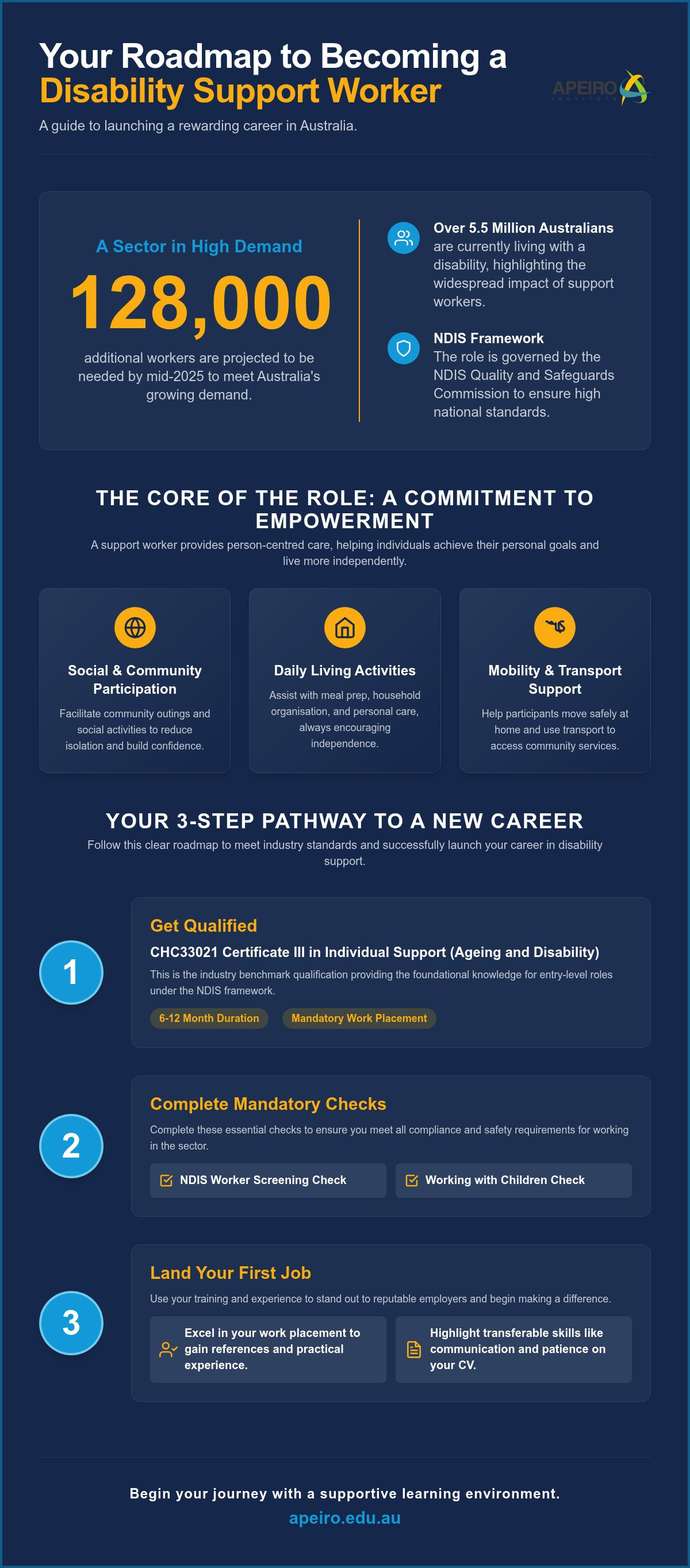
Did you know that the Australian disability sector is projected to need at least 128,000 additional workers by mid-2025 to meet growing demand? With over 5.5 million Australians currently living with a disability, your passion for helping others is in high demand. You might be feeling unsure about which qualifications you actually need or whether your previous life experience will be recognised. It is also completely natural to feel a bit daunted by the complex NDIS compliance and background checks required to get started.
We believe that starting a new career journey should feel attainable, not intimidating. This guide will show you exactly how to become a disability support worker in Australia by breaking down the mandatory checks and the exact steps needed to launch your career. We promise a clear roadmap that explains the difference between Certificate levels, how to balance your studies with work, and how to meet NDIS standards with total confidence. From understanding the latest SCHADS Award pay rates to choosing the right training pathway, you are about to find everything you need to begin this rewarding profession.
Key Takeaways
- Understand the vital role of person-centred care and how the NDIS framework shapes your daily responsibilities as a support worker.
- Discover the exact educational roadmap for how to become a disability support worker in Australia, starting with the industry-preferred CHC33021 Certificate III in Individual Support.
- Identify the mandatory compliance requirements, such as the NDIS Worker Screening Check and Working with Children Check, including current application fees.
- Learn practical strategies to land your first job, from making the most of your vocational work placement to highlighting transferable skills on your CV.
- Find out how a supportive learning environment can help you balance your studies with work while building the confidence to meet high industry standards.
What is a Disability Support Worker? Understanding the Role and Impact
A disability support worker is a dedicated professional who provides person-centred care for individuals living with physical, intellectual, or sensory disabilities. This role is far more than just a job; it's a commitment to improving the quality of life for others. In the current landscape, the role is strictly governed by the NDIS Quality and Safeguards Commission. This oversight ensures that participants are treated with dignity and that the support provided meets rigorous national standards. It's a career that places you at the heart of your community, helping people overcome barriers to lead more fulfilling lives.
The core philosophy of this profession is empowerment. Rather than simply performing tasks for a participant, you are there to help them live independently and achieve their unique personal goals. This might involve anything from teaching a new skill to providing the physical assistance needed to navigate the local community. Understanding this dynamic is the first step when you look into how to become a disability support worker in Australia. With roughly 21% of the population living with Disability in Australia, the impact of your work is both widespread and deeply personal.
Key Responsibilities in the Modern Australian Landscape
Daily life as a support worker is incredibly diverse. You won't find two days that look exactly the same. Your tasks are dictated by the individualised care plan of each participant, which you must implement and document with precision. This documentation is vital for tracking progress and ensuring that the support remains effective. Common responsibilities include:
- Social Community Participation: Facilitating community outings and social engagement to reduce isolation and build social confidence.
- Daily Living Activities: Assisting with meal preparation, household organisation, and personal hygiene while encouraging as much independence as possible.
- Mobility Support: Helping participants move safely within their homes or when using public transport to access services.
The Essential Soft Skills: Why Your Personality Matters
While technical training is vital, your personality is often your greatest tool. Success in this field requires a specific blend of emotional intelligence and practical resilience. Patience is non-negotiable. You'll often navigate challenging situations that require a calm demeanour and a steady hand. It is also about empathy rather than sympathy. True support means understanding a person's perspective to empower them, not feeling sorry for them. This distinction is what allows a participant to maintain their dignity.
Effective communication is another pillar of the role. You act as a vital bridge between participants, their families, and various healthcare professionals. Being able to listen actively and convey information clearly ensures that the participant's voice remains at the centre of their care. If you already possess these traits, you are well on your way to discovering how to become a disability support worker in Australia and making a genuine difference in the lives of others.
Essential Qualifications: The Educational Roadmap to 2026
If you are researching how to become a disability support worker in Australia, you've likely noticed a mix of advice regarding qualifications. While Australian law doesn't strictly mandate a specific degree for every entry-level role, the reality is that the vast majority of reputable employers won't consider an application without a nationally recognised qualification. This is because the sector is becoming increasingly professionalised to ensure the highest standards of safety and care for participants.
The CHC33021 Certificate III in Individual Support (Ageing and Disability) is the industry benchmark for entry-level roles. This qualification provides the foundational knowledge needed to work safely and effectively under the NDIS framework. Most courses take between 6 and 12 months to complete. This timeframe depends on whether you choose to study full-time or balance your learning with existing work commitments. It is a practical pathway that prepares you for the realities of the job from day one.
A critical part of this vocational training is the mandatory work placement. You'll typically need to complete 120 hours of hands-on experience in a real-world disability or aged care setting. This is where theory meets practice. It's also where many students build the professional networks that lead to their first job offer. Alongside your studies, you'll also need to complete a Mandatory NDIS Worker Screening Check to prove your suitability for the role. This check is a vital part of the compliance landscape in 2026.
Certificate III vs. Certificate IV: Which One is Right for You?
The Certificate III is designed for those entering the field, focusing on direct, hands-on support and fieldwork. If you are looking for more specialised or supervisory roles later in your career, the Certificate IV in Ageing Support might be a future step. However, the CHC33021 remains the primary pathway for disability-specific training in Australia for those just starting out. It gives you the specific tools required to empower participants while working within a regulated environment.
Recognition of Prior Learning (RPL) for Career Changers
You might already have years of experience that count toward your qualification. If you've worked in retail, hospitality, or provided unpaid care for a family member, your existing skills can often be formalised. The RPL assessment process involves mapping these transferable skills against national units of competency. Formalising your experience is often the smartest move for mature-age students. It can significantly fast-track your path to employment by acknowledging the expertise you already bring to the table.
We understand that returning to study can feel like a big leap, but you don't have to do it alone. If you're ready to take that next step, exploring our CHC33021 Certificate III options can help you launch your new career with the right support behind you.
Mandatory Checks and Compliance: The Essential Checklist
The compliance side of the disability sector often feels like a mountain of paperwork, but it is actually a straightforward process designed to keep both you and the participants safe. Understanding these requirements is a vital part of learning how to become a disability support worker in Australia. These checks ensure that every person entering the workforce is suitable and possesses the basic life-saving skills needed for the job. While the list might look long, most of these steps are one-off applications or simple training sessions.
Your compliance checklist starts with the NDIS Worker Screening Check. This is a national assessment that determines whether a person poses a risk to NDIS participants. As of May 2026, the fees for this check vary across the country, ranging from $107 in New South Wales to $157 in the Australian Capital Territory. Alongside this, you will likely need a Working with Children Check (WWCC) if your role involves supporting minors. In NSW, for example, this costs $112 for paid workers. A National Police Check is also a standard requirement for almost all providers to ensure a clear criminal history.
Practical certifications are just as important as background checks. You must hold a current First Aid and CPR certification (HLTAID011). In 2026, a standard first aid course typically costs between $80 and $150, while a CPR refresher (HLTAID009) costs between $50 and $90. These skills must be kept current, with CPR usually requiring an annual update. Organisations like Disability Employment Australia advocate for these high standards to maintain the integrity and safety of the entire sector.
Navigating the NDIS Worker Screening Process
Applying for your screening check is done through your state or territory’s dedicated worker screening unit. A key detail many newcomers miss is that you must be "linked" to a registered NDIS provider or a Registered Training Organisation (RTO) to complete the application. If you are currently studying, your training provider can often facilitate this link. Once processed, you will receive a "Cleared" status, which allows you to work. An "Excluded" status means you cannot work in risk-assessed roles within the NDIS.
Health and Immunisation Requirements
Maintaining your health records is essential for a smooth onboarding process. Most employers require evidence of current vaccinations, including COVID-19 and annual Flu shots, in line with Australian healthcare guidelines. It's a great idea to keep a digital folder of all your certifications and immunisation records. This makes it much easier to share your credentials with new employers. Additionally, many providers require manual handling training. This teaches you how to assist participants with mobility safely, which is crucial for preventing workplace injuries and ensuring you can stay in this rewarding career for the long term.
If you are feeling overwhelmed by these steps, remember that how to become a disability support worker in Australia is a journey best taken one step at a time. Many students find that their training provider offers significant support in navigating these background checks during their enrolment.
How to Land Your First Job in the Disability Sector
Once you have sorted your compliance and training, the focus shifts to entering the workforce. Landing your first role is often more straightforward than people expect because the sector is currently facing a significant workforce shortage. One of the most effective strategies for how to become a disability support worker in Australia is to treat your vocational work placement as a month-long job interview. Many students find that their placement hosts offer them a position before they even finish their course. It is the perfect way to show your reliability and how well you connect with participants in a real-world setting.
If you are updating your CV, focus heavily on your transferable skills. You don't need years of industry experience to stand out. Emphasise your reliability, your ability to manage time effectively, and your interpersonal communication skills. These are the traits that employers value most. We also recommend registering with specialised disability recruitment agencies and regularly checking NDIS provider portals for vacancies. Consider starting in casual or relief roles. These positions provide invaluable exposure to various disability profiles, allowing you to gain experience across different support needs while you build your confidence.
Volunteering as a Stepping Stone
Volunteering at local community centres or for non-profit organisations can be a powerful way to build your network. It demonstrates to potential employers that you have a genuine commitment to the disability community beyond just looking for a job. This experience can also serve as a bridge toward future goals, such as a Diploma of Community Services Australia. By giving your time, you show that you understand the value of community connection and empowerment.
Preparing for the Interview: Common Questions
Interviews in this sector are usually focused on your values and how you react in specific situations. Expect scenario-based questions like, "How would you handle a participant who is feeling frustrated or non-verbal?" Your response should highlight your patience and your commitment to a person-centred approach. You must also demonstrate that you understand the NDIS Code of Conduct and the importance of participant autonomy. Always ask the interviewer about their internal support structures. Knowing that you will have access to regular supervision and a supportive team is crucial for your long-term success.
Enrol in the Certificate III in Individual Support today
Advancing Your Career with Apeiro Institute
Choosing the right training provider is the most important decision you will make when researching how to become a disability support worker in Australia. At Apeiro Institute, we provide a supportive environment that focuses on your personal and professional growth. Our CHC33021 Certificate III is designed to be industry-relevant and practical, ensuring you graduate with the confidence to handle real-world challenges. You will learn from expert trainers who are deeply connected to the Australian care sector, bringing years of lived experience into every lesson.
We understand that many of our students are career changers. If you are moving from a background in retail, hospitality, or administration, you likely already possess valuable skills. We specialise in Recognition of Prior Learning (RPL), which allows us to map your existing expertise against national units of competency. This process respects your previous work history and can often fast-track your path to a qualification. Formalising your experience through RPL is a strategic move that acknowledges your existing value to the workforce.
Your journey does not have to stop at an entry-level role. We provide a clear pathway for those who wish to move into leadership or case management. You can transition seamlessly from your Certificate III into the Diploma of Community Services. This higher-level qualification is designed for those seeking to coordinate complex support plans and lead teams within the community sector. It is about building a long-term career, not just finding a job.
International Students: Vocational Pathways in Australia
For international learners, Australia offers world-class standards in disability care. Our CRICOS-registered courses ensure that your qualification is recognised for both visa requirements and professional registration. By studying with us, you are building a global career founded on Australian industry standards. We encourage you to read our 2026 guide for international students to fully understand your study options and how to navigate the vocational landscape.
Take the First Step Today
Starting a new educational journey can feel like a big step, but we are here to support you at every turn. Join a vibrant community of learners from over 38 nationalities who are all working toward making a difference. You can enquire about our upcoming intakes and flexible study options to find a schedule that fits your life. Contact our friendly team today to discuss your eligibility for RPL or to find out about any available funded training options. If you want to know how to become a disability support worker in Australia with the best possible foundation, Apeiro Institute is your partner in success.
Start Your Journey in the Australian Disability Sector Today
Launching a career in this sector is about more than just finding a job; it is about finding a purpose. You now have a clear understanding of the vocational roadmap, from the importance of the CHC33021 Certificate III to the specific compliance checks required by the NDIS. By focusing on your transferable skills and choosing a training provider that values your personal growth, you can move from confusion to career readiness. Knowing how to become a disability support worker in Australia is the first step toward a future where you empower others to live with dignity and independence.
At Apeiro Institute, we are committed to being your partner in this journey. As a nationally recognised RTO (45394), we offer guidance from industry-expert trainers and a supportive pathway that can lead you toward leadership roles in the Diploma of Community Services. Whether you are a local career changer or an international student, we provide the practical tools and community connection you need to succeed in the Australian care sector.
Enrol in the CHC33021 Certificate III in Individual Support at Apeiro Institute
Your new career path is closer than you think. Our team is ready to help you navigate your enrolment and discuss your eligibility for RPL so you can start making a genuine difference in your community as soon as possible.
Frequently Asked Questions
Do I need a degree to become a disability support worker in Australia?
No, you don't need a university degree to enter this field. Most Australian employers prioritises vocational qualifications, such as the CHC33021 Certificate III in Individual Support, over academic degrees. This training focuses on the practical, hands-on skills required to provide high-quality, person-centred care in real-world settings.
How long does it take to get a Certificate III in Individual Support?
A Certificate III typically takes between 6 and 12 months to complete. The exact duration depends on your study load and whether you choose to study full-time or part-time. This timeframe includes both your classroom theory and the mandatory 120 hours of vocational work placement required for graduation.
Can I work in disability support while I am still studying?
Yes, many students find casual employment while they are still completing their qualification. Some providers hire students as support assistants once they have finished their first few core units and cleared their mandatory background checks. It's an excellent way to gain experience and start earning while you learn how to become a disability support worker in Australia.
What is the difference between aged care and disability support work?
Aged care focuses on supporting older Australians with age-related needs and frailty. Disability support is centred on empowering individuals with physical, sensory, or intellectual disabilities to live independently and achieve personal goals. While both roles require deep empathy, disability support often involves more community-based activities and goal-oriented planning.
Is the NDIS Worker Screening Check mandatory for everyone?
Yes, this check is mandatory if you work in a risk-assessed role for a registered NDIS provider. As of 1 July 2026, all providers of Supported Independent Living (SIL) must be registered. This means every worker in these roles must have a cleared NDIS Worker Screening Check to ensure the safety of participants.
How much do disability support workers get paid in Australia in 2026?
Under the SCHADS Award effective from 1 July 2026, the minimum pay rate for a Level 1 employee is $27.55 per hour. Casual workers receive a 25% loading, making their minimum rate $34.44 per hour. More experienced workers at Level 2 earn a base rate of $36.22 per hour, or $45.28 for casuals.
Can international students study disability support in Australia?
International students can study disability support through CRICOS-registered providers like Apeiro Institute. This is a popular pathway for building a career based on world-class Australian industry standards. It allows learners to gain a qualification that is recognised both locally and internationally within the healthcare and community sectors.
What happens during a vocational work placement?
During your 120-hour placement, you'll work in a real care setting under the supervision of experienced professionals. You will apply the theory you've learned in class to assist participants with daily tasks, social outings, and personal care. It's a vital part of the process for anyone discovering how to become a disability support worker in Australia.

Disclaimer
The information provided on this blog is for general informational and educational purposes only. While every effort is made to ensure the accuracy and reliability of the content, the author makes no representations or warranties of any kind, express or implied, about the completeness, accuracy, suitability, or availability of the information contained on this blog.
The views and opinions expressed in blog posts are those of the individual author and do not necessarily reflect the official policy or position of any organization, company, or employer.
This blog may contain links to external websites or third-party content. These links are provided for convenience only, and the author has no control over and assumes no responsibility for the content, privacy policies, or practices of any third-party sites.
Nothing on this blog constitutes professional advice (legal, financial, medical, or otherwise). Readers are encouraged to seek appropriate professional guidance before making any decisions based on the information provided here.
By using this blog, you acknowledge that any reliance on the information is at your own risk.


