

For years, working in aged care was often described as a "labour of love" that didn't always reflect your true value in your pay packet, but that narrative has officially shifted. You've likely felt the frustration of historical low wages or the confusion of trying to decode complex Award levels while wondering if this career is financially sustainable for your future. It's a common concern, yet the reality of the aged care worker salary Australia 2026 landscape is now one of professional growth and significant financial recognition.
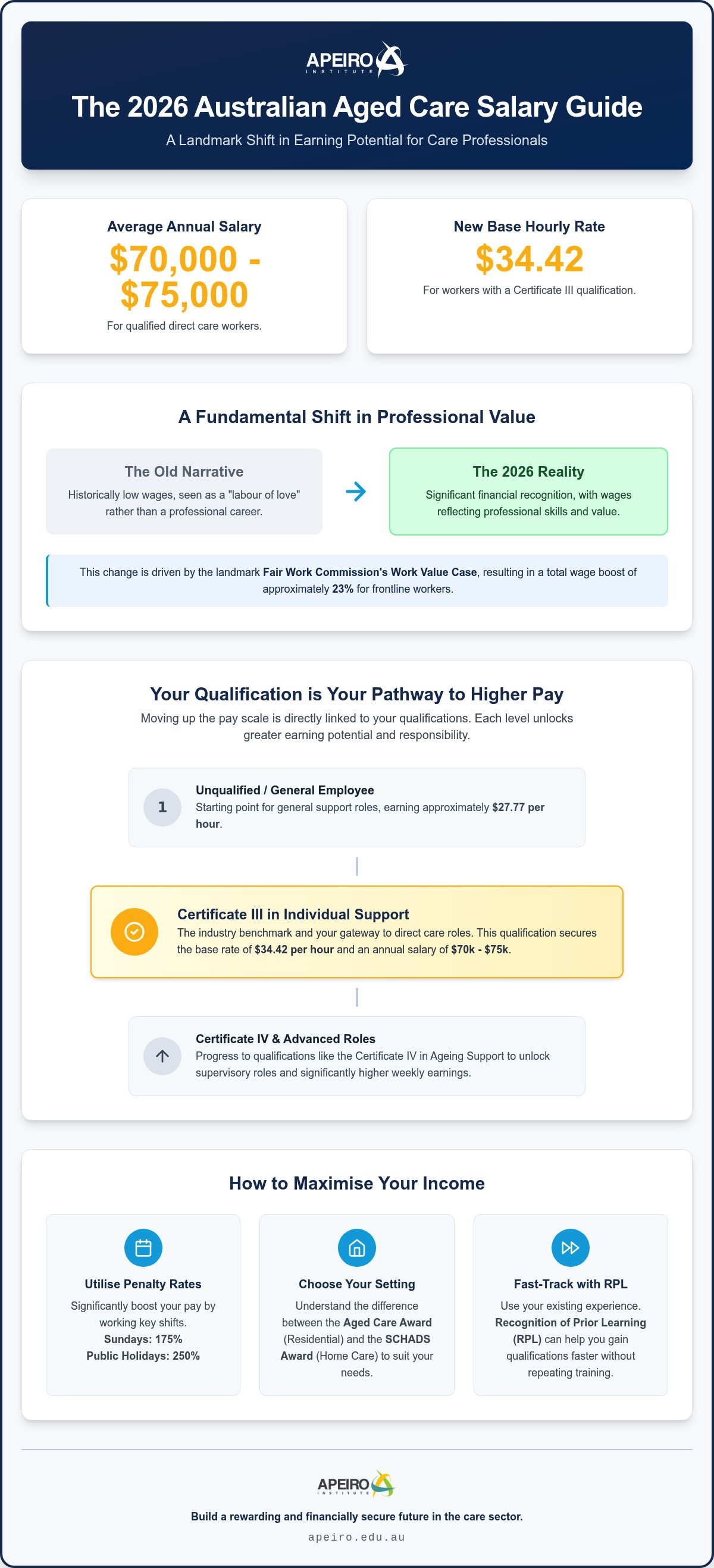
In this guide, we'll show you exactly how landmark wage increases have transformed the sector, with many direct care workers now earning average annual salaries between $70,000 and $75,000. You'll discover the specific hourly rates for your classification, including the $34.42 per hour base rate for Certificate III qualified staff following the latest Fair Work Commission adjustments. We will also provide a clear roadmap on how to maximise your earnings through the right qualifications, ensuring you have the confidence to build a rewarding career that supports both your passion and your lifestyle.
Key Takeaways
- Understand how the Fair Work Commission’s Work Value Case has permanently reshaped the industry by recognising the professional nature of care work.
- Get the latest data on the aged care worker salary Australia 2026 including updated hourly rates and annual earnings for different award levels.
- Learn exactly how specific qualifications like the Certificate III in Individual Support act as the gateway to higher-paying direct care roles.
- Explore how Recognition of Prior Learning (RPL) can help experienced workers move up the pay scale faster without needing to repeat basic training.
- Discover flexible study pathways that allow you to balance your current commitments while training for a more financially secure future in the care sector.
Understanding the Aged Care Salary Landscape in 2026
Australia's care sector is no longer a hidden industry with stagnant wages. It's a high-growth field where demand for skilled staff is outstripping supply. The aged care worker salary Australia 2026 reflects a fundamental shift in how the nation values its carers. This change didn't happen by accident. It's the result of the landmark Work Value Case, which saw the Fair Work Commission overhaul pay for more than 400,000 employees.
We've moved past the outdated perception of care as "low-skilled" labour. Today, you're recognised as a professional healthcare support worker. Your pay packet is now determined by clear, professional metrics. These include your specific qualification level, your years on the job, and the types of shifts you choose to work. Understanding the broader context of Aged Care in Australia reveals that these financial improvements are part of a wider effort to professionalise the entire system following recent Royal Commission reforms.
Why 2026 is a Landmark Year for Carers
August 2026 marks a significant milestone as the finalisation of staged pay rises that have been rolling out since the initial 15% increase in 2023. The industry target has been a total wage boost of approximately 23% for those on the front lines. This year represents the moment when these new, higher standards become the "new normal" for the sector. Beyond the money, there's the benefit of absolute job security. In a world increasingly worried about AI and automation, your role is safe. Empathy, physical assistance, and human connection are things a machine simply cannot replicate.
The Difference Between Residential and Home Care Pay
Your workplace setting changes your pay structure. If you work in a residential nursing home, you're usually covered by the Aged Care Award. If you prefer visiting clients in their private homes, you'll likely fall under the Social, Community, Home Care and Disability Services (SCHADS) Award. While base rates are competitive across both settings, penalty rates are where you can really maximise your earnings. Working Sundays or public holidays can significantly increase your take-home pay, often reaching 175% or 250% of your base rate respectively. To access these professional tiers, most employers look for a CHC33021 Certificate III in Individual Support (Ageing and Disability) as the essential entry requirement. It's the foundation for a sustainable, well-paid career.
Comparing Aged Care Salaries by Qualification Level
Your qualification level is the most powerful lever you have to increase your income. In the current market, an unqualified worker often starts at General Employee Level 1, earning roughly $27.77 per hour. However, once you hold a recognised qualification, you move into the Direct Care classifications. This shift is part of the recent Fair Work Commission Pay Rise, which ensures that your technical skills are financially rewarded. Whether you're a Personal Care Worker (PCW) or an Assistant in Nursing (AIN), your position on the pay scale is dictated by the Australian Qualifications Framework (AQF).
Higher qualifications don't just increase your hourly rate. They also unlock supervisory roles that offer significantly higher weekly earnings. As you progress through the levels, you move away from general support and into specialised care and leadership. This progression is essential for anyone looking to make their aged care worker salary Australia 2026 truly sustainable for the long term.
Entry-Level: Certificate III in Individual Support
The CHC33021 Certificate III in Individual Support (Ageing and Disability) is the industry benchmark. For a full-time worker in 2026, this qualification typically secures a base rate of $34.42 per hour. On an annual basis, this translates to roughly $70,000 to $75,000 depending on your shift patterns and overtime. Your day-to-day duties involve providing essential personal care and daily living support. Many students see a "step-up" in their pay once they complete their mandatory 120-hour work placement. This hands-on experience proves you're ready for the responsibilities of a Level 2 Direct Care role.
Advanced Care: Certificate IV in Ageing Support
Moving from basic care to specialised support requires a Certificate IV in Ageing Support. This level is designed for those who want to take on more responsibility, such as Team Leader or Care Coordinator positions. The 2026 Award rates reflect this increased complexity. You aren't just providing care; you're often supervising other staff and handling more intricate care plans. This transition results in a higher weekly rate and more consistent hours. If you're currently working but want to reach this level faster, exploring Recognition of Prior Learning could be your best move.
Leadership: Diploma of Community Services
If you're aiming for the top tier of the sector, the Diploma level is where you'll find management and social welfare roles. This qualification allows you to transition into case management, where you oversee the holistic needs of multiple clients. For a detailed look at this path, check out our Diploma of Community Services Australia guide. In 2026, management positions command salaries well above standard care rates, offering a clear path to financial security. It's a professional leap that moves you from the floor to the office, focusing on leadership and community impact.
The Fair Work Commission Pay Rise: What it Means for Your Pay Slip
The Fair Work Commission decided it was time to fix a long-standing issue in the Australian workforce. For decades, care work was undervalued, but the "Work Value Case" changed that forever. This legal decision recognised that your daily tasks aren't just about "helping out"; they involve complex clinical observations, emotional intelligence, and high-level physical support. Because the FWC officially acknowledged this complexity, they've mandated structural pay increases that move beyond simple cost-of-living adjustments.
If you're a Registered Nurse (RN) or Enrolled Nurse (EN) working in this sector, August 1, 2026, is a date to circle in your calendar. This milestone represents the finalisation of specific staged increases for nursing staff, ensuring their pay remains competitive with hospital roles. For Personal Care Workers (PCWs), the benefits are already flowing through, creating a more professionalised environment where your aged care worker salary Australia 2026 reflects your true contribution to the community.
Timeline of Increases: 2023 to 2026
The journey to these higher rates began with an interim 15% increase in 2023. Since then, we've seen a series of staged rollouts designed to help providers adjust while giving you a steady path to better earnings. By July 2026, the modern award minimum wages saw a further 4.75% increase, bringing the total wage growth for some workers to over 30% since the case began. Industry bodies like the Aged Care Industry Association have been closely monitoring these transitions to ensure the sector remains sustainable. To ensure you're being paid correctly, you should compare your current rate against the latest Fair Work pay guides. Unions like the HSU and ANMF played a massive role in securing these wins, proving that the industry is finally getting the respect it deserves.
Understanding Your Pay Slip: Base Rates vs. Allowances
Checking your pay slip shouldn't feel like solving a puzzle. Your base rate is the foundation, but your total take-home pay is often boosted by shift loadings and allowances. Afternoon and night shifts typically attract a 12.5% to 15% loading, while weekend work is where you'll see the biggest jump. Saturday shifts usually pay at 150% of your base rate, and Sundays often reach 175%. You might also notice small additions for things like laundry, uniform maintenance, or travel if you're working in home care. Award Wages are the legal minimum an employer must pay you based on your classification and the hours you've worked.
How to Increase Your Earning Potential in the Aged Care Sector
Moving up the pay scale in 2026 isn't just about waiting for your next work anniversary. While the Fair Work Commission has raised the floor for everyone, your individual aged care worker salary Australia 2026 can be significantly higher if you take a proactive approach. Private providers are often willing to pay above-award rates for carers who bring specialised skills or deep experience to the table. Negotiation is a tool you should use, especially when you can demonstrate how your Continuous Professional Development (CPD) directly improves resident outcomes.
Specialising in high-demand areas like dementia or palliative care is one of the most effective ways to secure a higher-tier role. These niches require a level of emotional intelligence and technical knowledge that is highly valued by employers. By focusing on these areas, you move from general care into senior or specialist positions that command better weekly rates and more stable shift rotations. Experience counts, but combining that experience with formal training is what truly unlocks the top pay brackets.
Recognition of Prior Learning (RPL): The Fast Track
If you've spent years in the sector but haven't updated your credentials, you're likely leaving money on the table. You can turn your existing on-the-job experience into a nationally recognised qualification through Recognition of Prior Learning (RPL). This process assesses your current skills against the requirements of the Certificate III or IV. It means you don't have to study what you already know. It's a faster, more affordable way to jump to a higher Award classification almost immediately.
For those looking for a structured approach, the Trade Pathways for Experienced Workers (TPEW) model is designed specifically to bridge the gap between experience and formal certification. By formalising your skills, you immediately qualify for the 2026 wage tiers reserved for qualified staff. It's about getting the recognition and the pay packet that matches the hard work you've already put in. This pathway saves you time in the classroom and puts you on the floor as a qualified professional much sooner.
Picking the Right Specialisations
Diversifying your skill set makes you indispensable to any facility. Many carers are now opting for a dual-focus approach, combining Ageing and Disability support. This increases your employability across multiple settings, from residential facilities to community home care. For international students, studying with a CRICOS-registered organisation ensures your training meets strict national standards. This is a major advantage when negotiating for senior roles. Focusing on complex care or behavioural support positions you as a premium candidate in a market that is hungry for expertise.
Boost your pay today with Recognition of Prior Learning
Starting Your Career: Qualifications and Pathways with Apeiro Institute
Deciding to enter the care sector is a significant life choice, but you don't have to walk that path alone. At Apeiro Institute, we act as a partner in your success, serving as a bridge between your current circumstances and your future professional goals. We understand that life is busy and often unpredictable. Whether you're a career changer or balancing family commitments, our flexible learning options are designed to fit your unique schedule. We focus on the practical, industry-ready skills that Australian employers value most. By the time you finish your training, you'll be ready to step into a role and claim the competitive aged care worker salary Australia 2026 offers to qualified professionals.
Our approach avoids the cold, detached language of traditional institutions. Instead, we offer a warm, student-centered environment where your personal growth is our priority. We pride ourselves on being globally aware yet locally grounded, providing a sense of security through expert mentorship. The process of upgrading your skills shouldn't be a source of stress. It's an opportunity to build a career that is both emotionally fulfilling and financially sustainable. With the right support, the transition into a higher-paying senior role becomes an attainable reality rather than a distant dream.
Why Study with Apeiro?
Our vibrant learning community is home to students from over 38 nationalities. This diversity creates an inclusive atmosphere where every learner feels a sense of belonging and community. You'll be guided by expert trainers who remain active in the Australian care industry. They bring current, real-world insights into the classroom, ensuring your education is practical and relevant. For those based in New South Wales, we provide access to Smart and Skilled funded courses NSW. This initiative allows eligible students to access subsidised training, significantly reducing the financial barriers to starting your new career.
Your Next Steps to a Higher Salary
Securing a better aged care worker salary Australia 2026 starts with a clear assessment of your current skills and career objectives. We encourage you to reach out and book a consultation with our team. We can help you determine if you're eligible for Recognition of Prior Learning (RPL) or guide you through the enrolment process for a Certificate III or IV. The aged care profession has officially entered a new era of professional respect and financial recognition. It's a stable, high-touch sector that offers genuine job security for years to come. Take that first step today and join a workforce that is finally being rewarded for the vital work it performs every day.
Secure Your Financial Future in Aged Care
The Australian care sector has undergone a fundamental transformation. With the final staged pay rises now in effect, your technical skills and empathy are backed by the financial recognition they deserve. Achieving a higher aged care worker salary Australia 2026 is no longer about guesswork. It is about choosing the right educational pathway to unlock senior classifications and specialised roles.
Apeiro Institute is a Nationally Recognised RTO (45394) dedicated to your professional growth. Our industry-expert trainers and specialists in RPL and Trade Pathways ensure that your journey is efficient and rewarding. We provide the warm, student-centered support you need to transition into a career that offers both purpose and a sustainable income.
Start your journey to a rewarding career—enrol in our Certificate III in Individual Support today!
The aged care sector is a professionalised field with unmatched job security. You have the passion to make a difference, and now you have the roadmap to a successful future. We are ready to help you take that next step toward your career goals.
Frequently Asked Questions
What is the average hourly rate for an aged care worker in Australia in 2026?
A qualified aged care worker with a Certificate III typically earns a base rate of $34.42 per hour as of July 2026. For those without a qualification, the entry-level rate starts at approximately $27.77 per hour. These figures represent the base pay before any shift loadings or overtime are added, which can significantly increase your total take-home earnings.
Do I need a Certificate III to get the full pay rise?
Yes, you generally need a CHC33021 Certificate III in Individual Support to access the higher Direct Care wage tiers. The Fair Work Commission's 2026 wage structure rewards qualified staff with higher base rates than those in non-direct care or unqualified roles. Holding this qualification ensures you are classified at least as a Level 2 employee, which is the gateway to a professional aged care worker salary Australia 2026.
How much more do aged care workers get paid for weekend shifts?
Weekend work offers a substantial boost to your base pay through penalty rates. Under the Aged Care Award, permanent employees usually receive 150% of their base rate for Saturday shifts and 175% for Sunday shifts. This means a qualified carer earning $34.42 on a weekday could see their rate jump to over $60 per hour for Sunday work.
Can I get my previous experience recognised to get a higher salary faster?
You can certainly use your existing experience to fast-track your way to a higher pay point through Recognition of Prior Learning (RPL). This process allows us to assess the skills you've already gained on the job and credit them toward a formal qualification. It is a practical way to move into a higher award classification without needing to repeat training for tasks you already master.
What is the difference between a Personal Care Worker and an Assistant in Nursing pay?
Personal Care Workers (PCWs) are typically covered by the Aged Care Award, while Assistants in Nursing (AINs) often fall under the Nurses Award. While their roles overlap, AINs may have slightly different pay scales and responsibilities depending on the clinical setting. However, the recent Work Value Case has worked to align these rates more closely to ensure all care staff receive fair compensation for their professional skills.
Is there an additional pay rise coming in August 2026?
August 1, 2026, is a specific milestone for nursing staff working within the aged care sector. This date marks the finalisation of staged pay increases for Registered Nurses and Enrolled Nurses to ensure their wages remain competitive with the broader healthcare industry. This follows the general 4.75% increase to modern award wages that came into effect on July 1, 2026.
Are there government-funded courses available for aged care in 2026?
Subsidised training is available for eligible students through initiatives like Smart and Skilled in New South Wales. These programs are designed to help you gain essential qualifications like the Certificate III or Certificate IV with reduced out-of-pocket costs. We can help you check your eligibility for these funded spots during your initial consultation.
How does the aged care salary compare to disability support work?
The aged care worker salary Australia 2026 is now very competitive with disability support roles. While disability work often falls under the SCHADS Award, recent legal decisions have brought the pay rates for both sectors into closer alignment. Both industries now recognise that high-touch care work requires professional compensation, making both paths financially sustainable and rewarding for dedicated carers.

Disclaimer
The information provided on this blog is for general informational and educational purposes only. While every effort is made to ensure the accuracy and reliability of the content, the author makes no representations or warranties of any kind, express or implied, about the completeness, accuracy, suitability, or availability of the information contained on this blog.
The views and opinions expressed in blog posts are those of the individual author and do not necessarily reflect the official policy or position of any organization, company, or employer.
This blog may contain links to external websites or third-party content. These links are provided for convenience only, and the author has no control over and assumes no responsibility for the content, privacy policies, or practices of any third-party sites.
Nothing on this blog constitutes professional advice (legal, financial, medical, or otherwise). Readers are encouraged to seek appropriate professional guidance before making any decisions based on the information provided here.
By using this blog, you acknowledge that any reliance on the information is at your own risk.


