

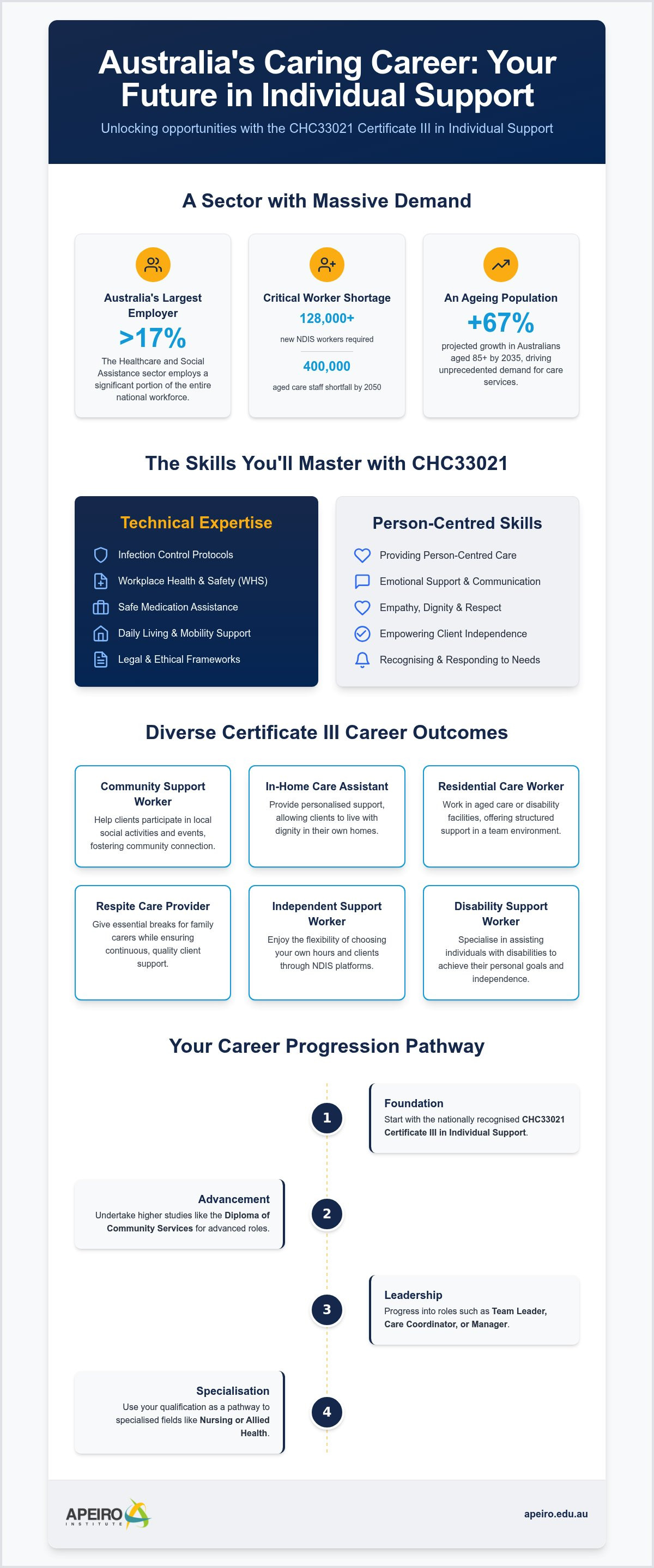
Did you know that the healthcare and social assistance sector is now Australia's largest employer, accounting for over 17% of the entire workforce? With the NDIS requiring an additional 128,000 workers and the aged care sector facing a projected shortfall of 400,000 staff by 2050, your skills are more valuable than ever. It's completely natural to feel uncertain about where a new path might lead or to worry about being stuck in a entry-level role forever. You might also feel a bit confused about the real-world differences between ageing and disability specialisations.
This article is here to clear up that confusion and show you that a CHC33021 qualification is much more than just a job ticket. We'll dive into the diverse Certificate III Individual Support career outcomes available right now, providing you with a clear roadmap for long-term growth. You'll gain confidence in the current job market, understand the latest 2026 salary trends, and see how this course acts as a bridge to advanced roles in community services or nursing. Let's explore how you can turn your passion for helping others into a secure, thriving career.
Key Takeaways
- Understand the massive demand in Australia's fastest-growing sector, where over 128,000 new workers are needed to support our ageing population and NDIS participants.
- Explore the diverse Certificate III Individual Support career outcomes, from residential care facilities to the increasing flexibility of home-based community support roles.
- Identify the essential blend of technical knowledge and interpersonal soft skills you'll gain to provide high-quality, person-centred care.
- Discover how this qualification acts as a springboard for professional growth, paving the way toward leadership roles and higher-level studies like a Diploma of Community Services.
- Learn how Apeiro Institute’s student-centred training and industry-expert mentors help you transition confidently into the professional healthcare workforce.
The Growing Demand for Individual Support Workers in Australia
In the modern Australian context, an individual support worker is much more than a healthcare assistant. They are the essential backbone of our community, providing the person-centred care that allows seniors and people living with disabilities to maintain their independence. This role involves assisting with daily activities, providing emotional support, and ensuring that clients can live with dignity in their own homes or residential facilities. By completing a formal qualification, you unlock diverse Certificate III Individual Support career outcomes that offer both professional stability and personal fulfilment.
The demand for these skills is surging due to Australia's rapidly changing demographics. Our population aged 85 and over is projected to grow by 67% between 2024 and 2035. This shift has placed immense pressure on the system of Aged care in Australia, creating a massive need for qualified professionals. Because care is a fundamental human need, this sector is often described as "recession-proof". While other industries may fluctuate with the economy, the healthcare and social assistance sector continues to grow, currently employing over 17% of the national workforce.
Why 2026 is the Best Time to Enter the Sector
Right now, the industry is facing a critical workforce shortage. The aged care sector alone may face a shortfall of 400,000 workers by 2050 if the current pace of recruitment doesn't increase. To address this, there has been a significant shift toward home-based community support services, allowing people to stay in familiar surroundings longer. Government initiatives, such as the "Jobs and Skills WA" programme, frequently offer support for vocational training in these high-demand roles. Starting your journey with the CHC33021 Certificate III in Individual Support (Ageing and Disability) now means entering the market when your skills are most needed.
Understanding the Role of the NDIS
The National Disability Insurance Scheme (NDIS) has completely revolutionised career opportunities in Australia. It moved the power into the hands of the participants, allowing them to choose who provides their care and how they receive it. This has created a wealth of roles beyond traditional nursing homes, including:
- Community Support Worker: Helping clients participate in local social activities and events.
- In-home Respite Care: Providing essential breaks for family carers while supporting the client.
- Independent Contracting: Many workers now enjoy the flexibility of choosing their own hours and clients through digital platforms.
Modern support work focuses heavily on empowerment rather than just "doing things" for a client. It requires a blend of technical proficiency and genuine empathy, ensuring every individual feels heard and respected in their own care journey.
Key Skills in CHC33021 Cert III Individual Support
To achieve the best Certificate III Individual Support career outcomes, you need a training programme that balances clinical knowledge with genuine human connection. The CHC33021 qualification isn't just about ticking boxes; it's about developing a toolkit of skills that make you a preferred candidate for top employers. By following the Official CHC33021 Qualification Details, the course structure ensures you are competent in both the technical and social aspects of care. This dual focus is exactly why graduates from a nationally recognised qualification are so highly regarded across Australia.
Technical Care and Safety Standards
Safety is the foundation of professional care. During your studies, you'll master essential infection control protocols and workplace health and safety (WHS) standards that protect both you and your clients. You will learn the correct techniques for assisting with medication and supporting daily living activities, such as personal hygiene and mobility. Understanding the legal and ethical frameworks of the community services sector is also vital. These technical "hard" skills ensure you can handle the physical and regulatory requirements of the job with confidence and precision. Most importantly, you'll apply these skills during at least 120 hours of practical work placement, which bridges the gap between the classroom and the real world.
Empowerment and Communication
While technical skills get you the job, your "soft" skills are what make you truly excel. Modern support work is built on empathy-led communication. You'll learn how to adapt your style to meet the diverse needs of clients, whether they are living with dementia or navigating a physical disability. A major part of the role is facilitating empowerment. This means moving away from doing everything for a client and instead supporting them to make their own choices. You'll also learn how to work effectively within multidisciplinary health teams and communicate clearly with families, who often rely on your insights for peace of mind. These interpersonal skills are what turn a standard support worker into a truly impactful professional.
Building this diverse skill set takes time and the right support. If you're ready to start your journey, you can explore our student-centred training options to see how we help you reach your goals. Having the right mentors by your side makes all the difference when you're preparing for the fast-paced Australian healthcare environment. By the time you finish your placement, you'll have the practical experience and the professional confidence to step straight into a rewarding role.
Exploring Diverse Career Outcomes and Job Roles
Once you've built a solid foundation of skills, the next step is choosing the environment where you'll make your mark. The beauty of Certificate III Individual Support career outcomes lies in their incredible variety. You aren't tied to a single type of workplace for your entire career. Instead, you can choose a setting that aligns with your personality and your desired work-life balance. According to the Aged and Disabled Carers Career Outlook, this sector is one of the largest and fastest-growing in the country, providing graduates with a level of job security that's rare in other industries.
Aged Care and Residential Support Roles
Residential care facilities offer a structured environment where you work as part of a larger, supportive team. As a Personal Care Assistant (PCA), your day involves helping residents with their morning routines, hygiene, meals, and mobility. If you enjoy social planning and community building, a role as a Residential Care Worker might suit you better. In this position, you focus on the social engagement and emotional wellbeing of residents through activities and outings. For those who prefer smaller settings, an Accommodation Support Worker manages group home environments, ensuring every resident feels safe and supported in a communal living space.
Disability and Community Support Roles
If you prefer working one-on-one, community-based roles offer a different pace and higher levels of autonomy. As a Disability Support Worker, you'll often assist NDIS participants with community access, helping them attend social events, go to the shops, or manage their appointments. Community Care Workers provide similar support in private homes, assisting with the daily tasks that allow seniors to remain independent for longer. There's also the vital role of an In-home Respite Worker. You provide a much-needed break for family carers while ensuring the client receives professional care. These roles allow you to build deep, lasting relationships with the people you support.
Beyond the specific job titles, the practical benefits of this career path are hard to ignore. Many roles offer 24/7 shift work, which is perfect if you're balancing family commitments or further study. You can choose morning, afternoon, or overnight shifts to suit your lifestyle. While the average hourly rate for a support worker in Australia is approximately $38.77 (Indeed, July 2026), the emotional rewards are often what keep people in the industry long-term. Knowing you've helped someone live a more dignified, joyful life provides a sense of purpose that's truly unique. If you're ready to step into one of these roles, our CHC33021 Certificate III in Individual Support (Ageing and Disability) provides the nationally recognised qualification you need to get started.
Career Progression: From Certificate III to Leadership Roles
One of the most common misconceptions about entering the care sector is the fear of being stuck in a basic role forever. In reality, your entry-level qualification is simply the foundation. It's the "foot in the door" that opens up a multi-directional career path. The Certificate III Individual Support career outcomes you see today are often just the first step toward significant professional growth. Whether you want to lead a team, coordinate complex care plans, or specialise in a specific health area, this qualification provides the essential clinical grounding you'll need to move up the ladder.
If you've already spent years caring for family members or working in unofficial support roles, you don't necessarily have to start from scratch. Many experienced workers can fast-track their journey through Trade Pathways and RPL (Recognition of Prior Learning). This process recognises the expertise you've already gained in the real world, potentially reducing your study time and letting you move into higher-tier roles sooner. It's a practical way to turn your existing life skills into a formal, nationally recognised qualification that employers value.
Moving into Case Management and Coordination
As you gain experience, you might find yourself drawn to the organisational side of care. Transitioning from hands-on support to service coordination is a popular path. By completing a Diploma of Community Services, you can move into case management roles where you design and oversee care programmes for multiple clients. These positions usually come with higher salary brackets and more administrative responsibility. You'll lead teams of support workers, manage budgets, and ensure that community service programmes meet strict Australian quality standards. It's a role that requires a blend of leadership and the deep empathy you developed during your initial Certificate III training.
Specialising in High-Needs Care
Another rewarding pathway involves becoming a specialist in high-needs areas. You might choose to focus on palliative care, dementia-specific support, or even become a specialist Behaviour Support practitioner. Many graduates also use their vocational training as a direct bridge to university. Your Certificate III and subsequent experience can provide a strong foundation for a Bachelor of Nursing or Social Work. This pathway allows you to keep working and earning in the sector while you study for your degree. It's a practical, steady way to reach your long-term professional goals without the financial pressure of being a full-time student without an income.
Explore our Trade Pathways to see how your experience can fast-track your career
Why Study Individual Support with Apeiro Institute?
Choosing the right training provider is the most critical decision you'll make when pursuing your professional goals. At Apeiro Institute, we take a student-centred approach that moves beyond traditional classroom learning. We understand that your success depends on more than just passing exams; it's about building the confidence to step into a high-pressure care environment. Our trainers are industry experts with years of real-world experience, ensuring that every lesson is grounded in the practical realities of the Australian healthcare system. This hands-on guidance is a key reason why our graduates achieve such strong Certificate III Individual Support career outcomes.
We are also deeply committed to supporting a diverse student body. As a CRICOS-registered provider, we offer specialised assistance for those looking into vocational courses in Australia. Our campus is a welcoming, community-focused space where global perspectives are celebrated. Whether you're a local career-changer or an international student building a new life, you'll find a supportive environment that values your unique background and personal growth.
Practical Training and Industry Connections
Gaining real-world experience is a non-negotiable part of your training. To meet the national requirements for the CHC33021 qualification, you must complete at least 120 hours of practical work placement. We don't leave you to navigate this alone. Our team provides active assistance in finding meaningful placement opportunities in facilities that mirror the settings where you'll eventually work. Our modern training facilities are designed to simulate actual care environments, allowing you to practice technical skills in a safe, supportive setting before you ever step onto a worksite. From your first day of enrolment through to your final graduation, our support staff is there to ensure your journey is smooth and successful.
Flexible Learning for Busy Lives
We know that many of our students are balancing their studies with existing jobs, family commitments, or other responsibilities. That's why we've designed our programmes to be as flexible as possible. You'll have access to a dedicated mentor who understands the challenges of vocational education and can provide the encouragement you need to stay on track. This person-to-person touch is what sets Apeiro apart as a friendly, expert guide in your career journey. If you're ready to transform your passion for care into a professional reality, there's no better time to start. Enquire about our Community Services courses today and take the first step toward a secure and rewarding future.
Step Into Your Future in Care Today
Australia's healthcare sector offers more than just a job; it provides a lifelong career with unparalleled security. By mastering the core competencies of the CHC33021 qualification, you're building a foundation for diverse Certificate III Individual Support career outcomes that range from residential aged care to independent community support. Whether you choose to specialise in disability services or aim for a management role through a Diploma pathway, the path ahead is clear and full of potential.
With nationally recognised training delivered by expert industry trainers, you'll have the guidance needed to thrive. As a CRICOS registered provider, Apeiro Institute is here to support every student in reaching their professional goals within a warm, inclusive environment. You don't have to navigate this transition alone when you have a mentor ready to help you succeed.
Start your journey in Community Services with Apeiro Institute today
Your rewarding new career in the care sector is just one step away. We look forward to helping you make a real difference in the community.
Frequently Asked Questions
Can I get a job immediately after finishing my Certificate III in Individual Support?
Yes, you can often secure employment immediately because the sector is currently facing a critical workforce shortage. Many students receive job offers during their practical work placement before they even graduate. Employers are constantly looking for qualified staff to fill roles in residential facilities and home care settings across Australia.
What is the average salary for an Individual Support worker in Australia in 2026?
As of July 2026, the average hourly rate for a support worker in Australia is approximately $38.77 according to data from Indeed. Annual salaries vary depending on your specific role; for instance, aged care workers earn around $87,496 per year while disability support workers average approximately $69,000. These figures often increase with weekend work and shift loadings.
Do I need to choose between ageing and disability specialisations?
You don't have to choose just one path. The CHC33021 qualification at Apeiro Institute is designed to cover both ageing and disability specialisations. This dual focus significantly expands your Certificate III Individual Support career outcomes, allowing you to work across residential aged care, disability group homes, or community based settings.
Is work placement included in the CHC33021 course at Apeiro Institute?
Yes, practical work placement is a mandatory and essential part of the course. You'll complete at least 120 hours of hands on experience in a real world care setting. Our team at Apeiro Institute actively assists you in finding a suitable facility so you can apply your classroom knowledge to actual client care under professional supervision.
Can international students study Certificate III in Individual Support?
Absolutely, international students are welcome to study this qualification. Apeiro Institute is a CRICOS registered provider, meaning we are authorised to deliver vocational training to student visa holders. We provide a supportive, inclusive environment that helps global learners transition smoothly into the Australian healthcare workforce while meeting all regulatory requirements.
What is the difference between a Personal Care Assistant and a Disability Support Worker?
The main difference lies in the setting and the primary goal of care. A Personal Care Assistant (PCA) usually works in residential aged care facilities focusing on daily living activities and clinical support for seniors. A Disability Support Worker often works with NDIS participants in the community, focusing on social inclusion, empowerment, and helping clients achieve personal goals.
How does Recognition of Prior Learning (RPL) work for this qualification?
Recognition of Prior Learning (RPL) allows you to gain credit for skills and knowledge you've already acquired through unofficial work or life experience. If you've spent years as a family carer or worked in a similar role abroad, our assessors can review your evidence. This process can reduce your study time and help you achieve your Certificate III Individual Support career outcomes much faster.
Will this qualification help me get into a Nursing degree later?
Yes, this qualification is an excellent stepping stone toward a Bachelor of Nursing. It provides you with a solid understanding of clinical safety, infection control, and person centred care. Many universities recognise the Certificate III as a valid entry pathway, and your industry experience will give you a significant advantage during your future university studies.

Disclaimer
The information provided on this blog is for general informational and educational purposes only. While every effort is made to ensure the accuracy and reliability of the content, the author makes no representations or warranties of any kind, express or implied, about the completeness, accuracy, suitability, or availability of the information contained on this blog.
The views and opinions expressed in blog posts are those of the individual author and do not necessarily reflect the official policy or position of any organization, company, or employer.
This blog may contain links to external websites or third-party content. These links are provided for convenience only, and the author has no control over and assumes no responsibility for the content, privacy policies, or practices of any third-party sites.
Nothing on this blog constitutes professional advice (legal, financial, medical, or otherwise). Readers are encouraged to seek appropriate professional guidance before making any decisions based on the information provided here.
By using this blog, you acknowledge that any reliance on the information is at your own risk.


