

What if the biggest barrier to your career in disability support isn't your lack of experience, but a simple misunderstanding of paperwork? It's completely normal to feel overwhelmed by the current NDIS support worker requirements, especially when you're trying to distinguish between an NDIS Worker Screening Check and a Working with Children Check. You're ready to make a genuine difference in someone's life, yet the fear of not being qualified enough or emotionally prepared can make you hesitate before hitting that apply button.
We understand that starting a new journey feels intimidating, but it doesn't have to be. This guide will strip away the confusion and provide you with a clear, supportive roadmap to entering the sector with confidence. We'll break down the mandatory legal checks, explain which nationally recognised qualifications like the Certificate III in Individual Support will actually get you hired, and explore the personal attributes that define a successful mentor in the field. By the end of this article, you'll have a practical checklist to help you transition from a passionate individual to a professional support worker.
Key Takeaways
- Understand the 2026 standards set by the NDIS Quality and Safeguards Commission to ensure you meet the baseline for professional, safe practice.
- Navigate the mandatory NDIS support worker requirements by securing your NDIS Worker Screening Check and Working with Children Check before starting your first role.
- Learn why a CHC33021 Certificate III in Individual Support (Ageing and Disability) is the industry benchmark for securing stable, long-term employment.
- Identify the essential soft skills, such as active listening and emotional resilience, that are vital for providing high-quality, person-centred support.
- Discover how to transition from a casual support role into coordination or case management with a Diploma of Community Services.
Understanding NDIS Support Worker Requirements: The 2026 Baseline
Being an NDIS support worker is about more than just assisting with daily tasks. It's a role built on empathy, where you provide direct support to help people with disabilities achieve their specific life goals. Whether you're helping someone learn a new skill, access the community, or manage personal care, you're acting as a bridge to independence. However, the 2026 landscape has shifted. The NDIS Quality and Safeguards Commission has raised the bar for worker standards to ensure higher levels of accountability across the board. This means that meeting the NDIS support worker requirements is no longer just about having a good heart; it's about professional compliance and a commitment to safety.
You'll likely notice two types of employers: Registered and Unregistered providers. Registered providers undergo rigorous audits and must ensure all staff meet specific training benchmarks. Unregistered providers, often used by self-managed participants, have more flexibility but are still bound by strict safety protocols. Regardless of who you work for, your professional baseline remains the same. You must be prepared to prove your suitability through formal checks and evidenced skills. Being a nice person is the essential starting point, but compliance is what keeps you and your participants safe.
The Purpose of NDIS Regulation
Regulation exists to protect the safety and dignity of every individual participating in the National Disability Insurance Scheme (NDIS). The NDIS Code of Conduct applies to every single worker, regardless of their employment status. It sets clear expectations for respect, transparency, and ethical behaviour. We've seen a strong shift towards participant-led care. This means your daily tasks aren't just a list of chores; they are actions directed by the participant to support their autonomy. The National Disability Insurance Scheme Amendment (Integrity and Safeguarding) Act 2026 has further strengthened these protections, introducing higher penalties for breaches to ensure the highest standard of care.
Who Can Become a Support Worker?
This career path is accessible to Australian citizens, permanent residents, and those with eligible working visas. Because you'll often work in risk-assessed roles, a clean criminal record is essential. Employers look for people from diverse backgrounds because lived experience often translates into exceptional support. Whether you're a career changer or a recent school leaver, the industry values your unique perspective. While entry is open, the current NDIS support worker requirements emphasise that formal training, such as the CHC33021 Certificate III in Individual Support (Ageing and Disability), provides the professional foundation needed to succeed in this highly regulated environment.
Mandatory Compliance: The "Must-Haves" to Start Working
Before you can step into a participant's home or provide community support, you need to clear several compliance hurdles. These aren't just suggestions; they are legal safeguards designed to protect vulnerable people and ensure a high standard of care across Australia. While the list might seem long at first, most of these requirements are straightforward to obtain. Getting your paperwork in order early shows potential employers that you're serious about your professional responsibilities and ready to hit the ground running.
The NDIS Worker Screening Check Explained
The most critical of these compliance items is the NDIS Worker Screening Check. This is a national requirement for anyone working in risk-assessed roles within the NDIS. It replaces previous state-based police checks for many roles, providing a more comprehensive and portable safety assessment. The check is valid for five years and is nationally portable, meaning you can move between states without needing a brand-new application every time you cross a border.
You apply through your specific state or territory's screening unit. It's helpful to know that fees vary by location. As of July 2026, paid workers can expect to pay $112 in NSW, $145 in WA, or $161.30 in Queensland. If you've heard people mention a "Yellow Card" in Queensland, this is the system that has now been integrated into the national screening process. Clearing this check is a non-negotiable part of the NDIS support worker requirements for anyone working with a registered provider.
In addition to screening, you must complete the "Worker Training - Quality, Safety and You" orientation module. This free, online course covers the NDIS Code of Conduct and your obligations as a worker. Most employers will also require a Working with Children Check (WWCC). Even if you primarily support adults, many providers require a WWCC to ensure you can work in family environments or with younger participants if needed.
Additional Practical Requirements
Beyond the legal checks, there are several practical tools you'll need for daily life on the job. A current Australian Driver's Licence and a reliable, insured vehicle are almost always essential. You'll often be responsible for transporting participants to appointments or social outings, so your car needs to be safe and well-maintained. Smartphone literacy is also a must. Most modern providers use apps for logging shifts, tracking goals, and reporting incidents in real-time.
Physical fitness and health shouldn't be overlooked. The reality of support work often involves manual handling, such as assisting someone in and out of a vehicle or supporting them with mobility aids. You'll also need to keep your First Aid and CPR certificates current. Typically, First Aid requires a refresher every three years, while CPR must be updated annually. Preparing for these practicalities while studying your CHC33021 Certificate III in Individual Support (Ageing and Disability) ensures you're job-ready the moment you graduate. This qualification provides the hands-on skills to manage these physical and administrative tasks with total confidence.
Do You Need a Qualification? Formal Training vs Experience
A common question for those entering the sector is whether you can work without a formal certificate. Technically, the answer in 2026 is still yes for some entry-level roles with unregistered providers. However, the "unqualified" path is becoming a myth for anyone seeking long-term job security. Most registered providers now list a qualification as a non-negotiable part of their own NDIS support worker requirements. They want to know you've been trained to handle the complexities of the role safely and professionally. Without a certificate, you might find your application overlooked in favour of those who have invested in their education.
The CHC33021 Certificate III in Individual Support (Ageing and Disability) is the industry benchmark. It provides more than just a piece of paper; it gives you the confidence to handle real-world scenarios. When reviewing career advice for NDIS support workers, you'll notice a clear trend: qualified workers enjoy better job prospects and higher pay. Under the SCHADS Award, your hourly rate is often tied to your qualification level. With the standard weekday rate rising by 4.8% on July 1, 2026, being on a higher pay point makes a significant financial difference over a year of full-time work.
If you already have years of experience in an informal care role, you don't necessarily have to start from scratch. You can use Recognition of Prior Learning (RPL) to turn your existing skills into a nationally recognised qualification. This pathway acknowledges the expertise you've gained on the job, potentially shortening your study time significantly. It's a practical solution for experienced workers who want to formalise their status and unlock higher pay brackets.
Benefits of the Certificate III in Individual Support
This course is designed to be practical and supportive. You'll learn safe manual handling techniques, which are vital for avoiding workplace injuries. It also covers support for complex needs, including dementia, autism, and psychosocial disabilities. Perhaps most importantly, you'll complete 120 hours of practical work placement. This hands-on experience is a brilliant way to build your resume and often leads directly to your first job offer.
Specialising with a Certificate IV in Ageing Support
Once you've mastered the basics, you might look toward leadership. A CHC43015 Aged Care qualification is an excellent way to specialise. It complements disability support perfectly, especially as participants age and require more complex clinical care. Being dual-qualified makes you an incredibly valuable asset in a competitive market. It opens doors to team leader positions and senior support roles that offer greater responsibility and rewards.
Essential Soft Skills and Emotional Resilience
While the technical NDIS support worker requirements focus heavily on mandatory checks and certificates, your daily success depends on your "human" skills. You aren't just performing a service; you're building a professional relationship based on trust and mutual respect. This requires high levels of active listening and the ability to adapt your communication style to meet a participant exactly where they are. Being truly present allows you to pick up on subtle cues that others might miss, ensuring the support you provide is genuinely person-centred.
Reliability is perhaps the most vital soft skill in disability support. For a participant, a missed shift isn't just a minor inconvenience; it can mean missing a vital medical appointment or being unable to access the community for the day. Punctuality and consistency are the foundation of safety. By showing up when you say you will, you provide a sense of security that is essential for a participant's wellbeing. Alongside this, you must develop strong professional boundaries. It's possible to care deeply for your participants while still maintaining the emotional distance needed to protect your own mental health.
Australia is a beautifully diverse country, and your work will reflect that. Cultural competency involves more than just being polite. It's about actively respecting different traditions, languages, and family structures. You'll often find yourself working with people from various backgrounds, and being open-minded is a core part of the role. This inclusive approach ensures that every participant feels seen and respected in their own home. Embracing these NDIS support worker requirements for empathy and diversity is what separates a good worker from a great one.
Develop your professional support skills with a CHC33021 Certificate III in Individual Support
The Emotional Reality of Support Work
This career can be emotionally demanding. You may encounter challenging behaviours or high-stress situations that require calm de-escalation techniques. Building trust takes time and is often achieved through small, consistent daily actions rather than grand gestures. To stay in the industry long-term, you must prioritise self-care. Developing strategies to "switch off" after a shift is vital for preventing burnout within your first 12 months of practice. A supportive training environment can help you build the resilience needed for these moments.
Communication That Adapts
Effective communication isn't one-size-fits-all. You'll often use non-verbal cues, communication aids, or simplified language to ensure you're understood. Accurate documentation is also a critical skill. Writing clear progress notes and incident reports ensures that the entire support team is on the same page regarding a participant's health and goals. Communication in disability support must be tailored to the individual’s unique needs to be truly effective.
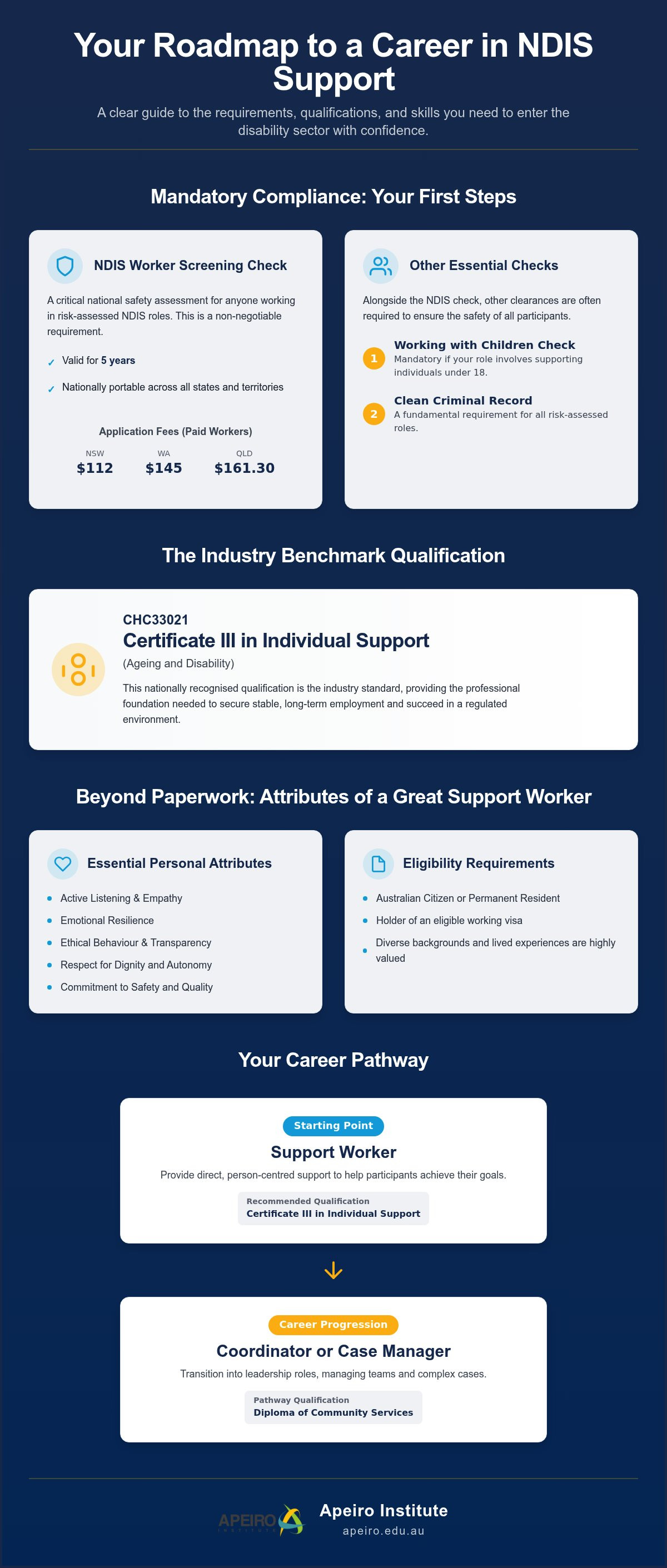
Your Career Pathway: From Support Worker to Case Manager
The care economy isn't just a job market; it's a community of professionals dedicated to making life better for others. Most people start as casual support workers. This gives you the flexibility to work with different participants and understand the diversity of the NDIS. It’s the perfect training ground. You’ll learn how to apply your empathy in practical ways while gaining the broad experience needed for future growth. Australia’s care economy is currently our fastest-growing sector, offering a level of job security that's hard to find elsewhere.
While meeting the initial NDIS support worker requirements gets you started, your career can go much further. Experienced workers often feel a pull toward coordination or management. If you’ve spent years in the field without a formal certificate, you can use Trade Pathways (TPEW) to formalise your skills. This process recognises your lived experience and professional history, helping you gain qualifications faster. It’s a supportive way to ensure your hard work is finally recognised by the wider industry.
Moving into Leadership
Advancing your career often means moving from direct care into service design and advocacy. A Diploma of Community Services adds essential management skills to your toolkit. You’ll learn how to coordinate complex support plans and lead teams of support workers. This shift allows you to advocate for participants on a systemic level, ensuring they receive the high-quality care they deserve. For more details on this transition, read our Diploma of Community Services Australia: The 2026 Career Guide.
How to Get Started Today
Starting a new journey can feel overwhelming, but we’re here to act as your bridge to success. You can begin meeting the NDIS support worker requirements today by following these three clear steps:
- Step 1: Apply for your NDIS Worker Screening Check. Visit your state or territory’s screening unit website to begin the process. Having this ready makes you much more attractive to employers.
- Step 2: Enrol in a nationally recognised course at Apeiro Institute. Whether you start with a Certificate III or aim for a Diploma, we provide the expert guidance you need to feel confident.
- Step 3: Build a resume that highlights your empathy and reliability. Focus on your "soft skills" and any previous experience where you’ve supported others.
Your future in the disability sector starts with a single, supported step. We’re ready to help you turn your passion for helping others into a rewarding, lifelong career. By focusing on both the mandatory compliance and the heart of the role, you'll be well-prepared for any challenge the 2026 landscape presents.
Empower Your Future in the Care Economy
Entering the disability sector is a journey of both professional growth and personal connection. You now have a clear roadmap for meeting the NDIS support worker requirements, from clearing mandatory screening checks to choosing the right qualification. By focusing on formal training and developing your emotional resilience, you're not just finding a job; you're building a sustainable career in Australia's fastest-growing sector. This path leads to a future where your daily efforts have a direct, positive impact on the lives of others.
Apeiro Institute (RTO 45394) provides the expert guidance you need to succeed. With industry-expert trainers and flexible study options for both local and international students, we ensure your learning experience is as supportive as the care you'll eventually provide. We act as your partner in success, helping you bridge the gap between your current experience and your long-term career goals.
Start your career in disability support with Apeiro Institute today
The sector is waiting for passionate people like you to step up. Take that first step today and begin your transformation into a confident, qualified professional. We look forward to supporting you as you make a genuine difference in the Australian community.
Frequently Asked Questions
Do I need a Certificate III to work as an NDIS support worker?
While a formal qualification isn't strictly mandatory for every entry-level role, it is increasingly preferred by registered providers. Holding a CHC33021 Certificate III in Individual Support ensures you meet the professional NDIS support worker requirements for higher-paying, stable positions. Most employers view this qualification as the industry benchmark for safety and quality care.
How much does the NDIS Worker Screening Check cost in 2026?
The cost of the mandatory screening check varies depending on your state or territory. As of July 2026, paid workers can expect to pay $112 in NSW, $139.20 in Victoria, and $145 in Western Australia. These fees are subject to change and typically increase on July 1 each year, so it's best to check with your local screening unit before applying.
Can I work as a support worker while I am still studying?
Yes, you can certainly begin working in the sector while you're completing your qualification. Many providers offer casual roles to students who have cleared their mandatory screening checks and completed their initial orientation modules. This is a brilliant way to gain practical experience and build your professional network while you finish your studies.
What is the difference between a police check and an NDIS screening check?
A standard police check only lists criminal history, whereas the NDIS Worker Screening Check is a more comprehensive assessment designed specifically for the disability sector. This check is valid for five years and is nationally portable across Australia. It provides a higher level of safety for participants by monitoring workers on an ongoing basis for any new relevant information.
Is a first aid certificate mandatory for all disability support roles?
Yes, almost all NDIS providers require a current First Aid and CPR certificate before you can start work. These certificates ensure you can respond effectively in an emergency. You'll need to keep these current, which usually means refreshing your First Aid every three years and updating your CPR skills every 12 months.
What are the physical requirements for disability support work?
You need a reasonable level of physical fitness to manage daily tasks such as assisting with mobility aids, light household chores, or community outings. Many roles involve manual handling, so it's vital to learn safe techniques through formal training. This helps you protect both your own health and the safety of the participant you're supporting.
How long does it take to become a qualified NDIS support worker?
Completing a CHC33021 Certificate III in Individual Support typically takes between six to 12 months. This timeframe includes your classroom learning or online modules and the mandatory 120 hours of practical work placement. This hands-on experience is essential for meeting the NDIS support worker requirements and ensures you're job-ready upon graduation.
Can international students work as NDIS support workers in Australia?
International students are welcome to work in the disability sector as long as they comply with the work hour limitations on their student visa. The industry highly values workers from diverse cultural backgrounds who can provide inclusive support. It's a popular choice for students because the shifts are often flexible and fit well around a study timetable.

Disclaimer
The information provided on this blog is for general informational and educational purposes only. While every effort is made to ensure the accuracy and reliability of the content, the author makes no representations or warranties of any kind, express or implied, about the completeness, accuracy, suitability, or availability of the information contained on this blog.
The views and opinions expressed in blog posts are those of the individual author and do not necessarily reflect the official policy or position of any organization, company, or employer.
This blog may contain links to external websites or third-party content. These links are provided for convenience only, and the author has no control over and assumes no responsibility for the content, privacy policies, or practices of any third-party sites.
Nothing on this blog constitutes professional advice (legal, financial, medical, or otherwise). Readers are encouraged to seek appropriate professional guidance before making any decisions based on the information provided here.
By using this blog, you acknowledge that any reliance on the information is at your own risk.


