

Why spend four years at university when the front lines of Australia's fastest-growing sector are calling for you right now? With over 1 million people already employed in the industry, finding the best pathway into community services can feel overwhelming. You might be staring at a dozen different course codes, wondering which one actually leads to a job. It's a common hurdle, especially when you're eager to turn your life experience into a professional role but don't want to get stuck in a classroom for years.
We know you're looking for security and a sense of purpose, not just another piece of paper. You want to be certain that your study time will lead directly to a rewarding role in aged care, disability support, or case management. This guide will clear the fog by showing you the most efficient, nationally recognised vocational routes to launch your career.
We'll break down the specific differences between Individual Support and Community Services qualifications. You'll also discover how to use your previous experience to fast-track your studies and follow a clear roadmap from enrolment to employment.
Key Takeaways
- Understand why the care economy remains Australia's most resilient job market, offering long-term security in a sector dedicated to social justice and empowerment.
- Discover why the Certificate III in Individual Support is considered the best pathway into community services for those wanting to start working quickly while gaining core industry competencies.
- Learn how to transition from hands-on support work into coordination and case management roles by stacking your qualifications with a Diploma of Community Services.
- Explore how Recognition of Prior Learning (RPL) and trade pathways can slash your study time by turning your existing life and work experience into a nationally recognised qualification.
- Identify the essential transferable skills, from cultural sensitivity to crisis management, that will make your resume stand out to Australian employers in the care sector.
Understanding the Community Services Landscape in Australia
Community services isn't just a job category; it's the heartbeat of Australian society. At its core, this sector is dedicated to social justice, support, and empowerment. It's where the Australian "Fair Go" is put into practice every single day. By supporting our most vulnerable citizens, community workers ensure that everyone has the opportunity to live a dignified and fulfilling life. This field shares many foundational values with the professional practice of social work, focusing on human rights and collective responsibility.
The landscape is incredibly diverse, covering several vital sub-sectors. You might find yourself working in aged care, helping seniors stay connected to their communities. You could work in disability support, navigating the NDIS to provide person-centred care. Other critical areas include youth work, mental health services, and family support. Because these services are essential, the industry remains steady even when the broader economy fluctuates.
Why a Career in Care is the Smartest Move in 2026
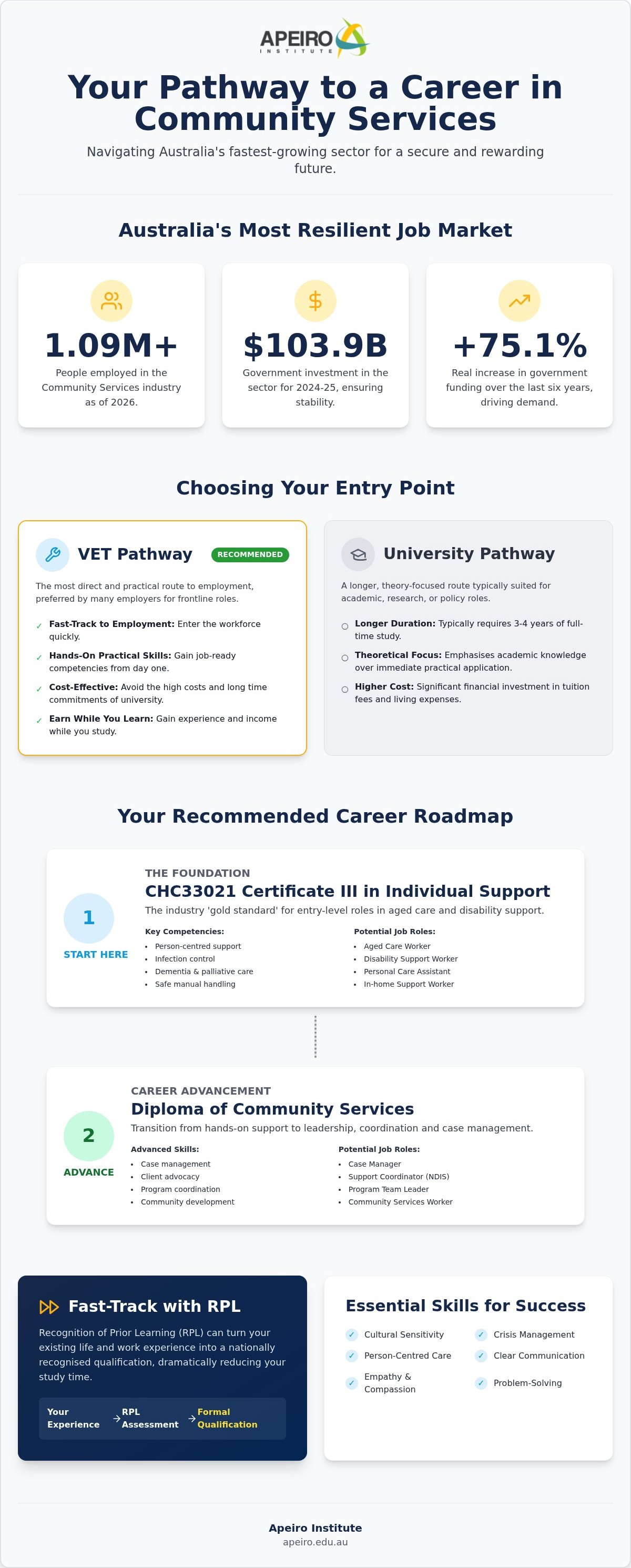
The "care economy" is currently Australia's most resilient and fastest-growing job market. As of 2026, there are 1,096,492 people employed in the community services industry across the country. This massive workforce is driven by our ageing population and a significant increase in government funding. Total government expenditure for community services reached $103.9 billion in the 2024-25 period, representing a 75.1% real increase over six years. For anyone looking for long-term job security, this is the best pathway into community services.
We've seen a major shift towards community-based support models. Instead of large institutions, the focus is now on providing care in people's homes and local neighbourhoods. This change has created a huge variety of roles. You can start with hands-on support and eventually move into strategic roles like case management or program coordination. The demand for qualified workers is so high that your skills will be needed in every corner of Australia, from major cities to regional towns.
Vocational vs. University: Choosing Your Entry Point
When you're starting out, you might wonder if you need a university degree. While degrees have their place, the vocational education and training (VET) route is often the most practical choice. Employers in this sector frequently prefer Certificate-level graduates for frontline roles because they come with hands-on, practical skills. A qualification like the CHC33021 Certificate III in Individual Support (Ageing and Disability) prepares you for the real-world challenges you'll face on the job.
Choosing a vocational path allows you to "earn while you learn." You can complete your initial training quickly and enter the workforce, gaining valuable experience while you decide if you want to specialise further. This approach avoids the high costs and long time commitments of university. For most career changers and school leavers, a VET qualification is the best pathway into community services because it prioritises immediate employability and practical competency over abstract theory.
The Entry-Level Foundation: Certificate III in Individual Support
Starting a new career is about finding the most direct route to a job. The CHC33021 Certificate III in Individual Support (Ageing and Disability) is widely recognised as the industry gold standard for entry-level care roles. It provides the essential technical skills and legal knowledge required to work safely in people's homes or residential facilities. By focusing on these core competencies, you ensure that you meet the high standards expected by Australian employers from day one.
During your studies, you'll learn everything from safe manual handling and infection control to providing support for people living with dementia. The course also covers complex areas like palliative care, ensuring you can provide compassionate end-of-life support. This blend of practical ability and emotional intelligence is what makes this the best pathway into community services for those who want to make a difference immediately. Theoretical knowledge is only half the story; you'll also complete a mandatory work placement. This gives you real-world experience under the guidance of industry professionals and often leads to direct job offers before you even graduate.
Graduates from this program typically move into roles such as:
- Personal Care Assistant (PCA): Providing daily living support in residential aged care.
- Disability Support Worker: Helping individuals with disabilities live more independently.
- Respite Care Worker: Offering temporary relief for primary carers.
- Home Care Assistant: Delivering essential services in a client's private residence.
Specialising in Ageing and Disability
The dual specialisation within the CHC33021 course is a strategic advantage. It allows you to work across both aged care and disability sectors, doubling your employment opportunities. In the disability space, you'll learn to navigate the NDIS framework, focusing on person-centred support that promotes independence. The CHC33021 qualification is the essential baseline for Australian care workers, setting the standard for quality and safety across the board. You can find more information about the scope of these roles through the official Department of Social Services careers portal.
The Daily Life of an Individual Support Worker
A typical day is rarely predictable. You might start your morning helping a client with personal grooming and then spend the afternoon facilitating a community outing. It's physically demanding and emotionally involved, but the rewards of seeing a client reach a personal goal are unmatched. Success in this role depends heavily on soft skills like empathy, patience, and maintaining professional boundaries. It's the perfect "foot in the door" for higher-level positions, providing the foundational experience needed for future leadership. If you're ready to start, exploring the Certificate III in Individual Support is a great first step toward a stable career.
Advancing Your Career: Moving into Community Services and Case Management
Once you have gained experience on the front line, you might find yourself ready for more responsibility. Transitioning from hands-on support to coordination is a natural progression. The CHC52021 Diploma of Community Services is designed for this exact purpose. It takes the practical skills you've built and adds a layer of strategic management and advocacy. For many, this is the best pathway into community services leadership because it builds directly on vocational foundations rather than starting from scratch with a theoretical degree.
Case management is a central part of this advancement. It involves coordinating complex care plans for individuals and families, ensuring they receive a holistic range of services. You aren't just providing the care; you're the one making sure all the pieces of the puzzle fit together. Many professionals find that stacking these qualifications is the best pathway into community services management. If your passion lies specifically in the aged care sector, the CHC43015 Certificate IV in Ageing Support serves as an excellent bridge. It prepares you for supervisory roles where you lead teams of personal care assistants and manage facility operations.
These qualifications open doors to diverse leadership outcomes. You could step into roles such as team leader, programme coordinator, or welfare centre manager. These positions require a higher level of decision-making and a deep understanding of the regulatory environment. You'll be responsible for ensuring your team provides high-quality support while staying compliant with Australian standards.
The Diploma of Community Services: A Strategic Career Step
Moving into the Diploma level represents a significant shift from "doing" to "organising" and "advocating". You'll spend more time navigating legal and ethical frameworks, ensuring that service delivery meets strict requirements. This level of study focuses heavily on case work and community development. For a detailed look at where this qualification can take you, check out the Diploma of Community Services Australia: The 2026 Career Guide.
Specialist Roles in Community Development
The Diploma also allows you to branch out into specialist areas. This might include domestic violence support, migrant services, or youth advocacy. At this level, networking and community engagement become vital parts of your toolkit. You'll work closely with other agencies and professional bodies like the Australian Association of Social Workers (AASW) to ensure the best outcomes for your clients. The Diploma qualification bridges the gap between frontline care and social work, providing a robust professional identity for senior community workers.
Alternative Pathways: RPL and International Student Options
Not every student starts their journey at the same point. Many people have already spent years providing care within their families or as uncertified workers in various settings. If this sounds like you, starting from the very beginning of a course might feel like you're treading water. Recognition of Prior Learning (RPL) is a formal process that assesses your existing skills against the requirements of a nationally recognised qualification. For many experienced individuals, this is the best pathway into community services because it respects your history and significantly reduces your time in the classroom.
The Trade Pathways for Experienced Workers (TPEW) system is a specifically designed framework to help you navigate this process. It ensures your practical experience is mapped correctly to current national standards. To secure a successful RPL assessment, you'll need to prove your expertise through a portfolio of evidence. This methodical approach turns your "on-the-job" knowledge into a professional credential that Australian employers trust.
Common evidence required for a successful assessment includes:
- Workplace logs: Detailed records of your daily tasks and responsibilities.
- Supervisor reports: Third-party verification of your skills from current or former managers.
- Practical evidence: Photos, videos, or observations of you performing core duties.
- Previous training: Certificates from non-accredited courses or workshops you've attended.
Getting Qualified with Work Experience
If you've spent years in unrecognised care roles, you don't have to stay in the shadows of the industry. You can convert that hard-earned experience into a formal qualification that opens doors to higher pay and better conditions. The process is straightforward but requires organisation. You'll work with an expert assessor to collect references and document your competencies. This ensures every skill you've mastered is counted toward your certificate. For a deeper look at how this works, read our Trade Pathways for Experienced Workers Australia: The 2026 Guide.
Community Services for International Students
Australia is a global hub for vocational training, and international students bring vital perspectives to our care sector. If you're coming from overseas, you'll need to navigate specific CRICOS requirements and student visa conditions. Studying here offers the chance to learn within a multicultural environment alongside peers from 38+ different nationalities. This diversity is a massive asset in community services, where cultural sensitivity is a core requirement. It's often the best pathway into community services for those looking to build a global career. You can find all the details in our Vocational Courses for International Students in Australia: The Complete 2026 Guide.
Get your experience recognised today
Launching Your Career: Skills, Outcomes, and Next Steps
Securing your qualification is a major milestone, but it's only the beginning of your professional journey. Transitioning from a student to a practitioner requires a specific set of transferable skills that go beyond what's written in a textbook. Australian employers are looking for people who can communicate clearly, manage crises with a level head, and show genuine empathy. When you're applying for roles, your resume should highlight your practical placement experience and any life skills that prove you can handle the emotional demands of the care sector.
Continuing professional development is essential in this field. The regulatory landscape in Australia, particularly regarding the NDIS and aged care reforms, changes frequently. Staying relevant means being proactive about your learning and keeping your clearances, like the NDIS Worker Screening Check, up to date. Apeiro Institute acts as your empowering mentor during this transition, providing the industry-focused training you need to move from the classroom to the front line with confidence.
The Skills That Employers Are Searching For
Modern community service roles require a delicate balance between technical knowledge and emotional intelligence. You'll need to be proficient in manual handling and infection control while simultaneously building deep rapport with your clients. Digital literacy is also a major requirement now. Most organisations use digital platforms for case management and reporting, so being comfortable with technology is a must. Cultural competence is a non-negotiable skill in the 2026 Australian workforce. Because our student community represents over 38 nationalities, you'll naturally develop the global perspective that modern employers value so highly.
Your First 90 Days in Community Services
The first three months in a new role are often the most intense. You'll be navigating new workplace cultures and building trust with clients who may be experiencing significant challenges. It's vital to have a plan for managing workplace stress and preventing burnout from day one. We recommend setting clear career goals early on. Perhaps you want to start as a support worker and move into a coordinator role within two years. Having a roadmap keeps you motivated and ensures you're always moving toward your next objective. Choosing the best pathway into community services means thinking about your long-term growth, not just your first job.
If you're ready to take the next step in your career, we're here to help you find the right course for your goals. Our team can guide you through the enrolment process and explain how your previous experience can work in your favour.
Enquire about our Community Services courses today
Your Future in the Australian Care Sector Starts Here
Building a career in this vital sector is about more than just finding a job. It's about finding a place where your skills and empathy can truly change lives. We've explored how starting with a foundation qualification provides immediate entry, while advancing to a Diploma level prepares you for leadership and case management. Your previous life experience is a professional asset that can be formally recognised through our specialist RPL pathways, saving you time and acknowledging your existing expertise.
Finding the best pathway into community services is the first step toward a career that offers both long-term security and profound personal reward. As a Nationally Recognised RTO 45394, we're dedicated to providing industry-led training that includes essential practical work placements. This ensures you're not just qualified, but fully prepared for the daily realities of the Australian workforce.
Start your journey with Apeiro Institute’s Community Services courses today
The community services sector is waiting for dedicated professionals like you. Take that first step with confidence and start making a real difference in your community today.
Frequently Asked Questions
What is the best pathway into community services for a career changer?
The best pathway into community services for a career changer is a vocational route starting with a Certificate III in Individual Support. This allows you to gain essential frontline skills and enter the workforce in months rather than years. You can then build on this foundation by pursuing a Diploma or specialised Certificate IV while already working in the sector.
Can I work in community services without a degree in Australia?
You can definitely work in community services without a university degree, as vocational qualifications are the industry standard for most roles. Employers often prefer candidates with a Certificate III or Diploma because these courses focus on practical, hands-on skills. These nationally recognised qualifications provide a direct route into support work, case management, and team leadership positions.
How long does it take to get a Certificate III in Individual Support?
A Certificate III in Individual Support typically takes between six and twelve months to complete. This duration covers all theoretical units and the mandatory work placement hours required for graduation. The exact timeframe often depends on whether you choose to study full-time or take advantage of more flexible, part-time learning options.
Is there high demand for community service workers in 2026?
Demand for community service workers is at an all-time high in 2026, with over 1,096,492 people now employed in the sector. The workforce has grown by an average of 6.4% per year since 2021, driven by Australia's ageing population and the NDIS. This growth ensures that qualified workers have excellent job security and numerous opportunities for career progression.
What is the difference between aged care and community services?
Aged care is a specialised sub-sector focused on supporting older Australians, while community services is the broader umbrella that covers many different fields. Community services includes disability support, youth work, mental health services, and domestic violence advocacy. While aged care is a major part of the industry, community services involves a wider range of social support and case management roles.
Can international students study community services in Australia?
International students can study community services through CRICOS-registered providers like Apeiro Institute. These programs are tailored to meet student visa requirements while providing high-quality, industry-focused training. Studying in Australia offers the chance to learn in a multicultural environment with peers from over 38 nationalities, which is excellent preparation for a diverse workplace.
How does Recognition of Prior Learning (RPL) work for community services?
Recognition of Prior Learning (RPL) is a process where your existing skills and experience are assessed against the units of a formal qualification. If you've spent years in unrecognised care roles, you can provide evidence like work logs and supervisor reports to gain credits. This is often the best pathway into community services for experienced workers who want to get qualified quickly.
What is the average salary for a community service worker in Australia?
Salaries are generally governed by the SCHADS Award, which saw a 4.75% increase in July 2026. A Certificate III qualified worker at Level 2.1 now earns a minimum of $36.22 per hour. For those who hold a Diploma and work at Level 3.1, the minimum rate is $40.49 per hour, with casual employees receiving additional loading on top of these base rates.

Disclaimer
The information provided on this blog is for general informational and educational purposes only. While every effort is made to ensure the accuracy and reliability of the content, the author makes no representations or warranties of any kind, express or implied, about the completeness, accuracy, suitability, or availability of the information contained on this blog.
The views and opinions expressed in blog posts are those of the individual author and do not necessarily reflect the official policy or position of any organization, company, or employer.
This blog may contain links to external websites or third-party content. These links are provided for convenience only, and the author has no control over and assumes no responsibility for the content, privacy policies, or practices of any third-party sites.
Nothing on this blog constitutes professional advice (legal, financial, medical, or otherwise). Readers are encouraged to seek appropriate professional guidance before making any decisions based on the information provided here.
By using this blog, you acknowledge that any reliance on the information is at your own risk.


