

What if the real hurdle in expanding your trade team isn't the cost of labour, but missing out on the financial support designed to offset it? Untangling the details of NSW Government wage subsidies for hiring apprentices alongside national support can feel daunting, especially when you're trying to distinguish between Commonwealth wage incentives and state-funded fee-free training initiatives.
You're certainly not alone if administrative paperwork, shifting eligibility criteria, or concerns about apprentice award rates and training downtime make you hesitate. Keeping a workshop or site productive while investing in an apprentice is a delicate balance for any business owner.
The good news is that you don't have to carry the financial load by yourself. In this guide, you'll discover how employers access wage subsidies, fee-free training, and national incentives when taking on apprentices. We provide a straightforward roadmap to help you register and onboard an eligible worker, partner with a quality Registered Training Organisation, and maximise your cost savings while building a certified, highly capable technical workforce.
Key Takeaways
- Learn how combining national incentive payments with NSW Government wage subsidies for hiring apprentices can significantly offset your supervisory and onboarding costs.
- Discover how NSW Smart and Skilled funding eliminates apprentice qualification fees entirely, keeping course costs to zero for your business.
- Follow a clear four-stage onboarding roadmap, from partnering with an Apprenticeship Network Provider to unlocking scheduled milestone payments.
- Understand workplace obligations around award rates and release time to protect your funding eligibility while building a supportive, productive workshop culture.
- Explore Recognition of Prior Learning (RPL) and Trade Pathways for Experienced Workers to upskill and certify existing team members without starting a traditional multi-year program.
Understanding Wage Subsidies and Financial Support for Hiring Apprentices
Bringing an apprentice into your business represents an investment in the future of your trade. While onboarding requires dedicated supervision and training downtime, financial assistance is structured specifically to absorb these initial costs. When employers investigate NSW Government wage subsidies for hiring apprentices, they quickly discover that funding actually operates through two complementary layers: direct federal employer incentives and state-level training programs.
This coordinated model sits within the broader Australian vocational education system, designed to keep businesses productive while developing qualified tradespeople. Structured training strengthens workshop loyalty, sharpens internal standards, and ensures your team retains critical technical skills for decades to come.
The Dual Funding Structure: Commonwealth Subsidies vs State Initiatives
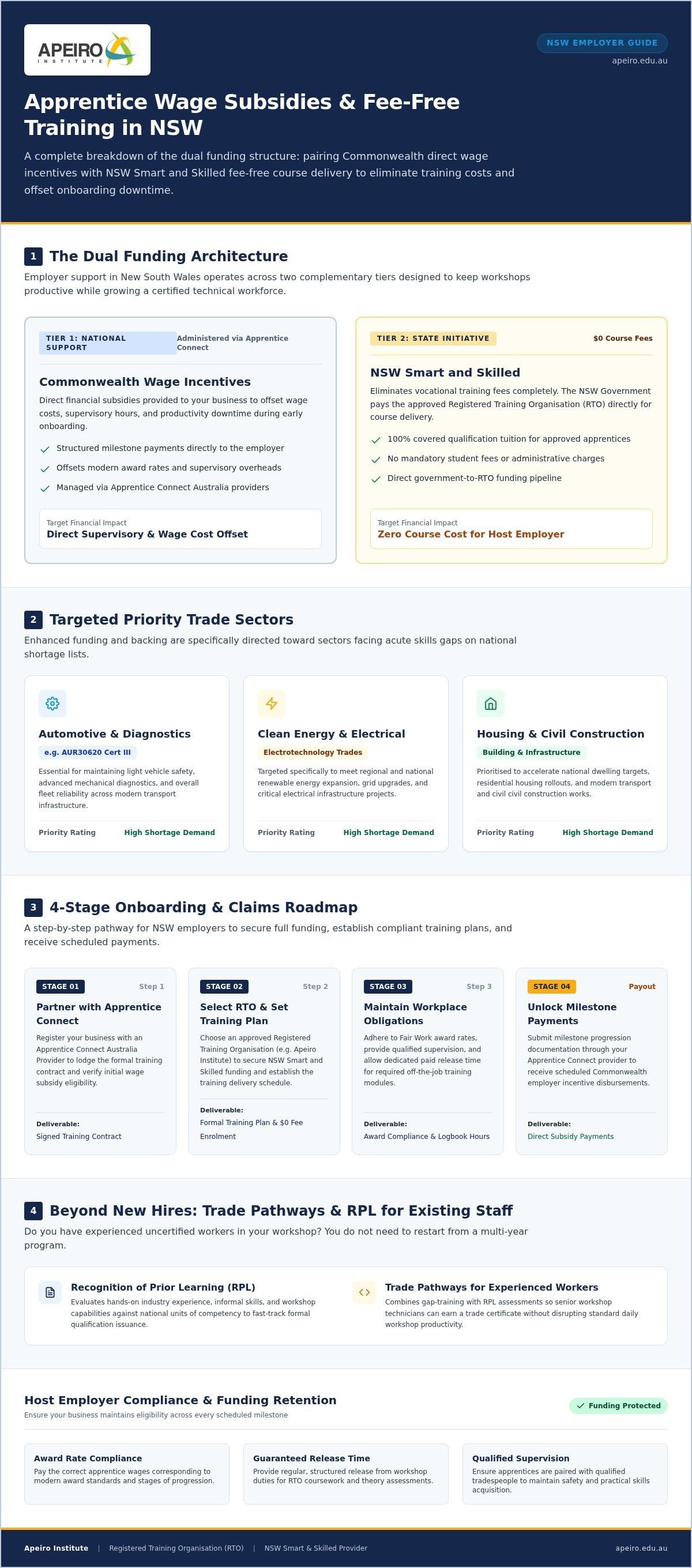
Gaining full financial value requires understanding how federal and state mechanisms interact. Commonwealth incentives focus on wage support, delivering structured milestone payments directly to your business to offset supervisory hours and award rates. An Apprentice Connect Australia provider manages these agreements and processes your claims.
State initiatives, on the other hand, eliminate training expenses at the source. Under the NSW Smart and Skilled program, the state covers the student qualification costs for approved apprenticeships. Instead of your business paying tuition or passing charges onto the learner, course fees drop to zero. Pairing direct federal wage assistance with fee-free state training creates substantial overall savings, giving you breathing room as your apprentice builds hands-on competency.
Priority Trade Occupations and Targeted Industry Sectors
Both funding streams deliberately target sectors experiencing acute skills gaps. If your workshop operates in fields like automotive technology, clean energy, civil construction, or electronics, you qualify for enhanced workforce backing. Industry bodies and national shortage lists constantly assess labour demands to designate these classifications.
Choosing an accredited qualification, such as the AUR30620 Certificate III in Light Vehicle Mechanical Technology, ensures your business aligns with these identified priorities. Key focus areas currently enjoying elevated support include:
- Clean energy and electrical trades: Targeted to meet infrastructure demands and renewable energy expansion.
- Automotive mechanical and diagnostics: Crucial for maintaining fleet reliability, light vehicle safety, and advanced mechanical systems.
- Housing and civil construction: Prioritised to meet national dwelling targets and modern infrastructure demands.
Aligning with priority lists ensures you capture all available NSW Government wage subsidies for hiring apprentices while systematically closing technical skills shortages in your workshop.
NSW Smart and Skilled Fee-Free Apprenticeships: Maximising Your Savings
Most online guides separate federal funding from state support, leaving employers confused about true out-of-pocket expenses. When you combine NSW Government wage subsidies for hiring apprentices with the NSW Smart and Skilled program, you remove one of the steepest barriers to hiring: qualification tuition costs. Stacking these mechanisms delivers complete financial efficiency for your workshop.
How Fee-Free Training Operates for Host Employers
Under standard vocational study, enrolments require mandatory student fees and administrative charges. Fee-free apprenticeships change this dynamic completely. The NSW Government pays the approved Registered Training Organisation (RTO) directly for course delivery. Neither your business nor your apprentice pays tuition fees.
Exploring our detailed guide to Smart and Skilled funded courses helps illustrate how this funding pipeline operates behind the scenes. Pairing fee-free course delivery with direct Australian Government financial support allows you to allocate training budgets directly back into practical workshop resources.
Eligible Technical and Trade Qualifications
Smart and Skilled targets high-priority trades experiencing persistent labour shortfalls. In automotive repair and servicing, mechanical proficiency is indispensable. Enrolling an apprentice in the AUR30620 Certificate III in Light Vehicle Mechanical Technology ensures your team masters complex diagnostics, engine servicing, and braking systems through structured workplace delivery.
For a closer look at training units and workplace assessment schedules, consult our Certificate III in Light Vehicle Mechanical Technology guide to see how formal learning integrates smoothly into daily workflow.
Key Eligibility Criteria for Businesses and Candidates
Accessing fee-free funding and qualifying for NSW Government wage subsidies for hiring apprentices requires meeting straightforward criteria. Your business must be equipped to offer appropriate on-the-job supervision, safe equipment, and genuine exposure to trade tasks.
Candidates must satisfy baseline state requirements:
- Be an Australian citizen, permanent resident, humanitarian visa holder, or New Zealand citizen.
- Live or work within NSW.
- Be at least 15 years old and no longer enrolled in school.
- Hold an approved training contract registered under an eligible new-entrant arrangement.
Existing team members transitioning into an apprenticeship face different rules than new hires. Verifying their employment status early ensures an effortless onboarding experience.
Step-by-Step Roadmap: How to Claim Subsidies and Hire an Apprentice
Securing the right support doesn't have to be bogged down in administrative confusion. By following a structured four-stage pathway, you can hire confidently, formalise contracts smoothly, and claim available payments right on schedule. Setting up this framework early ensures you access all relevant NSW Government wage subsidies for hiring apprentices without unnecessary operational friction.
Establishing the Training Contract and Network Provider Partnership
Your journey begins by connecting with an Apprentice Connect Australia provider. These government-contracted organisations facilitate the sign-up process at zero cost to your business. Together, you will execute the formal training contract that establishes the apprenticeship under state legislation.
This legally binding agreement sets terms for wages, duration, and supervisory oversight. It also details an initial probationary period, giving both your workshop and the apprentice time to assess mutual suitability before finalising long-term commitments.
Partnering with an Approved Registered Training Organisation
Once the training contract is lodged, your chosen Registered Training Organisation steps in to build the formal Training Plan. This document maps vocational competencies directly to the equipment, servicing bays, and diagnostic tools in your workplace. Selecting an experienced provider like Apeiro Institute ensures qualification delivery integrates cleanly with your operating rhythm.
The Training Plan determines study delivery schedules to maintain shopfloor momentum:
- Day release: The apprentice attends scheduled training one set day per week or fortnight.
- Block release: Training gathers into structured full-week blocks across the year, ideal for intensive skill building.
- Workplace-based delivery: Practical assessments occur directly on site under structured RTO mentoring.
Milestone Claims, Compliance, and Documentation Requirements
Receiving scheduled payments relies on orderly documentation and verified apprentice progress. When your apprentice hits key milestones, typically around six and twelve months into their first year, claim windows unlock. You can monitor your active entitlements through Australian Government financial support for employers portals alongside state reporting systems.
To ensure prompt processing for NSW Government wage subsidies for hiring apprentices, keep your employment records current. Providers will require verified timesheets, proof of award-compliant wage payments, and regular RTO supervisor sign-offs confirming on-the-job competency progression. Orderly records protect your business, streamline claims, and keep your focus where it belongs: expanding your team's capabilities.
Workplace Obligations: Managing and Retaining Your Apprentice for Success
Claiming incentives solves only half of the workforce equation. Maintaining eligibility for NSW Government wage subsidies for hiring apprentices requires ongoing compliance with industrial awards, supervisory duties, and training release hours. Beyond formal regulations, thoughtful shopfloor management is what turns an entry-level worker into an indispensable technician.
Supervising an apprentice demands time and patience. When workshop culture prioritises active mentoring, retention rates climb, productivity losses diminish, and your supervisory investment yields measurable returns.
Fair Work Compliance, Wages, and Off-the-Job Training Hours
Modern awards dictate clear wage progression structures. Apprentice pay rates rise systematically as the learner completes designated stages of their qualification, shifting away from simple tenure-based increases. Staying aligned with current award pay guides prevents underpayment risks and keeps your training contract compliant.
Compliance also extends to scheduled study hours and site safety:
- Paid training release: You must pay normal hourly rates while your apprentice attends scheduled off-the-job schooling, treating classroom attendance as regular work time.
- Direct trade supervision: Junior learners cannot be left unsupervised on complex tasks, requiring oversight from qualified tradespeople to meet SafeWork standards.
- Timely logbook maintenance: Ensure workplace experience logs are reviewed and endorsed consistently to prevent end-of-year assessment backlogs.
Mentorship Strategies that Boost Productivity and Retention
Apprentice attrition often traces back to disengagement rather than a lack of mechanical ability. Pairing your new hire with an experienced tradesperson creates a reliable sounding board for questions, workshop etiquette, and safety practices. This buddy system builds mutual trust while taking operational pressure off senior managers.
Coordinate daily repair jobs so that practical workshop assignments mirror the specific modules your apprentice is currently studying with their RTO. When an apprentice applies theory to physical work on the very same week, diagnostic confidence surges. Setting aside brief quarterly progress catch-ups gives both sides space to resolve minor friction, address technical hurdles, and maintain long-term enthusiasm.
By protecting your eligibility for NSW Government wage subsidies for hiring apprentices through meticulous compliance, you secure your financial support while fostering a capable, loyal team member.
Explore automotive apprenticeship training pathways with Apeiro Institute
Beyond New Hires: Trade Pathways and RPL for Existing Workers
Hiring a new apprentice isn't the only route to overcoming trade skills shortages. Many workshops already employ experienced technicians who have spent years on the tools without formal trade credentials. While NSW Government wage subsidies for hiring apprentices predominantly focus on new-entrant arrangements, certifying existing staff provides immediate commercial advantages.
Formal qualifications elevate your business reputation, ensure compliance with licensing authorities, and validate the real-world competence of your workforce.
How Recognition of Prior Learning Supports Business Capability
Recognition of Prior Learning (RPL) acknowledges existing skills gained across years of practical workshop experience. Rather than requiring seasoned team members to sit through introductory classroom modules, an assessor evaluates their technical tasks, workplace documentation, and supervisory references directly against national qualification standards.
When specific gaps in training appear, targeted bridging modules provide the exact training needed to bring uncertified workers up to full qualification standards. To explore how practical experience translates into accredited trade outcomes, consult our trade pathways for experienced workers overview.
Accelerating Trade Certification through Apeiro Institute
Formalising established trade skills protects your business capability and boosts staff morale. Through dedicated TPEW pathways, experienced automotive workers can achieve trade certification in months rather than years.
Senior mechanics and technicians can attain formal recognition under the Certificate III in Light Vehicle Mechanical Technology program. This process validates on-the-job diagnostic experience, engine servicing, and braking system competencies against nationally accredited Australian qualifications. Apeiro Institute works alongside your supervisors to design flexible workplace assessments that respect daily workshop schedules without disrupting revenue.
Whether you're tapping into NSW Government wage subsidies for hiring apprentices to bring on new talent or streamlining credentials for veteran crew members, structured training solidifies your competitive edge. Contact Apeiro Institute to assess candidate eligibility and select the most effective pathway for your business.
Take the Next Step in Growing Your Trade Team
Expanding your technical capabilities doesn't have to place undue pressure on your business finances. By pairing federal milestone payments with NSW Government wage subsidies for hiring apprentices and Smart and Skilled fee-free training, you can significantly reduce overheads while cultivating a loyal, certified crew. For established staff, options like Recognition of Prior Learning provide a fast-track route to formal trade credentials.
As an approved Smart and Skilled provider and Registered Training Organisation (RTO 45394), Apeiro Institute delivers industry-standard training designed around your daily workflow. Whether you need seamless qualification delivery for a new apprentice or structured Trade Pathways for Experienced Workers (TPEW), our team ensures the process remains straightforward and rewarding.
Investing in your people today builds the resilient, qualified team that keeps your workshop ahead of the curve tomorrow.
Frequently Asked Questions
What is the difference between a wage subsidy and fee-free apprentice training in NSW?
A wage subsidy provides direct financial assistance to employers to offset wage costs, while fee-free training covers qualification tuition directly with the training provider. Federal incentives deliver structured payments straight to your business bank account at key employment milestones. In contrast, NSW Smart and Skilled fee-free initiatives pay the Registered Training Organisation directly, removing mandatory tuition fees for both your workshop and your apprentice.
Can my business claim subsidies for existing employees, or only new apprentice hires?
Primary wage subsidies generally target new entrants, but existing workers can still access government-subsidised qualifications. While federal incentive programs prioritise recently recruited team members, established staff on your payroll can formalise their trade expertise through subsidised state training, RPL, or Trade Pathways for Experienced Workers. Certain state concessions, such as payroll tax rebates, strictly apply to new-entrant contracts rather than existing-worker arrangements.
Do employers have to pay apprentice wages while they attend off-the-job training with an RTO?
Yes, employers are legally required under modern awards to pay apprentices their regular wages while they attend off-the-job training. Time spent attending scheduled trade classes, whether delivered through weekly day release or full-week blocks, counts as paid working hours. Maintaining compliant wage records during these study release periods is essential to retain your eligibility for NSW Government wage subsidies for hiring apprentices.
How do employers apply for government apprentice wage incentives in NSW?
You apply by registering a formal training contract through an Apprentice Connect Australia provider. These contracted network organisations manage sign-up documentation at zero cost and submit your training contract to state training authorities. Once approved, your network provider tracks your training schedule and activates online portal claims at six-month and twelve-month milestones, streamlining your access to NSW Government wage subsidies for hiring apprentices.
What happens to claimed wage subsidies if an apprentice cancels their training contract?
Your business retains the milestone subsidy payments earned prior to the contract cancellation, provided all past compliance requirements were satisfied. If an apprentice resigns or cancels their registration, future scheduled claims cease immediately. Employers are not required to repay previous instalments, as long as verified timesheets, award-compliant wages, and supervision records were upheld up to the official termination date.
Are all trades eligible for fee-free apprenticeship training under Smart and Skilled?
No, fee-free training applies specifically to government-approved qualifications published on the NSW Skills List. The program targets industries experiencing documented skills shortages, including automotive servicing, civil construction, clean energy, and electronics technology. Enrolling your candidate in an approved qualification through a partner like Apeiro Institute ensures course tuition is covered without unexpected institutional fees.
Can mature-age or experienced trade workers qualify for apprentice subsidies and RPL?
Yes, mature-age apprentices qualify for employer incentives, while experienced workers can bypass traditional entry-level training using Recognition of Prior Learning. Wage incentives apply regardless of the apprentice's age when hiring into priority trades. For experienced team members who already possess practical trade skills, Recognition of Prior Learning and trade pathways assess existing competence against national standards, fast-tracking certification without repeating basics.

Disclaimer
The information provided on this blog is for general informational and educational purposes only. While every effort is made to ensure the accuracy and reliability of the content, the author makes no representations or warranties of any kind, express or implied, about the completeness, accuracy, suitability, or availability of the information contained on this blog.
The views and opinions expressed in blog posts are those of the individual author and do not necessarily reflect the official policy or position of any organization, company, or employer.
This blog may contain links to external websites or third-party content. These links are provided for convenience only, and the author has no control over and assumes no responsibility for the content, privacy policies, or practices of any third-party sites.
Nothing on this blog constitutes professional advice (legal, financial, medical, or otherwise). Readers are encouraged to seek appropriate professional guidance before making any decisions based on the information provided here.
By using this blog, you acknowledge that any reliance on the information is at your own risk.


