

What if the primary hurdle to receiving government support for your apprentice isn't strict eligibility, but a simple mismatch between payroll records and verified training milestones? Learning how to claim employer apprenticeship incentives shouldn't feel like wrestling with endless red tape. As an employer investing valuable time and resources into developing skilled workers, you rely on these wage subsidies to support your business operations.
Yet logging into the Apprenticeships Data Management System (ADMS) often brings confusion over documentation, portal errors, and frustrating payment delays. We are here to simplify that process. Discover how Australian employers can easily navigate ADMS, meet eligibility criteria, and claim national apprenticeship incentives without administrative delays. In this straightforward guide, we walk you through the claim procedure step by step, demonstrating how to connect payroll evidence with verified training progress so your payments arrive smoothly and on time.
Key Takeaways
- Understand how the national priority classifications and scheduled training milestones determine your business's eligibility for federal wage assistance.
- Discover how to claim employer apprenticeship incentives step by step through the secure Apprenticeships Data Management System portal.
- Avoid common administrative delays by ensuring your payroll records match verified training progression before submitting claim forms.
- Protect your cash flow by tracking federal lodgement deadlines within the required timeframe once milestone maturity dates pass.
- Collaborate closely with a responsive Registered Training Organisation to streamline competency sign-offs and keep claim approvals moving forward.
Understanding the Australian Apprenticeships Incentive System in 2026
Hiring an apprentice represents a substantial investment in your business's future capability. Across the country, national wage subsidies and milestone payments exist to help offset the direct overheads of mentoring new talent while they develop hands-on proficiency. Governed within the wider landscape of Vocational education in Australia, the modern incentive framework specifically rewards employers who commit to building skills in trades facing acute shortages. Understanding how to claim employer apprenticeship incentives begins with recognising that these payments aren't upfront grants. Instead, funds unlock at predetermined training intervals across the life of an active training contract, supported jointly by federal systems, support network providers, and partner Registered Training Organisations (RTOs).
Core Objectives of National Apprenticeship Wage Support
Federal wage assistance focuses on shared investment between industry and government. In the initial phases of employment, apprentices require intensive workplace supervision, dedicated mentoring, and regular off-the-job study. Wage support cushions these early overheads, making it commercially practical for small and mid-sized businesses to bring on entry-level staff. By distributing payments across key progression stages, the system encourages higher retention rates and lifts qualification completions across critical trade and technical sectors.
Primary Eligibility Requirements for Employing Businesses
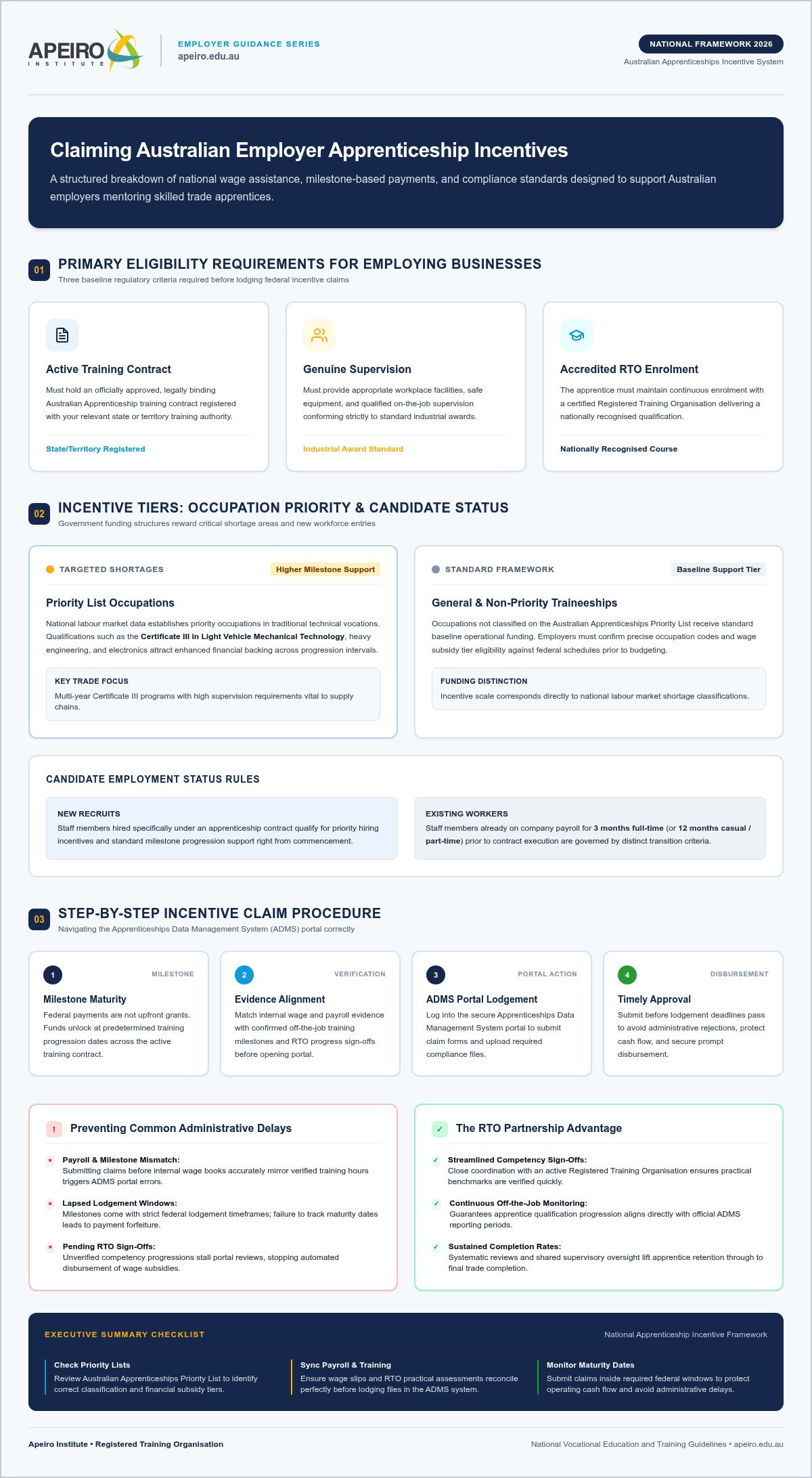
Before lodging a claim, businesses must satisfy three baseline regulatory standards:
- Active Training Contract: Your business must hold an officially approved, legally binding Australian Apprenticeship training contract registered with your relevant state or territory training authority.
- Genuine On-the-Job Supervision: You need to provide appropriate facilities, safe equipment, and qualified supervision that adheres to standard industrial award conditions.
- Accredited RTO Enrolment: The apprentice must maintain continuous enrolment with a certified training provider delivering a nationally recognised qualification.
When you know how to claim employer apprenticeship incentives correctly, your internal record-keeping mirrors these requirements seamlessly, ensuring every claim is processed without friction.
Key Categories: Priority Occupations versus General Traineeships
The Australian Government links the level of employer funding directly to identified workforce shortages. The Australian Apprenticeships Priority List determines which qualifications attract targeted wage assistance. Sourced from national labour market data, this list establishes distinct funding tiers. Employers taking on apprentices in critical shortage areas receive greater milestone support than those in non-priority roles. Reviewing official guidelines on Financial support for employers ensures you identify the precise classification tier attached to your apprentice's occupation code before establishing internal budgets.
Priority List Occupations and Trade Apprenticeships
Priority occupations focus heavily on traditional technical vocations, including heavy engineering, electronics, and automotive mechanics. These sectors rely on multi-year Certificate III programs that systematically build complex practical skills. Qualifications like the Certificate III in Light Vehicle Mechanical Technology represent essential trades vital to national supply chains. Because these technical trades demand comprehensive on-the-job supervision, the federal framework structures financial incentives around key retention and progression points, rewarding businesses that support learners through to final qualification sign-off.
New Recruits versus Existing Worker Traineeships
Government rules distinguish clearly between newly hired apprentices and existing staff who transition into formal traineeships. Knowing how to claim employer apprenticeship incentives requires checking employment history, as distinct criteria apply to each group:
- New Recruits: Staff members employed specifically under an apprenticeship contract typically qualify for standard priority hiring incentives and milestone support from commencement.
- Existing Workers: Team members already on your payroll for three months full-time (or twelve months casual or part-time) prior to starting their training contract may face restricted funding eligibility or separate tenure caps.
Verifying worker eligibility with your Apprentice Connect provider before signing formal paperwork ensures you understand your available subsidies from day one. When evaluating existing staff who already possess substantial practical experience on the workshop floor, exploring dedicated recognition routes like Trade Pathways for Experienced Workers can help you formalise their technical qualifications efficiently.
Understanding these distinct categories clarifies how to claim employer apprenticeship incentives successfully, aligning your recruitment strategy with the appropriate funding streams.
How to Claim Employer Apprenticeship Incentives Step by Step
Submitting a claim doesn't have to be a convoluted exercise. When milestone dates arrive, having a clear, sequential checklist ensures you move through the digital administrative pipeline without delay. The Commonwealth manages claims through the Apprenticeships Data Management System (ADMS), an online platform designed to automate validations between your business, training bodies, and Apprentice Connect providers. Following the official framework for Australian Apprenticeships employer incentives, here is how to navigate the portal and get your claims approved promptly.
Step 1: Set Up Digital Identity and Access the ADMS Portal
To begin, your business principal or authorised representative needs an active Digital ID (myID). Link this identity to your Australian Business Number (ABN) using the Australian Taxation Office's Relationship Authorisation Manager (RAM). Once permissions are established, log into the secure ADMS portal. Review your organisation dashboard immediately to ensure every current apprentice appears with accurate contract commencement dates and correct qualification details.
Step 2: Collect Wage Evidence and Training Milestone Proof
Incentives release only after verifying continuous employment and academic progression across the claim period. Before opening an application, assemble your compliance documentation:
- Detailed Payroll Reports: Collate pay slips and payroll ledgers verifying hours worked, gross wages paid, and award rates applied during the milestone window.
- Supervised Attendance Records: Confirm that standard on-the-job supervision hours and approved training leave were logged accurately.
- RTO Milestone Sign-Off: Check that your apprentice's training provider has recorded the expected competency progression units within national reporting registers.
Step 3: Complete the Online Claim and Submit for Validation
Once an incentive milestone matures, ADMS generates an active claim notification on your dashboard. Click into the open claim, review the pre-populated apprentice details, and input your verified payroll figures. Upload your supporting documents directly into the portal. You will then complete a legal declaration confirming ongoing employment and training support. Once submitted, your Apprentice Connect provider reviews the evidence and releases payment directly to your registered business bank account.
Mastering this sequential process makes knowing how to claim employer apprenticeship incentives an easy, predictable routine for your payroll team.
Preventing Payment Delays and Resolving Common Claim Issues
Payment delays can disrupt your cash flow planning. Most stalled claims don't fail because of basic eligibility disqualifications. Instead, they get held up by administrative mismatches between internal payroll entries and external training databases. Once an incentive milestone passes its maturity date, federal guidelines grant employers a 12-month window from the effect date to lodge the claim in ADMS. Missing this cutoff results in forfeiting your entitlement entirely. Proactive record-keeping and clear communication between your payroll team, your apprentice, and your training organisation will keep your claim moving smoothly through the assessment pipeline.
Aligning Milestone Claims with RTO Academic Progress
Incentive payments are strictly linked to real academic advancement. An apprentice might complete the required workplace calendar hours, but if their formal competency assessments remain unrecorded by their provider, ADMS will freeze the claim notification. Prompt assessment sign-offs ensure training benchmarks match national reporting registries. Choosing a collaborative provider delivering structured qualifications, such as the Certificate III in Light Vehicle Mechanical Technology, ensures regular competency evaluations happen on schedule so your eligible administrative windows unlock without delay.
Avoiding Payroll Discrepancies and Evidence Errors
Documentation errors trigger immediate manual audits by Apprentice Connect providers. When processing how to claim employer apprenticeship incentives, eliminate discrepancies before hitting submit by reviewing three critical areas:
- Award Base Rate Alignment: Verify that your apprentice's standard hourly rate strictly satisfies the relevant modern award or registered workplace agreement for their progression stage.
- Eligible Wage Isolation: Exclude non-qualifying payments from core subsidy calculations, such as unverified overtime allowances, travel reimbursements, or taxable bonuses.
- Digital Document Completeness: Ensure all uploaded pay slips display your company's full legal entity name, ABN, employee full name, and clearly delineated pay period end dates.
Partner with Apeiro Institute to streamline your apprentice's training milestones
Establishing these verification habits removes administrative friction, transforming how to claim employer apprenticeship incentives into a dependable, prompt financial return for your company.
Partnering with an RTO to Maximise Apprenticeship Outcomes
Selecting the right Registered Training Organisation shapes your entire apprenticeship journey. While an RTO delivers nationally recognised training, their administrative efficiency directly affects your bottom line. A proactive training partner does not simply deliver curriculum; they collaborate with your supervisors, mentor learners, and swiftly update unit completions. When understanding how to claim employer apprenticeship incentives, having an RTO that logs competencies promptly makes the difference between swift payment releases and weeks of administrative gridlock.
How High-Quality Vocational Delivery Protects Your Investment
Quality vocational education bridges theoretical concepts with real-world productivity. Dedicated trainers conduct regular workplace check-ins, keeping apprentices engaged, productive, and confident on the job. Practical training ensures new skills translate directly to daily operations. Crucially, transparent reporting workflows keep national training records fully synchronised. When competency assessments are recorded immediately upon completion, your ADMS portal accurately reflects your apprentice's status, allowing your business to lodge milestone wage claims without administrative pushback.
Upskilling Experienced Staff through Recognition Pathways
Apprenticeships aren't limited to brand-new recruits. Many enterprises employ seasoned staff who have performed trade duties for years without holding formal trade papers. Through structured Trade Pathways for Experienced Workers, you can assess and formalise existing crew competencies against national benchmarks. Validating practical knowledge through targeted recognition accelerates qualification outcomes, lifts workshop capability, and strengthens your company's operational profile without forcing staff to repeat skills they already possess.
Building a resilient technical workforce relies on a reliable training relationship. By aligning your business goals with a dedicated provider like Apeiro Institute, you secure high-standard trade education and dependable milestone administration. This collaborative approach takes the complexity out of how to claim employer apprenticeship incentives, ensuring your enterprise receives its entitled financial backing while fostering top-tier technical talent.
Take Control of Your Apprentice Incentive Claims Today
Securing federal wage support doesn't need to be an administrative headache. When you understand how to claim employer apprenticeship incentives, success comes down to keeping clean payroll documentation, tracking digital portal deadlines, and verifying academic progression early. By staying organised, your business protects its cash flow while building vital operational capabilities.
As a Nationally Recognised Training Provider (RTO 45394), Apeiro Institute delivers specialised workplace training across automotive, engineering, and technology sectors. Our team provides dedicated support coordinating structured training plans with employer milestone schedules, ensuring unit sign-offs happen without delay.
Investing in technical trade skills builds lasting value for your enterprise. With a collaborative training partner by your side, you can complete portal lodgements smoothly and stay focused on mentoring the next generation of industry talent.
Frequently Asked Questions
What is the Apprenticeships Data Management System (ADMS)?
The Apprenticeships Data Management System (ADMS) is the Australian Government's central digital portal for administering apprenticeship applications, contracts, and financial payments. Employers log in securely using their Digital ID (myID) linked via the Relationship Authorisation Manager. Through this centralised dashboard, businesses view apprentice registrations, monitor scheduled payment milestones, track application progression, and upload mandatory payroll evidence to process their claims directly with Apprentice Connect providers.
How long do employers have to submit an incentive claim after reaching a milestone?
Employers have a strict 12-month window from the claim's official effect date to lodge their application in ADMS. The effect date represents the precise point where your apprentice reaches their scheduled milestone, such as six or twelve months of continuous service. If you fail to lodge your claim and provide supporting payroll documentation within this 12-month timeframe, the portal permanently closes the claim window and forfeits your payment entitlement.
Can an employer claim incentives for an existing employee who begins an apprenticeship?
Incentives for existing employees depend strictly on prior tenure and qualification priority status. Staff members employed on a full-time basis for more than three months, or twelve months casually, are classified as existing workers rather than new recruits. While Commonwealth wage incentives are often restricted or capped for existing staff, employers can still build valuable internal capability through formal workplace training arrangements and structured recognition assessments.
What documents are required to support an employer wage subsidy claim?
Lodging a claim requires documented proof of continuous employment, wage compliance, and academic advancement across the milestone period. Employers must supply itemised payroll summaries, employee pay slips showing correct award rates, and timecards confirming supervised hours. In addition, you must verify that your apprentice's formal off-the-job training progress has been assessed, recorded, and officially reported by your partnered Registered Training Organisation before submitting your declaration.
Why has my apprenticeship incentive payment been delayed or rejected in ADMS?
Payment delays usually arise from discrepancies between your payroll data and the training contract dates registered in ADMS. When learning how to claim employer apprenticeship incentives, common stumbling blocks include uploading pay slips with mismatched business names, applying incorrect award wage levels, or lodging before your RTO records formal competency units. Resolving these discrepancies promptly with your provider will help release held payments to your bank account.
Do employers receive incentives if an apprentice leaves before completing their qualification?
Employers retain all incentive payments received for milestones successfully completed and approved prior to the apprentice's departure date. If an apprentice resigns or cancels their training contract midway through a milestone window, you cannot claim the subsequent milestone payment. Your business must notify your Apprentice Connect provider immediately upon cessation so your national database records remain accurate, compliant, and ready for future recruitment.
How does an RTO assist employers with claiming apprenticeship incentives?
A collaborative Registered Training Organisation maintains the verified academic progress data required to unlock your federal subsidies. An RTO does this by assessing practical workplace competencies on time and updating national reporting registers regularly. When understanding how to claim employer apprenticeship incentives, partnering with a responsive RTO ensures competency sign-offs align smoothly with your portal milestone schedules, avoiding costly documentation holds.

Disclaimer
The information provided on this blog is for general informational and educational purposes only. While every effort is made to ensure the accuracy and reliability of the content, the author makes no representations or warranties of any kind, express or implied, about the completeness, accuracy, suitability, or availability of the information contained on this blog.
The views and opinions expressed in blog posts are those of the individual author and do not necessarily reflect the official policy or position of any organization, company, or employer.
This blog may contain links to external websites or third-party content. These links are provided for convenience only, and the author has no control over and assumes no responsibility for the content, privacy policies, or practices of any third-party sites.
Nothing on this blog constitutes professional advice (legal, financial, medical, or otherwise). Readers are encouraged to seek appropriate professional guidance before making any decisions based on the information provided here.
By using this blog, you acknowledge that any reliance on the information is at your own risk.


