

Nearly one in three advertised positions in Australia goes unfilled today, yet you might be sitting on the exact skills the industry is desperate for without the formal paperwork to prove it. If you have spent years mastering your craft on-site, the thought of starting a four-year apprenticeship from scratch feels like a massive step backwards. That is why Trade Pathways for Experienced Workers NSW exists, providing a practical bridge between your hands-on expertise and the nationally recognised qualification you deserve.
We know how frustrating it is to feel stuck in your career progression when you're already doing the work of a qualified tradesperson. You want to unlock better pay rates and formal licensing opportunities without the anxiety of high costs or long years in a classroom. This article will show you exactly how to fast-track your certification through Recognition of Prior Learning (RPL) and government-funded gap training. We'll explore the evidence you need to succeed, the latest 2026 program updates, and the steps to formalise your skills so you can finally move your career forward with confidence.
Key Takeaways
- Understand how Trade Pathways for Experienced Workers NSW lets you skip the traditional four-year apprenticeship by formalising the skills you already use on-site.
- Explore how government subsidies through the Smart and Skilled initiative can help cover the costs of your trade qualification.
- Learn which specific documents, such as work logs and site photos, you'll need to provide to prove your industry competence.
- Discover the steps to map your years of practical experience against national standards to secure your trade certificate faster.
- See how partnering with a specialist RTO like Apeiro Institute ensures your assessment process is flexible and doesn't interfere with your work schedule.
What are Trade Pathways for Experienced Workers NSW?
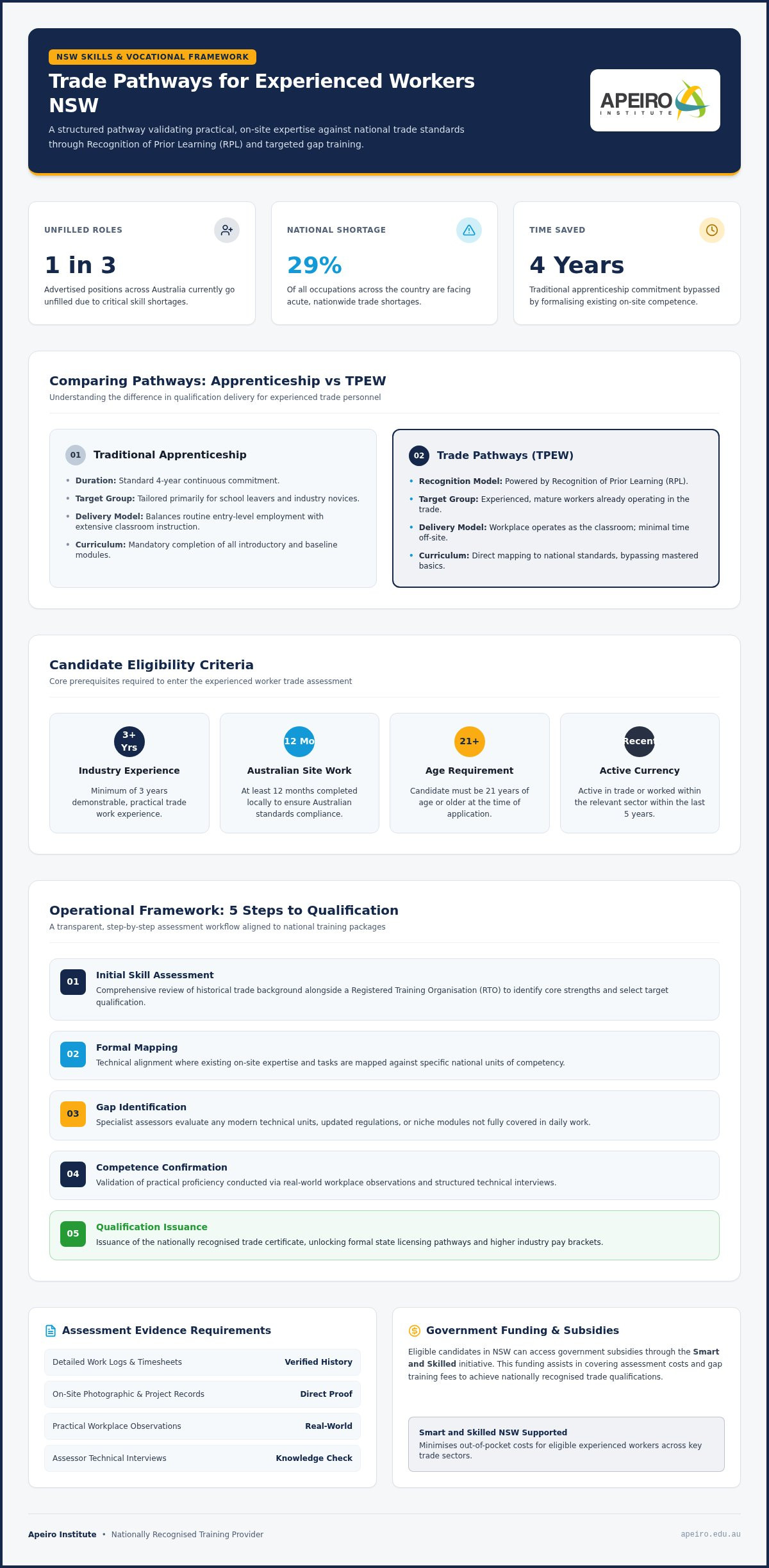
The Trade Pathways for Experienced Workers NSW initiative is a targeted program designed to bridge the gap between years of on-site experience and formal certification. It isn't just another course; it's a strategic response to the fact that nearly one in three advertised positions in Australia goes unfilled. By formalising the skills of veteran workers, the NSW Government aims to address the 29% of occupations currently facing nationwide shortages. For you, this means your time on the tools is finally recognised as a legitimate asset. Instead of sitting through introductory modules you mastered years ago, you can jump straight to the assessment phase. This pathway is the key to unlocking higher pay brackets and the formal licensing required to sign off on major projects.
The Difference Between an Apprenticeship and TPEW
Traditional apprenticeships are usually the starting point for school leavers, requiring a four-year commitment that balances work with extensive classroom time. While this suits beginners, it's often a poor fit for someone with a mortgage and a decade of experience. In contrast, Trade Pathways for Experienced Workers NSW focuses on Recognition of Prior Learning (RPL). This approach acknowledges that your workplace is your primary classroom. By mapping your existing expertise against the national vocational education and training (VET) framework, we can drastically reduce your time away from the site. You'll spend less time in a desk chair and more time proving your competence through practical evidence, which maximises your productivity while you earn your qualification.
Who is Eligible for Experienced Worker Trade Pathways?
To access these streamlined pathways, you generally need to demonstrate at least three years of relevant industry experience. At least 12 months of this work must have been completed within Australia to ensure you're familiar with local standards and safety regulations. You also need to be 21 years of age or older and be currently active in your trade or have worked in the sector within the last five years. Whether you're in the automotive sector or the electronics field, this pathway is open to those who aren't currently registered as apprentices or trainees. It's a professional route specifically built for mature workers who are ready to formalise their status and take the next step in their career.
How the Trade Pathway Framework Operates
The operational framework for Trade Pathways for Experienced Workers NSW is designed to be a transparent, step-by-step journey that respects your time and previous efforts. It moves away from the rigid structure of traditional schooling, focusing instead on a logical progression that validates what you already know. The process is methodical and highly organised, ensuring you're never overwhelmed by paperwork or technical jargon. By following this structured approach, you can move from an uncertified worker to a qualified professional with clarity and precision.
- Step 1: Initial Skill Assessment – You'll begin with a comprehensive review of your trade history with a Registered Training Organisation (RTO). This conversation identifies your strengths and determines the best qualification for your goals.
- Step 2: Formal Mapping – Your years of on-site experience are formally mapped against national training packages. This technical stage aligns your practical work with specific units of competency.
- Step 3: Gap Identification – Assessors look for any modern units or specific technical requirements you haven't yet covered in your daily work.
- Step 4: Competence Confirmation – Through practical workplace observations or technical interviews, you'll demonstrate your skills in a real-world context to confirm your proficiency.
- Step 5: Qualification Issuance – Once all requirements are met, you're issued a nationally recognised trade qualification, opening doors to licensing and better pay.
The Crucial Role of Recognition of Prior Learning
Recognition of Prior Learning (RPL) is the engine that makes this entire pathway possible. It's a formal process that evaluates your non-formal and informal learning – the skills you've picked up on the job – and measures them against official training standards. Instead of learning how to use tools you've handled for a decade, RPL allows you to skip the basics. It acts as a bridge between your current situation and your future career objectives. For those ready to start, the Apeiro Institute TPEW program provides specialized assessment support to ensure your existing expertise is fully captured and credited.
Addressing Skill Gaps Without Starting Again
If your assessment reveals a few missing units, don't worry. You won't be sent back to the start of a four-year course. Gap training involves targeted modules designed to fill those specific technical holes. For example, you might be an expert mechanic who just needs a refresher on the latest hybrid vehicle diagnostic tools. These modules are flexible and built around your existing working schedule, so you don't have to sacrifice your weekly pay to get certified. If you're looking to formalise your expertise, you can explore your pathway options to see how quickly you could finish.
Funding and Subsidies for Trade Certification in NSW
One of the biggest hurdles for tradespeople isn't the skill level; it's the perceived cost of returning to study. Fortunately, the NSW Government has prioritised vocational training to combat the current skills shortage, meaning you don't have to shoulder the full financial burden alone. The primary vehicle for this support is the Smart and Skilled initiative, which provides government subsidies for specific qualifications. By choosing Trade Pathways for Experienced Workers NSW, you can access these funds to significantly reduce or even eliminate out-of-pocket assessment costs.
The 2026-27 NSW Budget includes a $3.46 billion investment in skills and training, highlighting the state's commitment to building a qualified workforce. For many eligible candidates, the TPEW program is currently offered as fee-free training, meaning the government covers the entire cost of your qualification. To understand the broader landscape of how these subsidies work, you can explore our comprehensive guide to Smart and Skilled funded courses NSW. Keep in mind that funding availability is often capped and depends on the capacity of your chosen Registered Training Organisation (RTO).
Smart and Skilled Eligibility for Experienced Workers
To tap into these subsidies, you must meet the basic Smart and Skilled criteria. This ensures that the funding reaches those most likely to contribute to the local economy. The standard requirements include:
- Being an Australian citizen, a permanent resident, a New Zealand citizen, or a humanitarian visa holder.
- Living or working in New South Wales.
- Being aged 15 years or older and no longer at school.
Mature-aged workers are often prioritised for funding in high-demand sectors like automotive and electronics. If you've been working in the industry for years, you're exactly who these programs are designed to support. The process is straightforward, but you'll need to provide proof of residency and citizenship during your initial application.
Navigating Fee-Free and Subsidised Training Options
While many programs under the Trade Pathways for Experienced Workers NSW banner are fee-free, some qualifications may operate on a co-contribution model. In a co-contribution setup, the government pays the majority of the fee, and you or your employer pay a small remaining balance. You can check the current subsidy status of your specific trade qualification via the Skills NSW website, but the most reliable way to get an accurate quote is to consult an approved provider. They can assess your individual circumstances and confirm exactly how much funding you are eligible to receive before you commit to the assessment process.
Gathering Evidence for Your Trade Assessment
The speed and success of your application for Trade Pathways for Experienced Workers NSW depend almost entirely on the quality of your evidence. Think of your assessment as a legal case where you're proving your expertise to a judge. If your documentation is thin or disorganised, the process slows down while assessors ask for more detail. However, a well-prepared portfolio allows an assessor to verify your competence quickly, often moving you through the pathway much faster than expected. It's not about how much paper you have; it's about how relevant that paper is to the national standards.
There's a common misconception that you need ancient apprenticeship papers or original certificates from decades ago to prove your worth. While those are helpful, they aren't the only way to show you know your stuff. Assessors today value contemporary proof of your current skills. If you've lost your original records, don't panic. Modern evidence like site photos, project logs, and references from current licensed supervisors are often more persuasive because they prove you're up to date with today's industry codes and safety regulations.
Types of Acceptable Workplace Evidence
To build a bulletproof application, you should aim for a variety of evidence types. This gives the assessor a 360-degree view of your capabilities. Key documents include:
- Employment References: Detailed letters from licensed supervisors that list the specific tasks you performed daily.
- Statutory Declarations: These are vital if a previous employer is no longer trading; they allow you to legally swear to your work history.
- Work Samples and Logs: Photos or videos of you performing trade-specific tasks, alongside project logs or job cards.
- Prior Qualifications: This includes expired tickets, white cards, short course certificates, or even overseas trade licences that show a foundation of knowledge.
How to Organise Your Portfolio Efficiently
Don't just dump a folder of loose papers on your assessor's desk. Organising your portfolio by specific trade skill areas makes it much easier for them to tick off units of competency. For example, group all your engine diagnostic evidence together and separate it from your brake system repairs. This logical progression shows you're methodical and professional.
When using workplace photographs, ensure they clearly show you following safe practices and wearing the correct PPE. A photo of a perfect weld is useless if the worker in the background isn't wearing a mask. You should also focus on clear labelling for every item in your portfolio. A photo titled "Hybrid Battery Installation March 2026" is infinitely more valuable than one named "IMG_0042". Clear titles help the assessor find exactly what they need without having to guess your intent.
Start your skill assessment today
Accelerate Your Career with Apeiro Institute
Earning your trade qualification shouldn't mean pausing your life or sacrificing your weekly income. As a Registered Training Organisation (RTO Code 45394), Apeiro Institute acts as a supportive mentor to help you formalise your practical expertise. We specialise in helping busy professionals translate their on-site experience into official credentials. Our tailored approach minimises structural stress by handling the heavy lifting of the assessment framework for you. By choosing the right partner, you can navigate the Trade Pathways for Experienced Workers NSW initiative with absolute confidence and minimal disruption to your daily routine.
Targeted Trade Qualifications on Offer
We provide streamlined pathways for high-demand technical sectors across New South Wales. If you're an automotive professional looking to step up, the AUR30620 Certificate III in Light Vehicle Mechanical Technology pathway allows you to formalise your mechanical expertise. For those working in technical layout and repair, we offer the UEE30920 Certificate III in Electronics and Communications pathway. Because these qualifications are nationally recognised, they grant you the professional mobility to work anywhere in Australia once your assessment is complete.
Why Skilled Workers Partner with Apeiro Institute
Working with us means you're partnering with industry experts who respect the realities of working on the tools. Our dedicated assessors don't expect you to memorise textbook definitions; they focus on your real-world capability. We pride ourselves on cultivating a welcoming learning community that supports students from diverse backgrounds, combining high-level expertise with a genuine, person-to-person touch. We deliver NSW Smart and Skilled funded training options to ensure eligible candidates can access subsidised places. Our streamlined processes are designed to cut through red tape, getting you certified and ready for formal licensing without unnecessary delays.
Ready to take the next step? Enquire about Trade Pathways at Apeiro Institute today.
Take the Next Step on Your Trade Journey
Your years on the tools have given you real expertise, and it's time your credentials reflected that dedication. Navigating the Trade Pathways for Experienced Workers NSW framework allows you to skip the entry-level basics and focus entirely on what you already know. By gathering your on-site evidence and addressing any technical gaps through targeted training, you can secure a nationally recognised qualification without starting from scratch. This professional milestone is the key to unlocking better pay rates and the formal licensing opportunities required to lead major projects.
As a Registered Training Organisation (RTO Code 45394), Apeiro Institute is here to act as your supportive mentor throughout the assessment process. Our expert assessors bring real industry experience to the table, ensuring your practical skills are evaluated fairly and efficiently. We also provide access to NSW Smart and Skilled funded positions, helping eligible candidates reduce their out-of-pocket costs significantly. You don't have to let a lack of formal papers hold your career back any longer.
Get Trade Certified with Apeiro Institute
We look forward to welcoming you into our community and helping you achieve the professional recognition you've earned.
Frequently Asked Questions
What is the Trade Pathways for Experienced Workers NSW program?
The Trade Pathways for Experienced Workers NSW program is a state government initiative designed to help mature workers formalise their years of on-site experience into a nationally recognised trade qualification. It targets skilled individuals who lack formal papers, allowing them to bypass traditional four-year apprenticeships. The program uses Recognition of Prior Learning (RPL) to evaluate your existing skills against national training packages, providing a faster route to trade licensing and better pay rates.
How long does it take to get trade certified through this pathway?
Getting certified through this pathway typically takes anywhere from a few weeks to several months, depending on the quality of your portfolio. Because the process relies on mapping your existing skills, well-organised evidence allows assessors to review your application quickly. If you need to complete gap training for modern units, this can add a little extra time, but it remains a fraction of the time required for a standard apprenticeship.
Can I get a trade qualification based entirely on my overseas experience?
No, you cannot qualify based entirely on overseas experience because the program requires a local component to ensure safety compliance. While your international work history provides a fantastic foundation, you must have a minimum of 12 months of experience working within Australia. This ensures you're completely familiar with Australian standards, local building codes, and workplace health and safety regulations before a qualification is issued.
Is government funding available for experienced worker pathways in NSW?
Yes, significant government funding is available for eligible candidates through the NSW Smart and Skilled initiative. The government has heavily subsidised vocational training to combat critical skills shortages across the state, which can dramatically reduce your out-of-pocket assessment costs. In many cases, eligible students can access fee-free training places, meaning the entire cost of the qualification is covered by state funding allocations.
What happens if the assessment reveals gaps in my trade knowledge?
If your assessor identifies specific areas where your knowledge doesn't meet current national standards, you'll be enrolled in targeted gap training. You won't have to restart the qualification from the beginning. Instead, you'll complete specific, flexible modules designed to fill those exact technical holes, allowing you to maintain your full-time employment while you finish the remaining requirements.
Do I need to attend regular classroom lectures to complete the process?
No, you don't need to sit through regular classroom lectures because this pathway is built specifically around the schedules of busy working professionals. The assessment focuses heavily on workplace evidence, technical interviews, and on-site observations. Any necessary gap training is delivered flexibly, ensuring you don't have to sacrifice your weekly income or take extended time off the tools to get certified.
What specific documents do I need to provide for an RPL assessment?
To secure your Trade Pathways for Experienced Workers NSW certification, you must provide a comprehensive portfolio of workplace proof. This includes detailed employment references from licensed supervisors, statutory declarations, and clear photos or videos of you performing tasks on-site. You can also submit prior qualifications, expired tickets, white cards, or overseas licences to demonstrate your foundational industry competence.

Disclaimer
The information provided on this blog is for general informational and educational purposes only. While every effort is made to ensure the accuracy and reliability of the content, the author makes no representations or warranties of any kind, express or implied, about the completeness, accuracy, suitability, or availability of the information contained on this blog.
The views and opinions expressed in blog posts are those of the individual author and do not necessarily reflect the official policy or position of any organization, company, or employer.
This blog may contain links to external websites or third-party content. These links are provided for convenience only, and the author has no control over and assumes no responsibility for the content, privacy policies, or practices of any third-party sites.
Nothing on this blog constitutes professional advice (legal, financial, medical, or otherwise). Readers are encouraged to seek appropriate professional guidance before making any decisions based on the information provided here.
By using this blog, you acknowledge that any reliance on the information is at your own risk.


