

If you’re comparing Diploma of Automotive Technology options, the course with the most impressive title isn’t automatically the right fit. Check what the qualification covers, how it compares with Certificate III or Certificate IV study, and whether it suits your experience and goals.
Choosing a Diploma of Automotive Technology takes more than comparing course names. Check the qualification details, delivery and assessment arrangements, entry requirements, study commitment and the provider’s current information. These practical checks can help you make a confident decision before you enquire or apply.
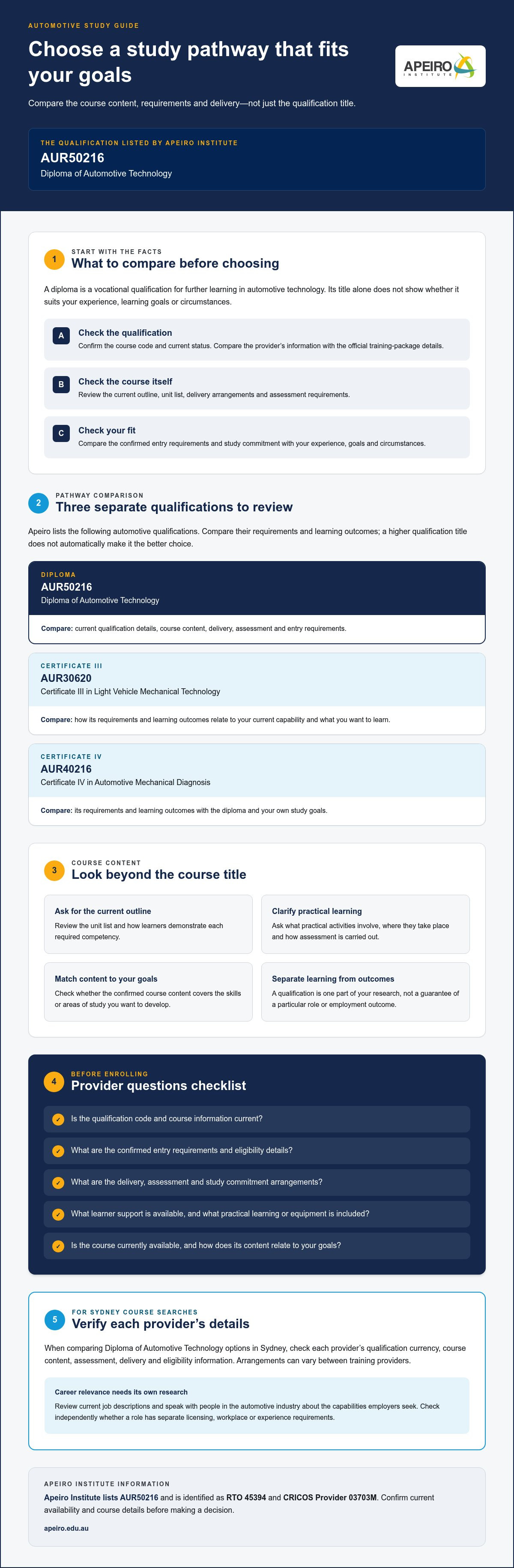
This guide explains what the AUR50216 Diploma of Automotive Technology may offer and how to compare it with other automotive pathways. You’ll find questions to ask about course content, delivery, eligibility and availability. Apeiro Institute lists the diploma among its offerings, but the right choice depends on your circumstances and confirmed course details, not the title alone.
Key Takeaways
- Check the current qualification details and compare the course content with your existing skills and goals.
- Compare the diploma with Certificate III and Certificate IV pathways by reviewing requirements and learning outcomes, not the qualification title alone.
- When researching Diploma of Automotive Technology Sydney options, verify each provider’s course currency, content, assessment, delivery and eligibility information.
- Use a pre-enrolment checklist to ask about entry requirements, study commitment, learner support and arrangements relevant to your circumstances.
- Apeiro Institute lists AUR50216 and is identified as RTO 45394 and CRICOS Provider 03703M. Confirm current availability and course details before deciding.
What is a Diploma of Automotive Technology, and who may it suit?
A Diploma of Automotive Technology is a vocational qualification for further learning in automotive technology. Apeiro Institute lists it as AUR50216 Diploma of Automotive Technology. Before choosing a course, check that the qualification code and status are current, then compare the provider’s course information with the official training-package details. This helps you assess what the course covers instead of relying on its title.
What does the Diploma of Automotive Technology represent?
Automotive technology can cover knowledge and skills related to how vehicles and their systems are designed, built and operated. For a broad introduction, see Automotive engineering. That overview isn’t a substitute for the qualification’s official description, units or assessment requirements. Check those details, along with how the provider delivers and assesses the course. Arrangements can vary between training providers.
The diploma is distinct from certificate-level automotive study, but “higher qualification” doesn’t automatically mean “better choice”. Apeiro also lists AUR30620 Certificate III in Light Vehicle Mechanical Technology and AUR40216 Certificate IV in Automotive Mechanical Diagnosis. These are separate qualifications, and the most suitable option depends on your current capability and what you want to learn. Review the Certificate III in Light Vehicle Mechanical Technology as one point of comparison.
Who should consider this automotive qualification?
The course may be worth investigating if you’re looking to develop automotive skills through formal vocational study, including if you already have relevant work or training experience. Start with your goals. Identify the knowledge you want to build and how it might relate to the work you’re pursuing. Then compare your experience with the provider’s confirmed entry requirements. Don’t assume previous study automatically meets them or that one qualification guarantees entry to another.
If you’re searching for a Diploma of Automotive Technology Sydney course, use the same checks: confirm the qualification’s current status, course content, eligibility and delivery arrangements with the provider. This guide can help you assess your options, but it can’t determine your eligibility or promise a particular job outcome. Begin by checking whether your starting point, learning goals and the verified course requirements align.
What should you check about the diploma’s content and outcomes?
A course title is only a starting point. To understand what AUR50216 covers, compare the provider’s outline with its current entry on training.gov.au, the National Training Register. The register provides qualification information, while the provider explains how it delivers the course to learners.
Qualification requirements define the nationally specified training. Timetables, delivery modes, assessment activities and learner support are provider-specific arrangements to confirm before enrolling. Check that the course information is current and that its qualification code matches the course you’re considering.
How to assess the course content
Ask for the current course outline and unit list, then find out how learners demonstrate each required competency. Assessment may include practical activities, but don’t assume a particular format, workshop access or equipment is included. Ask the provider what practical learning involves, where it takes place and how assessment is carried out.
Next, compare the confirmed content with your goals. If you want to build on existing automotive experience, check whether the listed learning addresses the skills you’re aiming to develop. Don’t rely on broad promises or assume that specialist topics are covered. Ask whether a particular system or area of study appears in the current course.
How to understand possible career relevance
Use the qualification information as one part of your research, not as a guarantee of a particular role or employment outcome. Review current job descriptions and speak with people in the automotive industry about the capabilities employers seek. Ask the provider how the course content relates to your goals, and independently check whether a role has separate licensing, workplace or experience requirements.
Apeiro’s Certificate III light vehicle mechanic guide offers a related pathway to explore. Certificate III and diploma qualifications are distinct, so compare their official requirements and content rather than assuming one automatically leads to the other.
Before deciding, ask Apeiro Institute for its latest AUR50216 course information and confirm availability, content, delivery and assessment details. You can also review the Certificate III in Light Vehicle Mechanical Technology course page if you’re considering an alternative starting point.
How does the diploma compare with other automotive study pathways?
Qualification titles are a useful starting point, but they don’t tell you whether a course suits your background or goals. Apeiro lists AUR50216 Diploma of Automotive Technology, AUR30620 Certificate III in Light Vehicle Mechanical Technology and AUR40216 Certificate IV in Automotive Mechanical Diagnosis. Confirm each qualification’s current status and availability before comparing options.
| Pathway | What to compare | Questions to ask |
|---|---|---|
| Certificate III AUR30620 |
The listed qualification is in light vehicle mechanical technology. Check its current official description and course content. | Does the content match the skills you want to build, and what are the entry requirements? |
| Certificate IV AUR40216 |
The listed qualification is in automotive mechanical diagnosis. Verify its current units, requirements and provider delivery details. | Does the course suit your existing training and the learning you’re seeking? |
| Diploma AUR50216 |
Check the current qualification description, required units and entry criteria rather than relying on the title. | Does the content align with your experience and intended direction? |
These are comparison prompts, not a claim that one qualification automatically follows another. The national register link supplied for the nationally recognised Diploma of Automotive Technology points to AUR50212, not AUR50216. Don’t use that record to confirm AUR50216. Check the exact code and current qualification details on the National Training Register before deciding.
When comparing Diploma of Automotive Technology Sydney options, weigh your prior training, current experience, desired learning and each provider’s verified entry criteria. A higher qualification level alone doesn’t establish the best route. The Certificate III in Light Vehicle Mechanical Technology is another option to investigate. Compare its current course details with the diploma rather than assuming either is the right starting point.
Could recognition of prior learning be relevant?
If you’ve built skills through work, ask whether Recognition of Prior Learning (RPL) may be suitable. RPL assesses evidence of your skills against relevant requirements. Experience alone doesn’t guarantee credit or a qualification, and you may need to show how your evidence demonstrates the required competency. Ask what evidence is needed, how assessment works and whether you may need to address any gaps.
Experienced workers can explore Apeiro’s Trade Pathways for Experienced Workers information and read the Australian trade pathways guide. Confirm current options and assessment requirements directly with the provider.
What should you ask a provider before enrolling in an automotive diploma?
A course page may not answer every question that matters to your decision. Before enrolling in a Diploma of Automotive Technology Sydney course, ask the provider to confirm key details and provide current information in writing. This is especially useful if eligibility, study commitments or course availability could affect your plans.
Pre-enrolment checklist
- Is the qualification current? Confirm the exact course code and qualification status. Check the provider’s RTO registration against current official records, and ask whether the course is currently available.
- What entry requirements apply? Ask about required prior study, experience, evidence or documents. If you have previous training or workplace experience, check how it will be considered and whether an assessment is needed.
- Who can enrol? Confirm whether the course is available to learners in your circumstances. Ask whether your learner category or other individual factors affect eligibility or access, and check relevant course registration details where applicable.
- How is the course delivered? Request written details of the delivery mode, attendance expectations and expected study commitment. Don’t assume the arrangements are the same as another provider’s.
- How are learning and assessment organised? Ask for the current course outline, assessment approach and any practical learning requirements. Clarify what activities are involved and how competency is assessed.
- What support is available? Ask what academic, administrative and practical learner support the provider offers, how to access it, and whether it suits your needs.
Apeiro Institute is listed as RTO 45394 and CRICOS Provider 03703M. You can check provider details against current official registers, then ask Apeiro to confirm the course’s availability, qualification status, learner eligibility and any relevant CRICOS details. Registration details alone don’t confirm that a particular course is available or that you meet its entry requirements.
Keep the answers together and compare like with like. A useful rule is to confirm the course, check your eligibility, understand the study arrangements and get decision-critical details in writing. That gives you a clearer basis for comparing providers without relying on assumptions.
How can Apeiro Institute help you explore the Diploma of Automotive Technology?
Apeiro Institute is listed as RTO 45394 and CRICOS Provider 03703M, and lists AUR50216 Diploma of Automotive Technology among its offerings. Treat this as a starting point for an enquiry, not confirmation that the course is currently available or suitable for you. Confirm its current status, availability and delivery arrangements directly with the institute before making plans.
What to confirm with Apeiro before making a decision
Have your questions and background ready. If you’ve completed automotive study or gained skills through work, explain what you’ve done and ask how that experience may be considered. Recognition of Prior Learning involves an assessment process, so don’t assume experience will result in credit or a particular outcome.
Ask Apeiro for current written information about:
- the qualification code, course availability and current course outline
- entry requirements and any documents or prior learning evidence to provide
- delivery arrangements, expected study commitment and assessment methods
- how your previous automotive study or experience may be assessed
- whether the course is available to you, and any relevant CRICOS information for your circumstances
These details can affect your decision, so understand them before applying. If anything is unclear, ask the provider to explain it in practical terms. For example, clarify what the assessment involves or what evidence may be needed to demonstrate previous learning.
Take your next step with confidence
When weighing up a Diploma of Automotive Technology Sydney option, focus on four checks: does the course fit your goals, have you verified the details, have you checked the provider’s registration, and do the entry requirements suit your background? Assess Apeiro using the same questions you’d ask any provider.
You don’t need every detail worked out before making an enquiry. Share your experience, explain what you hope to learn and ask about anything that could affect your decision. Confirm the answers before enrolling, then choose the pathway that best fits your circumstances.
Make your next course decision with confidence
The right automotive pathway depends on more than a qualification title. Compare confirmed course content and entry requirements with your skills and goals, then check delivery, assessment and eligibility directly with the provider. These steps can help you decide whether a Diploma of Automotive Technology Sydney option suits your plans.
Apeiro Institute is listed as RTO 45394 and CRICOS Provider 03703M, and AUR50216 Diploma of Automotive Technology appears among its listed offerings. Before deciding, ask Apeiro to confirm the qualification’s current status and availability, along with course details, entry requirements, delivery arrangements and any learner-specific eligibility information. Provider registration is useful to verify, but doesn’t confirm a particular course’s current availability or suitability.
Bring your questions and background to the conversation. You can ask how your previous study or work experience may be considered without assuming a particular RPL or enrolment outcome.
A considered choice starts with clear information. Check the details, then choose a pathway that fits your plans. To explore Apeiro’s AUR50216 Diploma of Automotive Technology, contact the institute and ask about its current course information and availability.
Frequently Asked Questions
What is a Diploma of Automotive Technology?
It’s a vocational qualification in the automotive training sector. The scope and course content depend on current qualification information and the provider’s course arrangements, so check both before deciding. Apeiro Institute lists AUR50216 Diploma of Automotive Technology among its offerings. Confirm the qualification’s current status, availability, entry requirements, delivery mode and assessment arrangements directly with the provider before applying.
What can you do with a Diploma of Automotive Technology?
The qualification may support further automotive skill development, but it doesn’t guarantee a particular job or career outcome. Relevant roles depend on the training completed, your experience, employer requirements and current industry expectations. Review the course content and compare it with capabilities requested in job descriptions for work you’re considering. You can also discuss your goals with the provider and ask how the course learning may relate to them.
How do I choose a Diploma of Automotive Technology course?
Confirm the qualification code and current status, then compare course content, entry requirements, delivery, assessment and learner support. If you’re comparing Diploma of Automotive Technology Sydney options, ask each provider for current written information so you can assess the details side by side. Check whether the course fits your experience and goals, and confirm your eligibility before applying. The course title alone won’t tell you whether it’s the right choice.
Is the Diploma of Automotive Technology suitable if I already have automotive experience?
It may be worth exploring, but your experience doesn’t automatically meet entry requirements or guarantee credit towards the qualification. Explain your previous work and study to the provider, then ask how prior learning is assessed, what evidence you’ll need and whether Recognition of Prior Learning (RPL) is available for the course. Confirm any credit or assessment outcome with the provider after the relevant process is completed.
Can I use RPL towards an automotive diploma?
RPL may be an option if the provider offers an applicable assessment pathway for the qualification. The outcome depends on evidence being assessed against relevant requirements, so it isn’t automatic credit or a guaranteed shortcut to certification. Ask what documents, workplace examples or demonstrations may be required, and whether RPL applies to the specific diploma you’re considering. The provider can explain the assessment process and help you understand what evidence to prepare.
How long does a Diploma of Automotive Technology take?
Study duration varies by provider and may depend on course structure, delivery arrangements, your circumstances and any prior learning formally recognised. Ask for the current expected duration, study commitment and assessment schedule, including any conditions that could affect completion. Get these details in writing before enrolling so you can plan around work and other responsibilities. Don’t rely on a general estimate unless the provider confirms it applies to your course.
Is the Diploma of Automotive Technology nationally recognised?
Check the current qualification status on authoritative Australian training information, and confirm the exact course code and relevant registration details with the provider. RTO registration alone doesn’t confirm every course-specific detail or availability. Apeiro Institute is listed as RTO 45394 and lists AUR50216 Diploma of Automotive Technology among its offerings. Verify the current qualification status and ask Apeiro to confirm its availability and delivery arrangements before applying.
Disclaimer
The information provided on this blog is for general informational and educational purposes only. While every effort is made to ensure the accuracy and reliability of the content, the author makes no representations or warranties of any kind, express or implied, about the completeness, accuracy, suitability, or availability of the information contained on this blog.
The views and opinions expressed in blog posts are those of the individual author and do not necessarily reflect the official policy or position of any organization, company, or employer.
This blog may contain links to external websites or third-party content. These links are provided for convenience only, and the author has no control over and assumes no responsibility for the content, privacy policies, or practices of any third-party sites.
Nothing on this blog constitutes professional advice (legal, financial, medical, or otherwise). Readers are encouraged to seek appropriate professional guidance before making any decisions based on the information provided here.
By using this blog, you acknowledge that any reliance on the information is at your own risk.


