

What if the biggest hurdle to growing your business wasn't a lack of talent, but simply the cost of training it? Understanding the financial benefits of hosting a trainee in NSW can change your perspective on recruitment entirely. It's a question many workshop owners and electronics firms face as they grapple with rising labour costs and a genuine shortage of skilled technicians. You've probably felt the frustration of complex government paperwork or the worry that hiring someone new will stretch your budget too thin. It's a common challenge, but it doesn't have to be your reality.
By tapping into specific state incentives and federal wage subsidies, you can significantly lower your payroll tax and access direct funding to support new staff. This article explores how to navigate the 2026 Australian Apprenticeships Incentive System and NSW-specific rebates like the icare premium reduction. We'll provide a clear roadmap to help you build a loyal, bespoke workforce that understands your business from the ground up, all while keeping your overheads manageable and your growth on track.
Key Takeaways
- Discover why shifting from external recruitment to internal talent development is a cost-effective strategy for future-proofing your local business.
- Understand the 2026 Australian Apprenticeships Incentive System and how to secure priority wage subsidies for high-demand technical trades.
- Identify the direct financial benefits of hosting a trainee in NSW, including specific payroll tax rebates and icare insurance premium reductions.
- Explore how the NSW Smart and Skilled program provides fee-free training options to eliminate out-of-pocket costs for eligible staff and employers.
- Learn how partnering with an expert Registered Training Organisation can streamline complex government paperwork and reduce your daily administrative workload.
The ROI of Workplace Training: Why NSW Employers are Hosting Trainees
Finding a qualified technician in NSW right now feels like looking for a needle in a haystack. The cost of traditional recruitment, including agency fees and the risk of a "bad hire," continues to climb. This is why many savvy business owners are shifting their focus toward "growing their own" talent. By looking at the financial benefits of hosting a trainee in NSW, you'll see that it's more than just a social contribution; it's a strategic investment in your bottom line. It's about taking control of your future workforce instead of waiting for the market to provide it.
While people often use the terms interchangeably, there are distinct paths within apprenticeships and traineeships in Australia. Generally, apprenticeships focus on traditional "trade" roles and take longer to complete. Traineeships are often shorter, typically lasting one to two years, and cover a broader range of vocational areas. Both pathways allow you to mould a worker to your specific shop standards from day one. This ensures they learn your way of doing things, which reduces errors and improves efficiency over time.
Addressing the Skills Gap in Local NSW Industries
Traditional hiring is increasingly expensive because you're paying a premium for someone else's training and potentially their bad habits. When you host a trainee, you create a worker who understands your specific workflows and customer service standards. In high-growth sectors like electronics or automotive, this bespoke training is invaluable. It builds a sense of loyalty that you simply won't find with a contractor. This reduced turnover is one of the most significant indirect financial benefits of hosting a trainee in NSW, as it saves you the thousands of dollars typically spent on re-hiring and onboarding every few years.
The Long-Term Productivity Argument
The "break-even" point for a trainee often happens sooner than most employers expect. While there's an initial period of supervision, the productivity gains of having an extra pair of hands that you've trained your way are immense. Partnering with an RTO like Apeiro Institute ensures the off-the-job training remains industry-relevant and practical. For instance, a student enrolled in a Certificate III in Light Vehicle Mechanical Technology brings fresh, up-to-date knowledge back to your workshop. This ensures they transition from a learner to a high-performing technician who contributes to your business's long-term profitability and success.
Federal Incentives: The Australian Apprenticeships Incentive System (AAIS) in 2026
The federal landscape for vocational training saw a significant shift on January 1, 2026, with the updated Australian Apprenticeships Incentive System (AAIS). This system is designed to direct funding where it's needed most, specifically targeting industries facing critical skills shortages. For local business owners, understanding these changes is essential to unlocking the full financial benefits of hosting a trainee in NSW. These federal payments are designed to offset the costs of supervision and training, making it much more affordable to bring on a new team member. They act as a financial bridge, allowing you to focus on mentoring while the government supports the wage bill.
Wage Subsidies for Priority Occupations
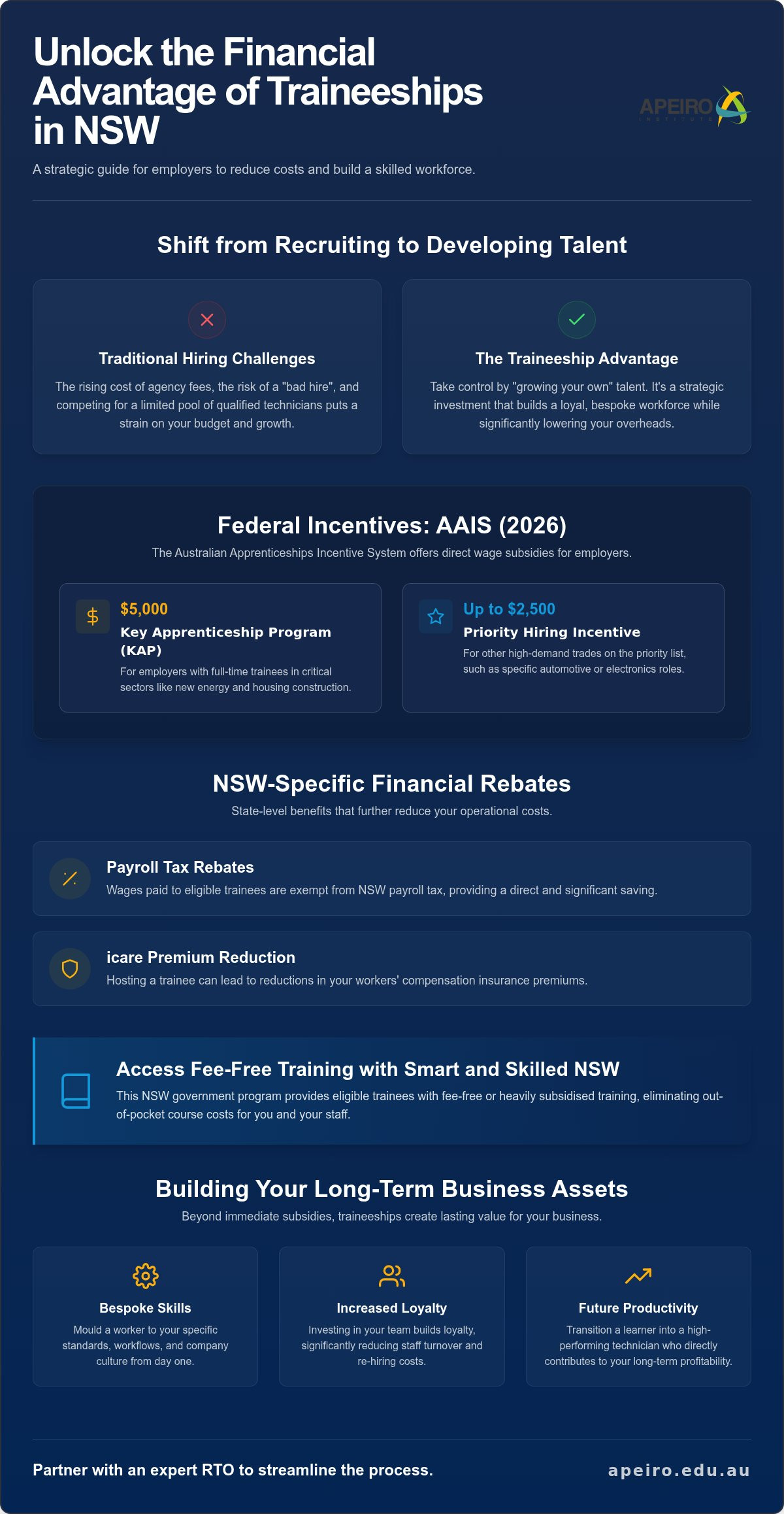
Under the 2026 guidelines, the Key Apprenticeship Program (KAP) offers $5,000 for employers of full-time trainees in the new energy and housing construction sectors. If your trade is on the priority list but not covered by KAP, such as certain automotive or electronics roles, the Priority Hiring Incentive provides up to $2,500 for full-time commencements. These incentives are claimed through an Australian Apprentice Connect Australia Provider (AACAP). They act as your primary point of contact for managing eligibility and ensuring you meet the required claim milestones throughout the training contract. For any traineeships that commenced before January 1, 2026, the previous rate of $5,000 continues to apply.
Hiring Incentives for New Entrants
A key distinction in the AAIS is whether your trainee is a "new entrant" or an "existing worker." The highest levels of support are typically reserved for new entrants to encourage fresh talent into your industry. This federal support reduces the initial financial risk of hiring by providing cash flow at critical stages of the traineeship. Beyond standard incentives, there is specific wage support for employers who hire apprentices with a disability through the DAAWS program, which offers $226.01 per week for full-time roles. This can also be combined with tutorial and mentor services worth up to $5,500 per year. If you're unsure where your trade sits on the 2026 priority list, you can explore our trade pathways to see how these incentives apply to your industry.
NSW-Specific Financial Rebates: Payroll Tax and Workers Compensation
While federal subsidies provide a solid foundation, the financial benefits of hosting a trainee in NSW extend deep into state-level expenses. Many local employers overlook the potential to claw back significant costs through payroll tax rebates and workers' compensation adjustments. These are not just "nice to haves"; they are essential components of a cost-effective recruitment strategy. By understanding how these state-specific programs work, you can effectively lower your overheads while investing in the future of your workshop or electronics firm.
Calculating Your NSW Payroll Tax Rebate
If your business is liable for payroll tax in NSW, you may be eligible for a rebate on the wages you pay to approved apprentices and new entrant trainees. This rebate acts as a direct offset against your total tax liability. It's important to remember that this generally applies to "new entrants." These are individuals who haven't worked for you for more than three months full-time or 12 months part-time before starting their traineeship. You'll need to maintain accurate records and apply through Revenue NSW, providing your training contract as evidence. It's a straightforward way to ensure that taking on a new learner doesn't penalise your growth.
Icare Workers Insurance Incentives
Insurance costs can be a major pain point for growing businesses. The icare Apprentice Incentive Scheme offers a practical solution by providing premium reductions based on the wages paid to your trainees. To qualify, your trainee must be registered under an approved training contract in NSW. Once your policy is updated to reflect their status, the reduction is typically calculated during your annual premium renewal or adjustment. It's a proactive way for the NSW government to reward businesses that take on the responsibility of trade training. Ensure your policy details are current to avoid missing out on these automatic savings.
The real magic happens when you stack these state rebates with the federal AAIS subsidies mentioned earlier. For example, a business in the automotive sector might receive a federal wage subsidy while simultaneously reducing their NSW payroll tax and lowering their icare premiums. When you combine these with fee-free training options, the net cost of hiring a trainee becomes a fraction of a standard recruitment. This multi-layered support system transforms a trainee from a potential financial burden into a sustainable asset for your business. It allows you to build a skilled team without the heavy financial weight usually associated with expansion.
Smart and Skilled NSW: Accessing Fee-Free and Subsidised Training
The NSW Government's Smart and Skilled program is a vital resource for local businesses. It ensures that the cost of high-quality vocational education doesn't fall solely on the shoulders of the employer or the student. This is a central part of the financial benefits of hosting a trainee in NSW. For trainees who commence their journey before June 30, 2027, the program provides fee-free training that covers student fees up to $2,000. It effectively eliminates one of the biggest upfront costs of staff development. This allows you to invest your capital back into your workshop or firm, focusing on growth rather than tuition invoices.
Subsidised Qualifications in Trades and Electronics
When you explore Smart and Skilled funded courses NSW, you'll find that Certificate III level qualifications are the "sweet spot" for many industries. These courses are designed to produce job-ready technicians who understand the modern requirements of electronics and mechanical technology. Comparing out-of-pocket costs for non-funded training versus a Smart and Skilled pathway reveals a massive difference in ROI. By choosing a subsidised path, you're securing expert training that is industry-aligned and nationally recognised, all while keeping your overheads significantly lower than traditional recruitment paths. It's a practical way to upskill your team without straining your cash flow.
The RTO’s Role in Funding and Compliance
Navigating government portals and eligibility rules can be a confusing task for any busy manager. This is where the right training partner becomes invaluable. Apeiro Institute manages the entire enrolment and reporting process for the Smart and Skilled program, taking the administrative burden off your desk. We verify that your trainee meets the essential "living or working in NSW" criteria and handle the complex compliance reporting required by the Department of Education. This streamlined approach ensures you reap the financial benefits of hosting a trainee in NSW without the associated "paperwork headache." It leaves you free to focus on what you do best: running a successful business and mentoring your new team member.
Check your eligibility for Smart and Skilled funding today
Partnering with Apeiro Institute for Traineeship Success
Choosing the right training partner is the final piece of the puzzle. While the financial benefits of hosting a trainee in NSW provide the motivation, the quality of your Registered Training Organisation (RTO) determines the long-term success of your new hire. At Apeiro Institute, we don't just deliver a curriculum; we work alongside you to ensure the training matches the daily realities of your business. We act as a bridge between classroom theory and the specific technical skills your workshop requires to stay competitive. It's about turning a student into a productive team member who understands your standards.
We offer tailored training plans for the Certificate III in Electronics and Communications, helping your staff stay ahead of rapid technological shifts. For those in the automotive sector, our support for the Certificate III in Light Vehicle Mechanical Technology focuses on producing confident, job-ready mechanics. You can find more detail on this specific pathway in our 2026 mechanic career guide. These programs are designed to be practical, ensuring that every hour of study translates into better performance on the shop floor.
Industry-Focused Training Delivery
Our delivery models are built with the modern Australian workforce in mind. We understand you can't afford to have your staff away from the tools for extended periods, so we offer flexible options that minimise disruption to your business operations. If you have an experienced worker who needs a formal qualification, our TPEW (Trade Pathways for Experienced Workers) program uses Recognition of Prior Learning (RPL) to fast-track their certification. This approach maximises the financial benefits of hosting a trainee in NSW by reducing the time spent in off-site training and increasing their billable hours sooner.
Getting Started: Your Checklist for 2026
Taking the first step toward a more skilled workforce is simpler than you might think. Follow this checklist to get your traineeship off the ground:
- Contact an Apprentice Connect Australia Provider: They'll help you register the training contract and confirm your eligibility for 2026 federal wage subsidies.
- Select Apeiro Institute as your RTO: We'll then collaborate with you to develop a training plan that fits your workshop's specific schedule and technical needs.
- Organise internal mentoring: Identify a qualified supervisor who can guide the trainee through their daily tasks and ensure they're learning safely.
By following these steps, you'll transform a skills shortage into a strategic advantage. You'll build a loyal, expert team that is trained exactly the way you need them to be, while keeping your business overheads under control.
Invest in Your Future Workforce Today
Integrating a new team member into your business is a strategic move that pays dividends. By leveraging the financial benefits of hosting a trainee in NSW, you can effectively lower labour costs while solving the skills gap in your workshop or electronics firm. We've explored how federal wage subsidies and state-based rebates like payroll tax offsets work together to create a sustainable growth model. It's about turning a recruitment challenge into a long-term asset for your brand.
As specialists in electronics and automotive trade pathways, Apeiro Institute (RTO 45394) provides the nationally recognised training your staff need to excel. We offer expert guidance on NSW government funding eligibility to ensure you don't miss out on available support. Our team handles the heavy lifting of compliance and reporting so you can focus on your daily operations without the administrative headache.
Taking the next step doesn't have to be daunting. With the right incentives and a dedicated training partner, you're well on your way to building a skilled, loyal team that will drive your business forward for years to come.
Frequently Asked Questions
What is the maximum wage subsidy I can get for a trainee in NSW in 2026?
Employers of full-time trainees in priority sectors can access up to $5,000 in the first year through the Key Apprenticeship Program. For other priority occupations, the hiring incentive provides up to $2,500 for full-time commencements. These 2026 federal subsidies are designed to support your business during the initial training phase. You can also access ongoing wage support of $226.01 per week if your trainee has a disability, ensuring inclusive hiring remains financially viable.
Do I have to pay payroll tax on a trainee’s wages in NSW?
You can claim a rebate on payroll tax for the wages paid to approved apprentices and new entrant trainees in NSW. This is one of the direct financial benefits of hosting a trainee in NSW, as it effectively reduces your total tax liability. It's important to remember that this rebate typically applies to new entrants rather than existing staff members. You should consult Revenue NSW to confirm current rates and ensure your documentation is correct.
How does the Smart and Skilled program reduce my training costs?
The Smart and Skilled program provides fee-free training for eligible trainees who start their courses before June 30, 2027. This covers student fees that can reach up to $2,000, removing a significant financial barrier for both the employer and the employee. By using this government funding, you can upskill your team without facing high out-of-pocket tuition costs. It allows you to invest your budget into other areas of business growth while building a qualified workforce.
Can I get financial benefits for an existing staff member who starts a traineeship?
Existing staff members may still be eligible for traineeships, but the financial incentives are often lower than those for new entrants. Most NSW state-level rebates, like the payroll tax offset, specifically target new entrant trainees to encourage fresh recruitment. However, you can still access high-quality training through Smart and Skilled pathways. It’s a practical way to formalise the skills of your long-term team members while still benefitting from subsidised course fees and improved workplace productivity.
What is the difference between an apprentice and a trainee for tax purposes?
For tax purposes, both apprentices and trainees can attract payroll tax rebates in NSW, provided they are new entrants. The main difference lies in the training contract duration and the specific industry. Apprenticeships usually cover traditional trades and last longer, while traineeships are often shorter and cover broader vocational sectors like electronics or business. Understanding these financial benefits of hosting a trainee in NSW helps you choose the right path for your specific workshop or office needs.
How much can I save on workers compensation insurance by hosting a trainee?
Hosting a trainee allows you to access the icare Apprentice Incentive Scheme, which provides a reduction in your workers' compensation insurance premiums. This saving is calculated based on the wages you pay to your trainees throughout their contract. To ensure you receive this benefit, you must notify your insurer when you hire a new trainee under an approved training contract. It’s a simple way to lower your mandatory overheads while investing in your team’s professional development.
What happens to the financial incentives if the trainee leaves before finishing?
If a trainee leaves your employment before finishing their qualification, you generally only receive the incentives for the milestones they completed. Most federal and state payments are staggered, with claims made at commencement, mid-points, or upon successful completion. You don't usually have to pay back funds already received, but you won't be eligible for any future payments related to that specific training contract. This structure ensures that financial support matches the actual time the trainee spent working.
How do I apply for the NSW Continuing Apprentices and Trainees Placement Service (CAPS)?
You can apply for the Continuing Apprentices and Trainees Placement Service (CAPS) through the Training Services NSW website. This service helps match displaced trainees with new employers who are ready to host them. By taking on a trainee through CAPS, you may be eligible for a relocation allowance or other financial supports to help the student complete their qualification. It’s an excellent way to find experienced learners who are already part-way through their industry-focused training journey.

Disclaimer
The information provided on this blog is for general informational and educational purposes only. While every effort is made to ensure the accuracy and reliability of the content, the author makes no representations or warranties of any kind, express or implied, about the completeness, accuracy, suitability, or availability of the information contained on this blog.
The views and opinions expressed in blog posts are those of the individual author and do not necessarily reflect the official policy or position of any organization, company, or employer.
This blog may contain links to external websites or third-party content. These links are provided for convenience only, and the author has no control over and assumes no responsibility for the content, privacy policies, or practices of any third-party sites.
Nothing on this blog constitutes professional advice (legal, financial, medical, or otherwise). Readers are encouraged to seek appropriate professional guidance before making any decisions based on the information provided here.
By using this blog, you acknowledge that any reliance on the information is at your own risk.


