

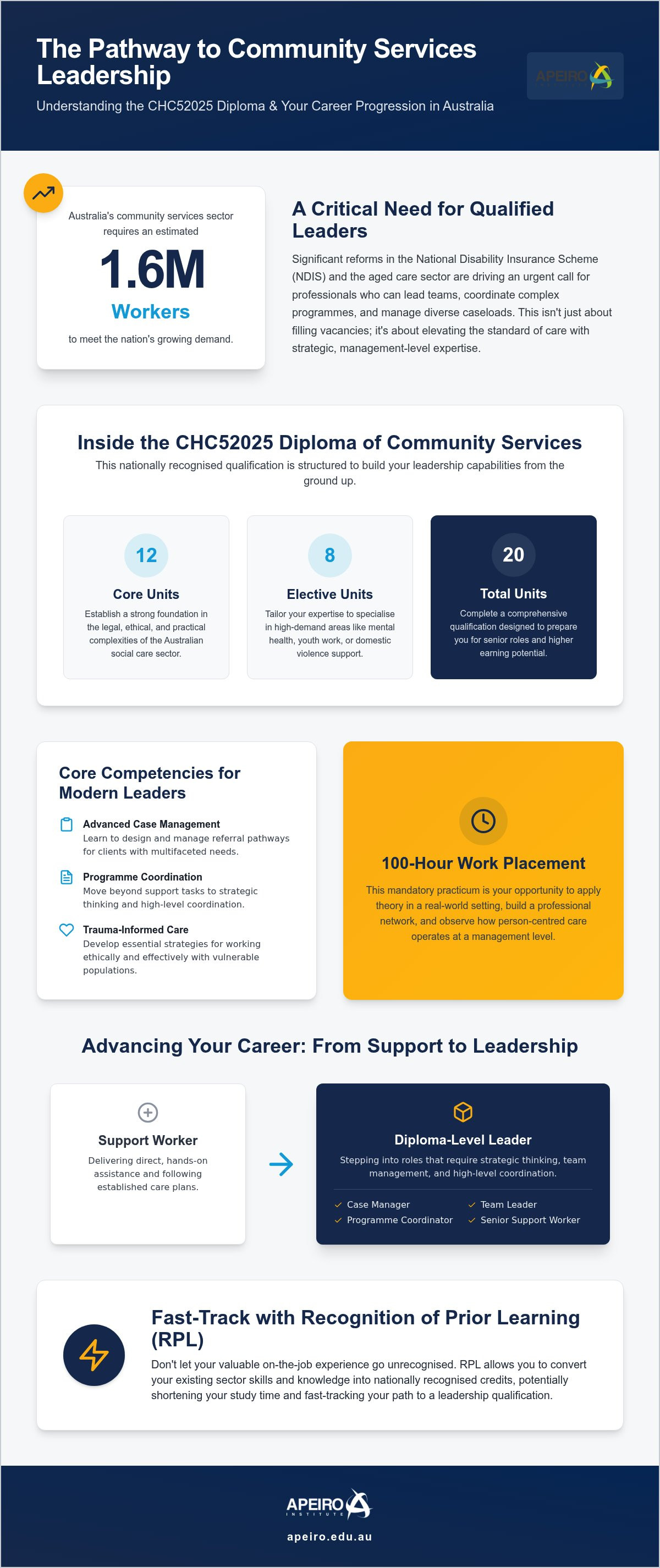
With Australia’s community services sector forecast to require 1.6 million workers to meet growing demand, the opportunities for professional growth have never been more significant. It’s a staggering figure that highlights just how vital this industry is to our national fabric. However, we understand that feeling stuck in an entry-level role can be frustrating when you know you have more to give. Perhaps you're worried about balancing a 100-hour work placement with your family, or you're simply confused by the 2026 requirements for the CHC52025 Diploma of Community Services.
You aren't alone in these concerns, and the good news is that a clear pathway to leadership exists. We promise to show you how this nationally recognised qualification can unlock higher earning potential and roles like Team Leader or Case Manager. This guide provides a comprehensive look at the 20-unit course structure, covering everything from core requirements to elective choices. We will also explore how Recognition of Prior Learning can value your existing experience, helping you transition into a leadership framework designed for the future of Australian social care.
Key Takeaways
- Understand why Australia’s NDIS and aged care sectors are prioritising management-level talent and how you can fill this critical gap.
- Learn how the CHC52025 Diploma of Community Services equips you with advanced case management and program coordination skills through a blend of theory and practical placement.
- Identify the professional differences between support roles and leadership positions, including the specific responsibilities required at the Diploma level.
- Discover how to use Recognition of Prior Learning (RPL) to fast-track your enrolment by converting your existing sector experience into a nationally recognised qualification.
- Explore the benefits of studying in a supportive, multicultural environment where industry-expert mentors are dedicated to your individual career success.
Why Australia Needs Community Service Leaders in 2026
Australia's social care landscape is reaching a critical turning point in 2026. As the National Disability Insurance Scheme (NDIS) and the aged care sector undergo significant reforms, the call for qualified leaders has never been louder. It isn't just about filling vacancies; it's about finding individuals who can coordinate complex programmes and manage diverse teams. The CHC52025 Diploma of Community Services is the primary qualification designed to meet this need. It prepares you to step away from basic support tasks and into roles that require strategic thinking and high-level coordination.
The urgency for these skills is driven by real societal challenges. Issues like Poverty in Australia continue to place pressure on local services, requiring managers who can navigate intricate funding models while maintaining a high standard of care. With industry forecasts from TAFE Queensland suggesting 1.6 million workers will be needed in the sector by late 2025, upskilling is a practical move. By acting now, you're positioning yourself at the forefront of an industry that values both empathy and professional expertise.
The Evolving Role of the Community Service Worker
The days of community service being limited to simple welfare are over. Today, a community service worker acts as a powerful advocate for social change. Under the NDIS framework, your role shifts toward empowering participants to exercise choice and control over their lives. Person-centred service delivery is defined as a collaborative approach where the individual’s unique needs, goals, and preferences remain the central focus of every decision made. This gold standard ensures that care is respectful and responsive, moving away from institutional models.
Stability and Growth in the Australian Care Sector
If you're looking for job security, few industries offer the resilience of the Australian care sector. While other sectors might fluctuate with economic cycles, the demand for mental health support, child protection, and aged care remains constant. Holding a CHC52025 Diploma of Community Services acts as a gateway to senior positions within government departments and major non-profit organisations. These roles often come with higher earning potential and the chance to influence policy at a local level. You could find yourself leading a dedicated team in a community centre or managing a specialised case-load in mental health. The pathway to a rewarding, long-term career starts with recognising that your current experience is the perfect foundation for these leadership responsibilities.
Inside the CHC52025: Units, Skills, and Practical Placement
The CHC52025 Diploma of Community Services isn't just a list of subjects; it's a structured framework designed to turn your passion into professional leadership. You’ll complete 20 units in total, consisting of 12 core units that build your foundation and 8 elective units that allow you to specialise. This balance ensures you grasp the legal and ethical complexities of the Australian social work sector while tailoring your expertise to areas like mental health, youth work, or domestic violence support.
Core Competencies for Modern Case Managers
Transitioning into a leadership role means mastering complex case management. You'll learn how to design referral pathways that actually work for clients with multifaceted needs. A key focus is developing trauma-informed care strategies, which are essential when working with vulnerable populations. If you want to focus specifically on these high-level skills, the CHC52025 Diploma of Community Services (Case Management) pathway offers a deep dive into coordination and advocacy. You'll learn to look beyond the immediate crisis to the systemic issues affecting a client’s well-being.
The Importance of the 100-Hour Practicum
Theory is vital, but the 100-hour work placement is where your learning truly comes alive. This mandatory requirement ensures every graduate meets the high standards expected by Australian employers. It's more than a checkbox; it's a chance to build a professional network and see how person-centred care operates in real-time. Unlike basic support roles, a Diploma-level placement often involves shadowing managers or assisting with programme coordination. This gives you a front-row seat to the administrative and strategic side of community work.
Balancing these hours with your current job or family life requires planning. We recommend treating your placement as a long-term interview. The relationships you build here often lead to job offers after graduation. This practical experience is backed by strong industry data, as seen in the Jobs and Skills Australia employment projections, which highlight the continued need for skilled professionals in health and social assistance through to 2028 and beyond.
Navigating the legal frameworks of the sector is a significant part of the curriculum. You'll explore privacy laws, mandatory reporting, and ethical decision-making. These units ensure you can protect both your clients and your organisation in complex scenarios. If you're ready to start this journey, you can explore our course details to see how we support our students through every unit and placement hour.
Career Outcomes: Moving from Support Worker to Case Manager
While a Certificate III or IV in Individual Support provides the essential skills for front-line care, the CHC52025 Diploma of Community Services is designed for those ready to lead. It represents a significant shift in your professional daily life. Instead of simply following a care plan, you are the one assessing the client’s environment, identifying systemic barriers, and designing the strategy for their long-term success. This qualification is widely recognised by Australian employers as the benchmark for mid-level management roles, offering a clear pathway to higher earning potential and greater professional autonomy.
According to the official CHC52025 Diploma of Community Services details, graduates are equipped to work in a variety of settings, including mental health, social housing, and family services. You might find yourself working as a Community Development Officer, Welfare Worker, or a Case Manager. These roles require a blend of empathy and administrative precision that only a Diploma-level education can provide.
The Leadership Leap: What Changes with a Diploma?
The most profound change when you move to the Diploma level is the transition from executing care to designing it. You aren't just providing support; you're coordinating it. This often includes the responsibility of supervising volunteers and junior staff members, ensuring that the team adheres to ethical frameworks and organisational policies. You become the bridge between the client and the broader social system. For a deeper look at how these roles are evolving, check out our Diploma of Community Services Australia: The 2026 Career Guide.
Pathway to Further Education
One of the most strategic advantages of this qualification is how it fits into the Australian education system's "stackable" model. Your Diploma isn't just a terminal qualification; it's a powerful stepping stone. Many Australian universities offer significant credit for this course, allowing you to use your studies as a bridge towards a Bachelor of Social Work or a Bachelor of Community Services. This means you can enter the workforce sooner, gain practical experience, and then complete your degree in less time.
Employers often prefer this vocational-to-higher-education route because it produces graduates who understand the day-to-day realities of the sector, not just the academic theories. It’s a practical way to future-proof your career while making a tangible difference in people's lives. If you're currently working in the sector, you might even be eligible for Recognition of Prior Learning to speed up this transition and move into a leadership role faster.
Enrolment and RPL: Fast-Tracking Your Community Services Career
Starting a new qualification shouldn't feel like a barrier. It should feel like a bridge. For many professionals already working in the sector, the biggest hurdle is the thought of repeating things they already know. The CHC52025 Diploma of Community Services addresses this by acknowledging your existing skills from day one. Whether you're a local practitioner or an international student, our enrolment process is built to be inclusive, supportive, and clear.
Understanding Recognition of Prior Learning (RPL)
If you've spent years in aged care, disability support, or youth work, you possess valuable expertise that shouldn't be ignored. Recognition of Prior Learning (RPL) allows us to assess your work history against the course requirements. The RPL process is a formal validation of your professional journey. By providing evidence such as job descriptions, workplace samples, and supervisor testimonials, you can bypass specific units. This is a core part of our Trade Pathways for Experienced Workers (TPEW), designed to reduce your study time and help you move into management faster. It’s a practical way to lower your costs while respecting the hard work you’ve already put in.
Step-by-Step Enrolment Guide
We've streamlined our application process so you can focus on your future rather than the paperwork. Our team acts as your mentor through every stage, ensuring you feel confident before you even start your first unit. The process typically follows three simple steps:
- Step 1: Initial enquiry. You'll have a conversation with a course counsellor to make sure the CHC52025 Diploma of Community Services is the right fit for your career aspirations.
- Step 2: Evidence submission. You'll provide your previous academic transcripts or your RPL evidence portfolio for assessment.
- Step 3: LLN assessment. You'll complete a Language, Literacy, and Numeracy assessment. This helps us identify any support you might need to succeed in your studies.
Managing your study load is also a priority. We offer flexible learning options that allow you to balance your diploma with your current employment and family life. We know that many of our students are juggling multiple responsibilities. Our trainers work with you to create a sustainable pace, ensuring you reach the finish line without burning out. It’s about making your education work for you, not the other way around. By choosing a provider that values your time, you can transition into a leadership role without sacrificing your current stability.
Start your enrolment for the CHC52025 Diploma of Community Services today
Studying with Apeiro Institute: Your Path to a Meaningful Career
Choosing where to study is just as important as the qualification itself. At Apeiro Institute, we don't treat you like just another enrolment in a database. We pride ourselves on being a bridge between your current circumstances and your future leadership goals. Our multicultural community represents over 38 nationalities, creating a rich, global perspective that is essential in the diverse Australian social care sector. This diversity ensures you learn to work effectively with people from all walks of life, which is a core skill for any graduate of the CHC52025 Diploma of Community Services.
As a nationally recognised RTO (45394), we focus on delivering industry-aligned training that translates directly into the workplace. We understand that starting a new educational journey can feel intimidating. That’s why our approach is built on empathy and helpfulness. We offer a sense of security through expert guidance, ensuring that every student feels capable of achieving their professional objectives. Our trainers are selected not just for their academic credentials, but for their deep roots in the Australian community services industry.
A Supportive Learning Environment
We keep our class sizes small to ensure you have direct, meaningful access to our industry-experienced trainers. These professionals act as mentors who are deeply invested in your personal growth. They bring real-world scenarios into the classroom, ensuring the theory you learn is always grounded in practical vocational outcomes. Whether you are building a foundation with a CHC33021 Certificate III in Individual Support or moving directly into the Diploma, you'll find an inclusive culture that celebrates global diversity. Our support services are designed to help you navigate everything from student life to the final steps of professional certification, making the transition as smooth as possible.
Ready to Lead in Community Services?
The journey from enrolment to graduation is one of professional transformation. You’ve seen the growing demand for leaders, understood the 20-unit course structure, and explored how your past experience can be recognised through RPL. Now, it's time to take the first step towards your new career. The CHC52025 Diploma of Community Services is more than a certificate; it's your invitation to lead teams, design complex care plans, and make a lasting impact on your community. Your years of dedication and empathy are incredibly valuable. Let’s work together to make that experience official. We are here to guide you through the application process and support you as you transition into a rewarding leadership role in Australia's booming care sector.
Take the Next Step in Your Community Leadership Journey
The Australian care sector is at a crossroads, and the need for skilled, compassionate leaders has never been greater. By choosing to upskill, you aren't just earning a qualification; you're gaining the tools to design care plans and advocate for systemic change. We've explored how this pathway bridges the gap between vocational experience and management roles, offering a clear route to career stability and higher earning potential in 2026.
Apeiro Institute is committed to being your partner in this professional transformation. As a provider of Nationally Recognised Training (RTO 45394), we offer mentor-led support to ensure you feel confident at every stage of your study. Our specialist RPL assessment for experienced workers means your years of dedication can finally be formalised into a leadership framework that respects your existing expertise. You'll join a vibrant, multicultural community dedicated to making a tangible difference in the lives of vulnerable Australians.
Enquire about the CHC52025 Diploma of Community Services today
Your passion for helping others is the foundation of a brilliant career. Let's work together to turn that passion into a lasting professional legacy that benefits both you and your community.
Frequently Asked Questions
What is the difference between CHC52015 and CHC52025?
The CHC52025 is the current, nationally recognised version of the qualification, replacing the superseded CHC52015. This update ensures that your training aligns with the latest 2026 Australian social care standards and regulatory requirements. While the core focus remains on community leadership, the newer version incorporates modern frameworks for case management and trauma-informed care. If you hold the older version, you might consider upskilling to ensure your credentials stay current with industry expectations.
Can I get a Diploma of Community Services through RPL if I have 5 years of experience?
Yes, you can absolutely use your five years of industry experience to apply for Recognition of Prior Learning (RPL). Apeiro Institute specialises in helping experienced workers formalise their skills into a CHC52025 Diploma of Community Services. By providing evidence like job descriptions, supervisor reports, and workplace samples, you can potentially reduce your study time significantly. It’s a practical way to turn your hard-earned professional journey into a nationally recognised leadership qualification.
Do I need to find my own work placement for the CHC52025?
You aren't required to navigate the placement process alone. While some students prefer to complete their 100-hour requirement at their current workplace, we provide guidance and support to help you find a suitable host organisation. This mandatory practicum is a vital part of the CHC52025 Diploma of Community Services, ensuring you gain hands-on experience in a leadership or coordination capacity. It’s also an excellent opportunity to build a professional network within the sector.
Is the Diploma of Community Services hard to pass for someone out of study for years?
Returning to study after a long break can feel daunting, but the right support makes it entirely attainable. We use a Language, Literacy, and Numeracy (LLN) assessment to identify any areas where you might need extra help. Our mentor-led training approach ensures you have direct access to trainers who understand the challenges of balancing study with work and family life. We focus on practical, industry-aligned learning rather than just dense academic theory.
What kind of jobs can I get with a CHC52025 Diploma of Community Services?
Graduates of this diploma are qualified for a range of leadership and coordination roles across the social care sector. You could pursue a career as a Case Manager, Community Development Officer, Team Leader, or Welfare Worker. These positions involve designing care plans, supervising staff, and coordinating community programmes. The qualification acts as a bridge to mid-level management in mental health, disability services, and aged care organisations throughout Australia.
How long does it take to complete the CHC52025 in Australia?
The duration typically ranges from 12 to 18 months, depending on your study mode and existing experience. If you're eligible for Recognition of Prior Learning, you can fast-track the process by receiving credit for your current industry skills. This flexibility allows working professionals to maintain their current income while upskilling for future leadership roles. Our trainers work with you to create a sustainable study plan that fits your personal and professional schedule.
Are there any government-funded spots for community services diplomas in 2026?
Government-funded training options continue to be available in 2026 to address critical workforce shortages in the care sector. Eligible students may access Smart and Skilled funding in NSW or similar subsidised programmes in other states. For example, some fee-free initiatives apply to students commencing training in the first half of 2026. We recommend checking your eligibility for these subsidies, as they can significantly reduce the financial barrier to starting your diploma.
What is the average salary for a Case Manager in Australia?
Case Managers in Australia typically earn a competitive salary that reflects the high level of responsibility required in the role. While pay scales vary based on your experience and the specific sector, such as mental health or disability support, many professionals in these leadership positions report annual earnings between $75,000 and $95,000. Holding a CHC52025 Diploma of Community Services is often the key to moving into these higher-paying tiers compared to entry-level support roles.

Disclaimer
The information provided on this blog is for general informational and educational purposes only. While every effort is made to ensure the accuracy and reliability of the content, the author makes no representations or warranties of any kind, express or implied, about the completeness, accuracy, suitability, or availability of the information contained on this blog.
The views and opinions expressed in blog posts are those of the individual author and do not necessarily reflect the official policy or position of any organization, company, or employer.
This blog may contain links to external websites or third-party content. These links are provided for convenience only, and the author has no control over and assumes no responsibility for the content, privacy policies, or practices of any third-party sites.
Nothing on this blog constitutes professional advice (legal, financial, medical, or otherwise). Readers are encouraged to seek appropriate professional guidance before making any decisions based on the information provided here.
By using this blog, you acknowledge that any reliance on the information is at your own risk.


