

What if your current job was actually the most effective classroom you've ever stepped into? Many community service professionals feel trapped in a cycle where they want to advance, but simply can't find the time to commute to a campus or sit through hours of abstract theory. It's frustrating to feel like your career is stagnating in an entry-level role when you know you have more to give. We understand that you need a solution that respects your busy schedule and your existing expertise.
One of the primary benefits of workplace based training - CHC52025 is the ability to bridge the gap between daily frontline tasks and high-level management skills. By choosing this pathway, you'll discover how to accelerate your career and enhance your practical skills without stepping away from your vital work. This article explores how a mentor-led approach turns your professional environment into a learning hub. We will preview the journey to a nationally recognised qualification, detail how to master leadership in a real-world setting, and show you how to prepare for the 19,000 new welfare support jobs expected in the Australian sector by 2026.
Key Takeaways
- Learn how to apply complex case management and ethical frameworks directly to your current role rather than relying on hypothetical classroom scenarios.
- Discover the specific benefits of workplace based training - CHC52025, which allows you to complete assessments in your actual place of employment.
- Understand how to build professional credibility and a robust industry network while maintaining your current job and income.
- Explore the 'earn while you learn' model that eliminates the need for unpaid study leave and supports a healthy work-life balance.
- See how a mentor-based approach from industry experts can help you transform your existing experience into a nationally recognised leadership qualification.
What is CHC52025 and the Workplace-Based Training Model?
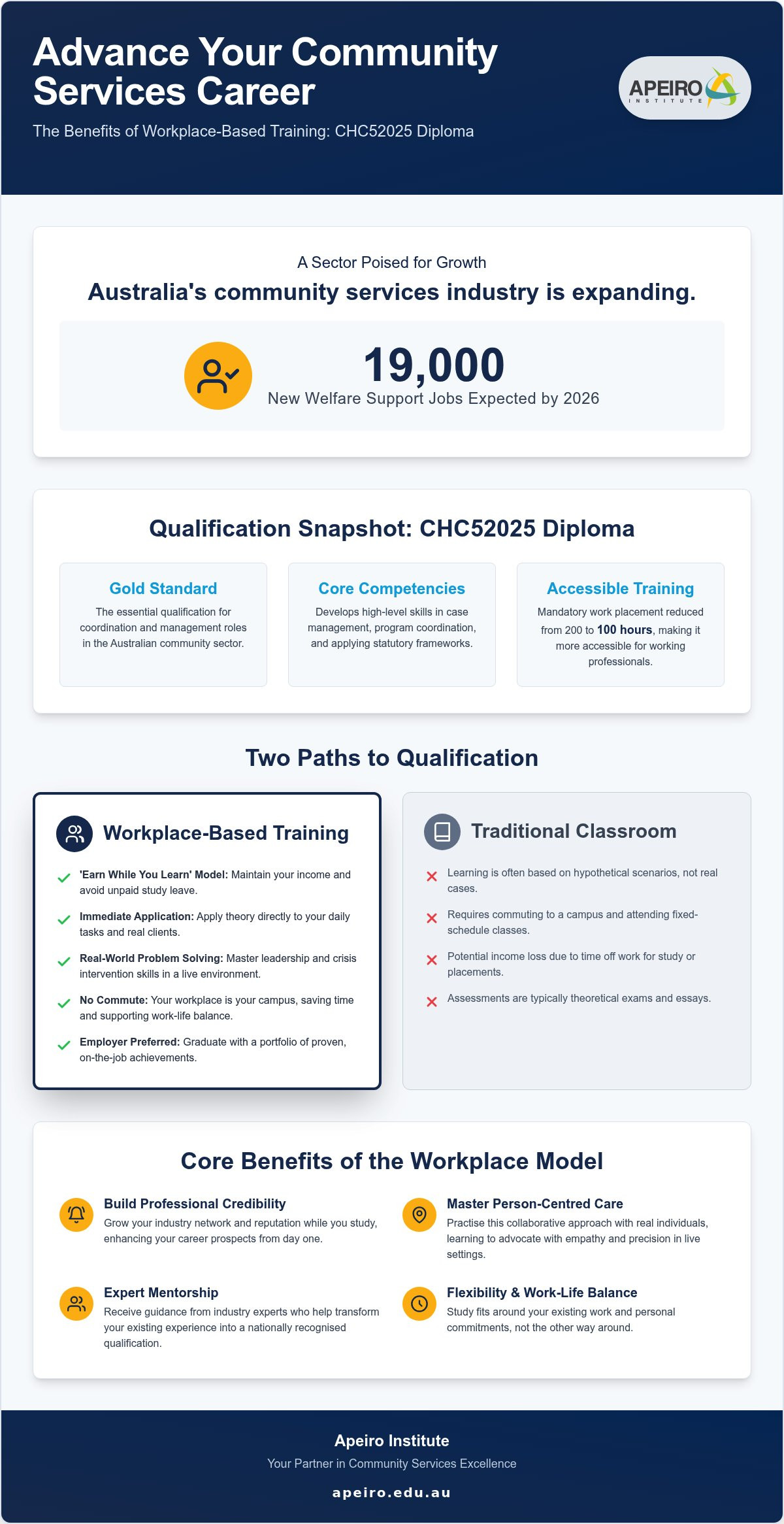
The CHC52025 Diploma of Community Services stands as the gold standard for those aiming for leadership roles in the Australian community sector. It's a qualification built for impact. Unlike traditional study, the workplace-based model lets you complete your assessments within your current place of employment. This approach ensures your daily professional duties align perfectly with the requirements of a nationally recognised qualification. One of the primary benefits of workplace based training - CHC52025 is the shift toward competency-based outcomes. Instead of just passing written exams, you prove your skills through actual tasks you perform every day. We believe your experience is your greatest asset, and this model treats it that way.
Understanding the CHC52025 Qualification
This qualification is essential for coordination and management roles. As we move through 2026, the industry has fully adopted the CHC52025 code, which superseded the older CHC52021 standard. A significant change in this current version is the reduction of mandatory work placement from 200 hours to 100 hours. This makes the diploma far more accessible for busy professionals who are already working in the field. Core competencies focus on case management, statutory frameworks, and program coordination. It is the backbone of Vocational Education and Training (VET) in the community sector, designed to meet the projected demand of 19,000 new welfare support jobs by 2026.
Workplace-Based vs. Traditional Classroom Learning
Choosing between a campus and your own workplace is a simple decision for many. You eliminate the commute entirely. You don't need to sit in a simulated classroom that often fails to replicate the complexity of real-world community challenges. Australian employers often prefer candidates with on-the-job training history because it proves you can handle the pressure of the environment. When exploring the benefits of workplace based training - CHC52025, it's clear that the most obvious advantage is the immediate relevance of your study. You master leadership skills while managing real clients and live situations. If you are looking for a Diploma of Community Services, this model provides the most direct path to career advancement without sacrificing your current income.
Immediate Skill Application: Turning Theory into Community Impact
Learning in a vacuum is hard. In the community services sector, it's almost impossible. One of the most significant benefits of workplace based training - CHC52025 is that it removes the 'hypothetical' from your education. You don't just read about complex case management; you practice it with real people who rely on your support. This immediate application ensures that when you study statutory and ethical frameworks, you see exactly how they protect vulnerable community members in real-time. Person-centred care is a collaborative approach that places the individual at the heart of all decision-making and service delivery. By mastering this within your current role, you refine your advocacy skills and learn to communicate with empathy and precision. This is vital when negotiating with government agencies or representing a client's needs in formal settings.
Real-World Problem Solving in Community Services
When a crisis occurs, a textbook can only take you so far. Workplace-based learning allows you to handle crisis intervention and support strategies under the guidance of experienced mentors. You're not just a student; you're a professional growing into a leader. This model helps you bridge the gap between policy knowledge and practical service delivery in several ways:
- Supervised Intervention: Manage high-pressure situations with the safety net of senior staff support.
- Leadership Development: Take charge of small teams or specific community projects on-site.
- Policy Integration: See how a change in state legislation affects your daily paperwork and client interactions immediately.
By the time you finish your course, your portfolio won't be full of essays. It will be full of successful case outcomes and improved community programs that have already made a difference. You aren't just memorising rules; you're understanding the 'why' behind every regulation.
Mastering Person-Centred Care in Situ
One of the standout benefits of workplace based training - CHC52025 is how it facilitates mastering person-centred care in its natural environment. True impact comes from understanding diversity. In your actual community, you'll work with individuals from diverse backgrounds. Tailoring support to these unique needs requires more than a lecture; it requires presence. You can use direct workplace feedback to sharpen your delivery of person-centred services immediately. This real-time refinement is what makes our graduates stand out. If you're ready to step into a leadership role, exploring a Diploma of Community Services Australia is the next logical step. This practical immersion ensures your skills are sharp, relevant, and ready for the 19,000 new jobs projected in the sector by 2026. We act as your mentor-partner, helping you turn every shift into a learning opportunity.
Career Acceleration and Professional Networking Opportunities
One of the most overlooked benefits of workplace based training - CHC52025 is the immediate boost it gives to your professional reputation. When you undertake a Diploma while staying active in your role, your employer sees a dedicated professional ready for more responsibility. You aren't just a student on a break; you're an emerging leader within the organisation. This visibility often leads to internal promotions even before the course concludes. You gain exposure to different departments, from youth outreach to disability services, which helps you decide where you want to specialise. Whether you aim to be a Case Coordinator or a Community Centre Manager, this model puts you in the right rooms at the right time.
Establishing Leadership Credibility Early
Balancing study with a daily workload shows immense initiative. Your assessments aren't just academic hurdles. They are practical projects that improve your workplace's efficiency. Think of these tasks as a live portfolio. When a senior role opens up, you've already proven you can master the soft skills required for management. You practice conflict resolution and team coordination within a supportive environment where you're already a trusted team member. This hands-on growth makes the transition to leadership feel natural rather than forced.
We act as your mentor-partner during this process. Our trainers help you identify opportunities for growth within your current agency. By applying your learning to real-world tasks, you demonstrate your value every single day. This proactive approach ensures you're at the top of the list when management considers future leadership candidates.
Industry Connections and Long-Term Prospects
Your network is your net worth in community services. By training on-site, you interact with a wider circle of social workers, government liaisons, and healthcare providers. These aren't just names in a phone; they are the people who will recommend you for future roles. You can leverage your trainer's industry experience to understand the broader Australian landscape. This gives you a competitive edge that classroom-only students often lack. You become a known entity in the sector before you even graduate.
For a deeper look at where this qualification can take you, check out our Diploma of Community Services Australia: The 2026 Career Guide. Workplace-based training ensures you aren't just gaining a certificate. You're building a sustainable career path. You'll understand how different agencies collaborate and how to navigate the complex web of Australian community support systems. This bird's-eye view of the industry is essential for anyone wanting to make a long-term impact in their community.
Flexibility and Work-Life Balance for Modern Learners
Many community service workers struggle to balance a full-time roster with the desire for career progression. Traditional campus-based models often demand that you take unpaid leave or cut back your hours just to attend a Tuesday morning lecture. This isn't just stressful; it's financially draining. One of the core benefits of workplace based training - CHC52025 is that it respects your time and your existing commitments. You don't have to choose between your family's financial security and your professional future. By integrating your study into your current routine, you significantly reduce 'study fatigue'. You're learning in the flow of work, not adding a separate, exhausting commute to your day. This approach keeps your energy high and your focus sharp.
Earning While You Learn
Financial stability is the backbone of successful adult education. The 'earn while you learn' model ensures your salary remains untouched while you upskill. You aren't losing money to gain a qualification; instead, you're maintaining your superannuation contributions and career momentum. You can maximise your productivity by using your daily work tasks to satisfy assessment criteria. If you're already writing case notes, coordinating a small community event, or participating in staff meetings, those activities can often count toward your Diploma requirements. This efficiency means you aren't doing double the work. You're simply doing your work more strategically. The financial advantage of upskilling without sacrificing your current income is one of the standout benefits of workplace based training - CHC52025 for many Australian families.
Customised Learning Pathways
Every community service organisation operates differently, and your learning should reflect that reality. We help you organise your units to match the specific needs of your current job role. This ensures your study is always relevant to what you're doing on the ground. You'll receive one-on-one support from trainers who understand the unique challenges of your specific workplace. This isn't a one-size-fits-all approach. It's a mentor-partner relationship designed to help you succeed in your specific environment. This flexible model is similar to how we support professionals through Trade Pathways for Experienced Workers, where we value and recognise what you already know. By tailoring the pathway, we ensure your education supports your specific career goals rather than just ticking boxes.
Enrol in the Diploma of Community Services today
Why Apeiro Institute is Your Partner in Community Services Excellence
Choosing the right training provider is as important as the qualification itself. At Apeiro Institute, we don't see you as just another student ID. We see a professional with valuable frontline experience. One of the key benefits of workplace based training - CHC52025 with us is our student-centred approach. We value what you already bring to the table. Our learning environment celebrates both global and local diversity, having worked with students from over 38 different nationalities. This inclusive atmosphere ensures you feel supported, heard, and empowered to reach your full potential in the Australian community services sector. We act as a bridge between your current circumstances and your future career goals, providing a path that feels attainable rather than intimidating.
Supportive Mentorship and Industry-Led Training
Our trainers aren't just lecturers; they're industry leaders who understand the real-world pressure of community work. They provide professional authority combined with a warm, supportive touch. As a national Registered Training Organisation (RTO 45394), we ensure your qualification is respected across every state and territory. We're committed to helping you achieve practical vocational outcomes that actually matter in your daily work. This mentorship-driven model turns your Diploma journey into a collaborative experience. You aren't just studying; you're evolving your practice under expert guidance. We prefer a voice that feels encouraging rather than detached, ensuring you have the confidence to master complex leadership skills in a setting where you already feel secure.
How to Get Started with Apeiro
Ready to take the next step? Getting started is a straightforward process designed to respect your busy schedule. We offer streamlined enrolment and dedicated support services to get you qualified faster. First, you'll need to assess your eligibility for workplace-based delivery. This usually involves a quick chat about your current role and responsibilities. Our team will guide you through the documentation required to recognise your existing expertise. We're here to provide a sense of security through expert guidance at every stage of the process. This allows you to leverage the benefits of workplace based training - CHC52025 while staying focused on your community impact. Once your eligibility is confirmed, you can begin aligning your daily duties with the diploma requirements immediately.
Enquire about your CHC52025 Diploma today
Take the Next Step in Your Community Services Career
Stepping into a leadership role doesn't have to mean stepping away from the community you serve. By choosing a path that values your current experience, you turn every shift into a chance for professional growth. The benefits of workplace based training - CHC52025 include mastering complex case management in real-time and building an industry network that supports your long-term goals. You've seen how this model protects your financial stability while preparing you for the 19,000 new welfare support jobs projected for 2026. It's about working smarter, not just harder.
Apeiro Institute is here to act as your mentor-partner. We provide Nationally Recognised Training (RTO 45394) and access to industry-expert mentors who understand your daily challenges. Our flexible workplace-based delivery ensures you can balance family, work, and study without the stress of a campus commute. You have the skills and the passion. Now it's time to gain the qualification that reflects your expertise.
Start your CHC52025 journey with Apeiro Institute
We're ready to help you transform your frontline experience into a rewarding leadership career. Your future in the Australian community services sector starts with a single, confident decision.
Frequently Asked Questions
What are the entry requirements for the CHC52025 Diploma of Community Services?
You don't need formal educational prerequisites to enrol in this diploma, but you must meet specific provider standards. Most learners need to be at least 18 years old and successfully complete a Language, Literacy, and Numeracy (LLN) assessment. Because this is a leadership qualification, you'll also need a valid National Police Check and a Working with Children Check (WWCC) to ensure you can safely interact with vulnerable clients during your workplace-based assessments.
Can I complete the CHC52025 qualification if I am not currently working in the sector?
Yes, you can still complete the qualification, but the specific workplace-based delivery model is designed for those already employed in the sector. If you aren't currently working, you'll need to undertake a traditional work placement to satisfy the mandatory 100-hour requirement. For those already in the field, one of the primary benefits of workplace based training - CHC52025 is using your current job to prove your competency without needing a separate host organisation.
How long does it take to finish the CHC52025 Diploma through workplace-based training?
The duration typically ranges from 12 to 24 months, though this depends on your existing experience and your weekly work hours. If you're an experienced professional, you might accelerate your progress through Recognition of Prior Learning (RPL). This allows us to credit your current skills toward the Diploma units. Because the learning happens on the job, you don't lose time commuting to a campus, which often helps students finish their qualification more efficiently.
Is the CHC52025 qualification nationally recognised across all Australian states?
Absolutely. The CHC52025 Diploma of Community Services is a nationally recognised qualification under the Australian Qualifications Framework (AQF). This means your certification is valid and respected by employers in every state and territory across Australia. Whether you're working in New South Wales, Western Australia, or Victoria, the units you complete with Apeiro Institute (RTO 45394) meet the high standards required for professional practice and leadership roles throughout the country.
What is the difference between CHC52021 and the new CHC52025 code?
The CHC52025 code is the most current version of the Diploma, having superseded the older CHC52021 standard. The most significant update in this new version is the reduction of mandatory work placement hours from 200 down to 100. This change was implemented to make the qualification more accessible and better aligned with the urgent needs of the industry. It focuses heavily on the case management and leadership skills required for modern service delivery.
Do I need to find my own work placement for the Diploma of Community Services?
If you're choosing the workplace-based training model, you'll typically use your current place of employment as your placement site. This is one of the major benefits of workplace based training - CHC52025 because it removes the stress of searching for a host agency. If you aren't currently employed in the sector, we recommend discussing your options with our support team. We can provide guidance on how to secure a suitable environment that meets the 100-hour requirement.
How does Apeiro Institute support workplace-based students?
We provide a mentor-partner relationship rather than a traditional teacher-student dynamic. You'll have access to expert trainers who offer professional authority and warm, inclusive support tailored to your specific workplace challenges. Our team helps you align your daily tasks with assessment requirements, ensuring you never feel overwhelmed. We also offer streamlined enrolment and regular check-ins to keep you on track, celebrating the diverse experience you bring from your unique professional background.
What kind of jobs can I get after completing the CHC52025 Diploma?
Graduates are prepared for high-level leadership roles such as Case Manager, Family Support Worker, or Program Coordinator. You could also find employment as a Community Centre Manager or Welfare Support Worker. With the Australian Government projecting over 19,000 new jobs in the sector by 2026, this qualification provides a clear pathway to stable, well-paid positions. It also serves as a bridge to further university study in social work or community development if you choose to specialise further.

Disclaimer
The information provided on this blog is for general informational and educational purposes only. While every effort is made to ensure the accuracy and reliability of the content, the author makes no representations or warranties of any kind, express or implied, about the completeness, accuracy, suitability, or availability of the information contained on this blog.
The views and opinions expressed in blog posts are those of the individual author and do not necessarily reflect the official policy or position of any organization, company, or employer.
This blog may contain links to external websites or third-party content. These links are provided for convenience only, and the author has no control over and assumes no responsibility for the content, privacy policies, or practices of any third-party sites.
Nothing on this blog constitutes professional advice (legal, financial, medical, or otherwise). Readers are encouraged to seek appropriate professional guidance before making any decisions based on the information provided here.
By using this blog, you acknowledge that any reliance on the information is at your own risk.


