

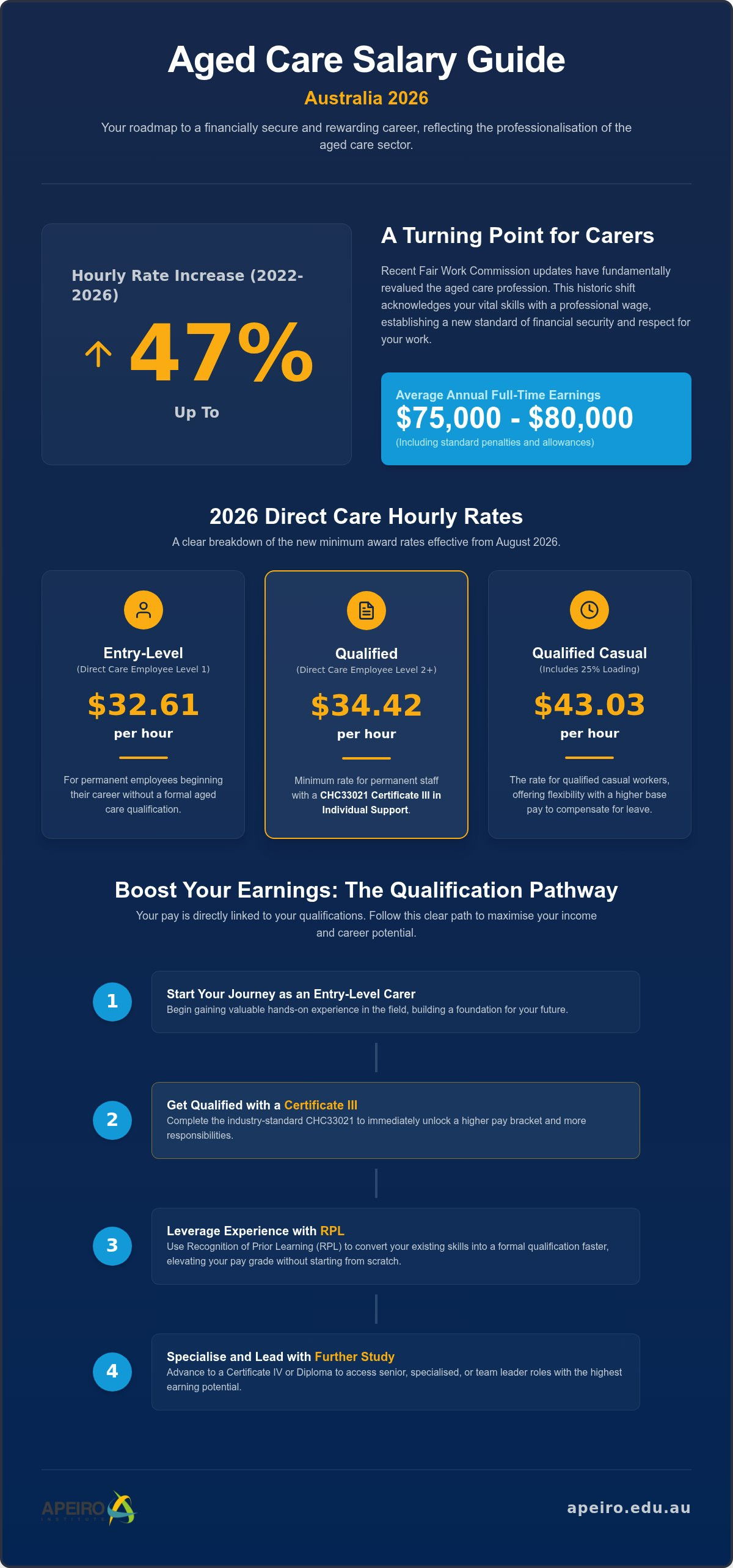
Did you know that between 2022 and 2026, the hourly rate for a qualified direct care worker in Australia increased by as much as 47%? This shift marks a massive turning point where your dedication to the community is finally being matched by a professional wage. Understanding the Aged care worker salary Australia 2026 landscape is essential if you want to ensure you're being paid fairly for your vital skills. It's completely understandable if you've felt confused by complex award levels or frustrated by the historical stigma of low pay in the care sector.
We agree that keeping up with the latest Fair Work Commission changes can feel like a challenge. That's why we've created this guide to give you total clarity on your take-home pay. You'll discover the exact 2026 award rates, how recent pay rises impact your bank account, and the practical steps you can take to maximise your earnings through further study. We'll provide a clear roadmap from entry-level roles to senior positions; this overview shows you exactly how to build a financially sustainable and rewarding career in aged care.
Key Takeaways
- Understand how the 2026 Fair Work Commission updates have professionalised the sector, providing a more secure financial foundation for all carers.
- Get a clear breakdown of the Aged care worker salary Australia 2026 including the latest hourly rates for direct care employees at every level.
- Discover the direct link between your qualifications and your pay slip, specifically how a Certificate III or IV can immediately increase your base rate.
- Learn how to use Recognition of Prior Learning (RPL) to turn your years of experience into a higher pay bracket without starting from scratch.
- Gain a clear roadmap for your career progression, moving from entry-level support to specialised roles with confidence in your financial future.
The New Standard: Aged Care Worker Salary in Australia 2026
The Australian care sector has officially moved beyond the era where working with the elderly was viewed solely as a "labour of love." In 2026, the industry has matured into a professionalised, high-growth sector where your skills are recognised with competitive pay. The Aged care worker salary Australia 2026 landscape now offers a level of financial security that matches the vital nature of the work. For many, this means a full-time direct care worker can expect an average annual salary ranging from $75,000 to $80,000 when including standard penalties and allowances.
This shift isn't just about a bigger pay slip; it's about respect. For years, historical stigmas kept wages lower than they should've been, but recent legislative changes have corrected this path. National demand for skilled carers continues to climb, fuelled by an ageing population and evolving NDIS requirements. As the broader system of Aged care in Australia expands, the government and the Fair Work Commission (FWC) have prioritised making these roles financially attractive to ensure the workforce remains sustainable for decades to come.
Why 2026 is a Landmark Year for Australian Carers
The 1st of August 2026 stands as a historic milestone for the industry. This date marked the finalisation of the staged pay increases resulting from the FWC Work Value Case. These changes didn't just add a few dollars to the hourly rate; they fundamentally reclassified aged care workers from "low-skilled" employees to "recognised professionals." Because of this, entry-level earnings in care work now compete directly with traditional trades, making it a viable long-term career for those who want both purpose and a solid income.
Average Annual Earnings: What to Expect
Understanding your potential take-home pay is easier when you look at the 2026 benchmarks. Following the 4.75% annual wage review in July and the final work value adjustments in August, the base rates have reached new heights. While your specific Aged care worker salary Australia 2026 depends on your classification, the baseline for stability is higher than ever before. Here's a quick look at the current hourly standards for direct care employees:
- Level 1 (Entry Level): $32.61 per hour for permanent employees.
- Level 2 (Qualified): Workers with a CHC33021 Certificate III in Individual Support now earn a minimum of $34.42 per hour.
- Casual Rates: Casual workers receive a 25% loading, pushing the Level 2 rate to approximately $43.03 per hour.
This stability is a breath of fresh air compared to other vocational industries. While retail or hospitality might see seasonal fluctuations, aged care provides a steady, recession-proof income. Whether you're working full-time or part-time, the legislated pay levels ensure you're compensated fairly for every hour you spend supporting our community's seniors.
Salary Breakdown by Qualification: From Cert III to Diploma
In the current market, your level of formal training is the single most important factor determining your take-home pay. The Aged care worker salary Australia 2026 landscape is built upon a transparent classification system that rewards those who invest in their professional development. This system ensures that as you gain more specialised skills, your hourly rate increases automatically under the legislated award. Understanding where you sit within the "Direct Care" levels is the first step toward planning your financial future.
The Fair Work Commission Pay Rise Impact has formalised these pay brackets, moving away from years of wage stagnation. While an entry-level employee without a qualification starts at Level 1, obtaining a recognised certificate immediately shifts you into a higher earning category. This structured approach means you don't have to guess when your next pay rise is coming; it's tied directly to your transcript.
Certificate III in Individual Support (Ageing and Disability)
For most entering the sector, the CHC33021 Certificate III in Individual Support is the industry benchmark. In 2026, workers with this qualification are typically classified at Level 2 or Level 3. A Level 2 direct care worker earns a base rate of $34.42 per hour, while those with more experience at Level 3 see this rise to $36.23 per hour. These roles, including Personal Care Assistants (PCA) and In-home Carers, form the backbone of the industry and offer a stable Aged care worker salary Australia 2026 for thousands of Australians.
Certificate IV in Ageing Support and Beyond
Stepping up to a Certificate IV marks your transition into senior care and leadership. This qualification typically unlocks Level 4 classification, where the base hourly rate reaches $37.68. If you're a full-time Senior Care Worker, this translates to an annual base salary of approximately $74,455 before penalties. Specialising in high-demand areas like dementia or palliative care can often help you negotiate "Above Award" rates with private providers who value your advanced clinical knowledge.
Diploma of Community Services: Leadership Pay Scales
Moving into management or case management requires a higher level of strategic skill. Holding a Diploma of Community Services allows you to pursue supervisory roles that sit at Level 5 or Level 6 of the award. These positions often command annual salaries well above $85,000, reflecting the increased responsibility of overseeing staff and complex care plans. If you're currently working and want to reach these levels faster, you might be able to use Recognition of Prior Learning to turn your years of hands-on experience into a formal qualification.
Understanding the Fair Work Commission Pay Rise Impact
The landscape for care wages changed forever following the Fair Work Commission (FWC) Work Value Case. This wasn't just a standard annual adjustment; it was a fundamental re-evaluation of what your work is worth to the community. For decades, care work was undervalued due to historical gender biases in female-dominated industries. The 2026 pay standards finally close this gap, recognising that the emotional intelligence and clinical skill required for the role deserve professional compensation. By the time the final staged increases were finalised on 1 August 2026, the industry had seen a transformation in how a typical Aged care worker salary Australia 2026 is calculated.
It's important to distinguish between "Direct Care" and "Indirect Care" roles when looking at these rises. Direct care workers, such as Personal Care Workers (PCWs) and Assistants in Nursing (AINs), received the most significant percentage increases because their roles involve the highest level of clinical responsibility. While indirect staff in laundry or catering also saw improvements through the 4.75% annual wage review in July 2026, the Work Value Case specifically targeted those providing hands-on support. This targeted approach ensures that the people at the bedside are seeing the most substantial impact on their bank accounts.
How to Read Your 2026 Pay Slip
Your pay slip might look more detailed than it did a few years ago. In 2026, many employers separate the base award rate from specific "Work Value" loadings to show how the FWC increases are applied. You should check that your hourly rate aligns with your current classification level. If your pay doesn't match the new 2026 standards, you can contact the Fair Work Ombudsman or your union for support. If you've been in the industry for years but are still stuck on a lower pay level, you might be eligible for Recognition of Prior Learning to officially upgrade your status and pay.
Penalty Rates and Shift Loadings
While base rates are higher than ever, the real secret to a high Aged care worker salary Australia 2026 lies in shift loadings. Working afternoon, night, or weekend shifts can significantly boost your earnings beyond the $75,000 median. For example, Sunday shifts often attract a 75% to 100% penalty rate depending on your specific agreement. When you factor in these penalties and the 11.5% superannuation contribution, the total package becomes very competitive. Many carers also choose casual roles to take advantage of the 25% loading, which provides a higher weekly take-home pay for those who value flexibility over leave entitlements. You can see how these market forces play out by checking the latest data for an Aged Care Worker Salary in Australia 2026 on major job boards.
Strategic Moves to Maximise Your Aged Care Earning Potential
Experience is a great teacher, but in the 2026 landscape, it isn't the only thing that fills your bank account. The current award structure means that your Aged care worker salary Australia 2026 is strictly tied to your formal level of education. If you've been working in the sector for five years but haven't updated your qualifications, you might find yourself earning less than a new hire who holds a Certificate IV. This is because the Fair Work Commission has legislated specific pay "locks" that only open once you provide proof of training. To reach the top pay brackets, you need to ensure your training comes from a nationally recognised RTO that understands these industry standards.
Choosing the right specialisation is another way to stand out and increase your value. While general aged care is rewarding, moving into Disability Support or Case Management often leads to higher-paying opportunities. These roles require a deeper understanding of complex care needs; this is why employers are willing to pay above the award minimum to secure the right talent. By focusing on high-demand areas, you make yourself indispensable to your organisation.
Recognition of Prior Learning (RPL): The Salary Accelerator
If you're an experienced carer, the thought of going back to a classroom might feel like a step backwards. However, you don't always need to sit through months of lectures to get the certificate you deserve. Through our Trade Pathways for Experienced Workers, you can use your existing hands-on skills to fast-track your qualification. The financial return on investment for an RPL assessment is often immediate. By converting your experience into a formal Level 3 or 4 classification, the jump in your hourly rate can pay for the assessment costs in just a few months. It's the most efficient way to align your pay slip with your actual skill level.
Upskilling while Working
Many of the highest earners in the sector today are those who chose to study while they worked. It's a smart move that allows you to maintain your income while building your future. Many aged care providers now actively encourage this. Some even offer internal support or flexible rosters to help you finish a Certificate IV or Diploma. Transitioning into a supervisory role is the ultimate goal for many. If you want to see what the future holds for leadership roles, our guide on the Diploma of Community Services Australia explains how this qualification can lead to case management positions. These roles offer a significant boost to your Aged care worker salary Australia 2026, providing the long-term career growth you've been looking for.
Fast-track your salary increase with an RPL assessment today.
Start Your Professional Aged Care Journey with Apeiro Institute
Your future in the care sector is about more than just a job title; it's about building a life of stability and contribution. At Apeiro Institute (RTO 45394), we act as a bridge between your current circumstances and your professional goals. We've seen how the Aged care worker salary Australia 2026 has evolved to reward high-quality training, and we are committed to ensuring our students are at the forefront of this change. Our role is to be your expert guide, providing the warm, student-centered support you need to succeed in a demanding yet deeply fulfilling industry.
Choosing a nationally recognised RTO is the only way to guarantee your pay is protected by Australian law. When you graduate from a registered provider like Apeiro, your qualification is a legislated ticket to the higher award levels we've discussed. This gives you the confidence to negotiate with employers, knowing your skills meet the national standard. We understand that many people entering this field are balancing family, work, and study. That's why our approach is built on flexibility and empathy, making the prospect of starting your educational journey feel attainable rather than intimidating.
Why Choose Apeiro for Your Aged Care Qualification?
We prioritise practical outcomes that make you "job-ready" from day one. Our curriculum is industry-aligned, meaning you learn the specific clinical and interpersonal skills that modern aged care providers are looking for. Beyond the textbooks, we offer a community-focused outlook that values global diversity and personal connection. Whether you're a local resident or an international student, you'll find a supportive environment where your growth is our priority. Our experts are also on hand to provide clear pathways for career progression, ensuring you don't just get a job, but build a long-term career.
Enrolment and Next Steps
Taking the first step toward your 2026 financial goals is straightforward. You can start by checking your eligibility for either direct enrolment or a Recognition of Prior Learning assessment. If you're ready to secure a competitive Aged care worker salary Australia 2026, our Certificate III in Individual Support is the ideal place to begin. This qualification provides the foundational knowledge required for Level 2 and Level 3 roles, setting you on a path toward financial sustainability. We invite you to reach out to our team today to discuss how we can partner in your success and help you achieve the professional recognition you deserve.
Secure Your Future in Australia's Professionalised Care Sector
2026 marks a historic shift for the care industry. With the final Fair Work Commission pay rises now in full effect, your role is recognised as the professional career it has always been. Understanding the Aged care worker salary Australia 2026 landscape means knowing that your qualification is your strongest asset for financial growth. Whether you're just starting out or looking to formalise years of hands-on experience through RPL pathways, the roadmap to a higher pay bracket is clearer than ever.
At Apeiro Institute, we provide nationally recognised training (RTO 45394) and industry-leading student support to help you navigate these changes with confidence. You don't have to stay stuck in a lower pay level when your skills are in such high demand. Our team is dedicated to helping you turn your dedication into a sustainable, well-paid career that reflects the true value you bring to our community.
Level up your salary — Explore our Aged Care Courses today!
We're here to support your personal and professional growth every step of the way. Take charge of your career today and step into a future that offers both purpose and a professional wage.
Frequently Asked Questions
What is the minimum hourly rate for an aged care worker in Australia in 2026?
The minimum hourly rate for a Level 1 direct care worker is $32.61 for permanent employees as of July 2026. This base rate reflects the latest Fair Work Commission adjustments designed to professionalise the sector. For casual workers, the rate increases to $40.76 per hour once the 25% loading is applied. These figures provide a baseline for the Aged care worker salary Australia 2026 landscape, ensuring even entry-level staff receive fair compensation.
Do I need a Certificate III to get the full Fair Work pay rise?
You don't strictly need a Certificate III to receive the general Work Value Case pay rises, as these apply to all direct care classifications. However, holding a Certificate III in Individual Support typically moves you from Level 1 to Level 2. This qualification increases your base rate to $34.42 per hour. It is the most effective way to ensure you are reaping the full financial benefits of the recent legislative changes.
How much more does a Certificate IV qualified worker earn compared to a Certificate III?
A worker with a Certificate IV in Ageing Support typically earns a base rate of $37.68 per hour, compared to $34.42 for those with a Certificate III. This difference of $3.26 per hour adds up to over $6,400 extra per year for a full-time employee. Choosing to upskill is a strategic move that unlocks senior roles and higher-level responsibilities, providing a significant boost to your long-term earning potential.
Will my pay increase automatically in 2026 or do I need to ask my employer?
Your pay should increase automatically from the first full pay period on or after 1 July each year following the Annual Wage Review. The specific aged care staged increases are also legislated requirements for employers. While you shouldn't have to ask, it's wise to check your pay slip against the latest Aged Care Award 2010 rates. If your pay doesn't match the 2026 standards, you should discuss this with your payroll department.
Can I use my overseas experience to get a higher pay bracket in Australia via RPL?
You can use your overseas experience to secure a higher pay bracket through Recognition of Prior Learning (RPL). Apeiro Institute specialises in helping experienced workers formalise their skills into nationally recognised Australian qualifications. By proving your existing expertise, you can skip redundant training and move directly into a higher classification level. This process ensures your Aged care worker salary Australia 2026 reflects your true global experience and clinical skill.
Are aged care salaries different for home care versus residential care in 2026?
Most aged care workers are covered by the same Aged Care Award 2010, meaning base rates are generally consistent across both home care and residential settings. However, home care roles often include additional allowances for travel time and vehicle use. Some private home care providers may also offer "Above Award" rates to attract staff for specialised community support. You should always review your specific employment agreement to see which loadings apply to your role.
Is there still a high demand for aged care workers in 2026?
Demand for skilled carers remains at record highs in 2026. Australia's ageing population and the expansion of the NDIS have created a persistent need for thousands of new workers every year. This high demand is a primary reason why the government has funded significant pay rises. It provides workers with excellent job security and the leverage to choose employers that offer the best conditions and professional support.
What shift penalties apply to aged care workers in 2026?
Shift penalties are a vital part of your total income. In 2026, standard penalties typically include a 50% loading for Saturdays and between 75% to 100% for Sundays. Public holidays usually attract a 150% loading. Additionally, afternoon and night shifts carry specific percentage loadings that boost your base hourly rate. These penalties ensure that those working non-traditional hours are fairly compensated for their flexibility and commitment to 24/7 care.

Disclaimer
The information provided on this blog is for general informational and educational purposes only. While every effort is made to ensure the accuracy and reliability of the content, the author makes no representations or warranties of any kind, express or implied, about the completeness, accuracy, suitability, or availability of the information contained on this blog.
The views and opinions expressed in blog posts are those of the individual author and do not necessarily reflect the official policy or position of any organization, company, or employer.
This blog may contain links to external websites or third-party content. These links are provided for convenience only, and the author has no control over and assumes no responsibility for the content, privacy policies, or practices of any third-party sites.
Nothing on this blog constitutes professional advice (legal, financial, medical, or otherwise). Readers are encouraged to seek appropriate professional guidance before making any decisions based on the information provided here.
By using this blog, you acknowledge that any reliance on the information is at your own risk.


