

What if the most direct route to your dream career isn't a four-year university degree, but a specialised vocational institute instead? In 2026, the traditional academic path isn't the only way to reach your goals, yet many people feel stuck. You might be confused by terms like RTO or CRICOS, or perhaps you're worried about investing years into a course that doesn't lead to a real job. It's often frustrating to feel like your existing work experience is being ignored while you search for a way to prove your worth to employers.
We understand these concerns and are here to help you clear the fog. This guide explains how an Australian vocational institute can fast-track your career through practical, industry-recognised training and nationally accredited qualifications. You'll discover how to identify the right pathway for your specific needs, find flexible study options that respect your prior experience, and gain a clear understanding of the VET landscape. We will walk you through the latest funding updates and show you how to turn your current skills into a certified professional future.
Key Takeaways
- Learn how a registered vocational institute ensures your training meets strict national standards through the RTO framework.
- Understand the competency-based learning model that prioritises practical, job-ready skills over theoretical academic study.
- Compare the time and cost benefits of vocational pathways versus university degrees to find the most efficient route for your 2026 career goals.
- Discover the essential steps for verifying a provider's credentials on training.gov.au to ensure your qualification is fully recognised by industry.
- See how specialised support services and community-focused learning can bridge the gap between your current skills and professional certification.
Defining the Institute in the Australian Education Landscape
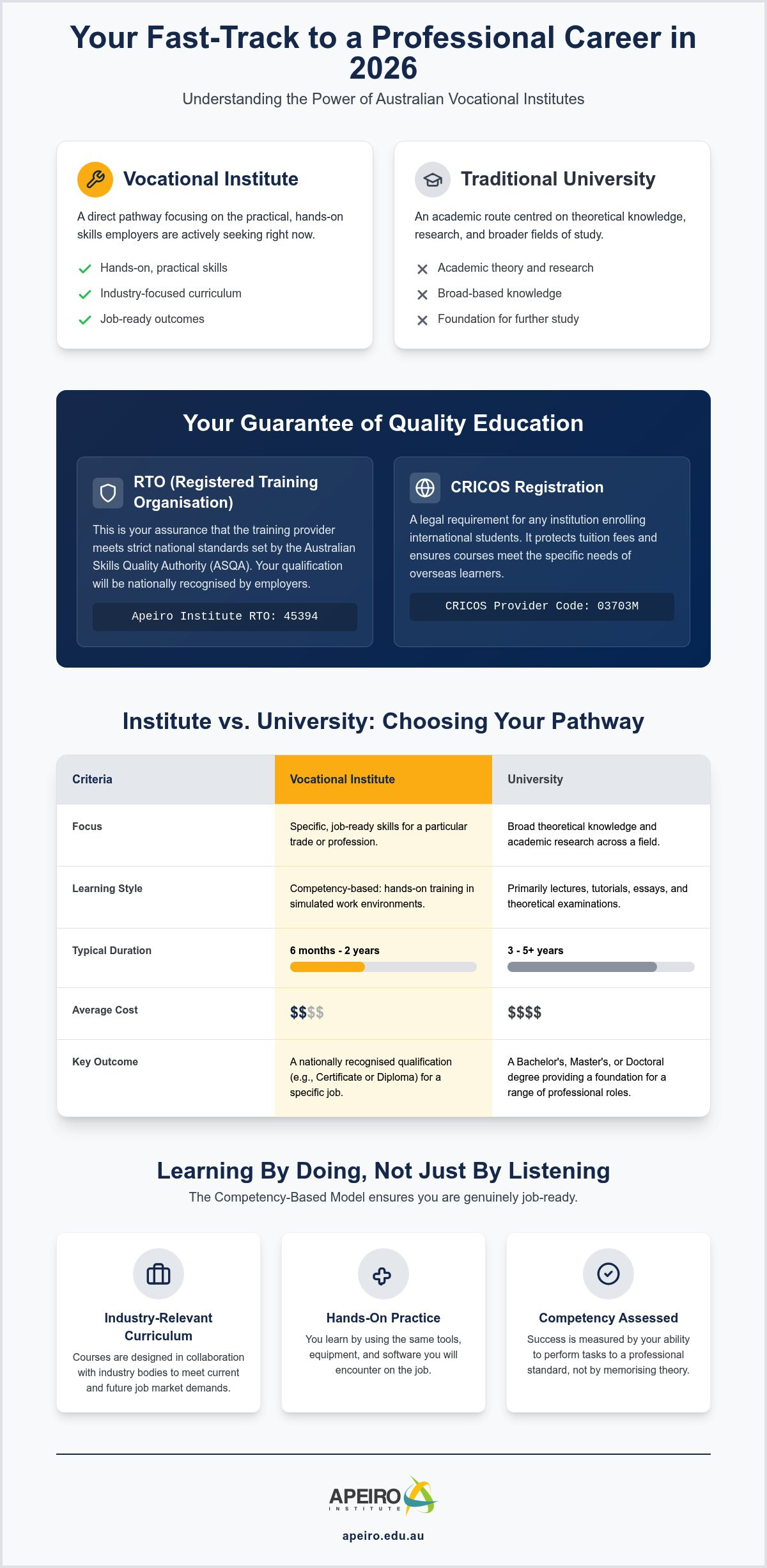
In the Australian education system, the term "institute" carries a very specific meaning. Unlike a university, which focuses heavily on academic theory and research, a vocational institute is designed to bridge the gap between learning and doing. These organisations focus on Vocational Education and Training (VET), providing students with the exact skills required by specific industries. Whether you are looking to enter the workforce for the first time or want to formalise years of experience, an institute offers a practical, hands-on alternative to traditional degrees.
While many Australians are familiar with the government-funded Technical and Further Education (TAFE) system, private providers operate within the same rigorous framework. Every qualification offered by a reputable institute must align with the Australian Qualifications Framework (AQF). This national system ensures that a Certificate III or a Diploma has the same value and recognition across the country, regardless of where you study. It provides a clear ladder for your career, allowing you to move from entry-level roles to management positions with confidence.
RTO vs. CRICOS: What Every Student Must Know
Security and quality are paramount when choosing where to study. A legitimate vocational provider must be a Registered Training Organisation (RTO). This registration, such as Apeiro Institute’s RTO code 45394, means the provider is monitored by the Australian Skills Quality Authority (ASQA). It guarantees that the training you receive meets strict national standards and that your qualification will be respected by employers. For international students, CRICOS registration (03703M) is equally vital. It's a legal requirement that protects your tuition fees and ensures the course meets the specific needs of overseas learners. These badges of authority aren't just paperwork; they're your assurance of a quality education.
The Institute’s Place in Career Progression
Vocational institutes excel at providing fast-tracked pathways into the professional workforce. Unlike high schools that offer broad general knowledge, an institute focuses on "job-ready" outcomes through an industry-vetted curriculum. This is particularly beneficial for those who don't want to spend four years on a degree before they start earning. For workers already in the industry, options like Trade Pathways for Experienced Workers (TPEW) or Recognition of Prior Learning (RPL) allow you to gain qualifications based on the skills you've already mastered on the job. It's a respectful, efficient way to upskill that acknowledges your existing expertise while preparing you for the next step in your career.
How Vocational Institutes Prioritise Hands-on Skills
The competency-based model is the heartbeat of vocational education. It means you aren't just memorising facts for a multiple-choice test; you're proving you can actually perform the task to a professional standard. At a vocational institute, success is measured by your ability to meet industry requirements in real-world scenarios. This approach ensures that every student who finishes their course is ready to walk onto a job site and contribute immediately. It's a practical way of learning that respects your time and focuses on what truly matters to employers.
To make this happen, institutes invest heavily in simulated workplace environments. You'll work with the same tools, software, and equipment used in modern workshops or professional clinics. By collaborating closely with industry bodies, providers ensure their curriculum stays ahead of technical shifts. This focus on providing practical skills for in-demand industries is why VET is so effective for those seeking a career change or a promotion. It turns the classroom into a launchpad for your professional life.
Industry collaboration isn't just a background activity. It's a necessity for keeping training relevant. When new technology hits the automotive or electronics market, an institute must update its training packages to reflect those changes. This agility ensures your certification isn't just a piece of paper; it's a guarantee that you're trained on the latest national standards. This is why employers often seek out VET graduates, knowing they possess the most current technical expertise available.
Trade-Specific Training: From Automotive to Electronics
Specialised courses like the Certificate III in Light Vehicle Mechanical Technology are built around hands-on workshops. You won't spend your days in a lecture hall. Instead, you'll be under the bonnet or using advanced diagnostic computers to solve real mechanical issues. Electronics technicians follow a similar path, mastering complex communications systems through practical labs. Practical assessments replace high-pressure written exams, allowing you to demonstrate your expertise in a way that reflects your daily work life.
Developing Soft Skills and Leadership
Technical ability is only one part of the puzzle. To truly succeed, you also need to manage people, projects, and professional relationships. Many students transition from a trade into a Diploma of Business to prepare for management roles. This blend of expertise creates a versatile professional who can handle both the tools and the team. Our learning community represents over 38 nationalities, providing a global perspective that is essential in the current Australian workforce. If you're ready to take that next step, exploring our automotive training options is a great way to start your journey.
Institute vs. University: Choosing the Right Pathway for 2026
Choosing between a university and a vocational institute is one of the biggest decisions you'll make for your career in 2026. It isn't about which is "better" in a general sense, but which one aligns with your learning style and professional goals. If you thrive in environments where you can apply your knowledge immediately, Australian vocational education and training (VET) is often the most effective choice. While universities focus on academic research and theoretical frameworks, an institute is built around practical execution and job-ready outcomes.
The time commitment is a major differentiator. Most university degrees take three to four years of full-time study. In contrast, vocational qualifications usually range from 6 to 24 months. This shorter duration means you can enter the workforce sooner, resulting in a faster return on your investment. It's a cost-effective way to gain a qualification without the long-term debt often associated with higher education. For those looking to start their career quickly, the efficiency of the VET sector is hard to beat.
Institutes are designed for people with busy lives. Whether you're balancing a current job or family commitments, the modular nature of VET allows for greater flexibility than the rigid semester structures of traditional academic immersion. You don't have to put your life on hold to gain new skills. Instead, you can study at a pace that respects your existing experience and personal schedule.
Which Path Leads to Your Goal?
While degrees remain the gold standard for fields like Medicine or Law, an institute is often the superior fit for trades, technical engineering, and community services. For example, a Diploma of Community Services provides the specific, regulated skills needed to start working in the sector right away. Many students now use "stackable" qualifications, starting with a certificate and moving up to a diploma as their career progresses. This pathway allows you to earn while you learn, building a resume of real-world experience alongside your formal studies.
Employment Outcomes and Industry Connections
Employers highly value the specific skill sets of VET graduates. Data from the National Centre for Vocational Education Research (NCVER) consistently shows that VET graduates often see employment rates equal to or higher than university graduates in technical and service-oriented fields. This success is largely due to the deep networks institutes maintain with local businesses for student placements. You aren't just learning from a textbook; you're being mentored by active industry professionals who know exactly what employers are looking for right now. This direct connection to the workforce makes the transition from student to employee much smoother.
Key Criteria for Selecting a Reputable Australian Institute
Selecting the right vocational institute is a pivotal step for your career. With many options available, you need a clear checklist to ensure your time and money are well spent. The first step is verifying the provider's national recognition. Every legitimate RTO has a unique code you can check on the official training.gov.au website. For instance, Apeiro Institute operates under RTO code 45394. This verification ensures your qualification is genuine and will be accepted by employers across the country.
Beyond registration, look closely at the physical environment and the financial support available. High-quality training requires modern facilities that mirror actual workplaces. If you're in New South Wales, check if the provider offers Smart and Skilled funded courses. This government initiative can significantly reduce your out-of-pocket costs for priority industries in 2026. For those who have been on the tools for years, look for specialised programs like Trade Pathways for Experienced Workers (TPEW). These pathways are designed to respect your time by focusing only on the skills you haven't yet mastered.
Recognition of Prior Learning (RPL)
If you have years of experience but no paperwork to show for it, RPL is your best friend. It's the most efficient way to get a nationally recognised qualification in Australia without starting from scratch. You'll need to provide evidence like work logs, photos of your projects, and references from previous supervisors. A reputable institute will have a dedicated assessment team to guide you through this process, ensuring your existing expertise is fully credited toward your new qualification. This approach acknowledges that learning doesn't just happen in a classroom.
Support for International and Local Learners
A great learning environment is about more than just workshops. It's about the community you join. Look for a provider that supports a diverse student body; we are proud to host learners from over 38 different nationalities. This diversity enriches your perspective and prepares you for a globalised workforce. Make sure the provider offers robust support services, including language assistance and career guidance. Flexible intake dates are also a major plus. They allow you to start your journey when it suits your professional life rather than waiting for a distant semester start.
Discover our flexible trade pathways today
Why Apeiro Institute is Your Partner in Vocational Success
At Apeiro Institute, we don't just see ourselves as a training provider. We act as a dedicated partner in your professional growth. Our community represents over 38 nationalities, creating a vibrant, supportive environment where every student feels at home. We believe that education should be inclusive and encouraging. Whether you're interested in a Diploma of Community Services or a career in Civil Construction Design, our focus remains on practical outcomes. We prioritise industry-aligned training that ensures you're job-ready from the moment you graduate. This approach removes the fear of spending years on a qualification that doesn't lead to a job. We've designed our curriculum to meet the immediate needs of Australian employers, giving you the security of a nationally recognised certification.
Empowering Trades and Community Care
We specialise in providing trade pathways for experienced workers in Australia, ensuring that your years of hard work are recognised and rewarded. Our trainers are active industry professionals who serve as mentors, guiding you through complex fields like electronics and communications. For those passionate about helping others, our individual support and ageing care qualifications offer a direct route into a rewarding sector. We understand that every student's journey is unique. By providing person-to-person support, we help you overcome challenges and build the confidence needed to excel in your chosen field. You aren't just another number here; you're a valued member of our learning community.
Accessible Training Through Funded Programs
Quality education shouldn't be out of reach. We help you explore various financial options, including Smart and Skilled funded courses in NSW, to make your training more affordable. Our team provides expert guidance on how to secure these spots for 2026. We also facilitate apprenticeships and traineeships, allowing you to gain hands-on experience while you study. This combination of classroom learning and workplace application is the fastest way to master new skills. Starting your journey at our institute is a straightforward process. You can reach out to our friendly support team to discuss your goals, verify your eligibility for funding, and begin the enrolment process today. Your professional growth is our priority, and we're here to help you every step of the way.
Your Path to a Certified Professional Future
The Australian educational landscape is shifting towards job-ready outcomes that meet the immediate needs of the workforce. Choosing a vocational institute means you're prioritising practical skills that employers value right now. You've seen how these organisations bridge the gap between raw talent and industry certification through competency-based learning and modern facilities. Whether you're looking to formalise years of on-the-job experience through specialised trade pathways or starting a fresh career in community services, the VET sector provides a flexible, cost-effective bridge to your goals. By verifying RTO status and seeking out funded training opportunities, you ensure your investment leads to a qualification that is respected across the country.
As a dual-registered provider (RTO 45394; CRICOS 03703M), we're committed to your success and personal growth. Our team is ready to act as your mentor, guiding you through every step of your career transformation with expert advice and inclusive support. Your professional future is well within reach, and we're here to help you grasp it with confidence.
Frequently Asked Questions
What is the difference between an institute and a university in Australia?
Vocational providers focus on Vocational Education and Training (VET), prioritising practical, hands-on skills for specific jobs. Universities usually focus on academic theory and research. While a degree might take four years, a vocational qualification often takes between six months and two years. This streamlined approach helps you enter the workforce faster with industry-recognised skills. It's an ideal path for those who prefer doing over purely theoretical study.
Is a qualification from a vocational institute nationally recognised?
Every qualification from a Registered Training Organisation (RTO) is nationally recognised under the Australian Qualifications Framework (AQF). This means your certificate or diploma holds the same value in every state and territory. Employers across Australia trust these standards because they know the training meets strict industry requirements. It's essential to verify an RTO's code on training.gov.au to ensure your chosen provider is fully accredited and legitimate.
Can I get a trade certificate based on my past work experience?
You can formalise your existing expertise through Recognition of Prior Learning (RPL) or Trade Pathways for Experienced Workers (TPEW). This process involves providing evidence like work logs, photos, and references to prove you already possess the required competencies. It allows you to skip training for skills you've mastered on the job. This is a highly efficient way for skilled workers to gain a formal trade certificate without starting from scratch.
What does it mean if an institute is a CRICOS provider?
CRICOS registration means an institute is legally authorised by the Australian Government to provide courses to international students. It stands for the Commonwealth Register of Institutions and Courses for Overseas Students. This registration ensures the provider meets strict quality and financial standards, protecting your tuition fees and educational experience. If you are studying on a student visa, you must ensure your chosen course and provider are both CRICOS-registered to remain compliant.
How long does it take to complete a course at a vocational institute?
Course lengths depend on the qualification level and your study load. A Certificate III typically takes around 68 to 82 weeks at a vocational institute, while a Diploma can range from 52 to 95 weeks. Graduate Diplomas are usually completed within a single year. If you have significant industry experience, you might finish much faster by using RPL to gain credit for what you already know, reducing the total time spent in the classroom.
Are there government-funded courses available at institutes?
Many providers offer government-subsidised training to help eligible students reduce their out-of-pocket costs. Programs like Smart and Skilled in NSW provide funding for apprenticeships, traineeships, and priority industry qualifications. Eligibility often depends on factors like your age, residency status, and whether you already hold higher-level qualifications. It's a practical way to access high-quality vocational training while making your career transition or upskilling much more affordable.
Can international students study trade courses at an Australian institute?
International students can certainly study trade courses through CRICOS-registered vocational programs. These courses cover high-demand areas like automotive technology, electronics, and civil construction design. By studying at a registered provider, global learners gain qualifications that meet national industry standards. This provides a clear pathway to gain practical skills and recognised certification within the Australian workforce, helping students build a professional future while experiencing the local learning community.
What are the entry requirements for a Certificate III or Diploma course?
Entry requirements vary depending on the course level. For most Certificate III or Diploma programs, you'll need to have completed Year 10 or Year 12, or possess equivalent work experience. International students usually need to meet specific English language proficiency levels, such as an IELTS score. Some advanced courses might require you to hold a lower-level qualification first. We recommend checking the specific requirements for your chosen pathway before applying.
Disclaimer
The information provided on this blog is for general informational and educational purposes only. While every effort is made to ensure the accuracy and reliability of the content, the author makes no representations or warranties of any kind, express or implied, about the completeness, accuracy, suitability, or availability of the information contained on this blog.
The views and opinions expressed in blog posts are those of the individual author and do not necessarily reflect the official policy or position of any organization, company, or employer.
This blog may contain links to external websites or third-party content. These links are provided for convenience only, and the author has no control over and assumes no responsibility for the content, privacy policies, or practices of any third-party sites.
Nothing on this blog constitutes professional advice (legal, financial, medical, or otherwise). Readers are encouraged to seek appropriate professional guidance before making any decisions based on the information provided here.
By using this blog, you acknowledge that any reliance on the information is at your own risk.


