

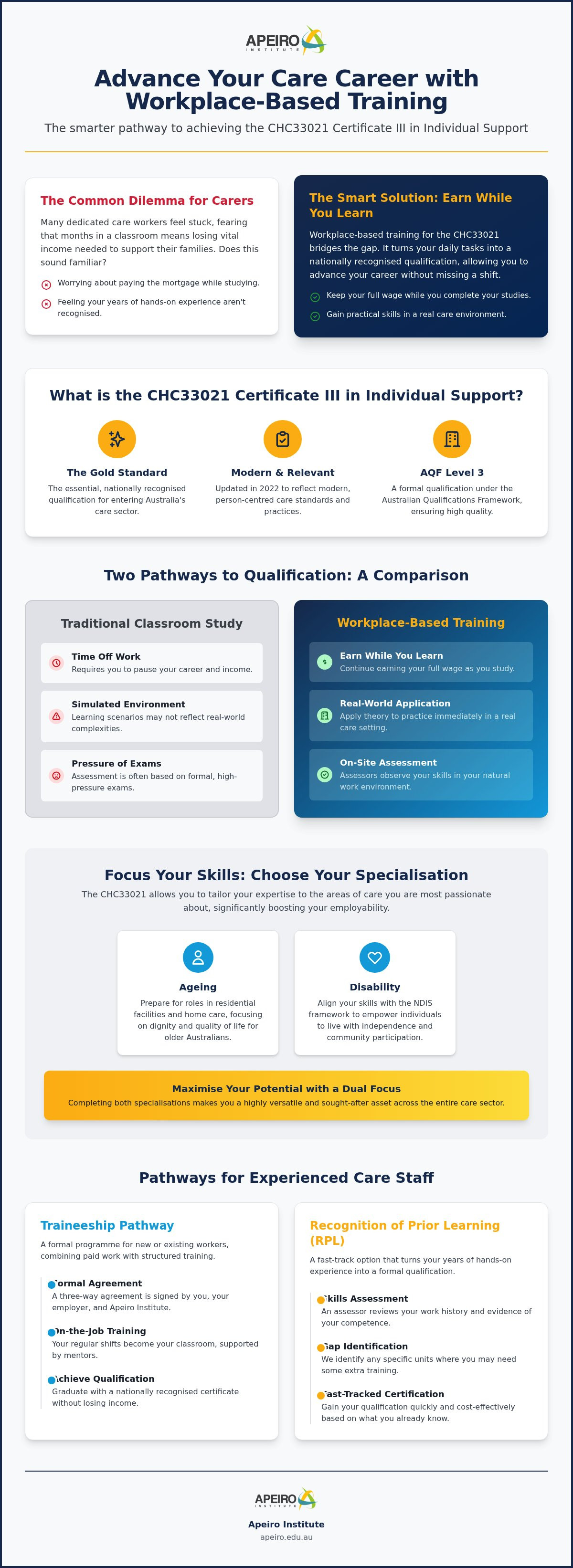
Choosing to study shouldn't mean choosing between a qualification and your weekly mortgage. Many dedicated care workers feel stuck, worrying that sitting in a classroom for months means losing the vital income they rely on to support their families. You might even feel that your years of hands-on experience deserve more credit than a traditional academic exam could ever provide. It's a common concern, and you're certainly not alone in wanting a more flexible way to grow.
The good news is that the benefits of workplace based training - CHC33021 are specifically designed to bridge the gap between where you are and where you want to be. This practical pathway allows you to earn while you learn, turning your daily tasks into a nationally recognised Certificate III in Individual Support. By training in a real care setting, you avoid the anxiety of campus-based classes and gain the real-world confidence that employers value most. This article explores how this hands-on approach can accelerate your career, recognise your existing skills, and help you step into higher-paying roles without ever missing a shift.
Key Takeaways
- Understand why the CHC33021 is the essential qualification for anyone looking to make a real difference in Australia's aged care and disability sectors.
- Learn how the benefits of workplace based training - CHC33021 allow you to earn a full wage while completing your studies in your current care facility.
- Discover how to eliminate the gap between theory and practice by mastering person-centred care techniques in a real-world environment.
- Explore flexible pathways like Recognition of Prior Learning (RPL) to turn your existing years of experience into a nationally recognised certificate.
- Find out how mentor-led support can help you gain the confidence needed to step into higher-paying roles and advance your career quickly.
Understanding the CHC33021 Qualification in Australia's Care Sector
The CHC33021 Certificate III in Individual Support isn't just a piece of paper; it's the gold standard for anyone entering Australia's care sector. As a recognised level 3 qualification under the Australian Qualifications Framework, it ensures you have the technical skills to support our most vulnerable community members. This version replaced the older CHC33015 qualification in late 2022 to better reflect modern, person-centred care standards. It's designed to be practical, relevant, and deeply focused on the dignity of the individual. Today, the industry is moving away from purely classroom-based learning. Employers realise that the benefits of workplace based training - CHC33021 offer a superior way to prepare staff for the realities of the job.
The massive demand for skilled carers across the country has changed how training is delivered. Facilities are looking for workers who can hit the ground running. This is why the benefits of workplace based training - CHC33021 are so significant. You aren't just reading about care in a textbook; you're practising it under the guidance of experienced mentors. This shift ensures that the next generation of workers can handle the social and emotional complexities of the modern care environment while meeting strict industry standards.
Ageing vs. Disability Specialisations
This qualification allows you to focus on the areas where you feel you can make the most impact. The Ageing specialisation prepares you for the nuances of residential facilities and home care. It focuses on dignity, safety, and quality of life for older Australians. Conversely, the Disability specialisation aligns with the NDIS, empowering individuals to live independently and participate in their communities. Many Apeiro students choose to complete both specialisations. This dual focus significantly increases your employability across a wider range of care settings, making you a versatile asset to any provider.
The Role of a Support Worker in 2026
Working in care has evolved significantly. In 2026, a support worker does much more than help with daily tasks. You're a companion, an advocate, and a vital link to the community. You'll need to master complex communication techniques and navigate legal and ethical frameworks daily. It's a role that requires empathy and professional boundaries in equal measure. Starting with our CHC33021 Certificate III in Individual Support gives you the foundation needed for these responsibilities. It also acts as a perfect stepping stone if you later decide to pursue a Diploma of Community Services Australia to move into case management or leadership roles.
How Workplace-Based Training Works for CHC33021
Workplace-based training flips the script on traditional education. Instead of spending your days in a lecture theatre, your daily shifts become your primary learning environment. Your facility or community setting isn't just where you work; it's your classroom. This integration is one of the standout benefits of workplace based training - CHC33021. It means you don't have to simulate care scenarios in a laboratory. You're doing the real thing, with real people, every single day. Theory becomes practice the moment you learn it. If you read about infection control in the morning, you're applying those exact protocols by lunchtime.
Assessments in this model are highly practical. A qualified assessor from Apeiro Institute visits you on-site to observe your skills in action. They watch how you assist with mobility, how you communicate with residents, and how you follow safety procedures. This ensures you meet the rigorous standards outlined in the official CHC33021 qualification details. It's a supportive process designed to confirm your competence in a natural setting. You won't have to worry about the pressure of a sterile exam room. You're simply showing what you do best in the place where you feel most comfortable.
The Traineeship Pathway
A traineeship is a formal three-way agreement between you, your employer, and Apeiro Institute. It's a fantastic way to secure your future. The best part is you'll earn while you learn. You get paid your usual wage for the hours you spend working and training on the floor. This completely removes the fear of losing your weekly pay packet just to get qualified. If you're already employed in care, it's worth asking your manager if they can support a workplace trainee. Most employers value this model because it develops a highly skilled, confident workforce tailored to their specific facility needs.
Flexible Assessment Methods
While the focus is on practical skill, you'll still cover essential theory. We use digital learning platforms so you can complete your modules whenever it suits you. You'll also maintain a logbook to document your daily care activities and hours. Your workplace supervisors play a vital role here, providing regular feedback on your progress and signing off on your practical experience. It's a collaborative approach that keeps everyone on the same page. If you're looking for a path that respects your time, our CHC33021 Certificate III in Individual Support provides the ultimate flexibility for busy care workers.
Core Benefits of Workplace-Based Training for Your Care Career
Learning how to provide care from a textbook is vastly different from doing it on the floor. One of the most significant benefits of workplace based training - CHC33021 is that it completely eliminates the 'theory-practice gap'. In a traditional classroom, you might practice manual handling on a plastic mannequin. In a real care setting, you learn to assist a person who might be anxious, in pain, or simply having a bad day. This immersion ensures your skills are sharp, safe, and deeply human. It's a faster route to competency because you're applying every lesson to a real-world scenario the moment you learn it.
Building rapport is the heartbeat of individual support. When you train where you work, you develop lasting bonds with residents and clients over months, not just during a short placement. This continuity allows you to understand their unique preferences and life stories, which is essential for delivering genuine person-centred care. Employers recognise this value. They look for candidates who have already proven they can handle the fast-paced, emotional environment of a modern care facility. You aren't just a graduate; you're a seasoned professional from day one.
Financial Stability and Career Momentum
Choosing to upskill shouldn't mean struggling to pay the bills. By opting for a workplace-based model, you maintain your steady income while working toward a promotion or a higher pay grade. There are many Benefits of an Apprenticeship or Traineeship, but the ability to avoid student debt while building a professional network is often the most life-changing. You remain an active part of your team, showing your manager your dedication to the role while you study. It's the most efficient way to keep your career moving forward without hitting the pause button on your life.
Mastering Soft Skills in Real-Time
Technical skills like medication assistance are vital, but soft skills are what make a great carer. Workplace immersion allows you to master empathy, patience, and active listening in real-time. You'll learn to navigate complex family dynamics and support people from diverse cultural backgrounds. At Apeiro, we celebrate this diversity, with our student community representing over 38 nationalities. This exposure builds the emotional resilience you need for a long-term, rewarding career in community services. You'll finish your course not just with a certificate, but with the confidence to handle any situation with grace and professionalism.
How to Get Qualified While You Work: Pathways for Experienced Care Staff
If you've been working in a nursing home or disability centre for years, you're likely already performing the duties of a qualified support worker. The only thing missing is the formal recognition of your expertise. For veterans of the sector, the benefits of workplace based training - CHC33021 are transformative. Instead of starting from scratch in a beginner's course, you can fast-track your progress by showing us what you already know. Our Trade Pathways for Experienced Workers (TPEW) programme is built exactly for this purpose. It respects your time and acknowledges the hard work you've already put in on the front lines of care.
Gathering evidence is the first step in this journey. You don't need to sit through lectures on topics you've mastered over a decade of service. Instead, you'll provide documentation that proves your competency. This includes items like current job descriptions, detailed supervisor reports, and records of any previous in-house training you've completed. By using your actual workplace as the source of your evidence, the process feels natural rather than academic. It's a supportive way to bridge the gap between your current role and your future career goals.
The RPL Assessment Process
Recognition of Prior Learning (RPL) is a formal assessment that identifies which units of the CHC33021 you've already mastered through your daily work. You'll submit a portfolio of evidence that demonstrates your industry knowledge and practical skills. A specialised assessor then reviews your history to see where your experience meets the national standards. This is undoubtedly the fastest way to achieve a nationally recognised qualification in Australia. It saves you from repeating units you've been practicing for years.
Bridging the Gaps
Sometimes, even the most experienced workers find that their history doesn't cover every single unit of a modern qualification. This is where 'gap training' comes in. If a specific technical skill or updated regulation wasn't part of your previous experience, we provide a tailored learning plan to cover only those missing pieces. You won't waste time on what you already know. This efficiency is perfect for busy professionals who need to stay on the floor while they upskill. It ensures you're fully compliant with 2026 standards without the need for a full-time study load.
Fast-track your qualification with our specialised TPEW pathway
Elevate Your Career with Apeiro Institute’s CHC33021 Programme
At Apeiro Institute, we don't just provide a course; we act as a dedicated partner in your professional success. Our CHC33021 Certificate III in Individual Support is specifically designed to deliver flexibility and practical outcomes for those already on the floor. We understand that the 2026 care market demands more than just basic technical knowledge. It requires a worker who is resilient, empathetic, and culturally aware. By focusing on the benefits of workplace based training - CHC33021, we ensure you're prepared for these specific demands from day one. You'll gain the skills to provide high-quality, person-centred care while maintaining your current employment.
We welcome students from all walks of life. Our inclusive learning community represents over 38 nationalities, creating a rich environment where global perspectives meet local industry standards. This diversity is a core part of our identity. It ensures that our graduates are well-equipped to support Australia’s multicultural population. Whether you're just starting out or looking to formalise years of experience, we provide the expert guidance needed to turn your career goals into reality. Our industry-aligned training is the bridge between your current circumstances and a higher-paying, more secure future.
A Supportive Learning Environment
Our trainers are much more than educators; they're expert mentors who understand the intricacies of the Australian care landscape. They provide ongoing guidance to help you navigate the delicate balance between your work shifts and your study requirements. You won't be left to figure things out on your own. We offer personalised feedback at every stage, ensuring you meet national standards with confidence. This student-centred support is what sets us apart. It transforms the prospect of getting qualified from something intimidating into something entirely attainable. We're here to provide the security and expert guidance you need to grow.
Next Steps: Starting Your Journey
Taking the first step toward a rewarding career in aged care or disability support is a straightforward process. If you’re already working in a care setting, the best way to begin is by enquiring about our workplace-based training options or our specialised TPEW pathways. You'll need to prepare some basic documentation for an initial skills assessment, such as your current job description or supervisor reports. This helps us identify the best pathway for your needs. By understanding the benefits of workplace based training - CHC33021, you can choose a route that respects your experience and your time. Let us help you advance your career to higher-paying roles quickly and with confidence.
Take the Lead in Your Care Career
Advancing your career in Australia's care sector shouldn't feel like an uphill battle against academic exams or lost wages. By choosing a workplace-based pathway, you turn your daily commitment to helping others into a nationally recognised qualification. You've seen how this model closes the gap between theory and practice while keeping your financial security intact. Whether you're a newcomer or an experienced worker looking for a fast-track through our TPEW programme, the support you need is right here.
The benefits of workplace based training - CHC33021 ensure that your education fits around your existing life. As a Nationally Recognised Training provider (RTO 45394), Apeiro Institute is proud to foster an inclusive community representing over 38 nationalities. We're here to act as your expert guide, helping you gain the confidence to provide high-quality support in a rapidly growing industry. Your journey toward a more rewarding, higher-paying role starts with a single conversation.
Enquire about our workplace-based CHC33021 programme today
You already have the passion to make a difference in people's lives. Now, it's time to get the qualification that reflects your true potential and provides the career security you deserve.
Frequently Asked Questions
Can I really get my CHC33021 qualification while I keep working?
Yes, you can definitely earn your qualification without leaving your job. One of the main benefits of workplace based training - CHC33021 is that your daily shifts count toward your learning requirements. You'll complete assessments on-site, allowing you to maintain your income while you upskill. This model is perfect for busy individuals who need to balance their financial commitments with their professional growth goals. It ensures you stay financially secure while gaining the confidence to step into higher-paying roles.
What is the difference between a traineeship and workplace-based training?
A traineeship is a formal training contract between you, your employer, and the RTO, often involving government funding. Workplace-based training is the specific delivery method where your learning happens at your place of employment rather than on a campus. While many traineeships use this delivery mode, workplace-based training can also apply to other pathways, such as Recognition of Prior Learning (RPL) or fee-for-service arrangements tailored to your facility. We'll help you choose the right path.
How long does it take to complete the Certificate III in Individual Support on the job?
The duration varies depending on your previous experience and the hours you work. Typically, students complete the Certificate III in Individual Support in 6 to 12 months. If you're an experienced worker using the Recognition of Prior Learning (RPL) pathway, you may finish much faster by proving your existing skills. We provide a tailored learning plan to ensure you progress at a pace that suits your professional and personal life, keeping you on track for success.
Is workplace-based training recognised the same way as a TAFE course?
Absolutely. As a Registered Training Organisation (RTO 45394), Apeiro Institute delivers the same nationally recognised CHC33021 qualification as any TAFE. The standards for competency are identical across Australia. The only difference is the setting where you learn. Many employers actually prefer workplace-based graduates because they've already demonstrated their ability to handle the practical, real-world demands of a care environment during their studies. You finish with a certificate that is valid and respected nationwide.
Do I need to find my own employer for workplace-based training?
Yes, to participate in workplace-based training, you generally need to be currently employed in a care facility or have an employer willing to host you. This is because your daily tasks form the basis of your practical assessments. If you aren't currently working in the sector, we can discuss how to find a suitable host or explore alternative pathways to help you get started. We're here to act as your mentor and guide throughout this entire process.
What happens if I have years of experience but no formal certificate?
If you have significant industry experience, you're an ideal candidate for our Trade Pathways for Experienced Workers (TPEW). We use Recognition of Prior Learning (RPL) to assess your existing skills against the national standards. This allows you to skip units you've already mastered and focus only on any 'gaps' in your knowledge. It's the most efficient way to turn your years of hard work into a formal qualification without repeating basic training modules you already understand.
Are there any entry requirements for the CHC33021 workplace programme?
While there are no formal academic prerequisites, you must meet industry safety standards. This includes a valid National Police Check and, depending on your role, an NDIS Worker Screening Check or a Working with Children Check. You'll also need to be working in a care setting that allows for the mandatory 120 hours of work placement. We'll guide you through these requirements during your initial enrolment process to ensure you're ready for your career journey.
Can workplace-based training help me get a job in the NDIS?
Yes, it certainly can. The CHC33021 qualification includes a specific specialisation in Disability Support, which is the foundational requirement for working with NDIS participants. By choosing the benefits of workplace based training - CHC33021, you'll gain the specific practical skills needed to empower individuals with disabilities to live independently. This hands-on experience in a real-world setting makes you a highly attractive candidate for NDIS registered providers across Australia. It's the best way to start a career.

Disclaimer
The information provided on this blog is for general informational and educational purposes only. While every effort is made to ensure the accuracy and reliability of the content, the author makes no representations or warranties of any kind, express or implied, about the completeness, accuracy, suitability, or availability of the information contained on this blog.
The views and opinions expressed in blog posts are those of the individual author and do not necessarily reflect the official policy or position of any organization, company, or employer.
This blog may contain links to external websites or third-party content. These links are provided for convenience only, and the author has no control over and assumes no responsibility for the content, privacy policies, or practices of any third-party sites.
Nothing on this blog constitutes professional advice (legal, financial, medical, or otherwise). Readers are encouraged to seek appropriate professional guidance before making any decisions based on the information provided here.
By using this blog, you acknowledge that any reliance on the information is at your own risk.


