

What if your passion for high-performance engines could be the very thing that secures your professional future in Australia? You likely already know that the Australian automotive industry is constantly searching for skilled hands, yet the path to getting qualified often feels like a maze of confusing acronyms and strict visa rules. It's perfectly natural to feel a bit stuck when trying to distinguish between RTOs and CRICOS providers or wondering if you can actually manage the study load while working your allowed 48 hours per fortnight.
The good news is that the right training makes every technical detail click into place. Our focus today is the certificate iii in automotive mechanical technology international students use as their primary gateway into the local trade. This article provides a clear, supportive roadmap for the AUR30620 qualification, showing you exactly how to transition from an enthusiast to a professional light vehicle mechanic. We'll explore the daily rhythm of an Australian workshop, the latest Genuine Student visa requirements, and how this investment in your skills delivers a genuine return in a high-demand sector.
Key Takeaways
- Learn how the AUR30620 qualification serves as the essential foundational standard for light vehicle mechanics, covering passenger cars, SUVs, and small commercial vehicles.
- Explore the practical, workshop-based skills you'll acquire, ranging from engine and transmission mastery to the latest electronic drive management systems.
- Understand the specific entry requirements and CRICOS compliance steps for the certificate iii in automotive mechanical technology international students need to start their journey.
- Discover why Australia is a premier destination for trade training, offering exposure to high technical standards and rapidly evolving hybrid vehicle technology.
- Identify your long-term career potential by mapping out pathways into advanced mechanical diagnosis or leadership positions within the automotive sector.
Understanding the AUR30620 Certificate III in Light Vehicle Mechanical Technology
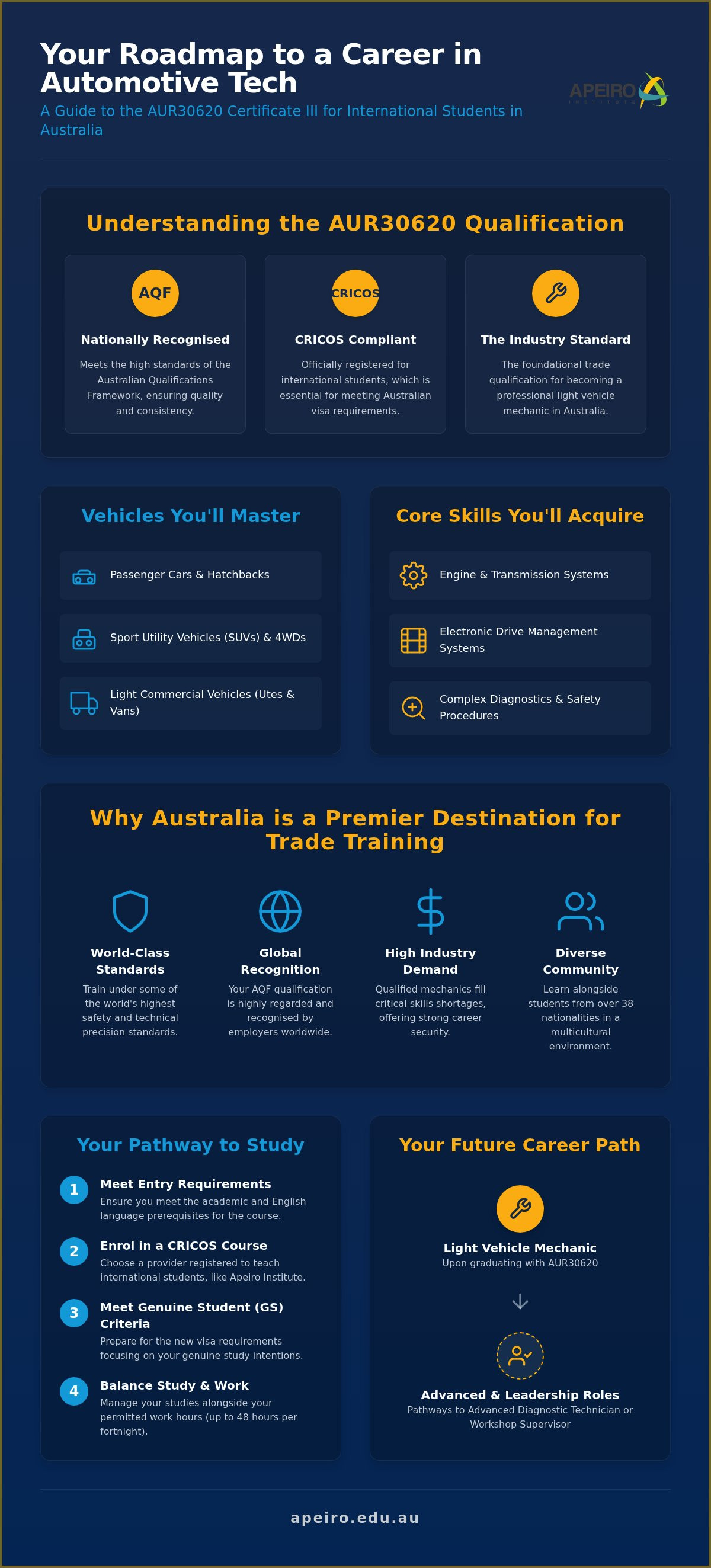
The AUR30620 Certificate III in Light Vehicle Mechanical Technology is the foundational qualification for anyone looking to build a career in the Australian automotive industry. It's more than just a certificate; it's a nationally recognised credential under the Australian Qualifications Framework (AQF). This ensures that the skills you learn in the workshop meet the high standards expected by employers across the country. For those moving from overseas, choosing a course registered with the Commonwealth Register of Institutions and Courses for Overseas Students (CRICOS) is vital. It guarantees that your study load meets visa requirements while you receive high-quality, regulated training.
The "Light Vehicle" designation specifically covers a broad range of transport. You'll gain expertise in:
- Passenger cars and hatchbacks
- Sport Utility Vehicles (SUVs) and 4WDs
- Light commercial vehicles, such as utes and small vans
What Makes This Course Essential for Aspiring Mechanics?
Many students begin as car enthusiasts, spending weekends under a bonnet at home. While passion is a great start, the Australian automotive sector is highly regulated. To work as a qualified mechanic, you need formal recognition of your technical skills. This certificate iii in automotive mechanical technology international students pursue provides that bridge. It transforms your hobby into a professional trade pathway. You'll learn the theory behind complex systems and apply it in a controlled environment. This ensures you can troubleshoot modern vehicles safely and efficiently, moving beyond basic repairs to complex diagnostics.
The Role of an International Student in the Australian Trade Sector
Australia's vocational landscape is incredibly diverse. It's common to find students from over 38 different nationalities training together in a single workshop. This global community brings a wealth of perspectives to the classroom, reflecting the multicultural nature of the Australian workforce. International students play a crucial role in filling critical skill shortages within the local trade sector. By gaining these specialised skills, you become a valuable part of the economy. If you're looking for a broader perspective on your options, check out our Vocational Courses for International Students in Australia: The Complete 2026 Guide. Much like the programs offered through Technical and Further Education (TAFE), our institute focuses on practical outcomes that get you job-ready from day one.
Why Australia is the Premier Destination for Automotive Trade Training
Australia's reputation for mechanical excellence isn't just about the cars on the road; it's about the rigour of the training behind them. The safety standards here are among the highest in the world, ensuring that every vehicle leaving a workshop is fit for purpose. When you study here, you aren't just learning to fix cars. You're learning to uphold a national standard of safety and technical precision. This commitment to quality is why the certificate iii in automotive mechanical technology international students enrol in is so highly regarded by global employers.
High Standards and Global Recognition
Australian trade certificates carry significant weight overseas. Employers in Europe, Asia, and the Americas recognise the depth of the Australian Qualifications Framework (AQF). Specifically, AQF standards for automotive trades ensure that every graduate possesses a uniform level of competency in both manual and diagnostic tasks. For those coming from abroad, enrolling in a CRICOS-compliant course is the first step toward gaining this global recognition. This rigorous assessment process ensures you're job-ready the moment you graduate. You won't just have a piece of paper; you'll have the confidence to step into any professional workshop and contribute immediately to the team.
Industry Demand and Career Security
The demand for qualified light vehicle mechanics has reached critical levels in 2026. As vehicle technology evolves, the need for specialists who understand hybrid and electronic systems is growing faster than the workforce can keep up. This skills gap provides a unique level of career security for new graduates. While automation changes many industries, the hands-on diagnostic skills of a mechanic remain essential and future-proof. You'll be training in modern, well-equipped workshops that mirror the environments of Australia's top service centres. These facilities allow you to practice on the latest vehicle models, ensuring your skills are relevant to the cars currently on Australian roads.
The Australian automotive service and repair sector remains one of the most stable parts of the economy. People always need their vehicles serviced, regardless of economic shifts. This creates a reliable environment for you to build your professional life. If you're looking for a stable and rewarding career path, our AUR30620 qualification offers a direct route into this high-demand sector. By choosing to study the certificate iii in automotive mechanical technology international students can secure a future in an industry that values expertise, precision, and practical problem-solving.
Core Skills and Mastership: What You Will Learn in the Workshop
Mastering the workshop floor is where your theoretical knowledge meets real-world machinery. In this environment, you move beyond basic maintenance to achieve true mastership of a vehicle's most complex systems. The training is designed to be immersive, giving you the confidence to handle everything from a routine service to a complete engine overhaul. By the time you complete the AUR30620 Certificate III in Light Vehicle Mechanical Technology, you'll have a deep, practical understanding of how every component interacts within a modern car.
Mechanical Systems and Engine Repair
The heart of your training involves getting your hands dirty with the core mechanical components. You'll learn the precise process of stripping and rebuilding petrol fuel systems, ensuring you understand every valve, seal, and injector. This mastery extends to cooling systems and final drive assemblies, where accuracy is non-negotiable. We place a heavy emphasis on a "safety-first" approach, particularly when working on braking and steering systems. Understanding the physics of how a car stops and turns isn't just a technical requirement; it's a fundamental responsibility you carry for every driver who enters your workshop.
The Shift to Electronic Diagnosis
Modern vehicles are as much rolling computers as they are mechanical marvels. This means the certificate iii in automotive mechanical technology international students enrol in today looks very different than it did a decade ago. While the spanner remains an essential tool, you'll spend a significant amount of time using specialised diagnostic equipment to identify complex electronic faults. You'll learn to interpret data from drive management systems to pinpoint issues that aren't visible to the naked eye. To get a better sense of how these digital skills fit into your overall career, our Certificate III light vehicle mechanical technology guide offers a detailed look at the 2026 standards.
Beyond the technical tasks, being a successful mechanic in Australia requires strong communication. You'll practice creating accurate technical documentation and explaining complex repairs to customers in a way they can easily understand. These soft skills are what separate a good mechanic from a great one. Employers value technicians who can manage their time, document their work clearly, and provide professional service. This holistic approach ensures that when you step into a professional role, you're prepared for the technical challenges and the daily interpersonal interactions of a busy Australian service centre.
Entry Requirements and CRICOS Compliance for International Students
Setting yourself up for a career in Australia starts with understanding the entry pathway. The certificate iii in automotive mechanical technology international students enrol in has specific prerequisites to ensure everyone is ready for the technical and academic load. Meeting these requirements early helps you avoid delays in your visa application and ensures you have the foundational skills to succeed in a fast-paced workshop environment.
To begin your enrolment, you generally need to follow these five steps:
- Step 1: Meet English language proficiency requirements. For most visa and course entries in 2026, this means achieving an IELTS score of 6.0 or an equivalent PTE result.
- Step 2: Provide evidence of your previous education. You'll need to show you have completed secondary school equivalent to Australian Year 10 or 12.
- Step 3: Understand your study load. Student visas require a minimum of 20 hours per week of face-to-face, scheduled training.
- Step 4: Organise Overseas Student Health Cover (OSHC). This is a mandatory health insurance requirement for the duration of your stay in Australia.
- Step 5: Prepare for the workshop. This includes having the right personal protective equipment (PPE) and being ready for the physical nature of mechanical work.
Navigating the CRICOS Framework
CRICOS is your primary safeguard while studying abroad. It's the official government register that ensures your course and institution meet the strict standards required for international education. When you enrol at a CRICOS-registered RTO, you receive a Confirmation of Enrolment (CoE). This document is essential for your student visa application. Beyond compliance, a quality institute acts as a mentor. They provide dedicated support services to help you settle into Australian life, from understanding local workplace culture to finding your way around the workshop floor.
Balancing Study and Workshop Practice
A typical week involves a blend of classroom theory and practical application. You'll spend significant time in the workshop, applying the diagnostic skills needed for modern vehicle repair. A key part of the AUR30620 qualification is the practical work placement component. Many programs include a requirement of around 300 hours of industry placement. This gives you a chance to experience the daily life of an Australian mechanic first-hand. It's also a fantastic opportunity to network within a diverse student community, building connections that can help you long after graduation.
Balancing your studies with work is also manageable. Under current 2026 regulations, international students can work up to 48 hours per fortnight during term time. This allows you to gain extra industry experience or support yourself while maintaining your 20-hour weekly study commitment. Engaging with your peers is just as important as the technical work. You'll be part of a global community, learning alongside people from dozens of different countries, all working toward the same professional goal.
Enquire about our AUR30620 enrolment process today
Advancing Your Career: Pathways Beyond the Certificate III
Completing your initial training is a proud milestone, but it's often just the beginning of a much larger professional journey. The certificate iii in automotive mechanical technology international students use to enter the industry provides the core mechanical skills, but the Australian trade system is designed for continuous growth. Once you've mastered the basics, you can choose to deepen your technical expertise or move into a leadership position. This structured progression ensures you don't just have a job; you have a lifelong career with clear steps for advancement.
Specialisation and Diagnostic Expertise
As vehicles become more technologically advanced, the demand for specialists is skyrocketing. Moving from a Certificate III to the AUR40216 Certificate IV in Automotive Mechanical Diagnosis allows you to focus on complex electrical and mechanical faults that require advanced troubleshooting. This level of specialisation often leads to roles as a Master Technician, where your ability to solve "unsolvable" problems makes you an invaluable asset to any workshop. Higher qualifications naturally correspond with higher earning potential, as you're handling the most difficult technical tasks in the service centre.
Specialising allows you to master:
- Advanced engine management and fuel systems.
- Complex electronic stability and braking control systems.
- High-level diagnostic tool integration and data analysis.
- Hybrid and electronic drive management systems.
If you already have years of experience from your home country, you might not need to start from zero. Our Trade Pathways for Experienced Workers Australia: The 2026 Guide explains how your existing skills can be recognised to fast-track your qualification through the TPEW pathway.
From the Workshop to Management
For those who enjoy the business side of the industry, the AUR50216 Diploma of Automotive Technology is the logical next step. This qualification shifts the focus from the tools to the team. You'll study units in business operations, leadership, and customer service management. This pathway is perfect for aspiring Workshop Managers or those who dream of eventually opening their own automotive service centre. It's about building a future where you lead a team and drive innovation within the sector.
Your journey into the Australian automotive sector starts with a single workshop session, but the potential is limitless. Whether you're aiming to be the best diagnostic technician in the country or a business owner, the right training provides the security and confidence you need to get there. By starting with the certificate iii in automotive mechanical technology international students can build a foundation that supports decades of professional success and personal growth.
Kickstart Your Automotive Career in Australia
Building a career as a light vehicle mechanic offers both stability and the chance to work with cutting-edge vehicle technology. By choosing the certificate iii in automotive mechanical technology international students gain more than just technical skills. You're entering a regulated industry where your expertise is backed by a nationally recognised qualification (RTO 45394). From mastering engine repairs to navigating complex electronic diagnostics, your training happens in industry-aligned workshops under the guidance of expert mentors who are invested in your success.
With comprehensive CRICOS support (Provider 03703M), you can focus on your studies with peace of mind, knowing your education meets every Australian standard. This is your foundational step toward becoming a master technician or even a workshop manager in a high-demand sector.
We're here to support you at every turn of your professional journey. Your future in the Australian trade sector is waiting for you to take the first step.
Frequently Asked Questions
Can I work while studying the Certificate III in Automotive Mechanical Technology?
Yes, you certainly can. Under 2026 student visa regulations, international students are permitted to work up to 48 hours per fortnight while their course is in session. During scheduled term breaks, you have unlimited work rights. This flexibility allows you to gain valuable experience in a local workshop or support your living costs while you maintain your 20-hour weekly face-to-face study commitment on campus.
What is the difference between an apprentice and an international student in this course?
Apprentices are generally local residents who are employed under a training contract, learning on the job while attending classes part-time. In contrast, international students usually complete the AUR30620 as a full-time vocational program. While both groups achieve the same qualification, international students must maintain a full-time study load to comply with CRICOS requirements and typically gain their practical experience through structured work placements rather than a four-year apprenticeship.
Is the AUR30620 qualification recognised internationally?
Yes, the AUR30620 is a nationally recognised qualification under the Australian Qualifications Framework (AQF), which is held in high regard globally. Many countries recognise the rigorous technical and safety standards of the Australian automotive sector. This makes the certificate iii in automotive mechanical technology international students choose a versatile asset if you decide to work abroad. It proves you have met high-level benchmarks in a sophisticated and well-regulated market.
Do I need to buy my own tools before starting the course?
You don't need to purchase a professional tool kit before your first day. Our training workshops are fully equipped with the latest diagnostic tools and mechanical equipment required for your practical sessions. You will, however, need to invest in personal protective equipment (PPE), such as steel-capped boots and appropriate workwear. As you move toward your work placement, our experienced trainers can provide expert advice on the best tools to buy for your career.
What happens if I have previous experience as a mechanic in my home country?
If you have prior experience, you may be eligible for Recognition of Prior Learning (RPL) or our Trade Pathways for Experienced Workers (TPEW). By providing documentation of your work history and completing practical assessments, you can demonstrate your existing competency. This process may allow you to receive credit for specific units, potentially reducing your study load or helping you gain your Australian qualification faster. We encourage you to discuss your experience with our admissions team.
How long does the Certificate III in Automotive Mechanical Technology take to complete?
The course duration typically ranges from 68 to 78 weeks, depending on the specific provider and intake date. This period generally includes 60 weeks of active training and workshop practice, with the remaining weeks allocated to scheduled holidays. This methodical pace is designed to ensure you master complex mechanical systems and complete your required work placement hours with confidence, ensuring you are fully prepared for the daily demands of a professional workshop.
Are there specific English language requirements for this automotive course?
Yes, international students must meet specific English proficiency levels to ensure they can safely follow technical instructions. For 2026, the standard requirement is an overall IELTS score of 6.0, or an equivalent result from a recognised test like PTE. This level of English ensures you can participate in workshop safety briefings, understand complex diagnostic data, and accurately complete the technical documentation required in the Australian automotive industry.
What kind of support does Apeiro Institute provide to international students?
We provide a warm, student-centered environment with dedicated support services to help you settle into Australian life. Our team offers guidance on meeting the Genuine Student (GS) requirements and provides mentor-like support throughout your training. We also foster a diverse, inclusive community where you can connect with peers from many different nationalities. Our trainers are industry experts who are deeply invested in helping you achieve your career goals and professional growth.

Disclaimer
The information provided on this blog is for general informational and educational purposes only. While every effort is made to ensure the accuracy and reliability of the content, the author makes no representations or warranties of any kind, express or implied, about the completeness, accuracy, suitability, or availability of the information contained on this blog.
The views and opinions expressed in blog posts are those of the individual author and do not necessarily reflect the official policy or position of any organization, company, or employer.
This blog may contain links to external websites or third-party content. These links are provided for convenience only, and the author has no control over and assumes no responsibility for the content, privacy policies, or practices of any third-party sites.
Nothing on this blog constitutes professional advice (legal, financial, medical, or otherwise). Readers are encouraged to seek appropriate professional guidance before making any decisions based on the information provided here.
By using this blog, you acknowledge that any reliance on the information is at your own risk.


