

What if the biggest obstacle to your career as a mechanic in Australia isn't the complex engine work, but the paperwork standing in your way? Understanding the automotive student visa requirements australia enforces can feel like trying to rebuild a transmission without a manual. It's completely normal to feel overwhelmed by shifting English test scores and the AUD $2,500 application fee that took effect on July 1, 2026. You want a clear path forward, not a confusing maze of migration jargon.
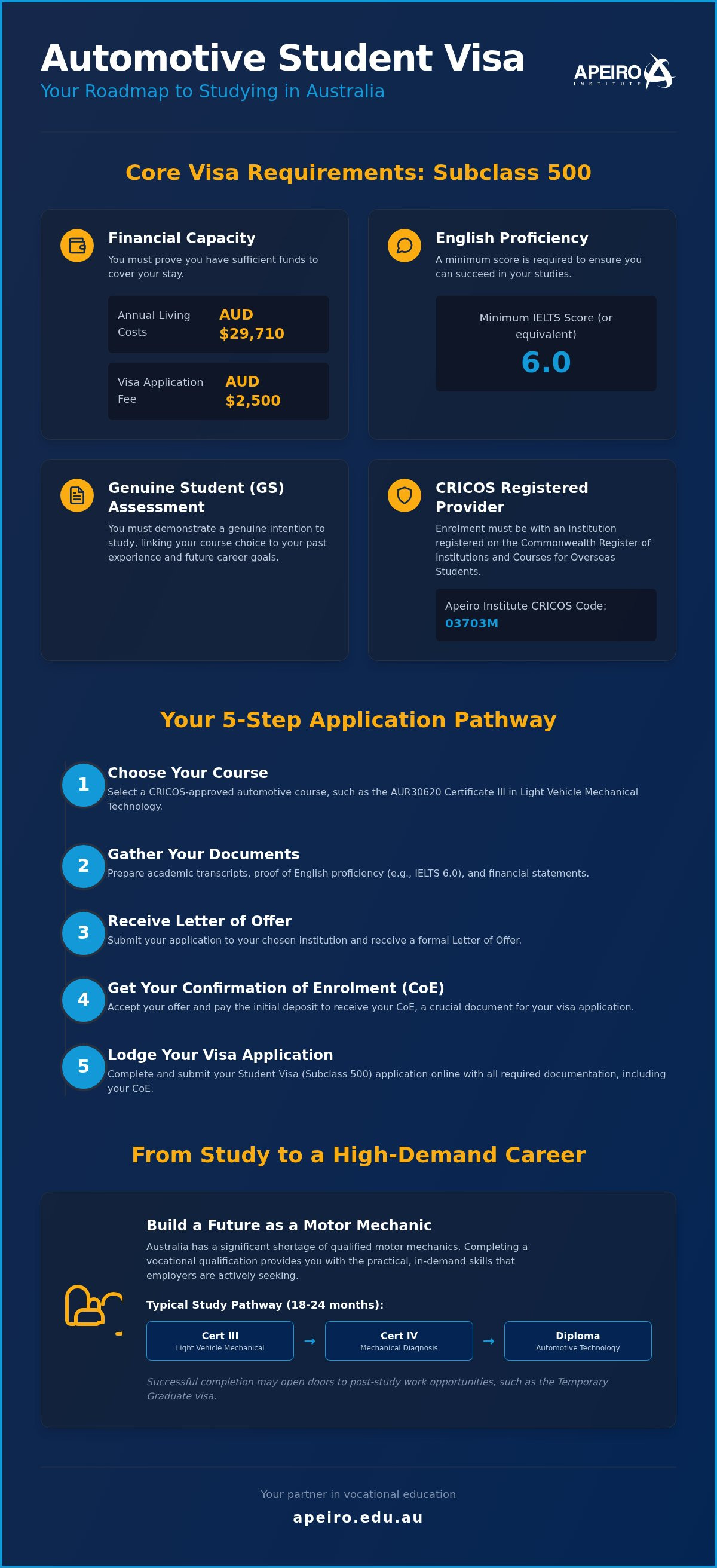
We believe that starting your educational journey should be an exciting milestone, not a source of stress. This guide simplifies the process, offering you a clear roadmap to secure your Student Visa (Subclass 500). You'll find a checklist of required documents, the latest living cost figures of AUD $29,710, and a breakdown of the 6.0 IELTS requirement. We also explain how to choose a CRICOS-registered provider to ensure your training is nationally recognised. By the end of this read, you'll have the confidence to lodge your application and focus on what really matters: your future trade career.
Key Takeaways
- Understand the specific automotive student visa requirements australia mandates for the Subclass 500, including the Genuine Student (GS) criteria and documentation checklists.
- Learn how to demonstrate your financial capacity to cover the updated AUD $29,710 annual living cost requirement and your course tuition fees.
- Discover the minimum English proficiency scores and academic prerequisites needed to enrol in trade qualifications like the Certificate III in Light Vehicle Mechanical Technology.
- Follow a clear, step-by-step process to secure your Letter of Offer and Confirmation of Enrolment (CoE) from a CRICOS-registered training organisation.
- Explore how completing your automotive studies opens doors to high-demand career roles and potential post-study work opportunities through the Temporary Graduate visa.
Understanding the Automotive Student Visa (Subclass 500)
The Student Visa (Subclass 500) is the essential gateway for anyone looking to build a trade career in Australia. This visa subclass allows you to reside in the country for the duration of your studies, provided you're enrolled in a full-time course. For aspiring mechanics, this usually falls under the Vocational Education and Training (VET) sector. Understanding the automotive student visa requirements australia has established is the first step in moving from a hobbyist to a professional technician. It's a process that rewards preparation and attention to detail. While the broader Visa policy of Australia can seem complex, the student stream is designed to be accessible for genuine learners who want to contribute to the local economy.
The Role of CRICOS in Your Visa Application
You cannot secure a student visa without a Confirmation of Enrolment (CoE) from a CRICOS-registered provider. CRICOS stands for the Commonwealth Register of Institutions and Courses for Overseas Students. It's a government database that ensures the education you receive meets strict Australian standards. If a training organisation isn't registered, they can't legally host international students. Apeiro Institute is a proud CRICOS-registered provider (03703M). When you're researching courses, always check that the provider's code is valid. You'll also need to ensure the specific course code on your application matches your CoE exactly. This alignment is a non-negotiable part of the automotive student visa requirements australia mandates for visa approval.
Why Automotive is a Strategic Choice in 2026
Choosing the automotive sector isn't just about a passion for cars; it's a smart career move. Australia is currently experiencing a significant shortage of motor mechanics, making this trade a priority for the government. Vocational training offers a distinct advantage over general university degrees because it focuses on practical, industry-aligned skills. Employers value graduates who can step straight into a workshop and start diagnosing faults. By completing a nationally recognised qualification, such as the AUR30620 Certificate III in Light Vehicle Mechanical Technology, you're gaining skills that are in high demand across the Australian car market. This demand often leads to more stable employment prospects once you've finished your training.
The typical duration for an automotive study pathway ranges from 18 months to two years. Most students package their courses to gain a comprehensive skill set. A common stream involves starting with a Certificate III, progressing through a Certificate IV in Automotive Mechanical Diagnosis, and concluding with a Diploma of Automotive Technology. This steady progression helps you build expertise while maintaining your visa compliance throughout your stay.
Core Requirements for an Australian Student Visa
Securing your place in an Australian workshop starts long before you pick up a spanner. Meeting the automotive student visa requirements australia expects involves several distinct layers of documentation. While the process is rigorous, it's designed to ensure you're well-prepared for your time abroad. The official Student visa (subclass 500) requirements are updated annually, so staying current with the latest figures is vital for a successful lodgement. Preparation is your best tool for avoiding the stress of a potential rejection.
The Genuine Student (GS) Assessment
The Genuine Student (GS) requirement is a critical part of your application. It replaced the previous GTE standard to focus more sharply on your academic and career intentions. Case officers look for a clear, logical connection between your past experiences and your choice to study automotive technology. If you've worked in a garage or have a passion for mechanical engineering, highlight those details. Don't submit a generic statement. Explain exactly why an Australian qualification is superior to options in your home country. A common pitfall is failing to show you've researched the specific course outcomes and the provider thoroughly. Your statement should prove that your primary goal is gaining high-quality education.
Financial and Health Prerequisites
You must demonstrate that you have the financial capacity to support yourself without relying on work alone. As of July 1, 2026, the base application fee for the Subclass 500 visa is AUD $2,500. Additionally, the Department of Home Affairs requires evidence of annual living costs, which currently sit at AUD $29,710. If you're bringing a partner, you'll need to show an additional AUD $10,394, plus AUD $4,449 for each dependent child. Accepted evidence usually includes bank statements or government-sponsored loans. These funds must be genuinely available for your use during your stay.
Health and character standards are equally important. You'll need to organise Overseas Student Health Cover (OSHC) for the entire duration of your visa. This insurance is mandatory and covers you for medical or hospital care while you study. Most applicants also need to provide a police clearance certificate from every country they've lived in for 12 months or more over the last 10 years. Meeting these standards shows you're a fit and proper person to join the Australian community.
English proficiency is the final piece of the puzzle. In 2026, the standard IELTS score required for direct entry into a vocational course is 6.0. This ensures you can safely navigate a workshop and understand complex technical instructions. If you're looking for a supportive environment to meet these standards, exploring our Certificate III in Light Vehicle Mechanical Technology can help you understand how these requirements fit into your broader career goals.
Academic Entry and English Language Standards
Academic and English readiness are just as vital as your mechanical aptitude. Meeting the Australian Student Visa (Subclass 500) requirements means proving you can handle both the technical theory and the practical workshop environment. These standards ensure you're equipped to succeed in a competitive industry. Clear communication is the foundation of workshop safety, and the Department of Home Affairs prioritises students who can demonstrate they're prepared for the rigours of Australian vocational training.
IELTS and PTE Score Requirements
For 2026, the minimum English proficiency for a direct entry student visa is an IELTS score of 6.0 overall. If you prefer the PTE Academic, you'll need a score of at least 50. These scores reflect the high level of communication needed to follow complex safety protocols and interpret technical manuals. If your score is slightly lower, don't worry. You can often enrol in an ELICOS (English Language Intensive Courses for Overseas Students) program first. A packaged ELICOS course allows you to start with an IELTS of 5.0, bridging the gap before you move into your automotive training. Strong English skills don't just help with your visa; they're crucial for explaining diagnostic results to customers and collaborating with your workshop team.
Academic Pathways: Cert III to Diploma
Entry into the AUR30620 Certificate III in Light Vehicle Mechanical Technology generally requires the equivalent of Australian Year 10 or 11 completion. If you have previous automotive experience from your home country, include those details in your application. It strengthens your Genuine Student profile by showing a consistent interest in the trade. While the Certificate III provides the core mechanical skills, many students choose to "package" their studies to gain a more comprehensive edge in the job market.
A typical strategic pathway involves linking multiple qualifications under a single visa application:
- Certificate III in Light Vehicle Mechanical Technology: Mastering the basics of engine systems, brakes, and steering.
- AUR40216 Certificate IV in Automotive Mechanical Diagnosis: Focusing on advanced fault-finding and complex electronic systems.
- Diploma of Automotive Technology: Developing management skills and high-level technical leadership.
This approach meets the automotive student visa requirements australia mandates while providing a longer visa duration. It allows you to transition smoothly from learning how to service a vehicle to mastering high-level diagnostic equipment. By the time you finish the Diploma, you'll have a robust portfolio of skills that makes you a much more attractive candidate for Australian workshops.
Step-by-Step: Applying for Your Automotive Student Visa
Applying for your visa is a methodical journey that requires precision. By following a structured sequence, you ensure you meet the automotive student visa requirements australia has in place while avoiding common administrative pitfalls. This clarity helps you focus on your future career rather than getting lost in paperwork. The process moves from your initial interest to a formal application through the following stages:
- Step 1: Select your course, such as the Certificate III in Light Vehicle Mechanical Technology, and receive a Letter of Offer.
- Step 2: Pay your tuition deposit and receive your official Confirmation of Enrolment (CoE).
- Step 3: Gather your supporting documents, including your GS statement, financial evidence, and OSHC.
- Step 4: Lodge your visa application via the official ImmiAccount portal and pay the AUD $2,500 fee.
- Step 5: Attend biometrics and health examinations at an approved centre if requested by the Department of Home Affairs.
Securing Your Confirmation of Enrolment (CoE)
Your CoE is the most significant document in your application. It acts as the anchor for your visa, proving to the government that you've secured a place with a registered training organisation. At Apeiro Institute (CRICOS 03703M), we act as a supportive mentor during this phase. We help ensure your enrolment paperwork is accurate and that your course dates align perfectly with your intended stay. If you're packaging courses, such as adding a Diploma to your Certificate III, we ensure your CoE reflects the entire study pathway. This alignment is vital for securing a visa that covers your full duration of study.
Document Checklist for a Strong Application
A strong application is a complete one. Before you hit the submit button on your ImmiAccount, ensure your digital folder is ready for the automotive student visa requirements australia expects. You'll need high-quality colour scans of your passport, English test results (IELTS or PTE), and your Overseas Student Health Cover certificate. If any of your academic transcripts or identity documents aren't in English, they must be translated by a NAATI-accredited professional. Common errors, such as inconsistent dates or blurred scans, can lead to lengthy processing delays. Take the time to review every attachment twice. A clean, well-organised application demonstrates that you're a genuine and prepared student.
Apply for your automotive course today
Career Outcomes and Post-Study Opportunities
Stepping out of the classroom and into a professional workshop is where your hard work truly pays off. Once you've navigated the automotive student visa requirements australia enforces, you'll hold a qualification that is respected across the country. Australian workshops are looking for technicians who don't just understand the theory but can apply it under the bonnet. Whether you're aiming to be a Light Vehicle Mechanic, a Diagnostic Technician, or eventually a Workshop Manager, your training provides the essential foundation for these roles.
A nationally recognised qualification from a reputable provider like Apeiro Institute ensures you're job-ready from day one. Meeting the automotive student visa requirements australia expects is just the beginning of a rewarding career where your skills are in high demand. Our industry-focused training mirrors real-world scenarios, helping you build the confidence needed to excel in a fast-paced environment. This practical approach is exactly what Australian employers value when hiring new talent into their teams.
Transitioning to the Australian Workforce
Adjusting to the Australian workshop culture involves more than just technical skill; it's about communication and safety. Vocational training at Apeiro prepares you for this transition by emphasising collaborative fault-finding and strict adherence to Australian safety standards. As the industry evolves, there's also a growing demand for specialised skills in hybrid and electric vehicle (EV) technology. Students who stay ahead of these trends often find themselves at the top of the list for competitive roles. Networking within the industry and engaging with local automotive communities are great ways to find your first role after graduation.
Long-term Pathways for Skilled Mechanics
For many international students, the journey doesn't end with a Certificate III. The Temporary Graduate Visa (Subclass 485) is a popular next step. It allows you to stay in Australia to gain valuable work experience after your studies are complete. This period is a fantastic opportunity to put your skills into practice and establish your professional reputation. In 2026, the ongoing shortage of motor mechanics means that skilled trade workers are often prioritised in migration pathways. This shortage impacts visa priority, making it a strategic time to enter the trade. You might eventually explore Skilled Independent Visa pathways, which recognise the vital contribution mechanics make to the Australian workforce.
Start your automotive journey with Apeiro Institute today!
Build Your Future in the Australian Automotive Trade
Building a career in the Australian automotive industry is an achievable goal when you have a clear plan. By understanding the automotive student visa requirements australia mandates, you've already taken the most important step toward your future. From mastering the Genuine Student assessment to preparing your financial evidence, every piece of documentation brings you closer to the workshop. Navigating these requirements ensures your focus remains on your training and professional growth.
Choosing a partner like Apeiro Institute means you're supported by industry-expert trainers who understand the local trade landscape. As a CRICOS-registered provider (03703M), we offer nationally recognised training that satisfies visa compliance while giving you practical, hands-on skills. You aren't just applying for a visa; you're investing in a career that's in high demand across every state and territory. The path from student to professional mechanic is well-defined and rewarding.
With the right preparation and a focus on quality education, you can confidently lodge your application and start your journey in 2026. We're here to act as your mentor and guide throughout this exciting transition.
Explore our CRICOS-registered Automotive Courses and apply today
We look forward to welcoming you to our diverse community and helping you turn your mechanical passion into a successful Australian trade career.
Frequently Asked Questions
How much money do I need in my bank account for an Australian student visa in 2026?
You must demonstrate that you have at least AUD $29,710 to cover your living costs for the first year. This figure was updated on July 1, 2026, to reflect the current cost of living in Australia. Additionally, you'll need to show funds for your remaining tuition fees and travel expenses. If family members are joining you, you must show an extra AUD $10,394 for a partner and AUD $4,449 for each child.
Can I work while studying an automotive course in Australia?
Yes, students on a Subclass 500 visa can work up to 48 hours per fortnight while their course is in session. During scheduled holiday breaks, you're permitted to work unlimited hours. This is a fantastic opportunity to find part-time work in a local garage or workshop. It helps you gain practical experience in the Australian automotive industry while providing extra financial support for your living expenses and tuition.
How long does it take to get a student visa for an automotive course?
Processing times can vary, but most vocational student visas are finalised within four to eight weeks. To avoid stress, it's best to lodge your application at least three months before your course starts. Ensuring you meet all automotive student visa requirements australia mandates, such as providing a complete document checklist, will help prevent delays. You can monitor your application's status through the ImmiAccount portal once you've submitted it.
What is the minimum IELTS score for an automotive student visa?
The minimum requirement for direct entry into a vocational automotive qualification is an IELTS score of 6.0 overall. If you're enrolling in a course packaged with English language training (ELICOS), you can apply with a score of 5.0. These standards ensure you have the communication skills needed to work safely in a workshop. Other recognised tests, such as the PTE Academic, are also accepted with a minimum score of 50 for direct entry.
Can I include my family on my automotive student visa application?
You can include your partner and dependent children as secondary applicants on your student visa. You'll need to provide proof of your relationship, such as a marriage certificate or evidence of a de facto partnership. Keep in mind that bringing family members increases your financial capacity requirements. You must prove you can cover their living costs and any school fees for children, ensuring everyone is well-supported during your stay in Australia.
What happens if my student visa application is refused?
If your application is refused, the Department of Home Affairs will send a letter explaining the reasons, such as insufficient financial proof or a weak Genuine Student statement. Depending on your circumstances, you might be able to appeal the decision through the Administrative Appeals Tribunal (AAT). However, the best approach is to ensure your initial application is thorough and accurately addresses all automotive student visa requirements australia expects to avoid the risk of a refusal.
Do I need previous mechanic experience to study automotive in Australia?
You don't need prior mechanic experience to begin your studies in a Certificate III in Light Vehicle Mechanical Technology. These courses are designed to teach you the trade from the very beginning, covering both basic tools and complex engine systems. While experience isn't mandatory, a passion for vehicles and a hands-on attitude are highly valued. If you do have previous experience, mentioning it can strengthen your application by showing a clear commitment to the automotive trade.
Is OSHC mandatory for the entire duration of my automotive course?
Yes, Overseas Student Health Cover (OSHC) is a compulsory requirement that must cover the full length of your visa. You must purchase this insurance before applying, as you'll need to provide the policy details in your application. OSHC helps pay for medical and hospital care while you're in Australia, ensuring you're protected if you fall ill or have an accident. It's a vital safety net that gives you and the government peace of mind.

Disclaimer
The information provided on this blog is for general informational and educational purposes only. While every effort is made to ensure the accuracy and reliability of the content, the author makes no representations or warranties of any kind, express or implied, about the completeness, accuracy, suitability, or availability of the information contained on this blog.
The views and opinions expressed in blog posts are those of the individual author and do not necessarily reflect the official policy or position of any organization, company, or employer.
This blog may contain links to external websites or third-party content. These links are provided for convenience only, and the author has no control over and assumes no responsibility for the content, privacy policies, or practices of any third-party sites.
Nothing on this blog constitutes professional advice (legal, financial, medical, or otherwise). Readers are encouraged to seek appropriate professional guidance before making any decisions based on the information provided here.
By using this blog, you acknowledge that any reliance on the information is at your own risk.


