

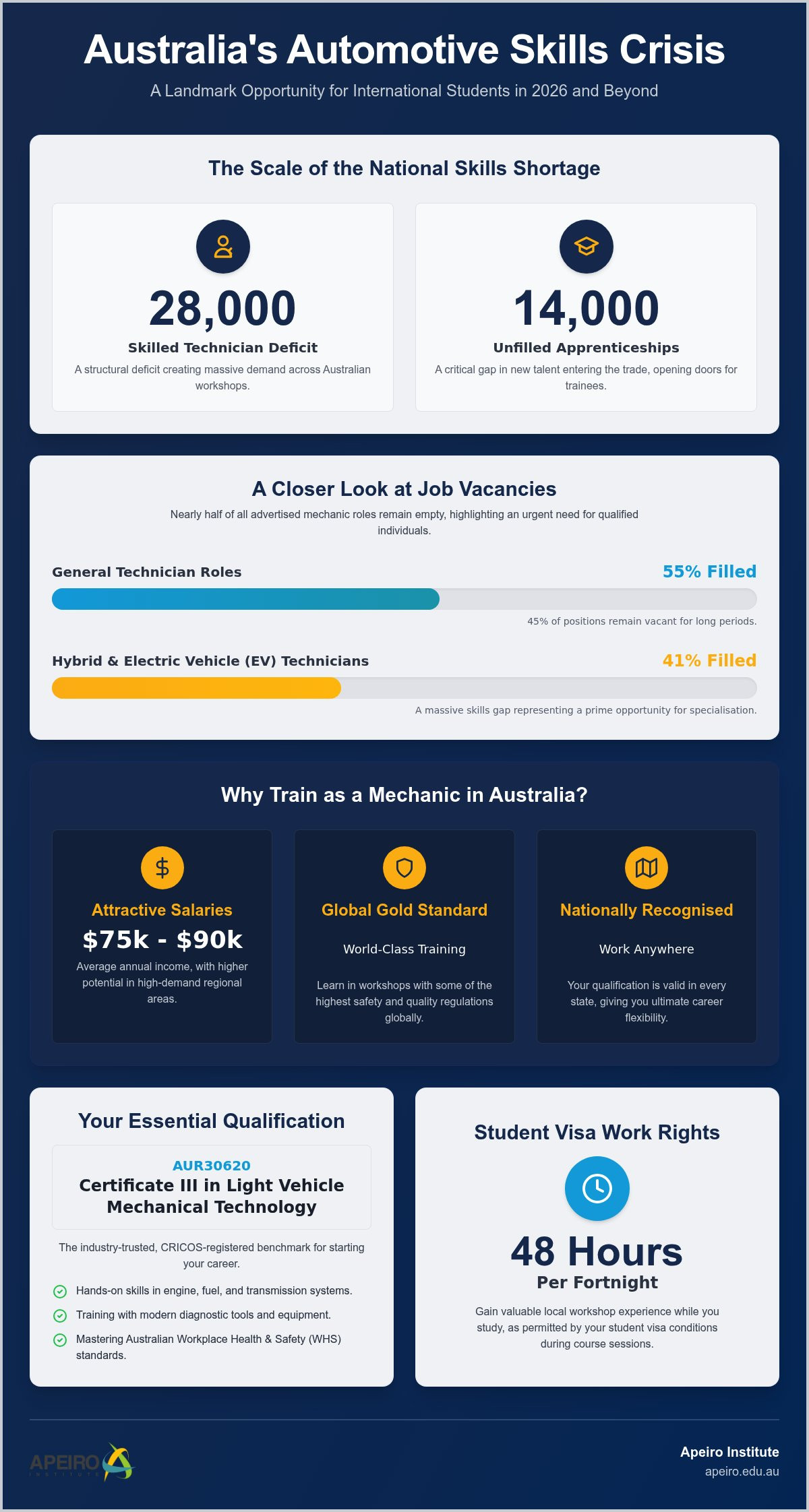
Did you know that Australia is currently grappling with a structural deficit of 28,000 skilled technicians and 14,000 unfilled apprenticeships? This massive shortage means that motor mechanic jobs for international students are more accessible than ever, provided you have a clear road map. It's a brilliant time to enter the trade, but we know the path forward can feel a bit daunting. You might be worried about visa work hour limits or feel anxious because you don't have local workshop experience yet.
We understand these challenges because we've supported students from more than 38 nationalities as they build their futures here. This guide will show you exactly how to secure your qualification and land a rewarding role in a local garage. We'll explore why the AUR30620 Certificate III in Light Vehicle Mechanical Technology is your essential foundation, explain your legal work rights under the latest 2026 visa rules, and help you find the right workshop for vocational placement. Let's get your automotive career moving in the right direction.
Key Takeaways
- Understand the scale of the current 2026 automotive skills shortage and why international students are essential to the future of Australian workshops.
- Identify why the AUR30620 Certificate III is the essential, industry-recognised qualification you need to secure motor mechanic jobs for international students.
- Learn how to successfully balance your student visa work conditions with the practical, hands-on experience required to become a trade-qualified professional.
- Discover the secrets to building a technical resume that appeals to Australian employers and highlights your specific mechanical competencies.
- Explore how the right training partner and dedicated mentors can help you bridge the gap between your studies and a rewarding long-term career.
The Demand for Motor Mechanics in Australia in 2026
Australia's automotive sector is facing a critical turning point. As of 2025, there was a structural deficit of 28,000 skilled technicians across the country. This gap hasn't closed in 2026; it has actually widened as the national fleet continues to grow. For those looking for motor mechanic jobs for international students, this creates a landscape of immense opportunity. Local workshops are no longer just looking for any staff; they are looking for dedicated individuals who want to build a long-term career in a high-demand trade.
The Australian "fair go" culture is a significant advantage for newcomers. In many trades, your background matters less than your ability to pick up a spanner and solve a problem. Hiring is largely merit-based. If you show up on time, work hard, and possess a solid foundation from an AUR30620 Certificate III in Light Vehicle Mechanical Technology, you'll find the industry incredibly welcoming. Employers value the diverse perspectives and strong work ethic that international students bring to their teams.
National Skills Shortage and Employment Outlook
The numbers tell a compelling story. With 14,000 unfilled apprenticeships nationally, the vacancy fill rate for technicians is only about 55%. This means nearly half of all advertised roles remain empty for long periods. Before applying, you might ask, What is a motor mechanic? At its heart, the role involves maintaining and repairing vehicle systems, but the scope is expanding rapidly into advanced electronics and software diagnostics.
The shift toward hybrid and electric vehicles (EVs) has added a new layer of complexity to the trade. Current data shows that only 41% of EV technician roles are being filled. This skills gap represents a massive chance for international students to specialise early in their careers. Whether you're looking at metropolitan hubs or regional areas where demand is even higher, the employment outlook is exceptionally strong for the next decade.
Why Australia is the Ideal Hub for Automotive Training
Australia maintains some of the highest workshop safety standards and regulations in the world. Learning here means you're being trained to a global gold standard, which makes you a highly valuable asset. The wages are equally attractive. Average annual salaries for mechanics range from $75,000 to $90,000. In high-demand regional areas, these figures can climb significantly higher to attract talent.
A major benefit of studying here is the "nationally recognised" status of your training. A qualification earned in one state is valid in every other corner of the country. This flexibility allows you to move where the best motor mechanic jobs for international students are located, ensuring your skills are always in demand. It's a secure, well-paid, and future-proof career path for anyone willing to put in the effort.
Essential Qualifications: The AUR30620 Certificate III
To secure motor mechanic jobs for international students, you need a qualification that Australian employers trust. The AUR30620 Certificate III in Light Vehicle Mechanical Technology is the industry benchmark. It serves as the formal entry point into the trade, ensuring you possess the technical foundation required to work on modern vehicles. For international learners, it's vital to choose a CRICOS-registered provider. This registration guarantees that the course meets strict national quality standards and complies with the legal requirements of your student visa.
Studying this certificate allows you to blend theoretical knowledge with practical workshop hours. While you learn, it's essential to stay informed about the work rights for international students. Under current 2026 regulations, you can work up to 48 hours per fortnight while your course is in session. This flexibility is a great way to gain local experience in a garage while you finish your units. Most workshops value students who are actively working toward their trade papers.
What You Will Learn in a Light Vehicle Course
The training is designed to be hands-on and practical. You won't just be reading manuals; you'll be under the bonnet using modern diagnostic tools and equipment. The course covers everything from engine cooling and fuel systems to complex transmissions and braking assemblies. You'll also learn the critical workplace health and safety (WHS) standards that are unique to the Australian automotive environment. These skills ensure you can step into a workshop and contribute safely and effectively from day one.
Pathways for Experienced Workers (TPEW)
If you've already spent years turning spanners in your home country, you might not need to start from the very beginning. Our Trade Pathways for Experienced Workers program is a dedicated stream for skilled migrants. Through a process called Recognition of Prior Learning (RPL), we can assess your existing overseas experience against Australian standards. This pathway helps you formalise your expertise and gain your qualification faster. It's a supportive, mentor-led approach that respects the skills you already bring to the table.
Getting your trade qualification is the most important step in your Australian career journey. If you're ready to take that step, you can view our automotive course details to see how to begin your enrolment.
Navigating Work Rights and Student Visa Conditions
Understanding your legal boundaries is just as important as knowing how to fix a gearbox. In 2026, the Subclass 500 Student Visa allows you to work up to 48 hours per fortnight while your course is in session. This regulation is designed to help you maintain a healthy balance between your training and earning a living. During scheduled course breaks, you're permitted to work unlimited hours. This is the perfect time to pick up extra shifts and immerse yourself in the fast-paced environment of a local garage.
Most reputable employers offering motor mechanic jobs for international students are very familiar with these visa conditions. It's best to be upfront about your 48-hour limit from the first interview. We recommend organising your week by blocking out campus days first; then, fill the remaining time with workshop shifts. You'll also need a Tax File Number (TFN) to ensure you're paid correctly and taxed at the right rate. While some might suggest an Australian Business Number (ABN), most workshop roles are employee-based. A TFN is the standard, safer choice for students entering the trade.
Balancing Study and Workshop Employment
Success in the automotive industry requires both technical knowledge and physical stamina. To avoid burnout, it's vital to communicate your study schedule clearly to your supervisor. Most workshops are happy to accommodate your timetable if you provide plenty of notice. Remember that you have the same workplace rights as any Australian citizen. The Fair Work Ombudsman ensures you receive the correct minimum wage, rest breaks, and a safe working environment. If a situation ever feels unfair, there are plenty of resources available to help you protect your rights.
Vocational Placements: The Secret to Experience
One of the most common hurdles for newcomers is the "no local experience" trap. This is where your vocational placement becomes a game-changer. These placements are a mandatory part of the AUR30620 Certificate III in Light Vehicle Mechanical Technology. Crucially, mandatory placement hours generally don't count towards your 48-hour work limit. This allows you to gain hands-on experience without sacrificing your paid working hours. Many of our students perform so well during their placement that the workshop offers them a permanent part-time role immediately after they finish their hours. It's a proven way to get your foot in the door while building your professional reputation.
How to Secure a Mechanic Job as an International Student
Landing motor mechanic jobs for international students requires a mix of technical proof and proactive networking. Don't just wait for an online ad to appear; the Australian automotive industry often relies on direct connections. Most workshop managers prefer meeting a candidate face-to-face to gauge their attitude and reliability. You need to present yourself as a focused professional who is ready to contribute to a busy team from day one. It's about showing you have the right foundation and the drive to succeed.
Start by tailoring your resume to the Australian market. Employers here value clarity and specific technical details. Instead of general descriptions, list the exact diagnostic tools and machinery you operated during your AUR30620 Certificate III in Light Vehicle Mechanical Technology. If you can use specific scan tools or wheel balancers, make sure that's front and centre. This level of detail proves you've spent real time in a workshop environment.
Building Your Professional Automotive Profile
Your technical skills get you the interview, but your soft skills get you the job. Punctuality is non-negotiable in a workshop where every hour is billable. Show that you're a team player who communicates clearly, especially when discussing complex repairs. Gathering references is a crucial step. Ask your trainers or your vocational placement supervisor for a written reference. This local validation is the most effective way to bypass the "no local experience" barrier that many newcomers face.
Effective Job Search Strategies
While major job boards are a starting point, "cold calling" is a traditional but highly effective technique in the trades. Put on some clean work gear, bring a printed resume, and visit local workshops in person. Ask for the workshop manager and introduce yourself briefly. This shows initiative and confidence. Additionally, don't overlook the power of networking within your own community. Classmates often know about "hidden" roles in their own workshops before they're ever advertised online.
If you're successful, you'll likely be asked for a trial shift. This is the standard "audition" in the automotive world. Always bring your own safety boots and high-vis gear. During the trial, focus on being helpful and proactive. If you finish a task, don't wait to be told what to do next; clean your bay or prep the tools for the next job. This mindset is exactly what Australian employers are looking for when they hire new technicians.
Enrol in our automotive course to start building your professional profile today
Why Study Automotive Technology at Apeiro Institute?
Choosing the right training provider is a decision that shapes your entire career. At Apeiro Institute, we've built a learning environment that prioritises your personal growth and professional success. We aren't just a registered training organisation; we act as a bridge between your current skills and a long-term career in the Australian automotive industry. Our workshops are designed to replicate real-world environments, ensuring you're comfortable with the latest diagnostic equipment and tools used by local employers. This hands-on approach is a key reason why our graduates are highly regarded when applying for motor mechanic jobs for international students.
Our trainers bring a wealth of industry experience and a genuine passion for mentoring. They understand the unique journey of international learners because they've supported students from more than 38 different nationalities. This global perspective means you'll receive guidance that is both authoritative and empathetic. We know that moving to a new country to study is a big step. That's why we focus on creating a supportive community where you can ask questions, make mistakes in a safe environment, and build the confidence needed to succeed in a busy workshop.
A Community for Global Learners
Being part of the Apeiro community means you're never alone in your journey. We provide clear, practical support to help you transition from the classroom to the professional workforce. Our team offers guidance on understanding Australian workplace culture, which is often the missing piece for many newcomers. We focus on outcomes that lead directly to employment. By the time you finish your AUR30620 Certificate III in Light Vehicle Mechanical Technology, you'll have the technical competencies and the soft skills that local workshops value most.
Beyond the Certificate III
The Certificate III is your entry point, but the automotive world offers many pathways for advancement. For those who want to specialise in complex fault-finding, the AUR40216 Certificate IV in Automotive Mechanical Diagnosis is an excellent next step. This qualification allows you to take on more senior roles and handle advanced diagnostic tasks that are becoming essential as vehicle technology evolves. If your goal is workshop management or high-level technical leadership, the AUR50216 Diploma of Automotive Technology provides the strategic expertise you need.
Taking the first step toward a new career can feel intimidating, but you don't have to do it alone. Whether you're starting fresh or using our Trade Pathways for Experienced Workers to formalise your existing skills, we're here to guide you every step of the way. Your future in the Australian automotive industry starts with the right training and a supportive mentor by your side.
Drive Your Career Forward in Australia
The road to a successful trade career in Australia is clear. With a national shortage of 28,000 technicians, local workshops are actively looking for skilled, dedicated individuals like you. By combining a nationally recognised qualification with a solid understanding of your 2026 visa conditions, you'll be well-prepared to secure one of the many motor mechanic jobs for international students. This is a unique moment to enter an industry that values your work ethic and diverse perspective.
Apeiro Institute is proud to be a CRICOS-registered partner in your success. Our industry-expert trainers provide the hands-on support and community environment you need to move from the classroom to the workshop with total confidence. We don't just teach the technical skills; we help you navigate the professional landscape of the Australian trade industry. It's time to stop dreaming and start doing.
Enrol in the AUR30620 Certificate III at Apeiro Institute today
We're excited to see what you'll achieve in the Australian automotive industry. Your new journey starts right here, and we're with you every step of the way.
Frequently Asked Questions
Can international students work as motor mechanics in Australia?
Yes, international students can certainly work in this trade. With a structural deficit of 28,000 technicians across the country, workshops are eager to hire dedicated learners. You'll need to be enrolled in a CRICOS-registered course like the AUR30620 Certificate III. This qualification allows you to apply for motor mechanic jobs for international students while you study, providing a fantastic way to build practical skills for a long-term automotive career.
What is the average hourly rate for a student mechanic in 2026?
While student wages vary, they must align with the Fair Work Commission's award rates for the automotive industry. Entry-level automotive positions in Australia typically start from around $43,195 per year for full-time roles. Most students working part-time find that hourly rates are competitive, especially when working for established workshops. It's important to ensure your employer is paying you the legal minimum and providing proper pay slips to track your earnings.
How many hours a week can I work as a mechanic on a student visa?
Under current 2026 visa conditions, you can work up to 48 hours per fortnight while your course is in session. This limit applies to all paid employment across any industry. However, during your scheduled course breaks, you are permitted to work unlimited hours. This is a great opportunity to take on extra shifts in the workshop and gain deeper technical experience. Always keep a clear record of your hours to stay compliant.
Do I need a specific licence to work in an Australian workshop?
You generally need to be working toward or hold a trade qualification like the AUR30620 Certificate III to work as a mechanic. While you don't need a specific licence to be a trainee or student worker, being trade-qualified is the industry standard for unsupervised work. Some states may have additional licensing requirements for specific tasks, such as air conditioning regassing. Your trainers will guide you through these specific state-based regulations during your course.
Is the AUR30620 Certificate III recognised in all Australian states?
Yes, the AUR30620 Certificate III in Light Vehicle Mechanical Technology is a nationally recognised qualification. This means the skills you learn and the certificate you earn are valid in every state and territory across Australia. This flexibility is a huge advantage, as it allows you to move for better motor mechanic jobs for international students without needing to retrain. Whether you are in a big city or a regional town, your qualification is respected.
Can I get a mechanic job if I have no previous experience?
You can definitely find work even without prior experience. Many workshops are looking for entry-level workers who are eager to learn and show up on time. Your vocational placement, which is a mandatory part of your training, is the best way to get your first bit of local experience. By performing well during this placement, you prove your value to an employer. Many workshops prefer hiring students they have already trained through the placement process.
What are the English language requirements for automotive courses?
Most automotive courses for international students require an English proficiency level of IELTS 5.5 or an equivalent score. This ensures you can safely understand technical manuals, follow workshop safety instructions, and communicate effectively with your team. If you don't quite meet this level yet, many providers offer English pathways to help you get ready. Strong communication is vital in a workshop environment where clear instructions are a key part of maintaining vehicle safety standards.
How do I find a workshop for my vocational placement?
Finding a placement involves a mix of training provider support and your own initiative. While your RTO will often have a network of partner workshops, we also encourage students to "cold call" local garages with a professional resume. Visiting a workshop in person shows the manager that you're proactive and serious about the trade. Networking with fellow students who are already working in the industry is another effective way to find workshops that are currently hiring.

Disclaimer
The information provided on this blog is for general informational and educational purposes only. While every effort is made to ensure the accuracy and reliability of the content, the author makes no representations or warranties of any kind, express or implied, about the completeness, accuracy, suitability, or availability of the information contained on this blog.
The views and opinions expressed in blog posts are those of the individual author and do not necessarily reflect the official policy or position of any organization, company, or employer.
This blog may contain links to external websites or third-party content. These links are provided for convenience only, and the author has no control over and assumes no responsibility for the content, privacy policies, or practices of any third-party sites.
Nothing on this blog constitutes professional advice (legal, financial, medical, or otherwise). Readers are encouraged to seek appropriate professional guidance before making any decisions based on the information provided here.
By using this blog, you acknowledge that any reliance on the information is at your own risk.


