

Did you know that Australia’s infrastructure workforce shortage is projected to peak at 148,000 people in metropolitan areas alone by 2026? This massive demand makes it a brilliant time to explore civil construction courses in australia for international students, but finding the right path isn't always straightforward. You might feel anxious about choosing a course that meets strict CRICOS requirements or confused about whether a Certificate III or a technical Diploma is the better fit for your long-term career goals.
It’s completely normal to feel a bit lost when you’re trying to align your studies with both your professional dreams and your visa status. We're here to help you discover how to launch a high-demand career in Australia’s infrastructure sector with the right civil construction qualifications and CRICOS-registered training. This guide provides a clear map of the study-to-work pathway, explains the vital differences between site work and design roles, and gives you the confidence to choose a nationally recognised RTO that truly supports your journey from the classroom to the project site.
Key Takeaways
- Discover why Australia’s massive infrastructure pipeline is creating a long-term demand for skilled professionals to build the nation’s roads, bridges, and public works.
- Gain a clear understanding of the Australian Qualifications Framework to help you choose the best civil construction courses in australia for international students, from hands-on site work to technical design.
- Learn to distinguish between residential building and the "brain" of infrastructure to decide if a career in civil design or a traditional trade suits your personal goals.
- Navigate the latest enrolment and visa requirements with ease, including the Genuine Student (GS) statement and English language proficiency standards.
- See how a student-centred RTO with a global community can act as your mentor, helping you bridge the gap between your current experience and your future professional objectives.
The Infrastructure Boom: Why Study Civil Construction in Australia?
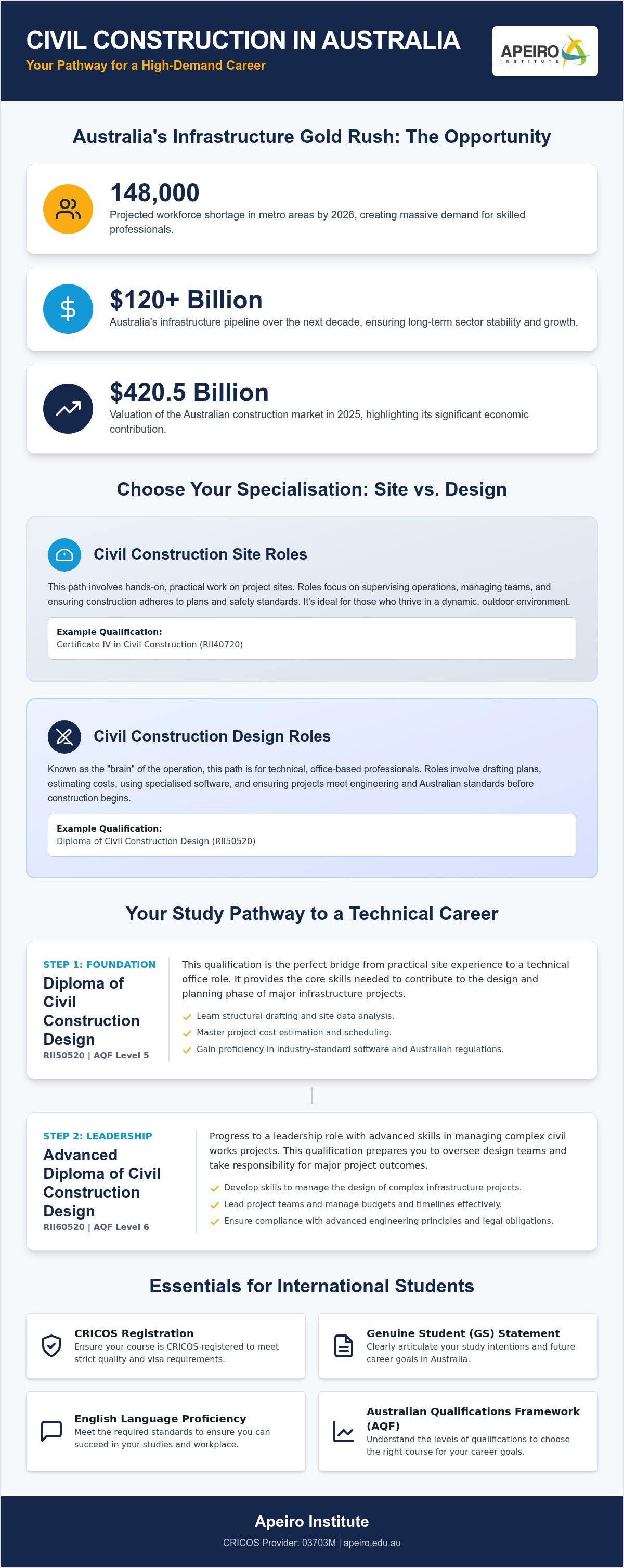
Civil construction is the literal backbone of our society. It is the technical discipline that organises the design and construction of the public works we use every day; think major motorways, bridges, rail networks, and massive water systems. Unlike residential building, which focuses on individual houses, Civil engineering and construction projects are often immense in scale and typically funded by the government. With Australia’s rolling infrastructure pipeline projected to exceed $120 billion over the next decade, there has never been a better time to look into civil construction courses in australia for international students. The Australian government prioritises this sector because it drives national productivity and connects our growing communities. For you, this means high earning potential and a strategic career path in a field that isn't going anywhere.
A Sector Built on Stability and Growth
Australia has successfully shifted from a growth model led by mining to one powered by sustainable infrastructure. This transition provides a safety net for workers. While other industries might fluctuate, civil construction remains an essential service. We always need roads maintained and power grids upgraded to support modern life. The 2025-26 budget allocated $278 billion for infrastructure over four years to FY2028-29, showcasing the government's long-term commitment. In 2025, the Australian construction market reached a valuation of approximately USD 420.5 billion, reflecting its massive contribution to the national economy. Choosing this path means you're entering a sector that values stability and long-term planning over short-term trends.
The Skills Shortage: Your Opportunity
The demand for talent is currently outstripping supply across the country. Infrastructure Australia predicts that workforce shortages in the construction sector will peak at 148,000 in metropolitan areas by 2026. Specific roles like civil engineering draftspersons and technicians are consistently on the national skills shortage lists, making qualified graduates extremely valuable. International students play a vital role in filling these critical gaps, bringing diverse perspectives and fresh energy to Australian firms. A nationally recognised qualification is your golden ticket to this industry. It proves to employers that you have been trained to rigorous Australian standards and are ready to contribute to high-profile projects from day one. By enrolling in civil construction courses in australia for international students, you aren't just getting a certificate; you're securing a place in a workforce that actively needs your expertise.
Navigating the Qualifications: From Cert III to Advanced Diploma
Understanding the Australian Qualifications Framework (AQF) is your first step toward a successful career. This system organises education into ten levels, ensuring your skills are recognised nationally. For anyone researching civil construction courses in australia for international students, checking CRICOS registration is non-negotiable. It ensures the course meets strict quality standards and satisfies your visa requirements. While a trade-based path like the Certificate IV in Civil Construction (RII40720) is excellent for supervisors, the Diploma stream offers a unique path into the technical side of the industry. At Apeiro Institute (CRICOS Provider 03703M), we take a mentor-led approach to help you navigate these choices with confidence.
Diploma of Civil Construction Design (RII50520)
The Diploma of Civil Construction Design (RII50520) is a level 5 qualification that acts as a bridge for those wanting to move from site work into a technical office role. It focuses on the "brain" of the operation. You'll dive into core units like structural drafting, site requirements, and project cost estimation. It's not just about drawing; it's about understanding Australian industry standards and mastering essential software. This transition allows you to apply your site experience in a strategic, design-focused environment. If you're ready to start your journey, exploring the options at Apeiro Institute is a great first step.
Advanced Diploma of Civil Construction Design (RII60520)
If you're aiming for leadership, the Advanced Diploma of Civil Construction Design (RII60520) is the logical progression. It introduces higher-level management and complex engineering design principles. This qualification prepares you for Senior Draftsperson or Design Manager roles where you oversee large-scale projects. Choosing between these civil construction courses in australia for international students depends on whether you prefer hands-on site management or the strategic world of design. For a broader look at how these fit into the Australian education system, check out our Vocational Courses for International Students in Australia: The Complete 2026 Guide. If you have years of experience already, our Trade Pathways for Experienced Workers (TPEW) program can help you gain recognition for the skills you already possess.
Civil Construction Design vs. General Building: Choosing Your Specialisation
Many students arrive in Australia thinking "construction" only means wearing high-vis and working on a housing site. While residential building is a vital part of the economy, it's just one piece of the puzzle. Choosing between the CPC stream (General Building) and the RII stream (Civil Construction) is a decision that shapes your daily work environment and long-term career trajectory. If you're looking for civil construction courses in australia for international students, understanding this distinction helps you avoid the trap of a career that doesn't align with your personal strengths or professional goals.
General Building and Construction (CPC Stream)
The General Building and Construction pathway is centred on the residential sector. This includes carpentry, bricklaying, and managing small-scale renovations or housing estates. It’s a rewarding path for those who love hands-on, physical work and want to see a house rise from the ground up. However, these roles are often physically demanding and typically follow an apprenticeship model that can be challenging for some international students to navigate. The work is mostly outdoors and subject to weather conditions, which is a significant factor to consider for your daily comfort and long-term physical health.
Civil Construction Design (RII Stream)
In contrast, Civil Construction Design focuses on the "big picture" infrastructure that keeps Australia moving. Instead of houses, you're working on urban planning, motorways, bridges, and large-scale engineering support. This specialisation is ideal if you prefer a technical, office-based environment where you use advanced software to solve complex problems. It’s a "future-proof" choice. As the industry adopts Building Information Modelling (BIM) and digital twins, your design skills become even more valuable. The infrastructure segment is currently the fastest-growing part of the market, with a projected CAGR of 6.18%, meaning your expertise will be in high demand by engineering firms and government bodies.
Career longevity is a major factor here. Site-based trades can be tough on the body over decades, whereas design roles offer a sustainable path into senior management or consultancy. For international students, the RII stream often provides a more robust pathway because technical design skills are highly transferable across global projects. At Apeiro Institute, we focus on these design-led qualifications because they empower you to work on the projects that define Australia’s future. It's about moving from "on the tools" to "in the lead," ensuring your career remains strategic and strategic for years to come.
Entry Requirements and Pathways for International Students
Stepping into the world of civil construction courses in australia for international students requires a clear understanding of the entry gates. Most RTOs look for a balance of academic readiness and English language proficiency. Typically, you'll need to have completed the equivalent of Australian Year 12. For your English requirements, an IELTS score of 5.5 or a comparable PTE Academic result is usually the standard. Beyond the paperwork, the Department of Home Affairs now evaluates applicants through the "Genuine Student" (GS) requirement. This process replaces the old GTE system and ensures you're truly focused on gaining high-quality skills that align with your career goals. If you already have years of experience in your home country, you shouldn't have to start from scratch. Our Trade Pathways for Experienced Workers (TPEW) programme is designed specifically to help you transition your existing expertise into the Australian market.
The RPL Pathway: Recognition of Prior Learning
Recognition of Prior Learning (RPL) is a powerful tool for experienced professionals. It allows us to map your international work history directly against Australian units of competency. Why study what you already know? To succeed with an RPL application, you'll need to provide solid evidence of your skills. This often includes detailed work samples, employer references, and participating in technical interviews with our trainers. Think of your RPL evidence as a professional portfolio; photos of your past projects or technical drawings you've created can be incredibly persuasive during the assessment. It’s a methodical way to fast-track your qualification while ensuring you meet national standards. For a deeper dive into this process, read our Trade Pathways for Experienced Workers Australia: The 2026 Guide.
CRICOS and Visa Compliance
Choosing a CRICOS-registered provider is a non-negotiable step for any international student. CRICOS registration (Apeiro Institute is 03703M) means the Australian government has vetted the course for quality and compliance. This protects your tuition and ensures your qualification is respected by employers nationwide. Enrolling in civil construction courses in australia for international students through a registered provider like Apeiro ensures you're on a secure path. While studying, you'll generally have the right to work up to 48 hours per fortnight, which is a great way to gain local industry exposure. However, your primary focus must remain on your education. It's vital to maintain satisfactory course progress and attendance to meet the mandatory conditions of your student visa.
Explore our pathways for experienced workers today
Building Your Future with Apeiro Institute: A Student-Centred Approach
Starting a new educational journey in a different country is a massive step. At Apeiro Institute, we don't just see you as an enrolment number. We see ourselves as your partner in success. Choosing civil construction courses in australia for international students is about more than just passing exams; it's about building a sustainable life and a rewarding career. Our approach is built on mentorship. We guide you through the technical requirements of the industry while helping you understand the "Australian way" of working. This includes everything from our strict safety culture to the collaborative communication styles used in modern engineering firms.
A Community of 38+ Nationalities
Our campus is a vibrant melting pot of cultures and perspectives. With students from over 38 different nationalities, you'll find a supportive community that understands exactly what it’s like to study abroad. This diversity is a professional advantage. By networking with peers from all over the world, you gain a global outlook that is highly valued in the civil construction sector. We pride ourselves on being a friendly, expert guide throughout your entire journey. From the moment you first enquire to the day you receive your qualification, our support services are designed to ensure you feel secure, included, and empowered to reach your personal goals.
Practical Outcomes and Professional Certification
We focus on delivering tangible skills that translate directly to the workplace. Our RII50520 Diploma and RII60520 Advanced Diploma of Civil Construction Design programmes are tailored to meet current industry demands. You'll master the technical drafting and design principles that Australian employers need right now. Because these qualifications are nationally recognised, you have the flexibility to work on projects anywhere in the country. We don't just deliver units; we prepare you for the strategic, high-level roles that drive our national infrastructure. Don't let confusion about qualification levels or visa compliance hold you back from your professional dreams.
Explore our Civil Construction Design courses today
Your Path to a Strategic Career in Infrastructure
The Australian infrastructure sector offers more than just a job; it provides a stable, high-growth environment for those who choose the right technical specialisation. By focusing on design-led qualifications, you move beyond the physical demands of general trades into strategic roles that shape the national landscape. It’s about finding a mentor who understands the unique challenges of studying abroad and provides the guidance needed to succeed in a new professional environment.
When you look into civil construction courses in australia for international students, ensure you choose a partner that values your previous experience and your future potential. As a CRICOS Registered Provider (03703M) and Nationally Recognised RTO (45394), we specialise in Trade Pathways for Experienced Workers to help you transition into the local workforce. We’re here to bridge the gap between your current circumstances and your professional objectives with practical, industry-aligned training.
Start your Australian civil construction journey with Apeiro Institute
Your future in Australia’s booming construction industry is within reach. We look forward to welcoming you to our diverse community and supporting your personal and professional growth every step of the way.
Frequently Asked Questions
Can international students study civil construction in Australia?
Yes, international students can certainly study this field. You need to ensure your chosen provider is CRICOS-registered to meet your visa conditions. These courses are designed to help you gain the technical skills required for Australia’s massive infrastructure projects. By choosing a nationally recognised RTO, you ensure your qualification is respected by employers across every state and territory, providing a secure foundation for your professional journey.
What is the difference between a Diploma and an Advanced Diploma in Civil Construction Design?
The main difference lies in the level of technical complexity and management responsibility. The RII50520 Diploma focuses on structural drafting, site requirements, and project cost estimation. In contrast, the RII60520 Advanced Diploma introduces higher-level engineering design principles and prepares you for leadership roles like Design Manager. Both are excellent civil construction courses in australia for international students, depending on whether you want to focus on technical delivery or senior project oversight.
Do I need prior experience to enrol in a civil construction course?
You don't necessarily need prior industry experience to begin your studies. Most entry-level programmes require the completion of Australian Year 12 or an equivalent international qualification. However, if you do have a background in engineering or construction from your home country, you can use that experience to fast-track your learning through our Recognition of Prior Learning (RPL) process. This allows you to focus on new skills rather than repeating what you already know.
How much can I earn as a civil construction designer in Australia?
While salaries vary based on experience and location, civil construction designers in Australia generally enjoy high earning potential due to the current skills shortage. Qualified professionals are in high demand to support the $120 billion infrastructure pipeline. Roles in this sector are often more stable and better paid than general residential trades. This makes it a strategic choice for students looking for a sustainable career path that rewards technical expertise.
Are civil construction courses on the Australian Skilled Occupation List?
Yes, several roles related to civil construction are frequently featured on the Australian Skilled Occupation Lists. Occupations such as Civil Engineering Draftsperson and Civil Engineering Technician are often identified as being in high demand. While we cannot guarantee visa outcomes, studying a nationally recognised qualification in a high-demand field is a practical way to align your skills with the needs of the Australian workforce and your long-term career goals.
What English language level is required for these courses?
Most vocational providers require an English proficiency level equivalent to IELTS 5.5 or a PTE Academic score of around 42. This ensures you can safely understand technical instructions, participate in collaborative design projects, and master the software used in the industry. If you haven't reached this level yet, many students choose to complete an ELICOS programme before starting their technical civil construction courses in australia for international students to build their confidence.
Can I use Recognition of Prior Learning (RPL) if I have experience from my home country?
You can absolutely use your international experience to apply for Recognition of Prior Learning (RPL). We look for evidence like work samples, technical drawings, and employer references to map your skills against Australian standards. This process respects the expertise you've already gained abroad and can significantly reduce your study duration. It’s a fantastic way for experienced workers to gain a formal Australian qualification that reflects their true professional standing.
Is the RII50520 Diploma of Civil Construction Design CRICOS registered?
Yes, the RII50520 Diploma of Civil Construction Design is a CRICOS-registered qualification at Apeiro Institute (CRICOS Provider 03703M). This registration is essential for international students as it confirms the course meets the strict quality and legislative requirements for those studying on a student visa. Enrolling in a registered course gives you peace of mind that your education is protected and that your qualification will be recognised by industry bodies nationwide.

Disclaimer
The information provided on this blog is for general informational and educational purposes only. While every effort is made to ensure the accuracy and reliability of the content, the author makes no representations or warranties of any kind, express or implied, about the completeness, accuracy, suitability, or availability of the information contained on this blog.
The views and opinions expressed in blog posts are those of the individual author and do not necessarily reflect the official policy or position of any organization, company, or employer.
This blog may contain links to external websites or third-party content. These links are provided for convenience only, and the author has no control over and assumes no responsibility for the content, privacy policies, or practices of any third-party sites.
Nothing on this blog constitutes professional advice (legal, financial, medical, or otherwise). Readers are encouraged to seek appropriate professional guidance before making any decisions based on the information provided here.
By using this blog, you acknowledge that any reliance on the information is at your own risk.


