

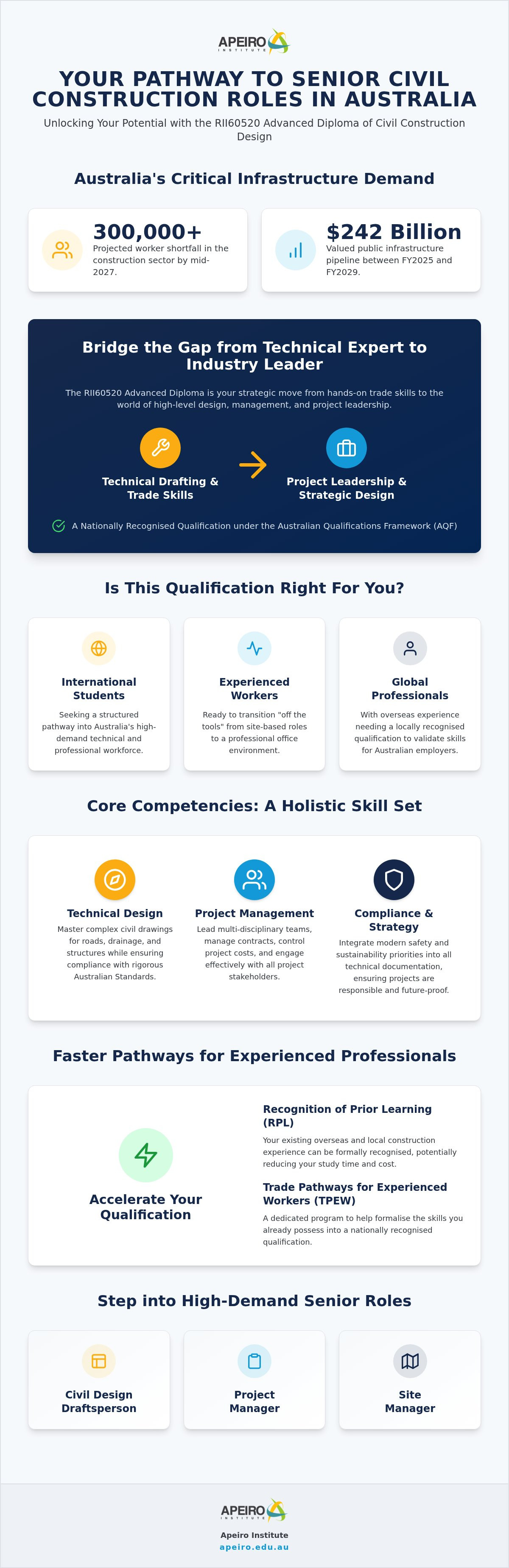
Australia is currently facing a massive construction skills shortage, with a projected shortfall of over 300,000 workers by mid-2027. If you are looking to advance your career, there has never been a more strategic time to enter the local infrastructure sector. You might feel a bit stuck between your current technical skills and the senior leadership roles you know you're capable of handling. It's also completely normal to feel a bit lost when it comes to CRICOS requirements or whether your hard-earned overseas experience will be recognised here.
We understand these challenges and are here to help you find a clear path forward. This article explains how the RII60520 advanced diploma of civil construction design international students can transform your professional outlook. You'll discover how this qualification bridges the gap between technical drafting and high-level project management. We'll also provide clarity on the Recognition of Prior Learning (RPL) process, helping you save both time and money. By the end of this guide, you'll have a roadmap to achieving a nationally recognised Australian qualification and stepping into senior roles like Civil Design Draftsperson or Project Manager.
Key Takeaways
- Learn how the RII60520 qualification helps you transition from technical drafting to high-level project leadership within the Australian infrastructure sector.
- Discover how Recognition of Prior Learning (RPL) can save you time and money by valuing your existing overseas construction expertise.
- Get clear on the academic and English language prerequisites required for the advanced diploma of civil construction design international students need to succeed.
- Explore the diverse career outcomes available to graduates, from Civil Design Draftsperson to Site Manager, in a market facing critical skills shortages.
Understanding the RII60520 Advanced Diploma of Civil Construction Design
The RII60520 Advanced Diploma of Civil Construction Design isn't just another certificate. It's a high-level vocational qualification specifically crafted for the complex demands of the Australian civil engineering sector. While many entry-level courses focus on manual skills, this advanced diploma represents a significant shift. It moves you from the physical "trade" aspect of the site and into the strategic world of "design and management." As a Nationally Recognised Qualification under the Australian Qualifications Framework (AQF), it meets strict standards that employers across the country trust and value.
Why is this so relevant right now? Australia's public infrastructure pipeline is currently valued at approximately $242 billion for the period between FY2025 and FY2029. With the construction market projected to reach USD 173.18 billion by 2026, the industry needs leaders who can handle the technicalities of road, rail, and water projects. By enrolling in the advanced diploma of civil construction design international students can position themselves at the forefront of this growth. It prepares you to take on responsibilities that go far beyond simple drafting, focusing instead on the full lifecycle of major civil works.
Who is this Qualification For?
This course is designed for a diverse range of learners who share a common goal: career growth. It's an ideal choice for those who want to be more than just a face in the crowd. Specifically, it caters to:
- International students: If you're looking for a specialised technical career in Australia, this qualification provides a clear, structured pathway into the local workforce.
- Experienced workers: Those currently working in civil construction who want to move "off the tools" and into a professional office environment. Experienced professionals can also explore the Trade Pathways for Experienced Workers (TPEW) if they want to formalise their existing skills.
- Global professionals: If you have experience from overseas, this is your chance to gain an Australian certificate that local employers recognise and respect.
The Strategic Importance of Civil Design in Australia
Civil design is the backbone of every major project, from regional bridges to metropolitan rail networks. Because Australia is facing a critical shortage of engineers and designers, the advanced diploma of civil construction design international students choose can be a real game-changer for their employment prospects. It aligns perfectly with modern industry standards for safety and sustainability. You'll learn how to integrate these priorities into technical documentation, ensuring projects are both functional and environmentally responsible. In the broader engineering ecosystem, this diploma acts as the bridge between conceptual ideas and practical, safe execution on the ground. It ensures that every road, bridge, and pipeline is built to last.
Core Competencies: From Technical Drafting to Project Leadership
The RII60520 curriculum is structured to move you beyond basic CAD skills. It focuses on three core pillars: Design, Management, and Compliance. This holistic approach ensures you aren't just drawing lines on a screen but understanding how those lines translate into safe, cost-effective infrastructure. By choosing the advanced diploma of civil construction design international students are opting for a curriculum that balances technical precision with high-level oversight.
Mastering Technical Design and Documentation
Technical documentation is the heart of civil works. You'll learn to interpret and create complex drawings for roads, drainage systems, and structural foundations. It isn't just about using software; it's about precision. Every design must meet rigorous Australian Standards and local government regulations. This technical foundation allows you to produce documentation that site teams can follow without error. You'll work with industry-standard methodologies to ensure your designs are accurate and ready for construction.
Developing Project Management and Leadership Skills
As you progress, the focus shifts toward leadership. You'll learn to manage multi-disciplinary teams and engage with stakeholders across the project lifecycle. Managing civil works contracts and project costs is a critical skill set covered in depth. You'll explore budgeting, scheduling, and procurement strategies that keep large-scale projects on track. This alignment with the National Construction Industry Forum's Blueprint ensures you are learning standards that promote a sustainable and fair sector. It's about being a leader who understands both the numbers and the people.
Site safety and environmental management are also key components. You'll learn to develop protocols that protect both the community and the workforce. When studying the advanced diploma of civil construction design international students gain the confidence to lead these initiatives on-site. If you're ready to take the next step in your career, you can explore our trade pathways to see how your experience fits.
RPL and TPEW: Faster Pathways for Experienced International Professionals
If you've spent years working on major infrastructure projects overseas, you shouldn't have to repeat what you already know. Recognition of Prior Learning (RPL) is a practical solution designed to respect your existing expertise. It allows you to use your past work experience to gain credits toward your qualification. This is particularly beneficial for those pursuing the advanced diploma of civil construction design international students often use to fast-track their Australian career. Instead of starting from scratch, you can focus on the new skills you need to succeed in the local market.
How RPL Works for International Students
The assessment process isn't about sitting more exams. It's about proving you already possess the required skills through a portfolio of evidence. By mapping your previous roles to specific units of competency, you can significantly reduce your course duration. This also has the potential to lower your overall tuition costs, making your educational journey more efficient. You don't just save time; you gain a clearer path to your professional goals. You can learn more about our TPEW and RPL services to see how we help experienced workers transition smoothly into the Australian workforce.
Formalising Your Global Experience in Australia
While your overseas certificates are valuable, local employers often prefer a nationally recognised Australian qualification. This ensures you understand the specific building codes, environmental regulations, and safety standards used here. The ESOS framework provides the legislative structure that protects your rights as a student while ensuring the quality of your education is top-notch. Formalising your skills helps bridge the gap between international methods and Australian standards. For a deeper look at these options, check out our Trade Pathways for Experienced Workers Australia: The 2026 Guide.
To get started with the process, you'll need to gather specific evidence of your competency. This usually includes work samples, detailed references from past employers, and technical interviews with our industry assessors. We look for proof that you can handle technical documentation, manage project costs, and lead site safety protocols. The Trade Pathways for Experienced Workers (TPEW) initiative is a fantastic way to turn your years of hard work into a credential that opens doors across the country. When studying for the advanced diploma of civil construction design international students find that this recognition gives them a competitive edge in a demanding industry. It's a straightforward way to prove you're ready for the challenges of the Australian infrastructure sector.
Admission Requirements and CRICOS Compliance for International Students
Starting your educational journey in Australia requires clear preparation and an understanding of the local entry standards. To enrol in the advanced diploma of civil construction design international students typically need to have completed Year 12 or an equivalent secondary qualification. You'll also need to demonstrate a solid grasp of the English language to ensure you can handle the technical vocabulary and management theories. Most institutions look for an IELTS score of 5.5 or 6.0, though PTE Academic results are also widely accepted as a valid proof of proficiency.
Choosing a CRICOS-registered provider is about more than just visa compliance; it's about your protection. This registration ensures that the institution meets strict Australian standards for education quality and student support. You'll also need to satisfy the Genuine Student (GS) requirement for your visa application. This process involves showing that your primary goal is to gain a high-quality education and that you have a logical plan for how this qualification will benefit your professional future. When studying the advanced diploma of civil construction design international students can feel secure knowing their education is backed by a robust regulatory framework.
The International Student Application Checklist
Gathering your documents early makes the application process much smoother and less stressful. Having everything ready helps avoid delays in your visa processing. You should prepare the following items:
- Certified copies of your academic transcripts and identity documents, such as your passport.
- Evidence of English proficiency through a recognised test like IELTS or PTE.
- Proof of financial capacity, showing access to at least AUD $29,710 per year for living costs.
- A valid Overseas Student Health Cover (OSHC) policy for the duration of your stay.
Support Services for the Global Student Community
Academic life in a new country can be challenging, but you don't have to navigate it alone. We provide robust support services, including Language, Literacy, and Numeracy (LLN) assistance to help non-native speakers master complex technical terminology. You can also access academic counselling to help you manage your workload and stay on track with your units. For a broader look at your study options, read our Vocational Courses for International Students in Australia: The Complete 2026 Guide. This resource covers everything from choosing the right course to understanding your work rights while studying.
Start your application for the Advanced Diploma today
Career Outcomes and Industry Demand in the Australian Sector
The Australian infrastructure boom is more than just a headline; it's a genuine opportunity for career progression. With the local construction market forecasted to reach USD 211.71 billion by 2031, the need for skilled designers is at an all-time high. By completing the advanced diploma of civil construction design international students can step into roles that are central to this growth. You won't just be a number in a large firm. You'll be a vital part of the team, whether you're working as a Civil Design Draftsperson, a Project Coordinator, or a Site Manager. These positions offer the chance to move off the tools and into a professional environment where your strategic input counts.
This qualification also serves as a powerful stepping stone for those who wish to continue their education. Many graduates use their diploma to gain credit towards university engineering degrees, effectively shortening their time in higher education. Networking is equally important in the Australian market. Engaging with industry-focused training ensures you're job-ready from day one. Because Australia is facing a shortfall of over 300,000 workers by mid-2027, your skills will be highly sought after in metropolitan and regional areas alike. Graduates often enter the workforce with competitive salaries that reflect the critical nature of their expertise.
Life After Graduation: Job Roles and Responsibilities
You have the choice to work in diverse environments that suit your career goals. Private consultancy firms often focus on innovative design projects for corporate clients, allowing for high levels of creativity. On the other hand, government infrastructure bodies manage large-scale public works like rail and road networks, offering long-term project stability. As a Civil Design Draftsperson, your daily routine is dynamic. You might spend your morning using specialised software to refine technical documentation and your afternoon on-site to inspect progress. Networking with colleagues and stakeholders is a constant part of the job. You'll also find that regional shortages are growing fast due to new renewable energy projects, offering even more options for where you choose to live and work.
Why Study with Apeiro Institute?
We pride ourselves on being more than just an education provider. We are your partners in success. Our community represents over 38 nationalities, creating a rich, inclusive environment where your global background is valued. Our trainers aren't just academics; they are experts with years of local industry experience. They understand the nuances of the Australian building codes and the expectations of local employers. We focus on industry-focused outcomes, helping you build the confidence to lead teams and manage complex projects. When you choose the advanced diploma of civil construction design international students receive mentor-led guidance that prioritises their personal and professional growth. It's a supportive environment where your success is our primary goal.
Build Your Future in Australian Infrastructure
The Australian infrastructure sector is expanding rapidly, creating a unique window of opportunity for skilled professionals to step into leadership roles. By completing the advanced diploma of civil construction design international students can effectively bridge the gap between technical drafting and senior project management. This qualification is a Nationally Recognised Training pathway that equips you with the expertise needed to excel as a Civil Design Draftsperson or Site Manager in a high-demand market.
If you bring years of experience from overseas, our dedicated RPL and TPEW support ensures your hard work is formalised and respected in the local industry. As a registered CRICOS Provider (03703M), we offer a secure and encouraging environment where your global background is seen as a major asset. You'll gain the confidence to navigate complex Australian building codes while contributing to the nation's massive infrastructure pipeline.
We're ready to act as your mentor and guide as you transition into this next exciting phase of your career. Taking this step today ensures you're prepared for the long-term growth and stability of the Australian construction sector.
Frequently Asked Questions
What is the difference between a Diploma and an Advanced Diploma in Civil Construction Design?
The main difference lies in the level of responsibility and the complexity of the tasks. While a Diploma focuses on technical drafting and entry-level design support, the Advanced Diploma moves into strategic project management and cost estimation. It's a higher AQF level qualification that prepares you for senior roles. This advanced diploma of civil construction design international students choose often acts as the final step before moving into high-level site management or university studies.
Can I apply for RPL if I have civil design experience from another country?
You can certainly apply for Recognition of Prior Learning (RPL) if you have relevant experience from another country. We specialise in mapping your global skills to Australian industry standards. You'll need to provide a portfolio of evidence, such as technical drawings, project reports, and employer references. This process can significantly reduce your study time and help you gain your Australian qualification faster while acknowledging the hard work you've already done overseas.
What are the English language requirements for international students?
To succeed in this technical course, you generally need an IELTS score of 5.5 or 6.0, or a PTE Academic equivalent. High-level English proficiency is essential because you'll be creating complex technical documentation and leading multi-disciplinary teams. If you're worried about your language skills, we offer support services to help you master the industry-specific vocabulary required for civil design. Clear communication is a vital skill for any future project manager in Australia.
How long does the RII60520 Advanced Diploma take to complete?
The RII60520 Advanced Diploma typically takes 104 weeks to complete for international students. This two-year duration includes scheduled course breaks and ensures you have enough time to master both the technical and managerial components. However, if you're eligible for RPL based on your previous experience, this timeframe could be shortened. It's best to speak with our team to get a clear, personalised estimate based on your specific professional background and existing skills.
Are international students allowed to work while studying this course?
Yes, you can work while you study. Under current Australian student visa conditions, you're generally permitted to work up to 48 hours per fortnight during study periods. During scheduled course breaks, you can work unlimited hours. This is a great way to gain local experience in the construction sector while completing your advanced diploma of civil construction design international students find that part-time work in a related field greatly enhances their learning and future job prospects.
What software will I learn to use during the course?
You will learn to use industry-standard software that's essential for modern civil design. This typically includes AutoCAD and Civil 3D for technical drafting and documentation. We also cover project management tools used for scheduling, budgeting, and resource allocation. Mastering these programs ensures you're ready to step straight into a professional office environment. Our trainers focus on practical, hands-on learning so you can apply these digital skills to real-world infrastructure projects immediately after graduation.
Is this qualification recognised throughout Australia?
This qualification is fully recognised throughout Australia. Because it's a Nationally Recognised Training (NRT) program under the Australian Qualifications Framework (AQF), your certificate will be valued by employers in every state and territory. Whether you're looking for work in regional areas or major cities, this diploma proves you've met the rigorous standards required by the Australian civil sector. It's a trusted credential that opens doors to senior roles across the entire country.
What happens if my student visa is refused after I enrol?
If your student visa is refused after you've enrolled and paid your fees, you are protected by the ESOS Act. Most providers, including us, have a clear refund policy in place for these specific circumstances. Usually, you'll receive a refund of your tuition fees minus a small administrative fee, provided you notify the institute promptly. We recommend checking our student handbook for the exact terms to ensure you feel secure and informed throughout the application process.

Disclaimer
The information provided on this blog is for general informational and educational purposes only. While every effort is made to ensure the accuracy and reliability of the content, the author makes no representations or warranties of any kind, express or implied, about the completeness, accuracy, suitability, or availability of the information contained on this blog.
The views and opinions expressed in blog posts are those of the individual author and do not necessarily reflect the official policy or position of any organization, company, or employer.
This blog may contain links to external websites or third-party content. These links are provided for convenience only, and the author has no control over and assumes no responsibility for the content, privacy policies, or practices of any third-party sites.
Nothing on this blog constitutes professional advice (legal, financial, medical, or otherwise). Readers are encouraged to seek appropriate professional guidance before making any decisions based on the information provided here.
By using this blog, you acknowledge that any reliance on the information is at your own risk.


