

Did you know the Australian construction industry is projected to grow by almost 6 per cent, adding nearly 70,000 new jobs by the end of 2026? This massive expansion, fuelled by a national target to build 1.2 million new homes, creates an incredible range of civil construction jobs for international students. We understand that trying to figure out where you fit into this booming market can feel daunting. Between confusing qualification frameworks and uncertainty about work rights, it is easy to feel like you are on the outside looking in.
It is completely normal to feel this way, but you don't have to navigate the path alone. This guide will help you discover how to launch a rewarding career in Australia’s civil construction sector with the right qualifications and industry insights. We will provide a clear understanding of key job roles, explain how to get qualified through pathways like the Diploma of Civil Construction Design, and offer a practical roadmap for your long-term career success. Whether you are starting fresh or looking to recognise your existing skills, your professional future in Australia starts here.
Key Takeaways
- Understand why Australia’s infrastructure boom is creating thousands of new opportunities in roads, bridges, and public works for global talent.
- Learn how to fast-track your entry into the industry by using Recognition of Prior Learning (RPL) to turn your overseas experience into nationally recognised qualifications.
- Identify the most effective pathways to secure civil construction jobs for international students, starting with essential certifications like the mandatory White Card.
- Discover how to transition from on-site labour to office-based management roles through the Diploma and Advanced Diploma of Civil Construction Design.
Understanding Civil Construction Jobs for International Students
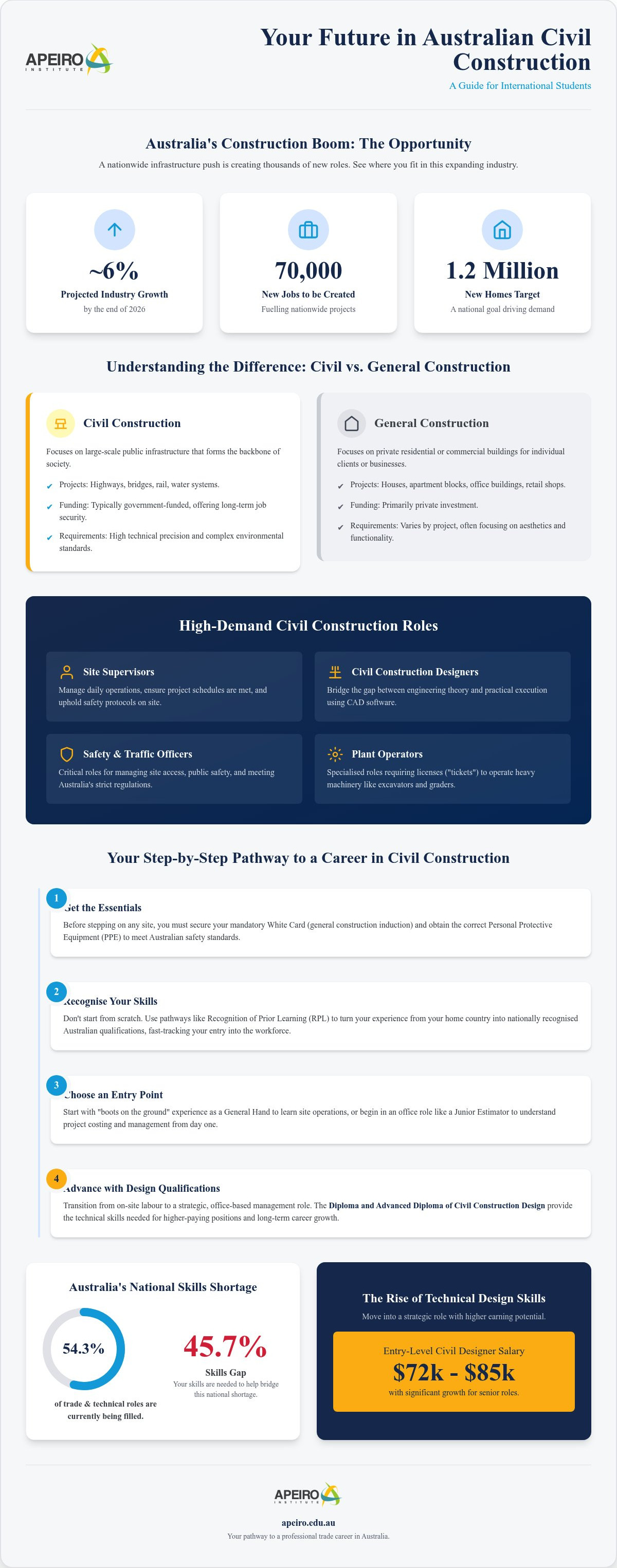
Civil construction isn't just about building houses. It's about the essential systems that keep our society moving. When we talk about civil construction jobs for international students, we mean working on massive infrastructure projects like highways, bridges, rail networks, and water treatment plants. These are the public works that form the backbone of Australia. By 2026, the sector is projected to grow by 6 per cent, creating roughly 70,000 new roles.
Australia has become a global hub for these projects because of massive government investment. With a national goal to build 1.2 million new homes by 2029, the demand for skilled workers is at an all-time high. Currently, only 54.3 per cent of trade and technical roles are being filled. This means there are plenty of civil construction jobs for international students to help bridge this national skills gap. Before you step on a site, you'll need a "White Card" (general construction induction) and the correct Personal Protective Equipment (PPE) to ensure you meet strict Australian safety standards.
Civil vs. General Construction: What is the Difference?
While general construction often focuses on private residential or commercial buildings, civil construction deals with the "big picture" of public infrastructure. Working in the civil sector usually offers greater long-term job security because projects are often government-funded and span several years. A deeper understanding of civil engineering and design is often required here. These projects must meet complex environmental and sustainability standards. It's a field where technical precision meets large-scale execution.
Work Rights and Regulations for Student Visa Holders
As a Subclass 500 visa holder, you have specific work conditions that allow you to earn while you learn. It's vital to balance your study commitments with site-based work to maintain your visa status. You are protected by Fair Work Australia. This ensures you receive the same pay rates and safety protections as any local worker. If you already have experience from your home country, you might explore Trade Pathways for Experienced Workers (TPEW) to get your skills recognised faster. This pathway helps you jump straight into the workforce with confidence.
High-Demand Civil Construction Roles in 2026
The landscape of civil construction jobs for international students has evolved significantly. While many people think primarily of manual labour, 2026 sees a massive shift toward technical and supervisory positions. As Australia tackles a 31.8 per cent job vacancy rate across the economy, the construction sector is feeling the pinch. This has opened doors for skilled overseas talent to step into high-demand civil construction roles that offer both stability and competitive pay.
- Site Supervisors and Leading Hands: These professionals manage daily site operations, ensuring projects stay on schedule and safety protocols are followed.
- Civil Construction Designers: Acting as the bridge between engineering theory and site execution, they are essential for modern infrastructure.
- Traffic Management and Safety Officers: With Australia's focus on safety, these roles are critical for managing site access and public interactions.
- Plant Operators: These specialised machinery roles require specific "tickets" or licenses to operate excavators, graders, and rollers.
The Rise of Civil Construction Design
Design skills are more sought-after than ever. The industry has shifted from relying solely on manual labour to prioritising technical planning and precision. Professionals who can use CAD software and understand structural requirements are in high demand. This shift offers better career longevity and higher salary potential. For instance, entry-level civil engineers earn between $72,000 and $85,000; senior designers can earn significantly more. It's a pathway that moves you away from the physical strain of the site and into a strategic office-based environment.
Entry-Level Opportunities: Where to Start?
You don't always need years of experience to enter the field. Many civil construction jobs for international students start in administrative or support roles. Positions like Junior Estimator or Site Clerk allow you to learn how projects are costed and managed behind the scenes. Alternatively, starting as a General Hand provides invaluable "boots on the ground" experience. This foundation makes it much easier to transition into permanent career pathways later. If you have previous experience from home, you might even qualify for a faster start through recognition of your existing skills.
Building a career in this sector requires a solid plan. Whether you are aiming for the site or the office, finding the right mentor can make all the difference. You can explore a range of vocational pathways at Apeiro Institute to find the course that fits your goals.
Essential Qualifications and Recognition of Prior Learning (RPL)
To secure civil construction jobs for international students, you must navigate the Australian Qualifications Framework (AQF). This national system ensures your skills are recognised and respected by employers across the country. Choosing the right level depends on your long-term goals. A Certificate III typically focuses on trade-based site work, while a Diploma of Civil Construction Design prepares you for technical and management roles. Regardless of the level, always verify that your training provider is a CRICOS-registered Registered Training Organisation (RTO). This ensures your study meets both educational standards and visa requirements.
The industry values high-level training. While vocational courses provide practical entry points, many students eventually look toward advanced career paths described in The University of Sydney Civil Engineering Program. Understanding these different educational tiers helps you decide whether you want to be on the tools or behind the design software. Starting with a solid vocational foundation allows you to enter the workforce sooner and earn while you progress toward higher qualifications.
Recognition of Prior Learning (RPL) for International Students
If you have worked in construction back home, you shouldn't have to start your education from scratch. Recognition of Prior Learning (RPL) allows you to turn your overseas experience into a formal Australian qualification. The assessment process involves providing evidence of your history, such as references, site photos, and previous certifications. It's a faster way to prove you have the skills required for civil construction jobs for international students without repeating basic units. You can learn more about Trade Pathways for Experienced Workers to see how your background can be fast-tracked.
Trade Pathways and Certification
Bridging the gap between international standards and Australian requirements is a vital step for your career. Trade pathways often include practical assessments where you demonstrate your skills in a controlled environment. This ensures you can meet specific Australian safety and technical codes. For a deeper look at how this works in the current market, check out Trade Pathways for Experienced Workers Australia: The 2026 Guide. These assessments are not just about checking boxes; they are about building the confidence you need to lead on an Australian site.
Step-by-Step Guide to Securing a Job in Civil Construction
Landing your first role starts with the basics. Every worker on an Australian site must hold a White Card. This mandatory safety induction proves you understand the risks involved in high-risk environments and know how to stay safe. Once that is sorted, your resume needs to speak the local language. Australian employers look for specific keywords like "WHS compliance" and "site safety." If you are applying for civil construction jobs for international students, highlight any experience with heavy machinery or technical design software at the top of your page.
Networking often beats a cold application in the Australian market. LinkedIn is a powerful tool for connecting with site managers and lead engineers on major infrastructure projects. Don't be afraid to reach out and ask about their project timelines or the skills they value most. Participation in industry forums or student chapters of professional bodies can also reveal the "hidden job market." Many roles are filled through internal referrals before they are ever advertised publicly. Building these connections early creates a sense of security and opens doors that might otherwise remain closed.
The Importance of Local Industry Certification
Local employers value qualifications that align perfectly with Australian standards. It gives them confidence that you can perform tasks safely and efficiently without constant supervision. If you are currently enrolled in a course, make sure it is prominent on your CV. This demonstrates your commitment to your professional development in the local sector. You can find more information on how these qualifications fit into your journey in this Vocational Courses for International Students in Australia: The Complete 2026 Guide.
Finding the Best Job Boards and Recruitment Agencies
While general job boards are a good starting point, specialist construction recruitment agencies often have access to exclusive roles. Firms that focus on civil infrastructure are more likely to understand the value of your international background and can advocate for you. Additionally, check your RTO’s career services. We maintain strong links with industry partners to help our students transition from the classroom to the site. When you get an interview, be ready for a site-based safety induction. Your ability to follow safety protocols is just as important as your technical ability to secure civil construction jobs for international students.
Get your skills recognised through our Trade Pathways for Experienced Workers
Advancing Your Career with Civil Construction Design
Transitioning from site-based labour to a professional design role is one of the most effective ways to secure your future in Australia. While entry-level roles provide a foot in the door, the physical demands of site work can be taxing over a long career. Moving into the office allows you to apply your practical knowledge to technical planning and project management. This shift is particularly valuable for those seeking civil construction jobs for international students that offer higher salary potential and greater career longevity. By 2026, the industry has become increasingly design-led, requiring professionals who can bridge the gap between engineering theory and practical site execution.
Modern infrastructure projects now place a massive emphasis on sustainable design and green infrastructure. With the National Housing Accord aiming for 1.2 million new homes by 2029, every new development must meet strict environmental standards. This creates a niche for specialists who understand how to integrate renewable energy systems and water-sensitive urban design into large-scale public works. Mastering these concepts early in your career makes you an indispensable asset to both government agencies and private firms. Apeiro Institute supports this transition by providing nationally recognised training that aligns with these emerging 2026 industry trends.
RII50520 Diploma of Civil Construction Design
Developing technical skills through the RII50520 Diploma of Civil Construction Design changes your career trajectory. This qualification focuses on core competencies like civil drafting, project estimation, and structural design. It's a game-changer for international students because it moves you away from manual labour and into a professional office environment. You will learn to use industry-standard software to produce precise plans for roads, bridges, and drainage systems. This technical expertise is highly regarded by employers who need staff capable of managing the complex documentation required for major infrastructure tenders. It’s a practical step that turns your site experience into a strategic professional toolkit.
Advanced Professional Trajectories
Once you have mastered the fundamentals, the RII60520 Advanced Diploma of Civil Construction Design opens doors to project leadership and senior designer roles. These positions involve overseeing entire design teams and managing multi-million dollar project budgets. Australian civil construction qualifications are also globally portable; the standards you learn here are respected in major markets worldwide. This means your education provides a safety net no matter where your career takes you. If you're ready to move beyond the tools and lead the next generation of Australian infrastructure, you should Enrol in Civil Construction Design to begin your professional advancement. Taking this step ensures you remain competitive in the ever-evolving market for civil construction jobs for international students.
Build Your Professional Future in Australian Infrastructure
Australia’s massive investment in public works means the demand for skilled talent is only getting stronger. You now have a clear roadmap to navigate the various civil construction jobs for international students, from obtaining your initial White Card to mastering technical design software. By choosing nationally recognised training and leveraging Recognition of Prior Learning, you can turn your existing skills into a lifelong career. The shift toward sustainable, high-tech infrastructure offers a stable environment where your international perspective is a genuine asset.
Apeiro Institute is here to act as your expert guide throughout this transition. As a CRICOS registered provider, we offer industry-focused trade pathways designed specifically for our diverse community. We help you move from the physical demands of site work into professional leadership and design roles with confidence and security.
Explore Civil Construction Design Pathways at Apeiro Institute
You're ready to move beyond the tools and lead the next generation of Australian infrastructure projects. Take the first step toward your professional goals today and start building the rewarding career you deserve in Australia.
Frequently Asked Questions
Can international students work in construction in Australia?
Yes, international students can work in the construction sector provided they hold a valid Subclass 500 visa and a mandatory White Card. This induction card is a legal requirement for anyone entering an active site. Most students begin in general hand or site clerk roles to gain local experience. It's an excellent way to earn an income while completing your studies in a related technical or design field.
What is the highest-paying civil construction job for students?
While entry-level labourers earn competitive wages, the highest-paying civil construction jobs for international students are typically found in supervisory or technical design roles. Site Supervisors can earn between $75,000 and $85,000 annually. For those who progress into senior Construction Manager positions, salaries often exceed $170,000. Specialised FIFO roles in remote infrastructure projects also offer significantly higher pay rates due to the nature of the work.
Do I need a degree to work in civil construction design?
You don't necessarily need a university degree to start a professional career in this field. Nationally recognised vocational qualifications, such as the Diploma of Civil Construction Design, provide a direct pathway into technical roles. These courses focus on practical skills like CAD drafting and project estimation. While an engineering degree is required for "Professional Engineer" status, a diploma allows you to work as a qualified designer or site lead.
How much does a White Card cost in 2026?
The cost of a White Card course generally ranges between $50 and $100 depending on the training provider you choose. This is a one-off investment that remains valid as long as you continue working in the industry. It's important to complete this training through a reputable Registered Training Organisation (RTO) to ensure your certification is accepted on all Australian work sites. Always check for current rates with your local provider.
Can I use my overseas construction experience to get a job?
Absolutely, your international experience is highly valued in the Australian market. You can use the Recognition of Prior Learning (RPL) process to have your overseas skills formally assessed against Australian standards. This can significantly shorten your study time. Programs like Trade Pathways for Experienced Workers (TPEW) are specifically designed to help skilled students formalise their background into nationally recognised qualifications that local employers trust and respect.
What are the work hour limits for international students in 2026?
In 2026, international students on a Subclass 500 visa are typically permitted to work up to 48 hours per fortnight while their course is in session. During scheduled course breaks, you are allowed to work unlimited hours. It's vital to monitor these limits carefully to ensure you remain compliant with your visa conditions. This flexibility allows you to gain practical experience on-site while maintaining a healthy balance with your academic responsibilities.
Is civil construction a good career for permanent residency pathways?
Civil construction is an excellent field for those considering long-term residency. Many roles, including civil engineers and technical designers, appear on the Medium and Long-term Strategic Skills List. Certain trades have also been elevated to "Core Skills" status, which can lead to priority visa processing. Choosing a career in a sector with a 54.3 per cent vacancy rate makes you a strong candidate for various skilled migration pathways.
What qualifications does Apeiro Institute offer for construction?
Apeiro Institute provides several industry-aligned qualifications designed to help you enter the professional sector. We offer the RII50520 Diploma of Civil Construction Design and the RII60520 Advanced Diploma of Civil Construction Design. These programs are CRICOS-registered specifically for international students. We also specialise in Recognition of Prior Learning (RPL) and Trade Pathways for Experienced Workers (TPEW) to help you fast-track your Australian certification using your existing expertise.

Disclaimer
The information provided on this blog is for general informational and educational purposes only. While every effort is made to ensure the accuracy and reliability of the content, the author makes no representations or warranties of any kind, express or implied, about the completeness, accuracy, suitability, or availability of the information contained on this blog.
The views and opinions expressed in blog posts are those of the individual author and do not necessarily reflect the official policy or position of any organization, company, or employer.
This blog may contain links to external websites or third-party content. These links are provided for convenience only, and the author has no control over and assumes no responsibility for the content, privacy policies, or practices of any third-party sites.
Nothing on this blog constitutes professional advice (legal, financial, medical, or otherwise). Readers are encouraged to seek appropriate professional guidance before making any decisions based on the information provided here.
By using this blog, you acknowledge that any reliance on the information is at your own risk.


