

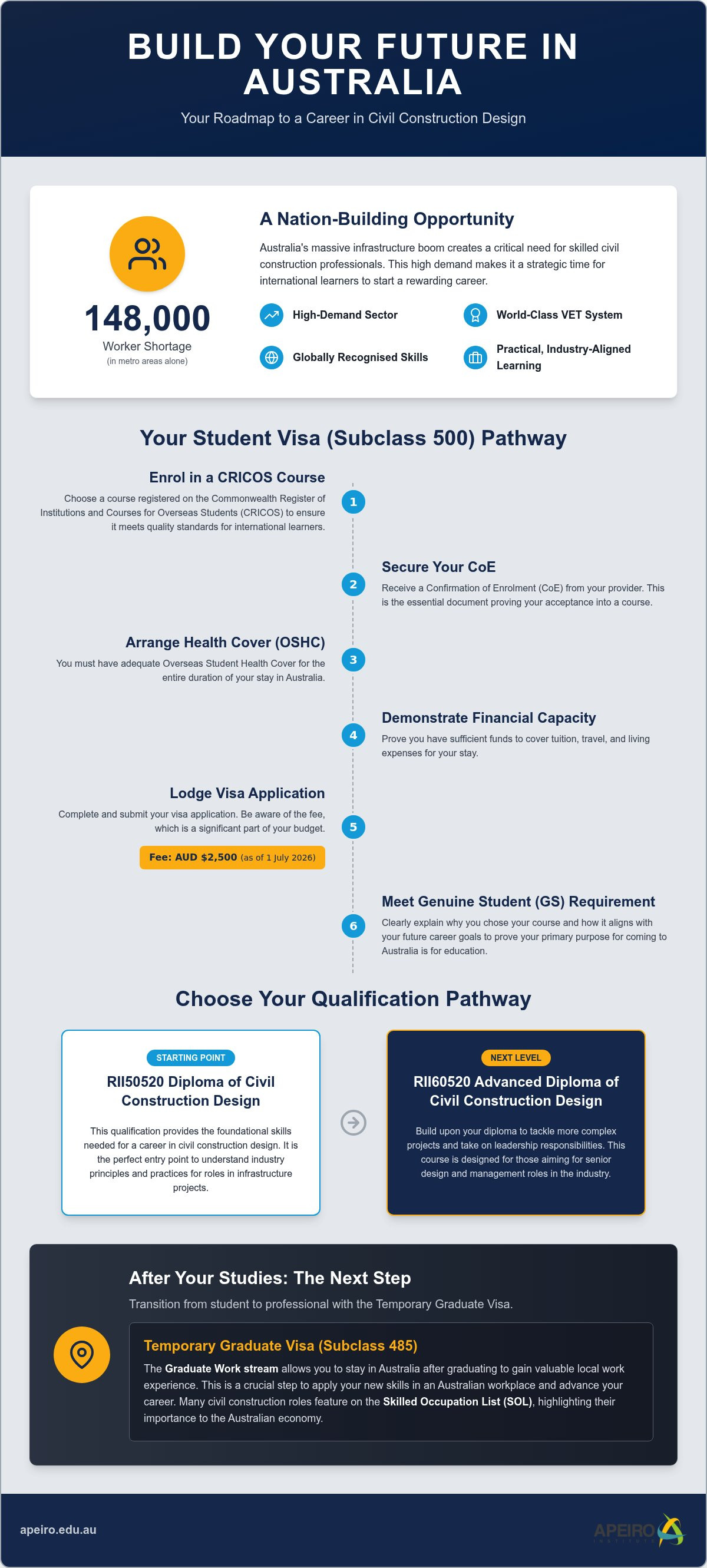
Did you know that Australia is currently facing a peak workforce shortage of 148,000 construction workers in metropolitan areas alone? This massive gap in the industry makes it a strategic time to launch your career in a sector that's building the nation's future. If you're planning to study civil construction in australia visa regulations and complex course structures are likely your first major hurdles. We understand that deciphering visa subclasses and entry requirements can feel like trying to read a blueprint without a legend. It's completely normal to feel overwhelmed by the jargon or worried about choosing a course that doesn't lead to real industry outcomes.
This guide simplifies the entire process, providing a clear roadmap from your initial student visa application to gaining a nationally recognised qualification. We'll explore the essential visa steps, explain the differences between civil design and on-site roles, and show you how to find a CRICOS-registered provider you can trust. By the end of this article, you'll have the confidence and clarity needed to build your professional life in Australia's thriving construction sector.
Key Takeaways
- Understand why Australia's massive infrastructure boom makes civil construction design one of the most strategic career choices for international learners.
- Learn the essential steps to secure your Student Visa (Subclass 500) and how to navigate the enrolment process for a nationally recognised qualification.
- Discover the specific differences between the RII50520 Diploma and RII60520 Advanced Diploma to choose the right pathway for your professional goals.
- Identify the requirements for the Graduate Work stream of the Temporary Graduate Visa (Subclass 485) to plan your journey beyond the classroom.
- Explore how a supportive, student-centred learning environment can help you successfully study civil construction in australia visa requirements and industry standards.
Understanding the Australian Civil Construction Sector and Visa Requirements
Civil construction is the physical backbone of the nation. It encompasses the design and building of essential infrastructure like roads, bridges, railways, and water systems. Because these projects are vital for economic growth and public safety, the Australian Government actively prioritises these skills. For international students, this means there are clear pathways to enter a high-demand sector with long-term potential. If you want to study civil construction in australia visa requirements specify that you must enrol in a CRICOS-registered course. This registration ensures the course meets strict quality standards specifically for international learners. While Apeiro Institute is a CRICOS-registered RTO (03703M) providing expert training, we are an educational provider, not a migration firm. We always recommend speaking with a registered migration agent for specific legal visa advice.
Why Australia is the Top Destination for Construction Studies
Australia's infrastructure pipeline is incredibly robust. Major projects are planned well through to 2030 and beyond. Infrastructure Australia, the government's independent advisor, consistently identifies a critical need for skilled professionals to manage this growth. The Australian Vocational Education and Training (VET) system is world-class. It focuses on practical, industry-aligned skills rather than just theory. This means you'll spend more time learning how to solve real-world problems. When you earn a qualification here, it's recognised globally. This gives you incredible flexibility in your career. You'll be gaining skills that are in high demand across the entire nation, providing you with a versatile professional toolkit that is valued by employers everywhere.
Key Visa Subclasses for International Students
Understanding the right visa is the first step in your journey. The Subclass 500 (Student Visa) is the primary entry point for most learners. It allows you to live and study here for the duration of your course. To qualify, you'll need a Confirmation of Enrolment (CoE) from a provider like us. Once you finish your studies, the Subclass 485 (Temporary Graduate Visa) often becomes the next logical goal. This visa lets you gain valuable local work experience after graduation. It's a great way to put your skills into practice in an Australian workplace. Many civil construction roles, particularly in design, are currently on the Skilled Occupation List (SOL). This list identifies the specific jobs that the country needs most to keep its economy moving. Choosing a course on this list is a very strategic move for any international student.
The Student Visa (Subclass 500): Your Ticket to Studying in Australia
Starting your journey begins with the right paperwork. The Student Visa (Subclass 500) is your primary gateway to an Australian education. As of July 1, 2026, the application fee is AUD $2,500. This is a significant factor to keep in mind when budgeting for your move. Before you can even lodge your application, you must secure a Confirmation of Enrolment (CoE) from a registered provider. This official electronic record confirms you've been accepted into a course and have paid the necessary initial fees. It's the essential foundation of your entire visa application.
You'll also need to demonstrate financial capacity. The Australian Government wants to be sure you can support yourself during your stay. This includes having enough funds for tuition fees, return airfares, and annual living expenses. Another non-negotiable is Overseas Student Health Cover (OSHC). This insurance must be active from the day you arrive until the day you leave. It ensures you have access to medical care and hospital services without facing massive out-of-pocket costs while you're away from home.
The Genuine Student (GS) Requirement
The Department of Home Affairs uses the GS requirement to ensure your primary reason for coming to Australia is high-quality education. When you decide to study civil construction in australia visa officers look for a clear link between your chosen course and your professional aspirations. You'll need to provide a statement explaining why you've selected this specific field and how it benefits your future. For 2026 visa success, the GS requirement focuses on your genuine intention to gain high-demand skills that align with your documented professional history and future career goals.
English Language and Academic Entry Standards
To succeed in a technical field like civil construction design, you'll need a solid academic foundation. Most Vocational Education and Training (VET) courses require the completion of secondary school equivalent to Australian Year 12. You'll also need to prove your English proficiency to ensure you can handle the course material and site safety requirements. Typically, an IELTS score of 5.5 to 6.0, or a comparable PTE Academic result, is required for entry. If your scores aren't quite there yet, don't worry. Many students start with an ELICOS (English Language Intensive Courses for Overseas Students) program to build their confidence. If you're looking for a supportive environment to start your journey, you can explore our vocational pathways to see how we help students achieve their career goals.
Choosing Your Qualification: Diploma vs Advanced Diploma of Civil Construction Design
Choosing the right course is a vital step in your professional journey. It's about matching your current interests with where you want to be in five years. When you plan to study civil construction in australia visa regulations usually require you to be enrolled in a full-time course of study registered with CRICOS. For most international students, these vocational pathways span between 1.5 and 2 years. This timeframe allows you to deeply absorb technical concepts while meeting the study duration requirements for future visa options. The primary choice you'll face is between the Diploma and the Advanced Diploma levels.
While both qualifications are highly valued, they prepare you for different environments. The Diploma is heavily focused on the technical "how-to" of drafting and support, whereas the Advanced Diploma moves into the "why" and "who," covering complex engineering designs and site leadership. Understanding these distinctions helps you pick the path that best suits your personality and career goals.
RII50520 Diploma of Civil Construction Design
This qualification serves as the essential foundation for your career in the Australian construction industry. It focuses on the core technical skills needed to support engineering projects from the ground up. You'll spend significant time mastering the following areas:
- CAD Drafting: Learning the digital software that serves as the universal language of modern construction.
- Structural Principles: Understanding how different materials and designs hold up under environmental pressure.
- Hydraulics: Gaining the skills to manage water flow and drainage in major infrastructure projects.
Most graduates from this program find success as Civil Construction Drafters or Technicians. It's a hands-on role where you turn engineering sketches into precise, workable blueprints that teams use on-site every day.
RII60520 Advanced Diploma of Civil Construction Design
If you're looking to take on more responsibility, the Advanced Diploma is the strategic choice. This course shifts the focus from technical execution to complex engineering design and project leadership. Key outcomes include:
- Geotechnical Design: Analysing soil and rock behaviour to ensure stable, safe construction foundations.
- Project Management: Developing the authority to manage teams, budgets, and resources for large-scale civil works.
- Career Advancement: Transitioning into senior roles such as Civil Construction Designer or Site Manager.
Completing this level of study is often a key step toward qualifying for the Graduate Work Stream visa, providing a bridge between your studies and the local workforce. For more details on how these programs fit into the broader educational landscape, read our guide on Vocational Courses for International Students in Australia. We're here to help you navigate these choices so you can start your career with confidence.
Post-Study Pathways: From Student Visa to the Graduate Work Stream
Finishing your course is a huge milestone. Now, you need to think about what comes next. The Temporary Graduate Visa (Subclass 485) Graduate Work stream is designed for students like you. It gives you the chance to stay in the country and gain that critical first year of local industry experience. As of July 2026, the application fee for this visa is AUD $5,750. To qualify, you must meet the Australian Study Requirement, which involves completing at least 92 weeks of CRICOS-registered study. This is why many students choose to study civil construction in australia visa pathways that combine both the Diploma and Advanced Diploma levels to ensure they hit that two-year mark.
This period isn't just about a visa; it's about building your reputation on-site. Employers in the Australian construction sector value "real-world" experience above almost everything else. Using this time to work on actual infrastructure projects allows you to apply your CAD drafting or site management skills in a high-pressure, professional environment. It's where the theory from your classroom truly comes to life. You'll be working alongside experienced engineers and project managers, learning the nuances of the Australian building codes and safety standards.
The Skills Assessment Process
To apply for the Graduate Work stream, you'll need a "Provisional Skills Assessment." For civil construction design, you'll likely interact with assessing authorities like Engineers Australia or VETASSESS. They look closely at your academic transcripts to ensure your course units directly match the requirements of your nominated occupation. A successfully completed qualification is the essential evidence required to prove your technical competency during the skills assessment process. This alignment is why choosing a high-quality, industry-recognised RTO is so important for your long-term success.
Transitioning to Permanent Residency (PR)
While the 485 visa is temporary, it's often a stepping stone toward permanent residency. Many graduates eventually apply for points-tested visas like the Skilled Independent (Subclass 189), Skilled Nominated (Subclass 190), or the Skilled Work Regional (Subclass 491). Working in regional Australia can often provide extra points toward your application, making it a popular choice for those looking to settle long-term. Because immigration laws change frequently, we strongly recommend you consult a Registered Migration Agent (MARA) for specific legal advice regarding your PR journey. They can help you navigate the complex points system and identify the best pathway for your unique situation.
Learn more about our trade pathways for experienced workers
How Apeiro Institute Supports Your Construction Career Journey
Starting a new life in a different country is a big move. You need a partner who understands the industry and the unique challenges international students face. At Apeiro Institute, we provide more than just a certificate. Our industry-focused training is delivered by trainers who have spent years on real Australian sites. This means you aren't just reading from a book; you're learning the practical tricks of the trade. We're proud of our inclusive community, representing over 38 nationalities. You'll be studying alongside people from all over the world who share your ambition and drive.
Our nationally recognised VET programmes are designed with flexibility in mind. We know that your schedule might need to balance study, work, and personal life. By offering structured but adaptable learning, we help you stay on track toward your goals without feeling overwhelmed. If you're looking for a deeper dive into the broader landscape of trade qualifications, you can read more about Trade Pathways for Experienced Workers Australia.
Recognition of Prior Learning (RPL) for Skilled Workers
One of the biggest advantages we offer is a pathway for those who already have experience. Many migration guides overlook this, but your previous work overseas is valuable. Through Recognition of Prior Learning (RPL), we can assess your existing skills and knowledge. If you've already spent years in the industry, you might be able to fast-track your qualification. This is a practical way to study civil construction in australia visa pathways while acknowledging the professional history you've already built. It's a streamlined solution that respects your expertise. Just keep in mind that while RPL helps you graduate sooner, you should check how it impacts the specific "study duration" requirements for post-study work visas. You can explore our TPEW page to see if you're eligible for this process.
Student-Centred Support and Facilities
Success in civil construction design requires the right environment and the right tools. Our modern learning centres feature dedicated design labs where you can get hands-on with the latest industry software. We prioritise a supportive, student-centred atmosphere where you can ask questions and get the help you need. Whether it's technical support in the lab or guidance on your study pathway, our team is deeply invested in your personal growth. We don't just want you to pass; we want you to build a secure future. If you're ready to take the next step, enquire today for a personalised study plan that maps out your career in the Australian construction industry.
Build Your Future in Australian Infrastructure
Australia's massive infrastructure pipeline is creating thousands of opportunities for skilled designers and project managers. By choosing a specialised qualification, you aren't just getting a certificate; you're building a foundation for a long-term career. Understanding how to study civil construction in australia visa requirements and post-study work rights will help you move from the classroom to the site with confidence. It's about turning your ambition into a practical, recognised profession.
At Apeiro Institute (RTO 45394), our expert trainers bring years of real-world experience to help you master the technical skills the industry demands. You'll join a vibrant global community with students from over 38 countries, all working toward a shared goal of professional success. We focus on providing the supportive environment you need to excel in your studies and beyond. Whether you're interested in digital drafting or site leadership, we have the pathways to get you there.
Your journey toward a rewarding career in civil construction starts with a single, well-informed step. We're here to support you every step of the way as you build your professional life in Australia.
Frequently Asked Questions
Can I work while studying civil construction in Australia on a student visa?
Yes, you can work while you study. Most student visas allow you to work up to 48 hours per fortnight while your course is in session. During scheduled course breaks, you can work unlimited hours. This is a great way to gain experience in the local industry and help cover your living costs. Just ensure you prioritise your studies to maintain your visa compliance and academic progress.
What is the difference between a civil engineer and a civil construction designer?
The main difference lies in the educational pathway and daily responsibilities. Civil engineers typically hold a university degree and handle high-level project approvals and complex mathematical modelling. Civil construction designers, who complete a Diploma or Advanced Diploma, focus on the practical application of design. They master CAD drafting, structural principles, and technical support. Designers are the professionals who turn engineering concepts into the detailed blueprints used on actual construction sites.
How long does a student visa for civil construction last?
Your student visa is generally granted for the total duration of your course plus a short grace period. For a two-year program like a combined Diploma and Advanced Diploma, your visa will typically last around 24 to 26 months. If you want to study civil construction in australia visa validity is tied directly to the Confirmation of Enrolment (CoE) provided by your RTO. This gives you enough time to finish your final assessments before your visa ends.
Do I need previous construction experience to enrol in a Diploma?
You don't need prior experience in the construction industry to enrol in the RII50520 Diploma of Civil Construction Design. This course is specifically designed to teach you the technical foundations from scratch. It starts with core concepts like drafting and structural principles, making it accessible to anyone with a high school education. However, if you do have previous experience, you might be eligible for Recognition of Prior Learning (RPL) to fast-track your qualification.
Is civil construction on the Skilled Occupation List (SOL) in 2026?
Yes, civil construction design roles are currently featured on the Skilled Occupation List (SOL) for 2026. For those who want to study civil construction in australia visa pathways are often clearer when the occupation is listed on the SOL. The Australian Government continues to prioritise these skills because of the massive infrastructure projects planned across the country. Being on this list means your chosen career path aligns with the nation's long-term economic needs.
What are the English language requirements for a construction visa?
To secure a visa for vocational study, you usually need to demonstrate an IELTS score of at least 5.5 to 6.0 or a PTE Academic equivalent. This ensures you can safely understand technical instructions and communicate effectively in a professional environment. If your current English level is lower, you can often package your construction course with an ELICOS program to reach the required standard before your main studies begin. This pathway helps build your confidence.
Can I include my family on my student visa while I study?
You can include your partner and dependent children as secondary applicants on your student visa. This allows your family to live with you in Australia while you complete your qualification. Each family member must meet specific health and character requirements. Keep in mind that you'll also need to prove you have enough financial capacity to support everyone included in your application for the duration of your stay. This ensures a smooth transition for your whole family.
What happens if my visa expires before I finish my civil construction course?
If your visa is set to expire before you finish your course, you must apply for a new student visa as soon as possible. You should generally start this process at least several weeks before your current visa ends. In many cases, you'll be granted a Bridging Visa A (BVA), which allows you to stay in the country legally while your new application is being processed. Never let your visa expire without taking action to protect your legal status.

Disclaimer
The information provided on this blog is for general informational and educational purposes only. While every effort is made to ensure the accuracy and reliability of the content, the author makes no representations or warranties of any kind, express or implied, about the completeness, accuracy, suitability, or availability of the information contained on this blog.
The views and opinions expressed in blog posts are those of the individual author and do not necessarily reflect the official policy or position of any organization, company, or employer.
This blog may contain links to external websites or third-party content. These links are provided for convenience only, and the author has no control over and assumes no responsibility for the content, privacy policies, or practices of any third-party sites.
Nothing on this blog constitutes professional advice (legal, financial, medical, or otherwise). Readers are encouraged to seek appropriate professional guidance before making any decisions based on the information provided here.
By using this blog, you acknowledge that any reliance on the information is at your own risk.


