
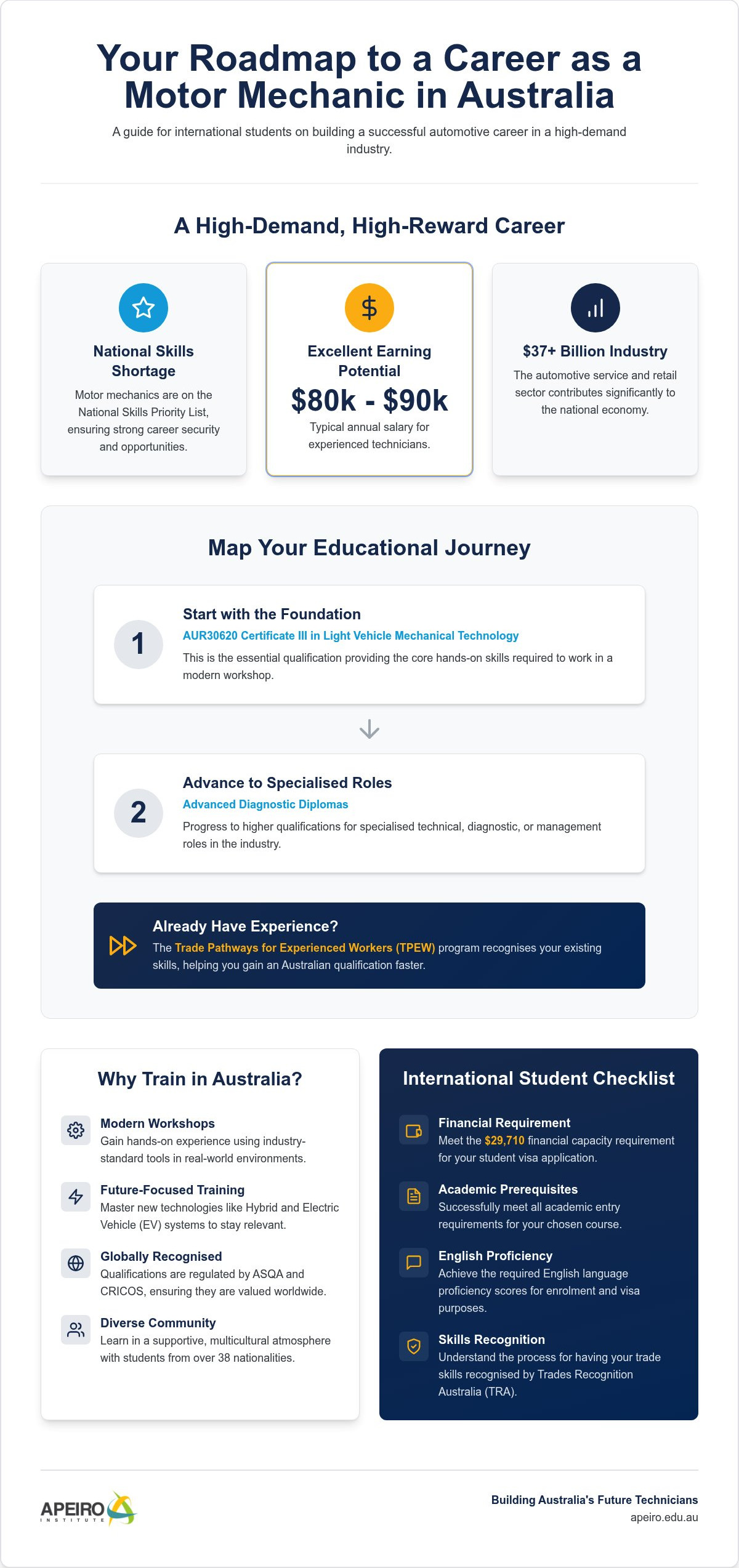
Did you know that motor mechanics are currently facing a national skills shortage in Australia, with experienced technicians often earning between $80,000 and $90,000 per year? It's a field with massive potential, yet many students feel stuck before they even begin. You might be confused about whether to start with a Certificate III or a Diploma; or perhaps you're feeling anxious about meeting the $29,710 financial requirement for your student visa. It's completely normal to feel this way when you're planning such a significant life change.
We've designed this guide to act as your expert mentor, clearing the path toward a successful career. You'll discover the best automotive courses in australia for international students, from foundational mechanical technology to advanced diagnostic qualifications. We'll walk you through the entry requirements, explain how to secure a nationally recognised qualification, and show you how to gain hands-on experience in a modern workshop. By the end of this article, you'll have a clear, step-by-step roadmap to becoming a qualified motor mechanic in a country that truly values your skills.
Key Takeaways
- Understand why motor mechanics are currently on the National Skills Priority List and what this means for your long-term career security in Australia.
- Map out your educational journey by exploring the best automotive courses in australia for international students, from foundational mechanical technology to advanced diagnostic diplomas.
- Get clear on the academic prerequisites and English proficiency scores required to successfully enrol and meet your student visa obligations.
- Identify the essential steps for having your trade skills recognised by Trades Recognition Australia to help you transition from a student to a professional technician.
- Learn how expert mentorship from a CRICOS-registered provider can help you navigate complex requirements and choose the right pathway for your specific goals.
The Growing Demand for Skilled Automotive Professionals in Australia
Automotive courses in Australia are specialised vocational programmes designed to equip you with the practical skills needed to repair, diagnose, and maintain a wide variety of vehicles. Choosing automotive courses in australia for international students means entering a sector that is currently crying out for fresh talent. According to the National Skills Priority List for 2026, motor mechanics remain in critical shortage across the country. This isn't just about fixing old cars. It's about becoming a high-tech problem solver in an industry that sets global benchmarks for quality and safety. Many workshops are struggling to find qualified staff, which creates a secure and welcoming environment for new graduates ready to start their careers.
The history of the automotive industry in Australia has evolved from traditional manufacturing into a sophisticated service and technology hub. Today, that excellence is rapidly shifting toward hybrid and electric vehicle (EV) technology. This transition is a major driver for new training, as modern workshops now require technicians who can navigate complex high-voltage systems alongside traditional internal combustion engines. Mastering these new technologies ensures you stay relevant in a fast-changing global market while contributing to a more sustainable future.
Why Australia is the Ideal Hub for Automotive Training
The Australian automotive industry is a massive economic driver that contributes over $37 billion to the national economy in 2026 through its vast network of services and retail operations. Automotive technicians play a vital role in this ecosystem by maintaining the essential transport and logistics chains that deliver goods across the continent. We are also seeing a surge in the secondary market and independent repair workshops. This growth ensures that qualified professionals who hold an AUR30620 Certificate III in Light Vehicle Mechanical Technology have diverse employment options across various business models. As vehicle owners keep their cars longer, the demand for skilled maintenance and complex repairs only continues to rise.
Navigating Automotive Qualifications: From Certificate III to Diploma
Choosing the right path among the various automotive courses in australia for international students depends on your current experience and your long-term career goals. The Australian vocational system is designed as a ladder. You start with the basics and climb toward specialised technical or management roles. Most students find that beginning with the AUR30620 Certificate III in Light Vehicle Mechanical Technology provides the strongest possible foundation for a career in a modern workshop.
If you already have significant experience in the industry from your home country, you might not need to start at the very beginning. Our Trade Pathways for Experienced Workers (TPEW) programme is a specialised route that recognises your existing skills. It's a fantastic way to gain an Australian qualification without repeating what you already know. This flexibility is a hallmark of the Australian training system, ensuring that your prior hard work is valued and respected.
AUR30620: The Foundation of Your Mechanic Career
This qualification is the essential starting point for becoming a qualified motor mechanic. You'll focus on core skills like servicing engines, transmissions, and braking systems. Practical workshop hours are a non-negotiable part of this course. You need these hours to meet trade recognition standards and prove you can handle real-world mechanical challenges. It's about getting your hands dirty while learning the theory behind how modern vehicles operate. For a detailed breakdown of what to expect, you can read our Certificate III light vehicle mechanical technology guide.
Advanced Specialisations: Certificate IV and Diploma
Once you've mastered the basics, you can move into advanced territory. The AUR40216 Certificate IV in Automotive Mechanical Diagnosis focuses on complex troubleshooting and electronic systems. As vehicles become more reliant on software, these diagnostic skills are becoming vital. These high-level roles are currently featured on the Core Skills Occupation List for automotive technicians, which highlights just how much the industry needs specialists.
The AUR50216 Diploma of Automotive Technology takes you even further. It's designed for those who want to move into workshop management or high-level technical research. You'll develop leadership skills and learn how to manage complex workshop operations. Holding a Diploma can significantly enhance your employability in specialised dealerships and large-scale service centres. If you're ready to take the next step in your professional growth, you can start your journey with us today and build a future you're proud of.
Essential Entry Requirements for International Applicants
Applying for automotive courses in australia for international students involves more than just a passion for engines. You need to meet specific criteria to ensure you're prepared for both the academic and practical demands of the trade. Generally, you'll need to have completed the equivalent of Australian Year 10 or 12. If you're aiming for a specialised qualification like the Certificate III in Light Vehicle Mechanical Technology, having a solid background in basic maths and science will help you navigate the technical theory and workshop calculations.
Beyond academics, you must satisfy the Genuine Student (GS) requirement. This is a standard part of the Australian student visa process where you demonstrate that your primary reason for coming to Australia is to gain a high-quality education. You'll also need to arrange Overseas Student Health Cover (OSHC) before your visa is granted. This insurance is vital as it covers medical expenses while you're away from home. Current estimates suggest OSHC costs between $500 and $700 per year, providing you with peace of mind as you settle into your new life.
English Language Proficiency Standards
Clear communication is a critical safety requirement in a busy mechanical workshop. For most automotive programmes, you'll need an IELTS Academic score of at least 5.5 or an equivalent result from PTE or TOEFL. If your current score is slightly lower, don't worry. Many students successfully use ELICOS pathways to bridge the gap before starting their trade training. Strong English skills ensure you can follow complex safety instructions and collaborate effectively with your team.
Financial and Visa Considerations
To secure your Subclass 500 student visa, you must provide evidence of your financial capacity. As of August 2026, the Australian Department of Home Affairs requires proof of access to at least $29,710 for your first year of living costs. This doesn't include your tuition or the $2,500 visa application fee. Studying at a CRICOS-registered RTO like Apeiro Institute ensures your enrolment is recognised by the government. It also ensures you're aware of the latest 2026 visa conditions, including your rights to work part-time while you study.
Employment Prospects and PR Pathway Considerations
Graduating from automotive courses in australia for international students opens doors to a variety of rewarding career paths. You aren't just limited to basic repairs. You could become a Light Vehicle Motor Mechanic, a specialised Diagnostic Technician, or eventually a Workshop Manager. The demand is particularly high in regional areas, where businesses often offer higher incentives to attract skilled workers. It's a career that offers both stability and the chance to work with cutting-edge technology every day.
For those looking to transition from study to professional life, the process is highly structured. Trades Recognition Australia (TRA) is the body responsible for assessing your skills. As an international graduate, you'll likely participate in the Job Ready Programme (JRP). This four-step programme allows you to prove your capabilities in an Australian workplace while gaining the necessary experience for a full skills assessment. It's a practical way to show you're ready for the local industry.
The Path to Permanent Residency (PR)
Automotive occupations like 'Motor Mechanic (General)' are currently featured on the Medium and Long-term Strategic Skills List (MLTSSL). This makes the trade a viable option for various skilled migration visas. Most students start by applying for a 485 Temporary Graduate visa after finishing their studies. This visa gives you the time needed to complete the JRP and gain valuable local work experience. A common and effective strategy for international students is to enrol in a qualification package consisting of a Cert III, a Cert IV, and a Diploma. This comprehensive approach ensures you meet the study requirements while building a high-level skill set that employers value.
Salary Expectations and Industry Benefits
The financial rewards in this sector are significant. In the 2026 market, qualified automotive technicians can expect an average annual salary between $80,000 and $90,000. Entry-level roles typically start around $57,628, while senior mechanics can earn up to $94,596. If you choose to work in regional hubs, salaries can climb even higher, sometimes exceeding $100,000. Beyond the pay, you'll gain portable skills that allow you to find work anywhere in the country. Many technicians eventually use this experience to open their own private mechanical businesses, providing long-term career independence.
Explore our trade pathways for experienced workers
Why Apeiro Institute is the Right Choice for Your Automotive Journey
Choosing where to study is just as important as the qualification itself. Apeiro Institute stands out as a premier CRICOS and RTO provider, offering a learning environment that is both professionally authoritative and deeply supportive. Our automotive courses in australia for international students are designed with a clear focus on the industry. We provide training that goes beyond theory, delivered by experienced trainers who've spent years in the trade. You'll learn in modern, well-equipped facilities that mirror the workshops you'll eventually work in, ensuring your transition to the workforce is as smooth as possible.
We take pride in our vibrant, multicultural community. With students representing over 38 nationalities, you'll find a welcoming atmosphere where diversity is celebrated. This global perspective, combined with our locally grounded expertise, makes us a unique partner in your success. We understand that moving to a new country to study is a big step. That's why we act as a bridge between your current circumstances and your future career goals, providing the security and expert guidance you need to thrive.
Student-Centred Support and Mentorship
At Apeiro, we treat every individual as a partner in their own growth. You'll receive personalised guidance from the moment you enquire until the day you graduate. Navigating the vocational education system can be complex, but you don't have to do it alone. Our team is here to help you understand your pathway and ensure you're meeting all your requirements. For a broader look at the landscape, you can check out our comprehensive 2026 guide for international students. This student-centred approach ensures you stay focused on your training while we help manage the details.
Flexible Learning and Trade Recognition
We recognise that many international students arrive with existing skills and hard-earned experience. We specialise in Recognition of Prior Learning (RPL), which allows us to assess your current expertise and potentially fast-track your qualification. This avoids unnecessary repetition and respects the work you've already done in your home country. Our Trade Pathways for Experienced Workers (TPEW) programme is specifically tailored for skilled individuals who need an Australian qualification to advance their careers. It's a flexible, logical solution that values your professional history. If you're ready to start your journey in a supportive and industry-aligned environment, Explore Automotive Courses at Apeiro Institute Today and take the first step toward your new career.
Take the Next Step Toward Your Automotive Career
The Australian automotive industry is full of potential for those with the right skills and dedication. By understanding the national skills shortage and mapping out your path from a Certificate III to a Diploma, you're positioning yourself for a stable and rewarding future. We've explored the essential entry requirements and migration pathways to help you feel confident in your decisions. Choosing the right automotive courses in australia for international students is the foundation of your success in this high-tech sector.
As a CRICOS Registered Provider, Apeiro Institute offers nationally recognised training delivered by experienced industry trainers. We act as your expert mentor, bridging the gap between your studies and the professional workshop. Whether you're starting fresh or looking for trade recognition through our specialised RPL options, we're here to support your growth every step of the way.
Your journey toward becoming a qualified motor mechanic starts with a single, informed choice. We look forward to welcoming you into our multicultural community and helping you achieve your professional goals in Australia. You have the drive to succeed, and we have the tools to help you get there.
Frequently Asked Questions
Can I work while studying an automotive course in Australia?
Yes, you can work while completing your studies. Most people enrolled in automotive courses in australia for international students on a Subclass 500 visa can work up to 48 hours per fortnight during the term. During scheduled breaks, you have unlimited work rights. This is a brilliant way to gain experience in a local workshop while helping to cover your living costs. Always check your specific visa conditions to stay compliant.
How long does it take to become a qualified mechanic in Australia as an international student?
It typically takes about two years of full-time study to become a qualified technician. Most students spend one year completing a Certificate III in Light Vehicle Mechanical Technology, followed by additional time for a Certificate IV or Diploma. Completing a two-year study package is often a strategic choice for those looking to meet the Australian study requirement for various graduate and skilled migration visa pathways later on.
What is the difference between a Certificate III and a Certificate IV in automotive?
A Certificate III provides the foundational skills needed for general vehicle servicing and mechanical repairs. It's the entry point for the trade. A Certificate IV focuses on advanced diagnostic tasks and complex electronic systems. While a Cert III qualifies you to work as a mechanic, a Cert IV prepares you for specialised roles where you'll handle high-level troubleshooting that modern, software-heavy vehicles require in today's market.
Do I need prior experience to enrol in an automotive course?
You don't need any prior mechanical experience to begin your journey. The Certificate III is designed as an entry-level programme that teaches you the basics from the ground up. As long as you meet the academic prerequisites, such as finishing Year 10 or 12, and satisfy the English language requirements, you can start learning. It's an ideal path for anyone with a passion for cars and a desire for a practical career.
Is the AUR30620 qualification recognised all over Australia?
Yes, the AUR30620 is a nationally recognised qualification. Because it is part of the Australian Qualifications Framework, your skills will be respected by employers in every state and territory. This gives you the flexibility to seek employment across the country, from bustling city centres to busy regional workshops. Having a standardised qualification ensures that your training meets the high regulatory benchmarks set by the Australian government for the automotive industry.
What are the English language requirements for automotive vocational training?
Most vocational providers require an IELTS Academic score of at least 5.5 or an equivalent result from tests like PTE or TOEFL. This ensures you can safely follow technical instructions and communicate effectively in a workshop environment. If you haven't reached this level yet, you can often enrol in an English language course first. This helps you build the necessary communication skills before you start your formal trade training.
Can I get a student visa for a Certificate III in Light Vehicle Mechanical Technology?
Yes, you can certainly apply for a student visa to study a Certificate III. These automotive courses in australia for international students must be registered with CRICOS to be eligible. Many students choose to package the Certificate III with a Certificate IV or a Diploma to create a longer study plan. This approach provides a more comprehensive education while ensuring your visa covers the full duration of your intended training pathway.
What is the Job Ready Programme (JRP) for automotive graduates?
The Job Ready Programme is a four-step skills assessment run by Trades Recognition Australia. It's designed for international graduates who have completed an Australian qualification. The programme allows you to demonstrate your skills in a real Australian workplace over a period of at least 12 months. Successfully completing the JRP provides you with a full skills assessment. This is a vital requirement for many skilled migration visa applications in the automotive sector.
Disclaimer
The information provided on this blog is for general informational and educational purposes only. While every effort is made to ensure the accuracy and reliability of the content, the author makes no representations or warranties of any kind, express or implied, about the completeness, accuracy, suitability, or availability of the information contained on this blog.
The views and opinions expressed in blog posts are those of the individual author and do not necessarily reflect the official policy or position of any organization, company, or employer.
This blog may contain links to external websites or third-party content. These links are provided for convenience only, and the author has no control over and assumes no responsibility for the content, privacy policies, or practices of any third-party sites.
Nothing on this blog constitutes professional advice (legal, financial, medical, or otherwise). Readers are encouraged to seek appropriate professional guidance before making any decisions based on the information provided here.
By using this blog, you acknowledge that any reliance on the information is at your own risk.


