

What if your current qualification is actually worth $10 more per hour than you're being paid today? It's common to feel a bit lost when you look at the gap between the NDIS price limits and your actual take-home pay. You might see the $73.58 weekday cap and wonder why your personal disability support worker hourly rate looks so different on your payslip. It's frustrating when you aren't sure if your weekend penalty rates are correct or if that Certificate III you worked so hard for should have bumped you up a pay point already.
This guide clears up the confusion by breaking down exactly what you should be earning or paying in 2026. We'll bridge the gap between the SCHADS Award and the NDIS Price Guide, showing you how to calculate penalty rates for public holidays and Saturdays. You'll also discover a clear roadmap for career progression, including how to use your experience to negotiate a higher rate or step into specialist roles. Whether you're just starting out or you're an experienced worker looking to formalise your skills, you'll find the clarity you need to move forward with confidence.
Key Takeaways
- Understand the difference between NDIS price limits and the SCHADS Award to ensure your pay matches the legal minimum for your role.
- Learn how to calculate your disability support worker hourly rate for weekdays, weekends, and public holidays, including mandatory penalty rate increases.
- Discover how national qualifications like a Certificate III in Individual Support can help you move up pay points and access specialist care premiums.
- Evaluate the true earning potential of independent contracting versus agency work by factoring in hidden costs like superannuation and insurance.
- Create a professional roadmap to maximise your income by combining formal training with industry experience to reach senior classification levels.
The 2026 Landscape: NDIS Price Guide and the SCHADS Award
To understand your potential earnings, you first need to distinguish between two critical documents: the SCHADS Award and the NDIS Price Guide. Think of the SCHADS Award as the legal "floor." It sets the absolute minimum wage an employer must pay you by law. On the other side, the NDIS Price Guide acts as the "ceiling." This is the maximum amount a registered provider can charge a participant's plan for your services. As the landscape of Disability in Australia evolves, these two benchmarks ensure the sector remains sustainable while protecting your rights as a professional.
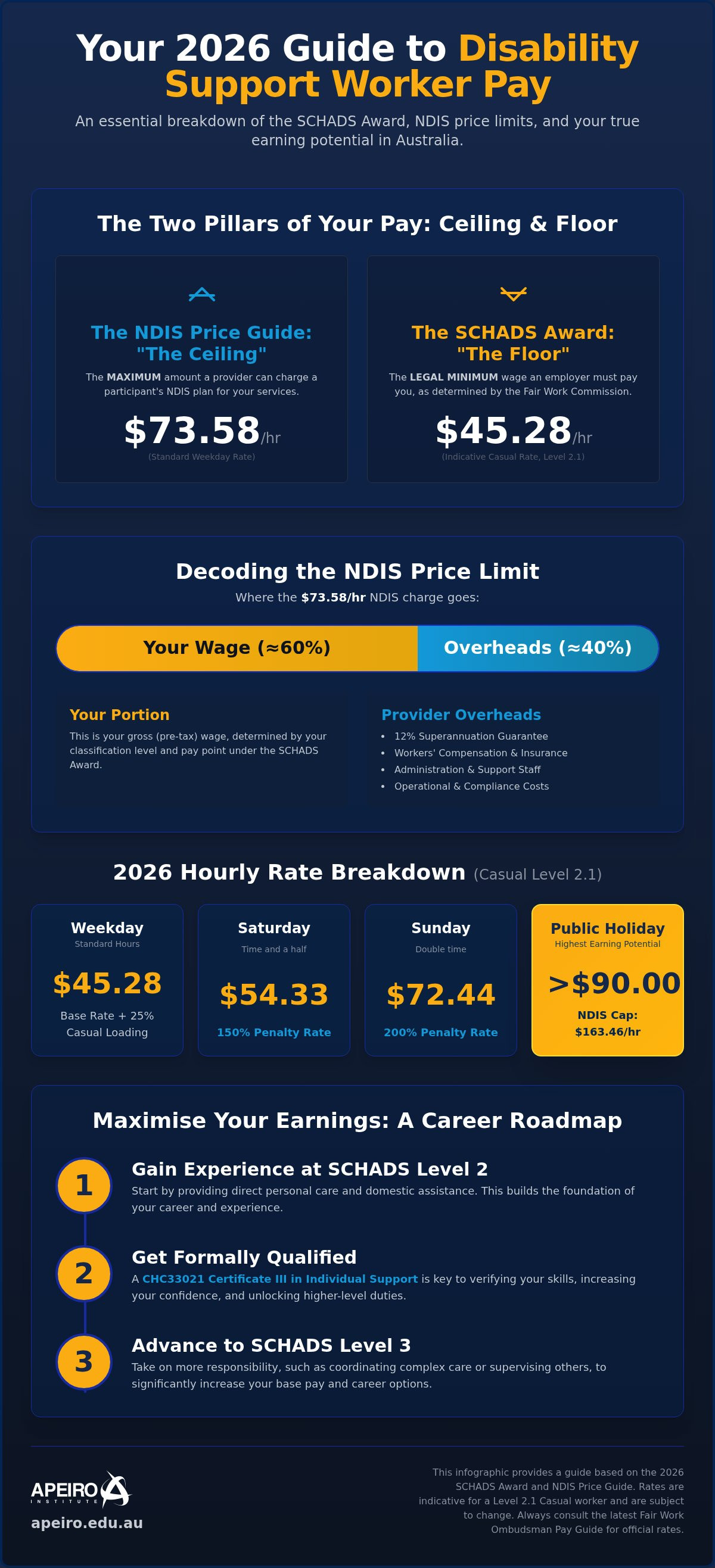
There's often a gap between the NDIS price cap and your take-home pay. For 2026, the standard weekday NDIS price limit is $73.58 per hour. However, this isn't the disability support worker hourly rate that lands in your bank account. Roughly 40% of that total cost covers essential overheads like your 12% superannuation, workers' compensation, insurance, and the administrative support provided by your agency. Understanding this distinction helps you see the "total cost of support" from a participant's perspective while knowing exactly where your personal wage fits into the bigger picture.
Understanding SCHADS Award Levels
Your pay grade is determined by your classification level under the SCHADS Award. Level 2 is the standard entry point for those providing direct personal care and domestic assistance. Once you gain more responsibility, such as coordinating complex care or supervising others, you move to Level 3. Within each level, you'll find "pay points." These are annual increments that reward your loyalty and experience. Moving from Level 2 to Level 3 is your first major financial milestone. It often requires a formal qualification like the CHC33021 Certificate III in Individual Support to prove you have the technical skills for higher-level duties.
The Role of the Fair Work Commission in 2026
The Fair Work Commission (FWC) reviews minimum wages every year to help workers keep up with the cost of living. In 2026, these reviews are vital for combatting inflation and ensuring the disability sector remains an attractive career choice. It's always a good idea to check the latest Pay Guide, as rates differ significantly between permanent employees who get paid leave and casuals who receive a loading for flexibility. In 2026, the minimum base rate for a casual Level 2.1 worker is $45.28 per hour, which includes the mandatory 25% casual loading.
Hourly Rate Breakdown: Weekdays, Weekends, and Public Holidays
Working in disability support offers incredible variety, not just in the people you meet, but in how your earnings are structured. While your base weekday rate provides a steady foundation, the real boost to your bank balance often comes from working outside standard business hours. Evening shifts typically attract a small loading, while "sleepovers" are paid as a flat allowance for the night, plus the hourly rate for any time you're actually required to perform support duties.
The weekend is where the disability support worker hourly rate truly shifts. Under the SCHADS Award, Saturday shifts attract a 150% penalty rate, while Sundays jump to 200%. For a casual worker at Level 2.1, this means your rate moves from a weekday base to roughly $54.33 on Saturdays and $72.44 on Sundays. Public holidays are even more significant. Because the NDIS price cap for public holidays reaches $163.46 per hour to cover high labour costs, workers can see their own rates climb to over $90 per hour. If you're looking to step into these higher-paying shifts with confidence, starting with a Certificate III in Individual Support is a great first step to ensure you have the skills required for weekend responsibilities.
Casual vs Permanent: Which Hourly Rate is Better?
Choosing between casual and permanent work is a personal decision based on your financial goals. Casual workers receive a 25% loading to compensate for the lack of paid annual leave and sick pay. This makes your immediate hourly rate look much higher on paper. However, many workers in 2026 are moving toward permanent part-time roles. This shift offers better financial stability, making it easier to apply for home loans or plan holidays without losing income. When calculating your "true" rate, remember that all employees, regardless of status, are entitled to the 12% superannuation guarantee as of July 2025.
2026 NDIS Price Limits for Standard Support
The National Disability Insurance Agency (NDIA) sets strict caps on what can be charged to a participant’s budget. These limits are updated regularly in the NDIS Pricing Arrangements and Price Limits. In 2026, the Temporary Transformation Payment (TTP) has been fully integrated into the base price limits, meaning there's no longer a separate loading for providers to claim.
| Support Timing | 2026 NDIS Price Limit (Standard) |
|---|---|
| Weekday Daytime | $73.58 / hr |
| Saturday | $103.54 / hr |
| Sunday | $133.50 / hr |
| Public Holiday | $163.46 / hr |
If you're a self-managed participant, you have the flexibility to negotiate a rate below these caps directly with your support worker. This often allows for more hours of support within your budget while still providing a fair wage to the worker.
Key Factors That Determine Your Hourly Rate
While the time of day you work sets your penalty rates, your base disability support worker hourly rate is largely determined by what you bring to the table. Employers look at your qualifications, your specific clinical skills, and even where you live to decide your pay grade. In a competitive 2026 market, being a "good person" is the baseline, but being a qualified professional is what moves you up the SCHADS pay scale.
Holding a CHC33021 Certificate III in Individual Support is the most significant factor for entry-level workers. Without it, you may be limited to Level 1 or basic Level 2 roles. With it, you're recognised as a trained professional capable of handling complex personal care. If you've been in the industry for years but lack the "paper," Recognition of Prior Learning (RPL) is a practical pathway to formalise your expertise. It allows you to skip the classroom for things you already know, helping you jump-start your pay scale progression without starting from scratch.
Location also plays a surprising role. In metro areas, there's a high volume of work, but in regional Australia, the shortage of skilled workers is often more acute. This demand can give you more leverage to negotiate a higher rate, especially if you're an independent contractor. Additionally, "Complex Care" skills like PEG feeding, tracheostomy care, or ventilator support command a premium. These aren't just extra duties; they require specific training that justifies a higher classification level.
The Qualification Gap: Cert III vs Cert IV
The difference between a Certificate III and a Certificate IV often comes down to the level of autonomy and complexity. A Cert III holder typically provides direct daily support. A Cert IV holder, however, is often tasked with high-intensity daily personal activities or coordinating small teams. Agencies prioritise Cert IV workers for complex cases because they have the advanced clinical knowledge required for safety and compliance. For those looking beyond direct support, exploring a Diploma of Community Services Australia: The 2026 Career Guide can lead to case management roles with even higher earning potential.
Specialisations that Command Higher Rates
The NDIS Price Guide recognises the extra effort required for specialised care through the "High Intensity" hourly rate. In 2026, the weekday high-intensity price limit is $79.60 per hour, which is roughly $6 higher than the standard rate. To access this, you need to document your specialised experience in areas like behaviour support or complex physical disability. When applying for roles, don't just say you're experienced. Provide a portfolio of your certifications and a log of your hours in high-intensity settings to justify your request for a higher pay point.
Independent vs. Agency Support Work: Which Pays Better?
When you look at the raw numbers, the difference in pay structures can seem huge. An independent contractor might quote a disability support worker hourly rate between $55 and $65, while an agency employee usually sees $35 to $45 land in their account. This gap often leads to the myth that independent workers are pocketing the entire NDIS price cap for themselves. In reality, that higher gross rate is a necessity to cover the business costs that an agency normally handles on your behalf.
It's a common misconception that charging $73.58 per hour as an independent means you're earning $73.58 per hour in profit. You're essentially running a small business. You're the CEO, the HR department, and the support worker all at once. Once you strip away the costs of doing business, the "take-home" pay often aligns much closer to agency rates than people expect. Choosing the right path depends on whether you value the high-responsibility, high-admin life of a contractor or the security and support of an established organisation.
The Reality of Being an Independent Contractor
Stepping out on your own requires a significant amount of self-discipline and financial planning. You'll need to arrange your own public liability and professional indemnity insurance to protect yourself and your clients. You also won't have an employer contributing to your superannuation automatically. With the super guarantee at 12% in 2026, you must be diligent about setting this money aside yourself to ensure you aren't left behind when you reach retirement. Finding consistent shifts is another hurdle. Without an agency's matching service, you'll spend unpaid hours marketing your services and interviewing potential clients.
Why Agencies Remain the Preferred Choice for Many
For many professionals, the trade-off for a slightly lower hourly rate is the peace of mind that comes with agency support. Agencies provide clinical governance, which means you have a team of experts to guide you through complex or unsafe situations. They handle the heavy lifting of NDIS billing, payroll tax, and workers' compensation, allowing you to focus entirely on providing care. Access to professional development is another major perk. Many agencies partner with RTOs to offer subsidised training, helping you stay current with your qualifications.
Agencies also act as a bridge for career progression. They often have the resources to help you formalise your years of experience through Recognition of Prior Learning (RPL), which can quickly move you into higher pay points. This structured environment is often the fastest way to build a diverse portfolio of experience across different types of disability support.
Get qualified with a Certificate III in Individual Support
Maximising Your Earning Capacity with National Qualifications
Increasing your income in the disability sector isn't just about working more hours. It's about working smarter by increasing the value of every hour you spend on the job. While the base disability support worker hourly rate provides a solid start, the most successful professionals use a structured approach to climb the pay scale. By following a clear roadmap, you can move from entry-level positions to specialised or management roles that offer significantly higher rewards.
Your journey to a higher pay grade typically follows these five steps:
- Step 1: Obtain a baseline qualification. Starting with the CHC33021 Certificate III in Individual Support ensures you meet the professional standards required by top-tier agencies.
- Step 2: Gain 12 months of diverse experience. This allows you to move up the SCHADS pay points within your level, rewarding your time in the industry with automatic annual increments.
- Step 3: Specialise in high-demand areas. Focus on Mental Health or Complex Care to justify the "High Intensity" rates discussed earlier in this guide.
- Step 4: Upskill for leadership. Moving into a CHC52025 Diploma of Community Services prepares you for coordination and management roles.
- Step 5: Formalise your expertise. If you're already an experienced worker, use Trade Pathways for Experienced Workers to turn your years of on-the-job knowledge into a formal qualification.
Leveraging Recognition of Prior Learning (RPL)
Many workers don't realise they're already performing duties at a higher level than their current pay reflects. Recognition of Prior Learning (RPL) is a practical solution that allows you to get qualified without repeating training for skills you've already mastered. A formal certificate obtained via RPL can immediately trigger a pay review with your employer, as it proves you meet the criteria for a higher SCHADS classification. For a deeper look at how this works, check out our Trade Pathways for Experienced Workers Australia: The 2026 Guide.
Transitioning into Case Management and Coordination
The jump from a direct support role to a Support Coordinator or Case Manager is one of the most effective ways to boost your disability support worker hourly rate. These roles involve less physical labour and more strategic planning, such as helping participants navigate their NDIS plans. Because these positions require the advanced clinical and administrative knowledge found in a Diploma-level qualification, they command a much higher base rate. Your career in disability support is a journey that offers genuine room for growth. By investing in your education, you're not just getting a job; you're building a sustainable and profitable future.
Take the Next Step in Your Support Career
Understanding your disability support worker hourly rate is the first step toward financial security in this rewarding sector. You now know that while NDIS price caps set the ceiling, your personal qualifications and specialisations determine your actual pay floor. By moving from entry-level roles to high-intensity care or coordination, you can significantly increase your earning potential in 2026.
Apeiro Institute is here to act as your mentor through this process. As a nationally recognised RTO 45394, we provide industry-led training designed for practical outcomes. Whether you're starting fresh or using our flexible pathways for experienced workers to formalise your skills, we're invested in your personal and professional growth.
Your dedication to the community deserves a clear path to professional success. We're ready to help you reach your goals and build a sustainable career you can be proud of.
Frequently Asked Questions
What is the minimum hourly rate for a disability support worker in Australia in 2026?
The minimum disability support worker hourly rate for a casual employee at Level 2.1 is $45.28 as of July 2026. This figure includes the mandatory 25% casual loading designed to compensate for the lack of paid leave. If you are a permanent employee, your base rate is $36.22 per hour, but you also receive paid annual and sick leave. These rates are set by the Fair Work Commission under the SCHADS Award.
Does the NDIS set the hourly rate for all support workers?
No, the NDIS doesn't set your specific wage; it sets the maximum price limit that registered providers can charge for a service. Your actual pay is determined by your employment contract and the SCHADS Award. While the NDIS price cap for a standard weekday daytime shift is $73.58, your take-home pay is a portion of that after the provider covers superannuation, insurance, and administrative overheads.
How much more do disability support workers earn on weekends?
Disability support workers earn significantly more on weekends due to mandatory penalty rates. On Saturdays, you're entitled to 150% of your base rate, while Sunday shifts pay 200%. For a casual worker at Level 2.1, this means earning roughly $54.33 per hour on Saturdays and $72.44 per hour on Sundays. These rates ensure you're fairly compensated for working outside standard business hours and help boost your overall weekly income.
Do I need a Certificate III to earn a higher hourly rate?
Holding a Certificate III in Individual Support is often the key to unlocking higher pay points. While you can enter the industry without it, many agencies require this qualification to classify you at a higher level under the SCHADS Award. Qualified workers are often prioritised for complex care roles, which attract higher rates. Formalising your skills through training or Recognition of Prior Learning is a proven way to justify a pay review.
What is the difference between a Level 2 and Level 3 support worker rate?
The main difference lies in the complexity of the support provided and the level of responsibility you hold. Level 2 workers typically assist with daily living activities and personal care. Level 3 workers often handle more complex physical or behavioural support and may supervise other staff. Moving from Level 2 to Level 3 represents a significant step up in your disability support worker hourly rate and usually requires a combination of experience and formal qualifications.
Are independent disability support workers paid more than agency staff?
Independent workers often have a higher gross disability support worker hourly rate, typically between $55 and $65, compared to agency staff who might earn $35 to $45. However, independent contractors must pay for their own 12% superannuation, workers' compensation, and public liability insurance. After these business expenses and unpaid administrative time are factored in, the net pay for both pathways is often quite similar, though independent work offers more flexibility.
Can I negotiate my hourly rate with an NDIS participant?
You can certainly negotiate your rate directly if you're working with a self-managed NDIS participant. While you cannot charge more than the NDIS price limits if working through a registered provider, self-managed participants have the flexibility to agree on a rate that reflects your specific expertise. This is particularly common if you have specialised skills in high-intensity support or if you're working in a regional area where support workers are in high demand.
How often do disability support worker pay rates increase?
Pay rates typically increase annually on 1 July following the Fair Work Commission's Annual Wage Review. In 2025, for example, the SCHADS Award minimum wages increased by 3.5%. Additionally, the NDIA updates its Pricing Arrangements and Price Limits at least three times a year. It's important to check your payslip each July to ensure your employer has applied the latest wage adjustments and that your 12% superannuation contributions are being paid correctly.

Disclaimer
The information provided on this blog is for general informational and educational purposes only. While every effort is made to ensure the accuracy and reliability of the content, the author makes no representations or warranties of any kind, express or implied, about the completeness, accuracy, suitability, or availability of the information contained on this blog.
The views and opinions expressed in blog posts are those of the individual author and do not necessarily reflect the official policy or position of any organization, company, or employer.
This blog may contain links to external websites or third-party content. These links are provided for convenience only, and the author has no control over and assumes no responsibility for the content, privacy policies, or practices of any third-party sites.
Nothing on this blog constitutes professional advice (legal, financial, medical, or otherwise). Readers are encouraged to seek appropriate professional guidance before making any decisions based on the information provided here.
By using this blog, you acknowledge that any reliance on the information is at your own risk.


