

What if the answer to your most expensive recruitment headache isn't found in a headhunter's database, but right there on your own workshop floor? It's incredibly frustrating to watch your budget vanish while staff turnover in technical roles remains stubbornly high. You've likely felt the sting of paying premium rates for external contractors only to receive inconsistent results that don't align with your quality standards. We understand that finding qualified tradespeople who truly fit your company culture often feels like an impossible task in the current market.
This challenge is exactly Why Traineeships & Apprenticeships are a Strategic Workforce Solution for forward-thinking Australian businesses. Instead of competing for a shrinking pool of expensive talent, you can build a sustainable pipeline of loyal experts who are trained specifically for your unique operations. Discover how integrating structured vocational training into your business strategy solves skill shortages and builds long-term technical sovereignty. We will walk you through the practical steps of accessing government subsidies to offset costs, standardising your team's skills, and cementing your reputation as an employer of choice through expert training partnerships.
Key Takeaways
- Learn how to slash recruitment costs by swapping expensive poaching tactics for government-subsidised internal training programs.
- Understand Why Traineeships & Apprenticeships are a Strategic Workforce Solution for building a loyal, homegrown team with standardised technical skills.
- Discover how to fast-track your workforce development by certifying existing staff through Recognition of Prior Learning (RPL) and Trade Pathways for Experienced Workers (TPEW).
- Identify the specific differences between long-term apprenticeship investments and flexible traineeship options to find the best fit for your business.
- Explore how a specialist Registered Training Organisation (RTO) handles the compliance and training heavy lifting so you can focus on your core operations.
The Skills Crunch: Why Traditional Recruitment is No Longer Enough
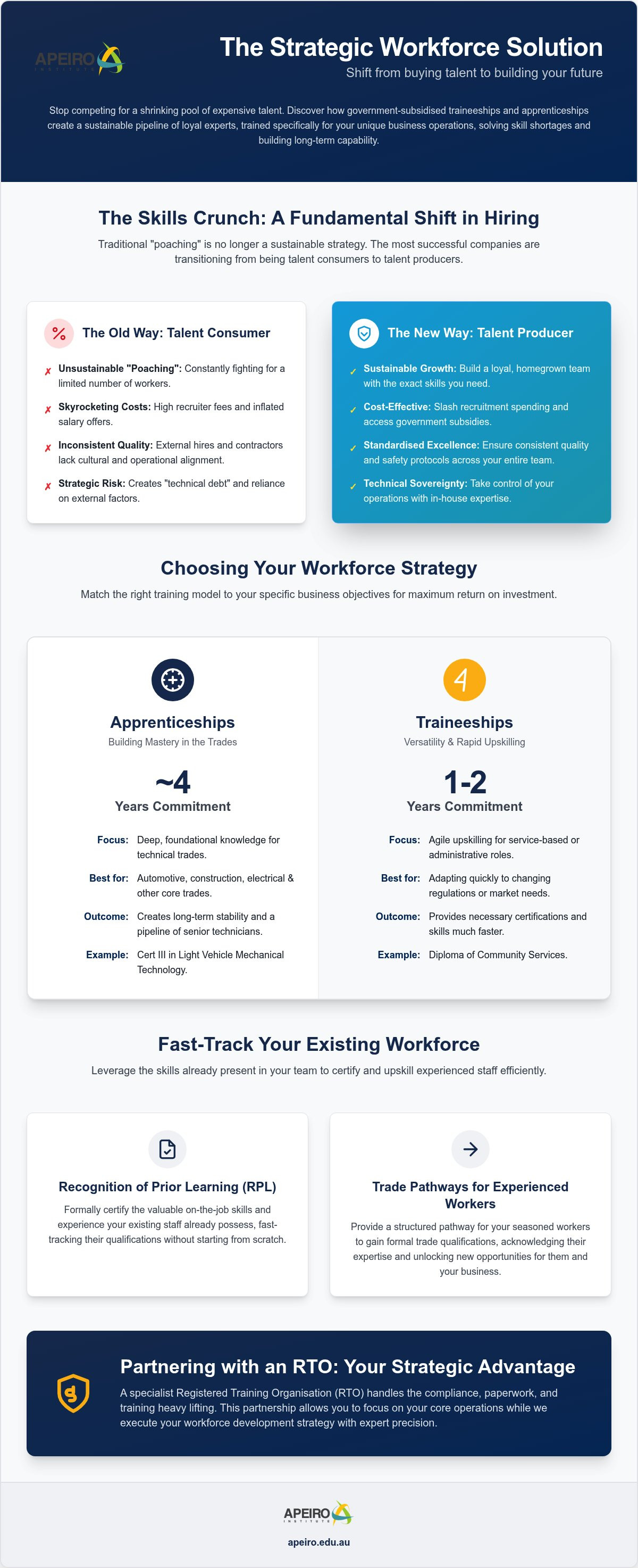
The Australian labour market is currently facing a significant shift. For years, many businesses relied on "poaching" qualified tradespeople from their competitors by offering slightly higher wages or better perks. This strategy is becoming increasingly unsustainable. As recruitment costs skyrocket and talent pools shrink, this approach simply shuffles a limited number of workers around without actually solving the underlying shortage. When you only hire from the outside, you're acting as a talent consumer. In 2026, the most successful companies are those that have transitioned into being talent producers.
Relying on external contractors for core technical competencies is a major strategic risk. These contractors often lack a deep understanding of your specific business culture or operational nuances. Over time, an unskilled or partially skilled workforce creates "technical debt". This debt manifests as slower project delivery times, higher error rates, and a general loss of competitive edge. This is precisely Why Traineeships & Apprenticeships are a Strategic Workforce Solution. They allow you to stop reacting to the market and start shaping your own future by developing the exact skills your business needs to thrive.
The True Cost of a Vacant Technical Role
A vacant seat in a trade-heavy sector costs far more than just the recruiter's fee. Lost productivity and significant project delays can quickly erode your profit margins. When a key role remains unfilled, the pressure falls on your remaining team members. This often leads to staff burnout, which triggers further turnover and creates a cycle of instability. Perhaps most importantly, a lack of qualified, certified staff often prevents your business from tendering for larger, more lucrative contracts that require specific headcount certifications and proven technical capability.
Future-Proofing Through Technical Sovereignty
Technical sovereignty is the ability of your business to solve complex problems using in-house expertise. It is about taking back control of your operations. By integrating structured training, you ensure that every team member follows your specific quality control measures and standardised safety protocols. This isn't just about acquiring general skills. It's about aligning those skills with your unique equipment, software, and business values. Building this internal capability ensures that your quality remains consistent, regardless of external market fluctuations or contractor availability.
Defining the ROI: Apprenticeships vs. Traineeships
Choosing the right training model is a commercial decision that shapes your team's capability for years to come. While both paths offer immense value, they serve different operational needs. A traineeship is a structured workplace program for specific vocational skills. Understanding these functional nuances is Why Traineeships & Apprenticeships are a Strategic Workforce Solution, as it allows you to match training duration with your specific business objectives.
Apprenticeships: Building Mastery in the Trades
Apprenticeships are the gold standard for technical trades that require deep, foundational knowledge. These programs typically involve a four-year commitment to technical excellence. For an automotive business, enrolling a team member in a Certificate III in Light Vehicle Mechanical Technology creates long-term workshop stability. You aren't just teaching someone how to fix a car. You're standardising skills across your entire site. This long-term investment ensures that your senior technicians have a pipeline of qualified support, which reduces the pressure on your most experienced staff and prevents burnout.
Traineeships: Versatility and Rapid Upskilling
Traineeships offer a more agile approach to workforce development. With training cycles usually lasting between 12 and 24 months, they allow for much faster upskilling in service-based or administrative roles. This model is particularly effective for departments that need to adapt quickly to changing regulations or market demands. For instance, staff moving into leadership within the care sector can benefit from structured Diploma of Community Services pathways. These shorter programs provide the necessary certifications without the multi-year timeline of a traditional trade apprenticeship.
Deciding which model fits your goals depends on your department's specific needs. If you require technical experts for core operations, the apprenticeship model is your best bet. If you need to quickly certify staff in management or support roles, traineeships provide the flexibility you need. This tailored approach is Why Traineeships & Apprenticeships are a Strategic Workforce Solution for businesses that value long-term technical sovereignty. If you're ready to start building your internal talent pipeline, you might consider exploring trade pathways for your experienced workers to see how existing skills can be formally recognised.
Comparing Workforce Strategies: Internal Training vs. External Hiring
External hiring is often a gamble with high stakes. When you bring in an outsider, you're paying for their past experience, but there is no guarantee they will mesh with your team culture. Homegrown talent, conversely, is socialised into your business values from day one. This deep alignment is Why Traineeships & Apprenticeships are a Strategic Workforce Solution, as it builds a "Loyalty Dividend" that external recruitment simply cannot match. Employees who see a clear pathway for their career progression within your company are far more likely to stay, significantly reducing your churn rates and the constant need to search for new labour.
Some managers worry about the risk of training someone only for them to leave. However, the far greater risk is choosing not to train your staff and having them stay. An unskilled workforce is a liability that costs you in errors, slow production, and missed opportunities. Investing in your people isn't just a "nice to do" social goal; it's a defensive strategy against technical stagnation. By creating an environment where skills are constantly improving, you're building a team that is capable of evolving alongside your industry.
The Recruitment Fee Trap
Recruitment fees for qualified tradespeople can be staggering, often reaching a significant percentage of a candidate's annual salary. This is a one-off cost that provides zero ongoing value to your business operations. When you choose to train an apprentice or trainee, you trade those upfront headhunter fees for long-term productivity. With access to NSW Smart and Skilled funded training and various federal subsidies, the financial burden of training is often lower than a single recruiter's invoice. Instead of buying talent at a premium, you're building it at a discount while securing your future capability.
Standardisation and Safety
Safety culture is notoriously difficult to teach to an external hire who has spent years developing their own habits elsewhere. When you train an apprentice in-house, they learn your specific safety protocols and quality standards from the beginning. This consistency is a major strategic advantage. Every technician follows the exact same process, which directly reduces rework and warranty claims. By ensuring everyone is on the same page through structured vocational training, you create a safer, more predictable workshop environment. This reliability is another reason Why Traineeships & Apprenticeships are a Strategic Workforce Solution for businesses looking to scale without sacrificing quality. For those with experienced staff who lack formal papers, exploring trade pathways is an excellent way to standardise your existing team's qualifications.
The Fast-Track Strategy: RPL and Trade Pathways
Many employers assume an apprenticeship always takes four years from scratch. This simply isn't the case for staff who have already spent years on the tools. Recognition of Prior Learning (RPL) allows a business to formalise the skills of their most loyal staff by acknowledging their existing expertise. This efficiency is Why Traineeships & Apprenticeships are a Strategic Workforce Solution, as it bridges the gap between practical experience and the formal papers required for site compliance. When you understand Why Traineeships & Apprenticeships are a Strategic Workforce Solution, you stop seeing training as a delay and start seeing it as a business accelerant.
Certifying the Uncertified
You likely have "accidental experts" in your team. These are workers who know your specific equipment inside out but lack the certification to sign off on work or supervise others. Providing a pathway to a nationally recognised qualification Australia is a massive morale boost that increases retention. It turns a long-term employee into a certified asset without forcing them to sit through lessons on things they already know. This is where Trade Pathways for Experienced Workers (TPEW) becomes invaluable. It creates instant qualified supervisors by validating their daily competence, allowing you to scale your operations with confidence.
Accessing Funded Training and Subsidies
Managing the costs of this rapid certification is simpler than most businesses realise. Navigating Smart and Skilled funded courses NSW can significantly lower the financial barrier to upskilling your workforce. Additionally, federal incentives for priority trades often offset wage costs during the assessment period. A specialist RTO acts as your expert guide here. They handle the compliance and paperwork heavy lifting, ensuring your business meets all regulatory standards while you focus on hitting your production targets.
Fast-track your team's certification through TPEW
Partnering for Success: How an RTO Executes Your Strategy
Selecting the right Registered Training Organisation (RTO) is just as critical as selecting the right candidate. An RTO shouldn't just be a certificate factory; it needs to act as a strategic consultant for your workforce planning. This partnership is Why Traineeships & Apprenticeships are a Strategic Workforce Solution, because the quality of the training directly dictates the quality of your output. At Apeiro Institute, we focus on providing industry-current trainers and modern campus facilities to ensure that the theoretical knowledge matches the practical reality of your workshop floor. We take the time to understand your specific business goals before we start the enrolment process.
For businesses in the technology sector, integrating the UEE30920 Certificate III in Electronics and Communications into your modern workflows is a game-changer. It ensures your team is proficient with the latest diagnostic tools and communication protocols. We work closely with you to customise this training so it aligns with your specific operational schedule, reducing the time staff spend away from active projects while maximising their technical growth.
Customised Learning for Minimum Disruption
We understand that your business has deadlines to meet. That is why we find a balance between workplace-based assessment and campus-based blocks. This hybrid approach ensures your staff learn skills that are immediately relevant to your current projects. Our role as your RTO is to monitor progress and handle the administrative burden of completion. We act as an extension of your HR department. We ensure every apprentice or trainee stays on track without you having to micromanage the educational side of their development.
Beyond the Trade: Leadership and Management
Training shouldn't stop at technical proficiency. A truly strategic workforce solution looks toward the next decade of your business. By building a clear pathway from a Cert III to a Diploma of Business Australia, you can identify future workshop managers and site leads early in their careers. This creates a self-sustaining leadership pipeline. You won't need to look outside for your next supervisor because you've already spent years grooming them for the role. This internal progression is Why Traineeships & Apprenticeships are a Strategic Workforce Solution for long-term business resilience and sustainable growth.
Building Your Future Workforce Today
Transitioning from a talent consumer to a talent producer is the most effective way to protect your business against the rising costs of recruitment and high staff turnover. By formalising the skills of your existing team through Recognition of Prior Learning and investing in structured trade pathways, you create a loyal, high-performing workforce. This shift in perspective explains Why Traineeships & Apprenticeships are a Strategic Workforce Solution for Australian businesses aiming to secure long-term technical sovereignty and consistent work quality.
Apeiro Institute (RTO 45394) handles the compliance heavy lifting for you. As specialists in Trade Pathways and RPL, we deliver industry-aligned training across Electronics, Automotive, and Construction that fits your operational schedule. You don't have to navigate the complexities of funded training or insurance requirements alone. We act as your expert guide, helping you access government subsidies and build a self-sustaining leadership pipeline. It's time to stop reacting to the skills shortage and start leading your industry with a team you've built from the ground up.
Book a Workforce Strategy Consultation with Apeiro Institute
Your team's growth is your company's greatest asset. Let's start building that future together.
Frequently Asked Questions
What is the difference between an apprentice and a trainee in Australia?
Apprenticeships focus on traditional skilled trades like automotive or electronics and typically last three to four years. Traineeships are generally shorter, lasting one to two years, and cover service-based or administrative roles. Both models provide structured, nationally recognised training. This distinction is a key part of Why Traineeships & Apprenticeships are a Strategic Workforce Solution, as it allows you to choose the commitment level that matches your specific department's technical requirements.
How much does it cost a business to take on an apprentice in 2026?
The total cost depends on several factors, including the specific trade, the award rate, and the age of the worker. While we don't quote specific dollar amounts, many businesses find that federal wage subsidies and state-based funding significantly offset these expenses. You should also consider the return on investment through increased productivity and reduced recruitment fees. It's best to check the current 2026 federal incentive rates for trade apprenticeships to see what applies to your business.
Can I put an existing long-term employee into an apprenticeship?
You can certainly enrol existing staff members into an apprenticeship or traineeship. This is an excellent way to reward loyalty while formalising the skills they've already gained on the job. Existing worker pathways often allow for a more streamlined training experience, especially when combined with Recognition of Prior Learning. It turns your most trusted employees into certified experts, ensuring your business maintains high technical standards without always needing to hire from the outside.
What government incentives are available for Australian trade employers?
The Australian Government provides various incentives to encourage businesses to hire and train staff. These often include wage subsidies for priority trades and hiring incentives for taking on new apprentices. State-specific programs also exist to help cover the cost of the training itself. These financial supports are a major reason Why Traineeships & Apprenticeships are a Strategic Workforce Solution, as they lower the barrier to entry for building a high-quality internal talent pipeline.
How does Recognition of Prior Learning (RPL) work for my current staff?
Recognition of Prior Learning (RPL) is a process that assesses the existing skills and knowledge your staff have acquired through years of work experience. Instead of forcing them to study things they already know, an RTO like Apeiro Institute evaluates their competence against national standards. If they meet the requirements, they can be granted a formal qualification much faster. This fast-track method is perfect for certifying your most experienced but uncredentialed team members.
Is there funding available for apprenticeships in NSW?
Yes, funding is available through the Smart and Skilled program. This initiative provides government-subsidised training for eligible apprentices and trainees in several vocational sectors. It's designed to help businesses upskill their workforce with minimal financial disruption. By partnering with an RTO that is an approved Smart and Skilled provider, you can access fee-free or low-cost training pathways that align with your industry's specific needs and compliance requirements.
What happens if my apprentice fails their vocational training?
If an apprentice struggles with a particular unit, the RTO provides additional support and opportunities for reassessment. We don't just leave them to fail; we act as mentors to help them achieve their goals. Employers are kept informed of progress, allowing for a collaborative approach to solving any learning gaps. Most vocational training is competency-based, meaning the focus is on proving the student can do the task safely and correctly rather than just passing a single test.
How do I choose the right RTO for my business's specific industry?
You should look for an RTO that employs industry-current trainers and maintains modern campus facilities. It's important that the training provider understands your specific sector, whether it's automotive, electronics, or construction. The right partner will customise the learning schedule to suit your operations and handle the compliance heavy lifting for you. A good RTO acts as a bridge between your current workforce capability and your future business objectives, ensuring practical, high-quality outcomes.

Disclaimer
The information provided on this blog is for general informational and educational purposes only. While every effort is made to ensure the accuracy and reliability of the content, the author makes no representations or warranties of any kind, express or implied, about the completeness, accuracy, suitability, or availability of the information contained on this blog.
The views and opinions expressed in blog posts are those of the individual author and do not necessarily reflect the official policy or position of any organization, company, or employer.
This blog may contain links to external websites or third-party content. These links are provided for convenience only, and the author has no control over and assumes no responsibility for the content, privacy policies, or practices of any third-party sites.
Nothing on this blog constitutes professional advice (legal, financial, medical, or otherwise). Readers are encouraged to seek appropriate professional guidance before making any decisions based on the information provided here.
By using this blog, you acknowledge that any reliance on the information is at your own risk.


