

Starting a new career in 2026 doesn't mean you have to start from the bottom of the ladder or settle for a junior's paycheck. It's a common worry for many Australians who feel stuck in a dead-end job but fear they'll lose years of progress if they switch paths. You've worked hard to build your professional reputation, and the thought of being treated like a fresh school leaver is understandably daunting. Finding the right vocational course for career change Australia wide is about more than just picking a new title; it's about finding a pathway that respects the experience you already bring to the table.
We've designed this guide to help you pivot into a high-demand industry quickly and confidently. You'll learn how to secure a nationally recognised qualification that reflects your true skill level, helping you bypass entry-level hurdles and boost your earning potential. We'll break down the Australian VET system, explain how Recognition of Prior Learning can fast-track your studies, and highlight the sectors with the strongest job growth for the year ahead. Your next chapter starts with a clear plan and the right support to make it happen.
Key Takeaways
- Understand why practical, industry-aligned training often offers a faster, more effective route into a new industry than a traditional university degree.
- Identify the best vocational course for career change Australia has to offer by targeting high-demand sectors like community services, trades, and leadership.
- See how Recognition of Prior Learning (RPL) can fast-track your journey by acknowledging the professional skills you've already mastered.
- Learn the essential checks for choosing a Registered Training Organisation (RTO) to guarantee your qualification is legitimate and respected by Australian employers.
- Follow a simple step-by-step guide to transition from your current role into a rewarding new career without having to start from scratch.
Why a Vocational Course for Career Change in Australia is the Smart Move
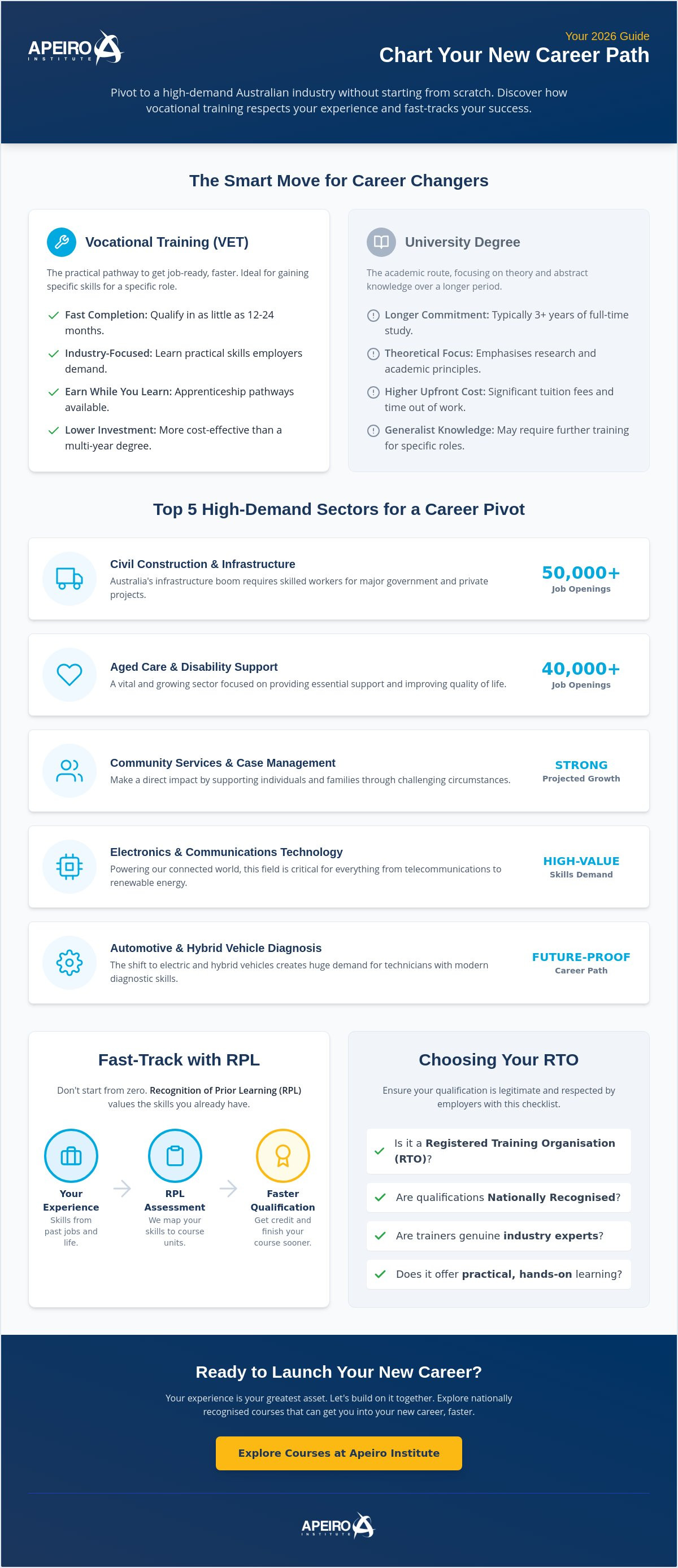
Vocational Education and Training, or VET, is the engine room of the Australian workforce. Unlike academic pathways that prioritise abstract theory, VET is built on practical, industry-led instruction. When you look for a vocational course for career change Australia offers a robust network of providers, including Technical and Further Education (TAFE) institutes and private Registered Training Organisations (RTOs). These institutions work closely with industry leaders to ensure what you learn in the classroom is exactly what's needed on the job. It's about gaining specific skills for a specific role.
The 2026 labour market is calling out for skilled professionals. Recent data shows over 50,000 job openings in construction and more than 40,000 openings in aged care and disability support across the country. This creates a massive opportunity for anyone looking to switch lanes. Choosing a vocational course for career change Australia wide allows you to enter these high-demand sectors in as little as 12 to 24 months. You get to market faster, often with a qualification that employers value more than a generalist degree. It is a strategic move for anyone who wants to avoid the long, expensive slog of a three-year university program.
The Economic Case for Vocational Upskilling
Vocational training often provides a better return on investment for career changers. You aren't just saving on tuition fees; you're also reducing the time you spend out of the full-time workforce. Many trade pathways even allow for "earning while learning" through apprenticeships or traineeships, which keeps your bank balance healthy while you study. The Australian Qualifications Framework (AQF) is the national policy that ensures your certificate or diploma is a recognised standard, making your new skills portable across every state and territory.
VET vs. Higher Education: Which is Right for You?
Choosing between a university and a vocational provider often comes down to how you prefer to learn. University degrees usually require a long-term commitment to theoretical study. In contrast, RTO training focuses on hands-on competency. This means you spend less time in lecture halls and more time in simulated or real-world work environments. There's a persistent myth that VET is just for school-leavers, but the reality is quite different. Most modern vocational students are mature-age workers looking to upskill or pivot. Whether you're interested in a Certificate III in Light Vehicle Mechanical Technology or a Certificate III in Individual Support, the focus remains on getting you job-ready without the fluff. You'll graduate with the confidence to start your new role on day one.
Top 5 Sectors for a Successful Career Pivot via Vocational Training
To successfully switch careers, you need to follow the demand. In 2026, Australia's economy is heavily focused on infrastructure, renewable energy, and the care economy. Finding a vocational course for career change Australia wide is the first step toward long-term security. It's vital to choose a nationally recognised qualification in Australia because it guarantees your new skills meet federal standards. By gaining job-ready skills through VET, you can bridge the gap between your previous experience and a new technical role without needing to restart your professional life from zero. The most promising growth industries for 2026 include:
- Civil Construction and Infrastructure
- Electronics and Communications Technology
- Automotive and Hybrid Vehicle Diagnosis
- Aged Care and Disability Support
- Community Services and Case Management
Electronics, Communications, and Civil Construction
Australia is in the middle of a massive infrastructure boom. Major government projects valued at $10 million or more now require at least 10% of labour hours to be worked by apprentices or trainees. This makes the UEE30920 Certificate III in Electronics and Communications a high-value asset for anyone entering the tech space. If you're coming from a general labour background, moving into a specialised field like the RII50520 Diploma of Civil Construction Design allows you to apply your on-site knowledge to more technical, higher-paying design and planning roles. These positions are critical for closing the technical skills gap currently affecting large-scale Australian infrastructure projects.
Automotive and Mechanical Technology
The automotive industry is undergoing its biggest shift in a century. As hybrid and electric vehicles become the norm, the demand for technicians who can handle complex diagnostic software is soaring. Completing an AUR30620 Certificate III in Light Vehicle Mechanical Technology is no longer just about turning wrenches; it's about becoming a high-tech specialist. Qualified mechanics enjoy incredible job security across Australia. People will always need their vehicles maintained, and those with the skills to diagnose modern systems are highly sought after by employers.
Community Services and Aged Care
If you're looking for a career with a deep sense of purpose, the care sector has over 40,000 job openings estimated for 2026. A CHC33021 Certificate III in Individual Support is the perfect entry point. From here, you can climb the ladder toward leadership roles. This sector values the empathy and communication skills you've developed in previous jobs, making the transition feel natural. You might even consider specialising further by pursuing a diploma of community services to move into case management or advocacy. The high vacancy rates mean you'll likely have your pick of rewarding roles once you're qualified.
Fast-Tracking Your Change: Recognition of Prior Learning (RPL)
One of the biggest hurdles when looking for a vocational course for career change Australia wide is the feeling that you're throwing away years of hard-earned experience. It's a common misconception that you have to sit through introductory classes for things you already know how to do. Recognition of Prior Learning (RPL) changes that. It's a formal process that evaluates the skills you've gained through previous work, volunteering, or informal training and matches them against the requirements of a national qualification. This means your past life as a manager, a technician, or a business owner actually counts toward your new certificate or diploma.
This pathway is particularly valuable for seasoned professionals or those who have worked in trades without formal papers. For example, the Trade Pathways for Experienced Workers (TPEW) program is specifically designed to help people move into licensed trades by validating their existing expertise. It's not a shortcut or an easy out; it's a rigorous assessment of your actual competence. By choosing the right vocational course for career change Australia offers, you can bypass redundant training and focus only on the new skills you need to master.
The RPL Assessment Process: What to Expect
When you apply for RPL, you're essentially building a case to prove you're already competent in specific units of study. You'll work with a qualified RTO assessor who reviews your evidence to ensure it meets current industry standards. This evidence usually includes:
- Detailed work samples, project logs, and job descriptions.
- Photos or videos of you performing specific technical tasks.
- Statutory declarations and references from former employers or clients.
- Technical interviews or practical demonstrations of your skills.
Successful RPL can drastically reduce the time you spend in a classroom. Instead of a full two-year course, you might only need to complete a handful of units, potentially saving you months of study time and allowing you to start your new career much sooner.
Converting Overseas Experience to Australian Standards
For international students or migrants, RPL is a vital tool for entering the local workforce. Your experience from home is valuable, but it needs to align with the Australian Qualifications Framework (AQF). The Australian Government's Your Career website highlights how VET pathways respect prior learning while ensuring you meet local safety and technical regulations. Often, an assessment identifies that you possess most of the required skills but need to learn specific Australian codes or legislation. Gap training is required when an assessment shows you have the core skills but need to master specific Australian legislative or safety requirements to meet national standards.
How to Choose the Right Registered Training Organisation (RTO)
Selecting the right provider is just as vital as choosing the course itself. In Australia, the VET sector is overseen by the Australian Skills Quality Authority (ASQA). This regulator ensures that every Registered Training Organisation (RTO) maintains high standards of delivery and assessment. When you're searching for a vocational course for career change Australia wide, your first move should be to check the provider's RTO code on the national database. Only registered providers have the legal authority to issue qualifications that employers trust. This registration is your protection, ensuring the time and money you invest result in a legitimate, industry-standard credential.
Understanding CRICOS and National Recognition
If you're an international student, your choice of provider is governed by even stricter rules. A CRICOS registered training organisation is the only type of institution permitted to enrol student visa holders. Beyond visa compliance, you should always look for the "Nationally Recognised Training" (NRT) logo. This symbol confirms that the training package meets the requirements of the Australian Qualifications Framework (AQF). Because these standards are national, your qualification is portable. If you study in one state but land a job in another, your credentials move with you without any extra red tape.
Evaluating Course Flexibility for Working Adults
Adults switching careers don't usually have the luxury of studying full-time without an income. That's why flexibility is a primary consideration. When selecting a vocational course for career change Australia based students often prioritise blended learning, which merges convenient online theory with essential face-to-face practicals. This allows you to manage your own schedule while still getting time on the tools or in the lab. It's also worth visiting the campus to see if the facilities are modern and the equipment is industry-standard. A supportive environment, featuring career guidance and a diverse student community, can make the transition feel much smoother. You aren't just a number in a lecture hall; you're part of a community working toward a shared goal.
Ready to begin your transition? You can view our full list of accredited vocational programs to see which pathway aligns with your career ambitions.
Your Next Steps: Launching Your New Career in 2026
Making the decision to switch industries is a significant milestone. It marks the moment you stop settling for a job that no longer serves you and start building a future with purpose. The most effective way to begin this journey is with a clear, objective look at your current capabilities. An initial skills assessment is the perfect starting point. This process helps you identify which of your existing talents translate directly to your new field and where you need to focus your training efforts. It removes the guesswork, ensuring you choose the right vocational course for career change Australia wide based on your unique professional profile.
Once you have a general direction, it's time to get a feel for the learning environment. We encourage you to organise a campus visit or book a one-on-one session with an enrolment officer. These conversations are invaluable for clarifying course structures, discussing timetables, and understanding the practical requirements of your chosen qualification. Beyond the classroom, remember that your new career relies heavily on the connections you make. Building a professional network early on by engaging with trainers and fellow students can open doors to job opportunities that never reach public job boards. You aren't just gaining a certificate; you're joining a professional community.
Preparing for Your Enrolment
To make your transition as smooth as possible, gather your documentation early. You'll generally need proof of identity, transcripts from any previous education, and a detailed work history if you're applying for Recognition of Prior Learning. If you're a resident in New South Wales, it's worth exploring potential funding options like the Smart and Skilled programme, which can significantly reduce your out-of-pocket expenses for eligible courses. For those joining us from abroad, there are distinct benefits of vocational training for international students, including gaining local work experience that is highly regarded in the Australian market. Having your paperwork ready allows you to focus on the exciting part: learning your new craft.
The Apeiro Advantage: Why Study With Us?
At Apeiro Institute, we act as your mentor and partner throughout this professional evolution. Our expert trainers are industry veterans who bring real-world insights into the classroom, ensuring our curriculum remains focused on what employers actually need in 2026. With modern campuses in Perth and Sydney, we provide the facilities and support services required to help you succeed, regardless of your background. We believe that education should be accessible, practical, and deeply rewarding. Your ambition deserves a training provider that is as invested in your success as you are. Explore our range of vocational courses and start your career change today!
Take Charge of Your Professional Future
Transitioning into a new industry in 2026 is about working smarter, not harder. By selecting a high-quality vocational course for career change Australia wide, you're choosing a path that respects your professional history while giving you the technical edge needed for today's market. We've seen how Recognition of Prior Learning (RPL) can drastically reduce your study time, and how focusing on growth sectors like civil construction or individual support provides genuine job security.
Apeiro Institute (RTO 45394 / CRICOS 03703M) is here to act as your mentor through every step of this journey. As specialists in Trade Pathways for Experienced Workers, we provide industry-aligned training across six major sectors to ensure you're job-ready from day one. You already have the drive and the professional background; all you need now is the right qualification to unlock your next chapter. Don't let the fear of starting over hold you back from a more rewarding life.
Begin your career pivot with Apeiro Institute’s nationally recognised courses and start building the future you've always wanted. Your new path is ready when you are.
Frequently Asked Questions
How long does a vocational course for career change in Australia take?
A vocational course for career change Australia wide typically takes between 12 and 24 months to complete. Certificate III level qualifications are often on the shorter end of this scale, while Advanced Diplomas require a longer commitment. If you have relevant work history, the Recognition of Prior Learning (RPL) process can shorten this duration by months or even years.
Can I get a trade qualification based on my work experience?
Yes, you can gain a formal trade qualification through the Recognition of Prior Learning (RPL) process if you have substantial industry experience. This is ideal for workers who have the skills but lack the paperwork. Programs like Trade Pathways for Experienced Workers (TPEW) specifically help you map your existing competence against national standards to get qualified faster.
Are vocational courses in Australia recognised overseas?
Australian vocational qualifications are highly respected globally because they are part of the Australian Qualifications Framework (AQF). Since the sector is strictly regulated by federal authorities, international employers recognise the high standard of training provided. This makes your skills portable if you decide to work in other countries in the future.
What is the difference between a Certificate III and a Diploma?
A Certificate III focuses on the practical, hands-on skills needed to perform a specific trade or role, such as a light vehicle mechanic. A Diploma or Advanced Diploma moves into higher-level technical knowledge, management, and design. While a Cert III gets you on the tools, a Diploma might qualify you for case management or civil construction design roles.
Is it too late to start a vocational course at 40?
It is never too late to pivot; many vocational students are over the age of 40. Employers actually value the maturity, soft skills, and reliability that older workers bring from their previous careers. Vocational training is designed to build on your life experience rather than making you feel like you are starting from zero.
What are the most in-demand vocational courses in Australia for 2026?
For 2026, the strongest demand is in sectors facing structural shortages, particularly healthcare, construction, and emerging technology. Finding a vocational course for career change Australia based in individual support, electronics, or automotive diagnosis offers excellent job prospects. These fields provide stable, long-term career pathways for those looking to upskill effectively.
How much does a vocational course cost for an international student?
Tuition fees for international students vary significantly depending on the specific course and the duration of study. These fees generally cover your instruction and access to campus facilities, but you should also budget for Overseas Student Health Cover (OSHC) and materials. It is best to check with an enrolment officer for a detailed breakdown of what is included in your chosen program.
Can I work while studying a vocational course in Australia?
You can certainly work while you study, as most vocational programs are designed with flexibility in mind. Local students often balance work with evening or weekend classes. International students on a student visa are also permitted to work, though there are government-mandated limits on the number of hours you can work per fortnight during the term.

Disclaimer
The information provided on this blog is for general informational and educational purposes only. While every effort is made to ensure the accuracy and reliability of the content, the author makes no representations or warranties of any kind, express or implied, about the completeness, accuracy, suitability, or availability of the information contained on this blog.
The views and opinions expressed in blog posts are those of the individual author and do not necessarily reflect the official policy or position of any organization, company, or employer.
This blog may contain links to external websites or third-party content. These links are provided for convenience only, and the author has no control over and assumes no responsibility for the content, privacy policies, or practices of any third-party sites.
Nothing on this blog constitutes professional advice (legal, financial, medical, or otherwise). Readers are encouraged to seek appropriate professional guidance before making any decisions based on the information provided here.
By using this blog, you acknowledge that any reliance on the information is at your own risk.


