

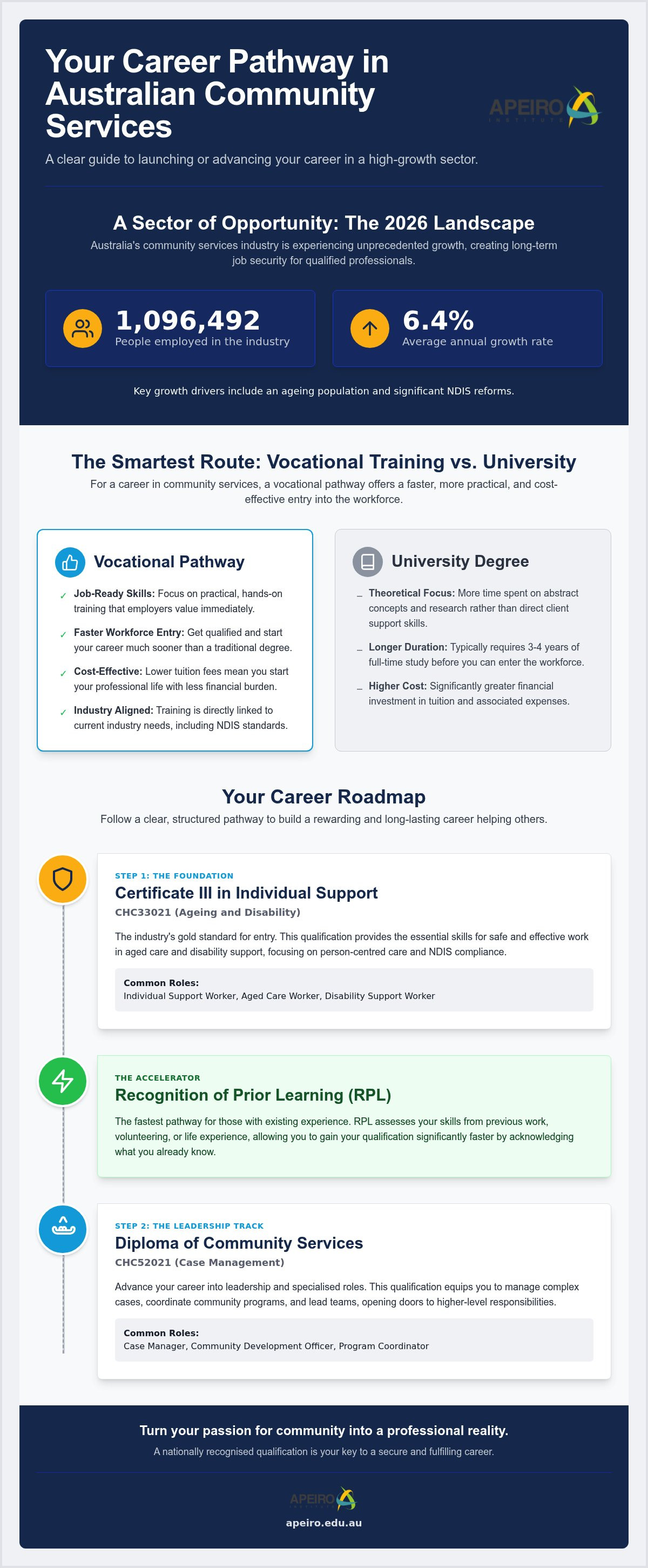
Did you know that as of 2026, more than 1,096,492 people are now employed in Australia's community services industry? With the sector growing at an average of 6.4% per year, there has never been a more secure time to transition into a career focused on helping others. However, finding the best pathway into community services can feel daunting when you are faced with a sea of different qualification levels and the fear of committing to long degrees without a clear outcome.
You might be wondering if your years of volunteering or lived experience actually count for anything, or if you are stuck starting from scratch. It is a common concern; many of our students feel exactly the same way before they discover how flexible vocational training can be. We believe your existing skills are valuable and should be the foundation of your professional journey.
This guide provides a clear, step-by-step roadmap to help you launch or advance your career efficiently. You will discover how to use Recognition of Prior Learning to get qualified faster and identify which specific roles offer the best long-term prospects in the current NDIS and aged care landscape. Let's explore how to turn your passion for community into a professional reality.
Key Takeaways
- Understand why the Australian community services sector is seeing unprecedented growth in 2026 and what this means for your long-term job security.
- Identify why starting with a Certificate III is often the best pathway into community services for those looking to enter the workforce quickly.
- Learn how to advance into leadership and case management roles by stepping up to a Diploma-level qualification.
- Discover how Recognition of Prior Learning (RPL) can fast-track your studies by acknowledging the skills you have already gained through life and work.
- Explore how choosing a nationally recognised RTO ensures your training meets industry standards and prepares you for immediate employment.
Understanding the Community Services Landscape in Australia
Community services act as the backbone of the Australian social support system, providing essential care to our most vulnerable citizens. It's a sector built on empathy and practical action, ensuring that every member of society has access to the support they need. As of 2026, this industry employs 1,096,492 people, reflecting its massive scale and national importance. Major non-government organisations like Mission Australia demonstrate how widespread these services are across the country. The community services pathway is a vocational journey through the VET sector that focuses on building real-world skills for immediate impact.
We are seeing unprecedented growth in 2026. This is largely driven by an ageing population and significant NDIS reforms introduced in the 2026-27 budget. These changes include clearer eligibility requirements and increased oversight, creating a continuous need for highly skilled, qualified workers. Finding the best pathway into community services means aligning your training with these high-demand areas to ensure long-term job security. It's about being in the right place with the right skills when the community needs you most.
Why a Vocational Pathway Beats a University Degree
Choosing a vocational route offers several advantages over a traditional university degree. Vocational training focuses on practical, hands-on skills that employers want right now. You won't spend years stuck in lecture halls studying abstract theories; instead, you'll learn how to actually support clients in real-world settings. This leads to a much faster entry into the workforce. It's a cost-effective route that prioritises job-ready outcomes, helping you start your career without a massive debt. For many, this is the best pathway into community services because it bridges the gap between passion and a paid professional role quickly.
The Diverse Roles Available to Qualified Workers
The sector offers more than just one type of job. You could find yourself working in individual support, disability services, or aged care. Many workers start with a CHC33021 Certificate III in Individual Support (Ageing and Disability) to get their foot in the door. As you gain experience, you might move into community development or case management. Those looking for leadership often progress to a CHC52021 Diploma of Community Services. The options are vast, ranging from home-based support to coordinating large-scale community programmes. You have the flexibility to choose a role that matches your personal strengths and career goals.
The Entry-Level Pathway: Starting with a Certificate III
While some job boards might suggest you can jump into a role without formal training, the reality in 2026 is quite different. Employers now prioritise safety, compliance, and a deep understanding of the NDIS framework. This is why the CHC33021 Certificate III in Individual Support (Ageing and Disability) is considered the industry's gold standard for entry. It provides the essential foundation you need to work safely and effectively. For most beginners, this is the best pathway into community services because it balances thorough preparation with a relatively short study period.
This qualification doesn't just teach you how to help; it teaches you how to empower. You'll move beyond basic personal care to learn how to support people with disabilities in achieving their personal goals. It's about fostering independence and dignity. Because this course is so comprehensive, it often acts as a mandatory prerequisite for many higher-level roles. If you're ready to make a difference, you can explore our Certificate III course options to get started today.
What to Expect During Your Certificate III Study
Your journey involves a practical blend of classroom theory and hands-on placement. You'll spend time learning the core principles of person-centred care, which means putting the individual's needs and preferences at the heart of every decision. Ethical practices and legal requirements are a major focus, ensuring you understand your responsibilities as a professional. You'll also develop the communication skills needed to support diverse community groups, making sure every client feels heard and respected. It's a fast-paced environment designed to make you job-ready from day one.
Career Outcomes for Certificate III Graduates
Graduating opens the doors to a variety of rewarding roles across Australia. You could find yourself working as a Residential Care Worker, a Disability Service Officer, or an In-home Respite Worker. These positions are in high demand. The sector is expected to grow by 13.5% over the next few years, adding approximately 188,900 jobs. Even government initiatives like the Community and Social Services Graduate Program highlight the structured support available for those entering the field. Salary expectations for entry-level roles remain competitive as the workforce shortage continues to drive demand for qualified staff. Choosing this qualification is often the best pathway into community services for those who want a balance of career speed and professional depth.
The Leadership Pathway: Diploma of Community Services
While a Certificate III gets you on the floor, the CHC52021 Diploma of Community Services is what elevates you to the office where decisions are made. It's a significant step up in responsibility. You move from providing direct, frontline care to managing the systems and teams that make that care possible. This is the best pathway into community services for anyone who wants to take on leadership roles or specialise in case coordination. It's designed for those who want to do more than just follow a plan; they want to create one.
In 2026, the sector is more complex than ever. With total government expenditure for community services reaching approximately $103.9 billion in the 2024-25 period, the demand for skilled managers to oversee these funds and programmes is huge. Case management skills are particularly vital now as the NDIS shifts towards standardised assessments and tighter oversight. You aren't just a worker in this role. You're an advocate, a strategist, and a coordinator who ensures that vulnerable Australians don't fall through the cracks of a busy system.
Advanced Skills for Senior Roles
Senior roles require a completely different toolkit. You'll learn to manage complex caseloads where clients might have multiple, intersecting needs, such as mental health challenges combined with disability support. This often involves high-level advocacy work, representing your clients' interests to government bodies or healthcare providers. Leading a team of support workers requires a firm grasp of how to implement community programmes effectively. You also need to navigate the legal and ethical frameworks that govern the sector at a management level, ensuring your organisation remains compliant while delivering high-quality, person-centred care.
Bridging the Gap to a Professional Career
A Diploma is more than a qualification; it's a bridge. It provides a solid foundation if you eventually decide to pursue further tertiary study, often granting credit towards a university degree. However, it's also a powerful standalone tool for a career change. Graduates often find rewarding work in crisis intervention, community mental health, and social housing. For a deeper look at what this journey looks like, check out our Diploma of Community Services Australia: The 2026 Career Guide.
If you're looking for longevity and professional growth, this is the best pathway into community services. It transforms your passion for helping people into a career where you can shape the future of community support in Australia. It's a practical, high-impact choice for those ready to lead.
Recognition of Prior Learning (RPL): The Fastest Pathway
Many Australians have already spent years providing unofficial support to family, friends, or community groups. If you've been working in these roles, you likely possess many of the skills required for a formal qualification. Recognition of Prior Learning (RPL) allows you to turn that experience into a nationally recognised certificate or diploma without starting from scratch. For those with a background in care, this is often the best pathway into community services because it acknowledges that valuable learning happens outside the classroom.
The Trade Pathways for Experienced Workers (TPEW) programme is specifically designed to support this transition. By proving your existing competencies, you can significantly reduce your study time and avoid the need to relearn things you already do every day. This approach is not just about speed; it's about respecting the expertise you've already built. It makes the journey towards your career goals feel like a natural progression rather than a repetitive hurdle. It's a practical solution for busy people who want to advance their careers quickly.
The RPL Assessment Process Simplified
Unlike traditional education that relies on high-pressure exams, RPL uses a competency-based assessment. You simply need to provide evidence that you can perform the required tasks to industry standards. This might include your current resume, references from previous supervisors, and samples of work or volunteer reports. At Apeiro Institute, we act as your mentor throughout this journey. We help you identify which parts of your life and work experience align with specific units of competency, ensuring your application is as strong as possible. It's a supportive, person-to-person process that takes the stress out of getting qualified.
Who Should Consider the TPEW Pathway?
This pathway is ideal for experienced workers from overseas who need Australian certification to continue their professional journeys here. It's also a perfect fit for long-term volunteers who have dedicated years to the community sector but lack the paperwork to back it up. If you've been working in a related field and want to formalise your status, this is the best pathway into community services for you. To understand how this works on a national level, you can read our Trade Pathways for Experienced Workers Australia: The 2026 Guide. We're here to help you bridge the gap between your current skills and your future career.
Check your eligibility for RPL today
Designing Your Future Career with Apeiro Institute
Choosing the right training provider is just as important as choosing the right course. At Apeiro Institute, we are committed to providing industry-focused, practical training outcomes that prepare you for the real challenges of the 2026 workforce. As a nationally recognised RTO and CRICOS provider, we ensure that our qualifications meet the highest Australian standards. This gives you the confidence that your hard work will be respected by employers across the country. We believe that the best pathway into community services is one where you feel supported, heard, and professionally prepared from your very first day of study.
Our learning environment is uniquely enriched by a diverse community representing over 38 nationalities. This global perspective is invaluable in a sector that values cultural sensitivity and inclusive care. You'll learn alongside people from all walks of life, sharing experiences that broaden your understanding of the diverse groups you'll eventually support. We don't just teach you the technical skills; we help you develop the empathy and global awareness needed to thrive in Australia's multicultural community landscape. It's about being part of a supportive network that values your personal growth as much as your professional success.
Support for International and Local Students
Navigating the Australian VET system can be complex, especially for international learners. We provide tailored guidance to help you understand your study requirements and career options clearly. Whether you are a local student looking for a career change or an international student building a life in Australia, our focus remains on building your professional networks while you study. We connect you with industry practices and ethical frameworks that are current for 2026, ensuring your training is relevant to the latest NDIS and aged care reforms. Our nationwide focus means you receive consistent, high-quality education that prepares you for roles anywhere in Australia.
Take the First Step Today
Your journey begins with a simple decision. If you're unsure where to start, we offer a free assessment of your current skills to see if you qualify for Recognition of Prior Learning. This can help you decide between a CHC33021 Certificate III in Individual Support for entry-level roles or a CHC52021 Diploma of Community Services for leadership goals. Once you've identified your target, our enrolment checklists make the process straightforward and stress-free. We invite you to enquire today about our 2026 intake and discover why so many students consider us the best pathway into community services. Your future in helping others is waiting, and we're here to help you design it.
Your Future in Community Services Starts Today
The demand for compassionate, skilled workers across Australia is at an all-time high. Whether you are entering the workforce through a Certificate III or stepping into leadership with a Diploma, choosing a vocational route is the best pathway into community services for long-term career success. By focusing on practical, industry-aligned outcomes and leveraging Recognition of Prior Learning, you can transition into this rewarding sector much faster than you might think.
Our commitment to your growth goes beyond the classroom. Apeiro Institute provides Nationally Recognised Training (RTO 45394) and is a registered CRICOS provider, supporting both local and international students in achieving their professional goals. We act as your expert mentor, helping you turn your passion for helping others into a professional reality with a real-world impact that lasts.
You have the potential to make a genuine difference in people's lives every single day. We look forward to helping you take that first step toward a fulfilling and secure career in the heart of your community.
Frequently Asked Questions
What is the most in-demand job in community services for 2026?
Aged and disability support workers are currently the most in-demand roles within the Australian community services sector. This demand is driven by an ageing population and the ongoing expansion of the NDIS. By the end of 2026, the industry expects to add approximately 188,900 new jobs for community and personal service workers. These roles provide essential frontline care and represent a secure entry point for those seeking long-term employment stability.
Can I work in community services without a qualification in Australia?
While it was once possible to enter the field without formal training, most employers now require at least a Certificate III to ensure safety and compliance. Working without a qualification limits your career progression and may exclude you from high-quality roles in government-funded programmes. Obtaining a nationally recognised qualification is widely considered the best pathway into community services because it guarantees you have the ethical and practical skills required by current industry standards.
How long does it take to complete a Diploma of Community Services?
A Diploma of Community Services typically takes between 12 and 24 months to complete, depending on whether you study full-time or part-time. However, your journey can be significantly faster if you have existing industry experience. Through Recognition of Prior Learning (RPL), you can prove your current competencies and skip units you already know. This personalised approach respects your time and helps you transition into management or case coordination roles much sooner.
Is the Certificate III in Individual Support enough to get a job?
Yes, the CHC33021 Certificate III in Individual Support is the primary entry-level qualification for the industry. It provides the specific skills needed to work as a Residential Care Worker, Community Support Worker, or Disability Service Officer. This qualification is highly respected by Australian employers because it combines theoretical knowledge with mandatory practical placement. For many learners, starting here is the best pathway into community services to gain immediate employment while considering future leadership studies.
What is the difference between a Certificate IV and a Diploma in this sector?
A Certificate IV generally focuses on advanced frontline skills and specialised support, while a Diploma prepares you for management and case coordination. While a Certificate IV might help you specialise in areas like ageing support, a Diploma moves you into leadership. You'll learn to manage complex caseloads, lead diverse teams, and implement community programmes. Choosing between them depends on whether you prefer working directly with clients or managing the systems that support them.
Can international students study community services in Australia?
International students can certainly study community services in Australia through CRICOS-registered providers like Apeiro Institute. These programmes are designed to meet Australian industry standards while welcoming a global community of learners. As of July 2026, the government fee for a primary student visa application is $2,500. Studying here allows you to gain world-class vocational training while building a professional network within one of Australia's fastest-growing and most culturally diverse sectors.
How much does an RPL assessment cost for community services?
The cost of an RPL assessment depends on the specific qualification you are seeking and the amount of evidence you need to provide. Since this process proves your existing skills, it often works out to be a more affordable option than paying for a full course of study. By reducing your time in the classroom, you can also return to full-time work sooner. We recommend requesting a free initial skills assessment to determine your eligibility and get a clear quote.
What is the average salary for a community service worker in Australia?
Salaries for community service workers vary based on your qualification level and specific role. Entry-level support workers can expect competitive award rates that reflect the high demand for their skills. As you progress into case management or leadership roles with a Diploma, your earning potential increases significantly. Many industry professionals report that the current workforce shortage has led to better conditions and more opportunities for career progression across the entire sector.
Disclaimer
The information provided on this blog is for general informational and educational purposes only. While every effort is made to ensure the accuracy and reliability of the content, the author makes no representations or warranties of any kind, express or implied, about the completeness, accuracy, suitability, or availability of the information contained on this blog.
The views and opinions expressed in blog posts are those of the individual author and do not necessarily reflect the official policy or position of any organization, company, or employer.
This blog may contain links to external websites or third-party content. These links are provided for convenience only, and the author has no control over and assumes no responsibility for the content, privacy policies, or practices of any third-party sites.
Nothing on this blog constitutes professional advice (legal, financial, medical, or otherwise). Readers are encouraged to seek appropriate professional guidance before making any decisions based on the information provided here.
By using this blog, you acknowledge that any reliance on the information is at your own risk.


