

What if your first step into healthcare could combine workplace experience with a recognised qualification? Searching for “Healthcare traineeship Australia” can bring up both job advertisements and course pages, which can make it hard to see how the two fit together. You might be weighing up whether to study first, which care role could suit you and how training would fit around work and other commitments.
A traineeship combines employment with structured training towards a qualification. This guide explains how that differs from studying a course on its own, what to consider when exploring roles in aged care, disability support and related services, and how CHC33021 Certificate III in Individual Support (Ageing and Disability) may fit your goals. You’ll also find practical steps for comparing role requirements, training arrangements and funding options. Eligibility and funding can vary by programme and state or territory, so it’s important to check the details that apply to your circumstances.
Key Takeaways
- A Healthcare traineeship Australia pathway combines employment with structured vocational training, unlike a standalone course.
- Explore care roles such as aged care and disability support, then compare their duties with the focus of CHC33021 Certificate III in Individual Support (Ageing and Disability).
- Compare traineeships, courses and apprenticeships by the employment relationship, workplace learning and study commitments each involves.
- Prepare by choosing a role, understanding its requirements and gathering relevant evidence. Eligibility and registration processes vary across states and territories.
- Apeiro Institute offers CHC33021 as a formal training option for people exploring care-sector goals.
What Is a Healthcare Traineeship in Australia, and How Does It Work?
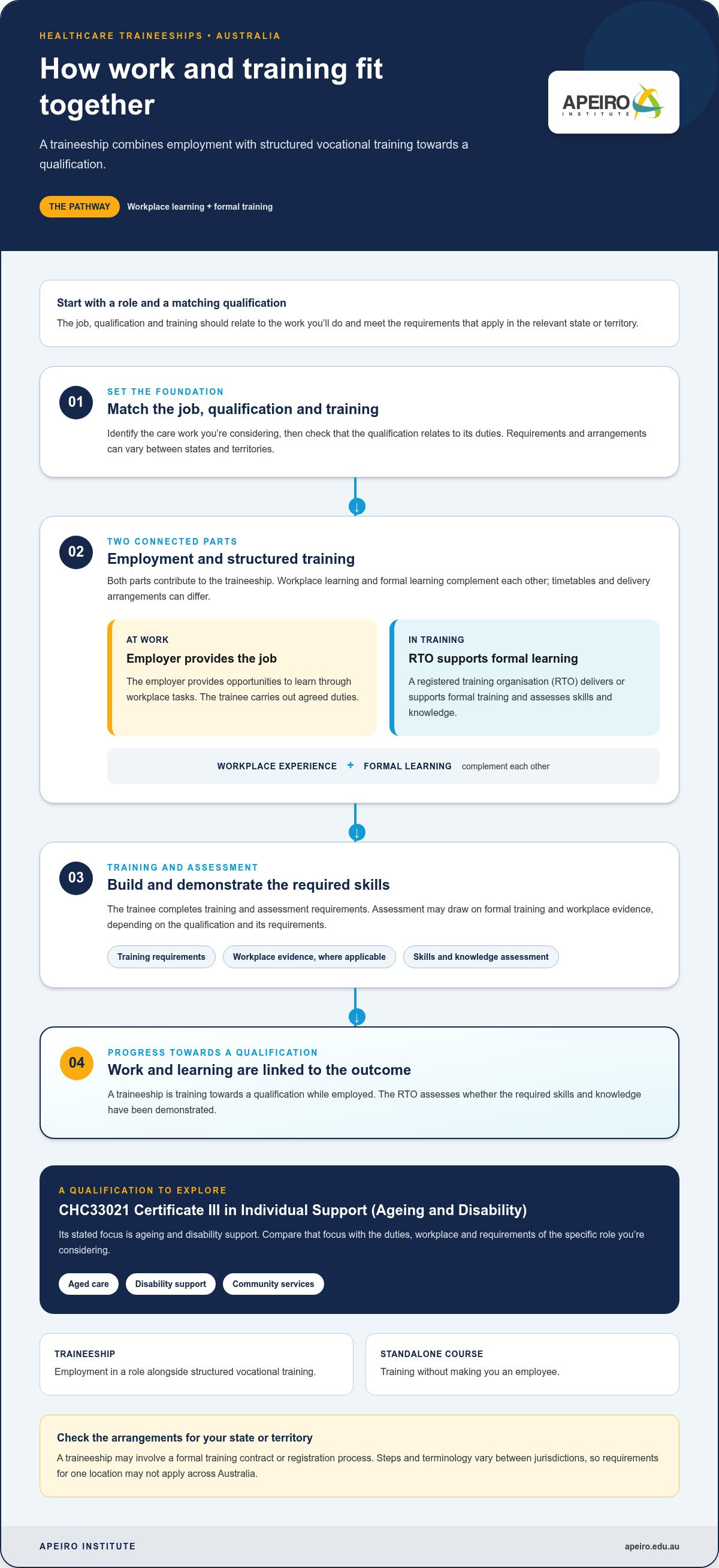
If you’re weighing up a first care job against formal study, a traineeship can bring the two together. In a healthcare traineeship, you’re employed in a role while undertaking structured vocational training towards a qualification. The role, qualification and training should match the work you’ll do, and the employment and training arrangements need to meet the requirements that apply in the relevant state or territory.
A healthcare traineeship combines paid employment with structured training; a standalone course provides training without making you an employee. That distinction helps you decide which pathway to pursue. A traineeship links your learning to a workplace, while a course may suit you if you want to gain a qualification before looking for a related role. Australian Vocational Education and Training is delivered through providers such as Registered Training Organisations. Read this overview of Vocational Education and Training (VET) for background.
How do work and formal training fit together?
The employer provides the job and opportunities to learn through workplace tasks. As the trainee, you carry out your agreed duties and complete the training and assessment requirements. A registered training organisation (RTO) delivers or supports the formal training and assesses whether you’ve demonstrated the required skills and knowledge.
Workplace experience and formal learning complement each other, but the timetable and delivery arrangements can differ. Assessment may draw on both training and evidence from the workplace, depending on the qualification and its requirements. A traineeship may also involve a formal training contract or registration process. The steps and terminology vary between jurisdictions, so use the requirements for the state or territory where the traineeship is arranged rather than assuming one process applies across Australia.
Which healthcare settings may offer traineeship pathways?
Possible care settings include aged care, disability support and community services. Duties vary between roles: one position may focus on day-to-day personal support, while another may involve helping people participate in their communities. Start by identifying the work you want to do, then check that the qualification relates to those duties rather than assuming one course suits every care position.
For example, CHC33021 Certificate III in Individual Support (Ageing and Disability) is a relevant qualification to explore for care-sector goals. Learn more about CHC33021 Certificate III in Individual Support. Not every healthcare support job is a registered traineeship, and some clinical professions have separate qualification or registration requirements. Compare the qualification with the specific role you’re considering.
Which Healthcare Roles and Qualifications Can a Traineeship Lead Towards?
Choose a healthcare training pathway by starting with the work you want to do, not just the title of a qualification. Support roles in aged care, disability services and community settings differ from clinical professions, and their entry requirements aren’t interchangeable. Role requirements depend on the duties involved and the standards that apply to the position.
A traineeship can combine employment with training towards a relevant vocational qualification, but the role and qualification need to align. The Australian Government’s Australian Apprenticeships and traineeships resource provides information about these work-and-training pathways. Use it as a starting point while you consider which work suits your interests and the responsibilities you’re ready to take on.
What does Certificate III in Individual Support relate to?
CHC33021 Certificate III in Individual Support (Ageing and Disability) focuses on ageing and disability support. It’s a qualification to explore if you’re interested in supporting people in care settings. The specific duties of a job depend on the position, workplace and applicable requirements, so the qualification alone doesn’t define every task you may perform.
As you compare your interests with potential support roles, use the qualification’s stated focus as one guide. Then consider the actual duties involved, the setting you’d prefer and whether the work feels like a good fit. This makes it easier to assess a course in relation to a real career direction, rather than choosing based on a qualification title alone.
How do healthcare traineeships differ from clinical training?
Support work and clinical professions follow different pathways. A qualification in individual support isn’t a nursing qualification and doesn’t automatically meet the requirements for another registered clinical occupation. Those professions have their own education and registration requirements.
Community services study is another related option, but it isn’t automatically part of an individual support traineeship. A Diploma of Community Services may suit different learning or career goals, with its own qualification requirements and potential roles. Treat it as a distinct study pathway, not a guaranteed next step after a traineeship.
To narrow your options, write down the duties you’re interested in, identify qualifications associated with that work, and compare the requirements with the role’s expectations. If you’re considering a Healthcare traineeship Australia pathway, matching the job, training and applicable standards is a practical way to choose a direction with confidence.
Healthcare Traineeship vs Course or Apprenticeship: Which Pathway Fits?
The right pathway depends on how you want work and learning to fit together. A traineeship links training to employment, while a standalone course lets you study without a trainee employment arrangement. Apprenticeships are commonly associated with trade occupations, but the labels and formal arrangements depend on the occupation and relevant state or territory requirements.
| Pathway | Employment relationship | Training and workplace experience | May suit you if… |
|---|---|---|---|
| Traineeship | You’re employed in a role connected to your training. | Structured vocational study is combined with learning on the job. | You want to develop skills alongside relevant workplace experience. |
| Standalone vocational course | Enrolling in study doesn’t itself make you an employee. | You complete structured training; workplace experience depends on the course and arrangements. | You’d prefer to study before pursuing a related job, or need a study pathway separate from employment. |
| Apprenticeship | Typically involves employment linked to training in an apprenticeship occupation. | Structured training is combined with practical workplace learning. | You’re pursuing an occupation with an apprenticeship pathway. |
What is the difference between a traineeship and a course?
The key distinction is the employment relationship. In a traineeship, your job and structured training are connected. With a standalone course, you enrol as a student without that trainee employment arrangement. Both pathways may involve nationally recognised vocational qualifications, but the amount and type of workplace learning can differ.
Your existing commitments matter, too. Consider how work hours, study, caring responsibilities and travel would fit into a typical week. A course can provide a study-first route; a traineeship means managing work and training together. Neither option is automatically faster or easier. The Health Training Australia resource offers healthcare-specific context on training pathways.
When might a healthcare traineeship suit your circumstances?
A traineeship may suit you if you want workplace experience alongside structured learning and have an employment opportunity that aligns with the qualification. If you’d rather build foundational knowledge before applying for care work, a standalone course may be a better fit. An apprenticeship is a separate option when the occupation and applicable arrangements support that pathway.
Funding is another consideration, but it isn’t a national entitlement. For example, NSW Smart and Skilled is a NSW-specific funded training programme, and eligibility and arrangements depend on the programme and your circumstances. As you compare a Healthcare traineeship Australia pathway with study-first options, consider the Certificate III in Individual Support as one relevant vocational study option for care-sector goals.
How to Prepare for a Healthcare Traineeship in Australia
Preparation can help you focus your search and judge whether a role and its training arrangements suit you. Start with the work you’re interested in, then build a clear picture of the requirements, study commitment and application steps. Use this sequence as a starting checklist for a Healthcare traineeship Australia pathway, not as a promise of a placement:
- Choose a care setting and role. Decide whether you’re most interested in aged care, disability support or community services. Note the duties you’d like to learn and the setting in which you’d prefer to work.
- Check role requirements. Read current position information and use relevant official sources to understand screening, workplace and other requirements for that role.
- Prepare your evidence. Gather your work history, relevant experience, qualifications and any requested documents. Be ready to explain your interests, transferable skills and availability clearly.
- Understand the training. Check the qualification and training arrangements associated with the opportunity, including how study and workplace learning fit together and what assessment involves.
In short: choose a role, check its requirements, prepare your evidence and understand the training before applying.
What should you understand before applying?
Think about the setting you prefer, the work involved and the time you can set aside for study. If you have experience in customer service, volunteering or caring responsibilities, consider what transferable skills you’ve developed. Describe them honestly and connect them to the role’s duties. For example, you might explain how an experience helped you communicate with people, work reliably or respond to different needs. Requirements can differ between workplaces, so use current, authoritative information rather than assuming one position’s expectations apply to every care job.
For information about how Australian apprenticeships and traineeships work, consult the Australian Government’s Australian Apprenticeships and traineeships guidance. You can also look up a qualification on training.gov.au to review its current national training details.
How can funding and eligibility differ across Australia?
Eligibility, funding and traineeship registration processes depend on the relevant programme, your circumstances and the state or territory. Don’t assume that funding available in one jurisdiction applies nationally, or that every learner or role qualifies. NSW Smart and Skilled is one jurisdiction-specific example of funded training. Read the Smart and Skilled funded training guide for an overview of that programme.
As you prepare, compare the role’s requirements with your circumstances and the training information. Keep a short list of questions about eligibility, study commitments and workplace learning, and use official programme guidance to resolve them. A clear plan helps you take the next step with realistic expectations.
Build Your Healthcare Training Pathway with Apeiro Institute
Once you’ve identified the kind of care work that interests you, consider which training could help prepare you for its responsibilities. Apeiro Institute offers CHC33021 Certificate III in Individual Support (Ageing and Disability), a vocational qualification relevant to people exploring ageing and disability support. It can build knowledge and skills for care-sector goals, but completing a qualification alone doesn’t guarantee employment or a particular role.
How can vocational training support your next step?
Vocational education is built around practical learning and nationally recognised qualifications. The right course depends on the duties you’re working towards, your existing experience and the skills you want to develop. Connect those factors before choosing a pathway. A clear goal makes it easier to judge whether individual support training, community services study or another option is relevant to your plans.
Community services is related to care-sector work, but it can lead towards different areas of learning and development. If you’re considering that direction, read Apeiro’s community services career guide to explore it as a distinct pathway. Choose study that reflects the work you want to do, rather than assuming one qualification suits every role.
A Healthcare traineeship Australia pathway may combine employment and structured training, while a standalone qualification can provide a study-first step. Whichever route you’re considering, compare the training with the role’s duties and requirements. That helps you make a considered choice without expecting a qualification to secure a job or determine your entire career.
What should you do after reading this guide?
Start with a role that interests you. Learn what duties and requirements are associated with it, decide whether a traineeship or study-first approach better fits your circumstances, and explore relevant vocational training. These steps can turn a broad career idea into a practical plan.
Apeiro Institute is a Registered Training Organisation (RTO 45394). Its CHC33021 qualification is a relevant training option to explore if your interests centre on ageing and disability support.
Take Your Next Step Towards Care-Sector Training
A Healthcare traineeship Australia pathway combines employment with structured vocational training, while a standalone course offers a study-first option. The right fit depends on the role you’re aiming for, its requirements and how training can fit alongside your other commitments.
Start by identifying a care setting that interests you, then compare the duties with relevant qualifications. CHC33021 Certificate III in Individual Support (Ageing and Disability) is one qualification to explore for ageing and disability support goals. A qualification can support your development, but it doesn’t guarantee a job or a particular career outcome.
Apeiro Institute is a Registered Training Organisation, RTO 45394, delivering vocational training and apprenticeships and traineeships. If you’re ready to explore a relevant training option, take a look at the healthcare study pathways available.
You don’t need to have every detail mapped out today. Choose a role that matters to you as a first step, then use its duties and requirements to shape your training plan.
Frequently Asked Questions
What is a healthcare traineeship in Australia?
A healthcare traineeship combines employment with structured vocational training towards a relevant qualification. The employer provides workplace experience, while a Registered Training Organisation delivers or supports formal training and assessment. Your work duties, qualification and training arrangements should align. A traineeship includes an employment relationship, unlike a standalone course. Formal steps and terminology can vary between states and territories, so check the requirements that apply to your role and jurisdiction.
Can I get a healthcare traineeship with no experience?
You may be able to apply for an entry-level traineeship without previous healthcare experience, but requirements depend on the role and employer. Relevant experience isn’t always paid work: volunteering, caring responsibilities or customer service may help you describe transferable skills. Be ready to explain your interest in the work, your availability and your willingness to learn. Check the specific position requirements, as screening and other workplace conditions can vary.
What qualification can I get through an aged care traineeship?
The qualification depends on the role and training arrangements. CHC33021 Certificate III in Individual Support (Ageing and Disability) is a relevant care-sector qualification to explore for ageing support goals. It isn’t automatically the qualification for every aged care position or traineeship. Compare the duties you’re interested in with the qualification’s focus and the requirements of the specific opportunity before deciding whether it fits.
Are healthcare traineeships paid in Australia?
Healthcare traineeships generally involve paid employment, as the trainee works for an employer while undertaking training. The pay rate and conditions depend on the applicable award or enterprise agreement, classification and employment arrangements. Don’t assume one rate applies to every trainee or role. For current pay and workplace information, check the relevant official Fair Work guidance and the terms that apply to the position.
How long does a healthcare traineeship take?
There isn’t one timeframe that applies to every healthcare traineeship. Duration can depend on the qualification, training plan, work arrangements and how the programme is delivered. Full-time and part-time arrangements may affect the time needed to complete training and assessment. Before committing, understand the expected study and workplace commitments for the specific opportunity, rather than relying on a general estimate for a different role or qualification.
Can I study a healthcare qualification without a traineeship?
Yes. You can study a vocational healthcare qualification as a standalone course without being employed as a trainee. For example, CHC33021 Certificate III in Individual Support (Ageing and Disability) is a qualification to investigate if you’re interested in care-sector learning. A standalone course doesn’t provide a trainee employment arrangement, so consider whether you’d prefer to study first or combine work and training.
Does a healthcare traineeship guarantee a job after completion?
No. Completing a traineeship can give you a qualification and workplace learning, but it doesn’t guarantee ongoing employment or a particular job after completion. Future opportunities depend on factors such as available roles, employer requirements and your experience. Treat the traineeship as a way to develop skills and experience, then use what you’ve gained when considering your next career step.

Disclaimer
The information provided on this blog is for general informational and educational purposes only. While every effort is made to ensure the accuracy and reliability of the content, the author makes no representations or warranties of any kind, express or implied, about the completeness, accuracy, suitability, or availability of the information contained on this blog.
The views and opinions expressed in blog posts are those of the individual author and do not necessarily reflect the official policy or position of any organization, company, or employer.
This blog may contain links to external websites or third-party content. These links are provided for convenience only, and the author has no control over and assumes no responsibility for the content, privacy policies, or practices of any third-party sites.
Nothing on this blog constitutes professional advice (legal, financial, medical, or otherwise). Readers are encouraged to seek appropriate professional guidance before making any decisions based on the information provided here.
By using this blog, you acknowledge that any reliance on the information is at your own risk.


