

Could your first step into care work combine hands-on experience with study towards a recognised qualification? A Care worker traineeship brings workplace learning and formal training together, helping you build relevant skills while you work. The arrangement depends on the employer and applicable state or territory requirements, so understand the details before committing.
If you’re unsure whether care work is right for you, or how study and workplace training fit together, you’re not alone. This guide explains how a traineeship generally works, what to consider when weighing up eligibility and employment conditions, and how the CHC33021 Certificate III in Individual Support (Ageing and Disability) relates to an individual support pathway. You’ll also find practical ways to prepare and questions to clarify before starting.
Apeiro Institute is an Australian Registered Training Organisation (RTO 45394) offering the CHC33021 qualification, along with apprenticeships and traineeships. Training can support your skills and qualification goals, but it doesn’t guarantee a job or a particular traineeship arrangement. Here’s how to explore your options with confidence.
Key Takeaways
- A Care worker traineeship links employment with structured vocational training, but the arrangement and requirements can vary across Australia.
- Compare a traineeship, a standalone qualification and entry-level work to find the option that best fits your circumstances and learning preferences.
- Prepare by considering your motivation, availability and readiness to learn, and by understanding the role and workplace expectations.
- Explore how the CHC33021 Certificate III in Individual Support (Ageing and Disability) could support your care career goals through Apeiro Institute, RTO 45394.
- Use this step-by-step overview to understand how training, workplace practice and competency assessment fit together.
What is a care worker traineeship, and how does it work?
A care worker traineeship combines paid employment with structured vocational training under a formal arrangement. You learn in a real workplace while working towards a qualification relevant to the role. Duties, pay conditions, duration and training plans depend on the agreement and arrangements that apply to your traineeship.
A traineeship differs from a standalone course, which isn’t automatically linked to a job. It also differs from an unpaid placement, which provides workplace experience but isn’t employment, and from an informal induction, which introduces you to a workplace without necessarily leading to a qualification. Read the opportunity and training arrangements closely to understand how work, learning and assessment fit together.
What happens during a care worker traineeship?
You build knowledge through formal learning, then practise relevant skills in the workplace with supervision. For example, a learning activity may cover respectful communication, while workplace practice gives you an opportunity to apply that knowledge appropriately. This educational approach connects learning with real community settings, although the delivery pattern varies between traineeships.
You take part in learning and demonstrate your skills. The employer provides the work environment and supervision, while a registered training organisation (RTO) delivers training and assesses competency against the qualification requirements. An RTO connects learning and assessment to the formal course, rather than leaving progress to workplace induction alone. Apeiro Institute, RTO 45394, offers the CHC33021 Certificate III in Individual Support.
Which care settings might a trainee explore?
Individual support can relate to ageing, disability or community support. The setting and each person’s needs shape a worker’s day-to-day responsibilities. Depending on the position and workplace, tasks may include providing practical assistance, supporting participation, or communicating with a person and their support network. The focus is respectful, person-centred support, not a one-size-fits-all checklist.
A qualification can prepare learners for relevant work, but it doesn’t automatically qualify someone for every care role. Requirements and responsibilities differ between positions and settings. As you consider a pathway, think about which people and support environments interest you, then compare the qualification and workplace learning with the role you have in mind.
How does care traineeship training build practical skills and a qualification?
A Care worker traineeship brings employment and formal vocational learning together through a planned process. The workplace gives you opportunities to practise relevant skills, while an RTO supports your training and assesses whether you meet the qualification requirements. The Australian Government’s overview of a nationally recognised qualification explains the general earn-while-you-learn model. The specific arrangements are set out for each traineeship and training plan.
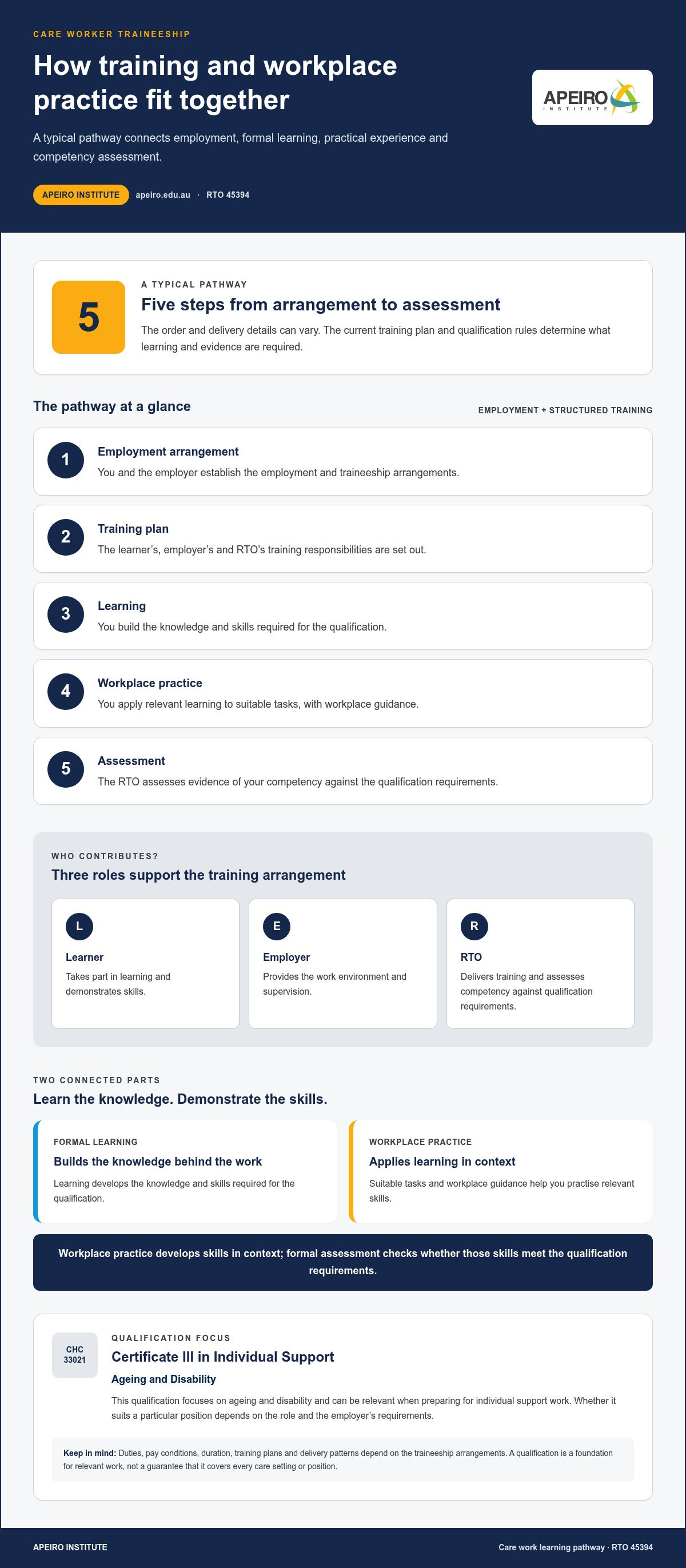
Workplace practice develops skills in context, while formal assessment checks that those skills meet the qualification requirements. Together, they connect what you learn with what you’re expected to demonstrate at work.
A typical pathway can be understood in five steps:
- Employment arrangement: You and the employer establish the employment and traineeship arrangements.
- Training plan: The learner’s, employer’s and RTO’s training responsibilities are set out.
- Learning: You build the knowledge and skills required for the qualification.
- Workplace practice: You apply relevant learning to suitable tasks, with workplace guidance.
- Assessment: The RTO assesses evidence of your competency against the qualification requirements.
The order and delivery details can vary. The current training plan and qualification rules determine the learning and evidence required, so there isn’t one timetable or workplace pattern for every trainee.
How does CHC33021 relate to care work?
The CHC33021 Certificate III in Individual Support (Ageing and Disability) focuses on ageing and disability. It can be relevant if you’re preparing for individual support work. Whether it suits a particular position depends on the role and the employer’s requirements. The qualification is a foundation for relevant work, not a guarantee that it covers every care setting or position.
Apeiro Institute offers the CHC33021 Certificate III in Individual Support, a formal qualification pathway in individual support.
How are learning and assessment completed?
Formal learning develops the knowledge behind the work, while assessment checks whether you can demonstrate the required competencies. Depending on your training plan, practical evidence may include appropriate tasks you perform in the workplace. Your employer supports workplace learning; the RTO delivers training and makes the assessment decision. The training plan and qualification rules set the requirements, rather than an assumed list of tasks or a universal delivery method.
Apeiro’s CHC33021 course information outlines the qualification’s focus and can help you consider how it aligns with your care work goals.
Care worker traineeship or course first: which pathway suits your situation?
The right starting point depends on whether you want to secure relevant work as you study, begin with formal learning, or explore a role before committing to a qualification. A Care worker traineeship connects training to an employment arrangement. A standalone course and entry-level work offer different combinations of study and workplace experience.
| Pathway | Employment connection | Structured learning | Practical experience | Flexibility |
|---|---|---|---|---|
| Traineeship | Linked to employment through a formal traineeship arrangement with an employer. | Training towards a qualification is planned alongside the work. | Workplace tasks can provide relevant experience and opportunities to practise skills. | Work and study commitments need to fit together. |
| Standalone qualification | Study isn’t automatically tied to a job. | Formal learning follows the course requirements. | Practical requirements depend on the qualification and provider. | May suit learners who want to start studying before securing a role; delivery arrangements vary. |
| Entry-level work | Provides a job, but isn’t necessarily part of a formal traineeship. | Workplace induction may be provided, but it doesn’t automatically lead to a qualification. | Experience comes from the duties of the position. | Depends on the role and workplace, without a structured study commitment unless one is arranged. |
Pathway suitability comes down to your access to relevant work and the way you prefer to learn. Neither a traineeship nor a qualification guarantees employment or a particular role. Consider the work and training arrangement, how the qualification relates to your goals, and the employer’s requirements.
When might a traineeship be a good fit?
A traineeship may suit you if you want structured learning alongside relevant workplace experience. You’ll need an employer and a formal traineeship arrangement, and you should be ready to balance work responsibilities with study and assessment. Combining work and learning can be rewarding, but it takes planning and consistent participation in both.
The Australian Government’s guidance on starting an apprenticeship or traineeship outlines practical considerations for getting started. Use it as a further reference while exploring employment-based training.
When might a course-first pathway suit better?
Starting with a course may suit you if you want to build formal knowledge before pursuing a care role, or if you haven’t secured an employer. Course delivery and practical requirements vary by qualification and provider, so consider how the study structure fits your circumstances. For a broader study option, explore the Diploma of Community Services pathway.
How to prepare for a care worker traineeship in Australia
Before pursuing a Care worker traineeship, consider whether the work, employment arrangement and learning commitments suit your circumstances. Preparing in advance can help you approach applications with realistic expectations and identify what to clarify before starting.
Use this checklist to organise your thinking:
- Clarify your motivation: What draws you to supporting people? Are you particularly interested in ageing or disability support?
- Review your availability: Consider how work hours, study and assessment could fit around your existing responsibilities.
- Reflect on communication: Care work calls for respectful, patient communication and the ability to listen to the person receiving support.
- Prepare to learn: Think about how you’ll manage feedback, build new skills and keep track of learning tasks alongside work.
- Understand the arrangement: Be clear about the role, workplace expectations, supervision, and how training and assessment are planned.
What should you consider before starting?
Individual support is person-centred. It involves respecting each person’s preferences, communicating appropriately and maintaining professional boundaries. The work can be meaningful, but may also involve practical demands and emotionally challenging situations. Consider how you respond to change, seek guidance and learn with confidence.
Before accepting an opportunity, write down questions about who will supervise you, how study time fits with work, and how workplace practice contributes to assessment. Clear answers can help you understand the day-to-day commitment and decide whether it’s manageable.
What documents or checks might be relevant?
Identity documents, screening and other role-specific requirements depend on the position, employer and relevant state or territory rules. There isn’t one set of checks for every care role across Australia. Use current official guidance for the jurisdiction and role, and follow the employer’s instructions about any required documentation.
Traineeship registration, eligibility and funding arrangements can also differ between states and territories. If funding is involved, eligibility isn’t automatic, and programme rules and conditions apply. Look for up-to-date information from the relevant government authority and make sure you understand the employment and training commitments before making a decision.
Apeiro Institute offers the CHC33021 Certificate III in Individual Support (Ageing and Disability), a relevant qualification to consider as you plan your training pathway.
Start your care worker traineeship pathway with Apeiro Institute
Choose a pathway by matching your interests in care work with a role and learning structure that suit your circumstances. If you’re drawn to individual support, consider whether your goals relate to ageing, disability or both, and whether you’d prefer to study alongside employment or begin with a qualification. A Care worker traineeship connects work with structured learning, while the employment arrangement and requirements depend on the employer and applicable rules.
How can CHC33021 support your next step?
The CHC33021 Certificate III in Individual Support (Ageing and Disability) focuses on supporting people in ageing and disability contexts. It can be relevant to individual support pathways. The qualification needed for a particular position depends on the role and employer requirements.
Apeiro Institute is an Australian Registered Training Organisation, RTO 45394, and offers the CHC33021 Certificate III in Individual Support. Apeiro delivers vocational training and assesses learners against the relevant qualification requirements. The qualification can support your learning goals, but it doesn’t guarantee employment, a specific role or a particular traineeship arrangement.
What to do next if care work feels right for you
Compare the realities of the role with your interests, availability and preferred way of learning. Think about the people and support settings you’d like to work with, how much time you can commit to study, and how workplace learning and assessment could fit around your responsibilities. These considerations can help you choose between a traineeship and course-first study.
Apeiro also delivers NSW Smart and Skilled funded training. This is a state-specific pathway, and eligibility depends on the current programme rules and your circumstances. Funding isn’t automatic, so review the latest NSW requirements before including funded training in your plan.
Explore the CHC33021 course information to understand its ageing and disability focus and consider how it could fit your next step in individual support.
Take your next step towards a career in care
A Care worker traineeship brings paid work and structured learning together. A standalone qualification may suit you better if you’d like to begin studying first. Whichever route you’re considering, look closely at the role, training commitments and applicable requirements so your next step fits your interests and circumstances.
For learners interested in individual support, the CHC33021 Certificate III in Individual Support (Ageing and Disability) offers a qualification pathway focused on ageing and disability. Apeiro Institute is a Registered Training Organisation, RTO 45394, and delivers training and assesses learners against relevant qualification requirements. A qualification can support your development, but it doesn’t guarantee employment or a particular role.
Explore the course information and consider how it aligns with the kind of support work you’d like to pursue. A clear understanding of your goals and commitments can help you choose a suitable pathway.
Your interest in helping others is a meaningful starting point. Build on it with a pathway that suits your circumstances.
Frequently Asked Questions
What is a care worker traineeship?
A care worker traineeship combines employment with structured vocational training towards a relevant qualification. You gain workplace experience while learning and demonstrating skills, with an employer and registered training organisation (RTO) supporting different parts of the process. Duties, training plans and employment conditions depend on the formal arrangement. It differs from a standalone course, which isn’t automatically linked to a job, and from an informal workplace induction.
Do you get paid during a care worker traineeship?
Generally, trainees are paid because a traineeship combines training with employment. The wage depends on the applicable employment arrangements, such as the relevant award or agreement and the trainee’s circumstances. There isn’t one rate for every care traineeship. Before accepting an opportunity, read the employment terms and check how pay, hours and training time are set out. Training funding doesn’t automatically determine your wage.
What qualification do you need for care work in Australia?
There isn’t one qualification that applies to every care role. Requirements depend on the position, employer and care setting. The CHC33021 Certificate III in Individual Support (Ageing and Disability) is relevant for people exploring individual support, with a focus on ageing and disability. Check the requirements for the type of work you’re considering, as a qualification suited to one role may not meet the requirements of another.
Can I start a care worker traineeship with no experience?
You may be able to apply without previous care experience, as a traineeship is a training pathway for building skills while working. Your suitability depends on the employer’s selection requirements and the role. Employers may also set screening or other position-specific conditions. Show your interest in supporting people, readiness to learn, and ability to meet the work and study commitments. Review each opportunity carefully, as requirements can vary.
How long does a care worker traineeship take?
Aged care traineeships leading to a Certificate III in Individual Support typically take 12 to 24 months. The actual timeframe can vary with the formal traineeship arrangement, training plan and progress towards assessment requirements. Other care traineeships may have different durations. Before starting, make sure you understand the expected timeframe and how training and workplace commitments are organised for your pathway.
Can I get government funding for a care worker traineeship?
Government funding may be available, but eligibility and arrangements vary between states and territories, and not every learner qualifies. Apeiro Institute delivers NSW Smart and Skilled funded training, subject to the programme’s current rules and individual eligibility. Funding may depend on factors such as the course and your circumstances. Check current official state or territory guidance before relying on funding, and clarify any fees or conditions that apply to your training.

Disclaimer
The information provided on this blog is for general informational and educational purposes only. While every effort is made to ensure the accuracy and reliability of the content, the author makes no representations or warranties of any kind, express or implied, about the completeness, accuracy, suitability, or availability of the information contained on this blog.
The views and opinions expressed in blog posts are those of the individual author and do not necessarily reflect the official policy or position of any organization, company, or employer.
This blog may contain links to external websites or third-party content. These links are provided for convenience only, and the author has no control over and assumes no responsibility for the content, privacy policies, or practices of any third-party sites.
Nothing on this blog constitutes professional advice (legal, financial, medical, or otherwise). Readers are encouraged to seek appropriate professional guidance before making any decisions based on the information provided here.
By using this blog, you acknowledge that any reliance on the information is at your own risk.


