

Want to earn while you learn, but aren’t sure whether to approach an employer or an RTO first? If you’re asking, “How can I get a CHC33021 traineeship in NSW?”, begin by looking for an employer willing to hire you as a trainee. A traineeship combines paid work with structured training, so you need both an employment arrangement and an RTO to deliver the qualification.
The employer provides your workplace learning, while the RTO delivers the CHC33021 Certificate III in Individual Support (Ageing and Disability) and supports your training. NSW Smart and Skilled may help eligible students with training costs, but eligibility and funding depend on current requirements. Keeping the employment, training and funding steps separate makes it easier to understand what needs to be arranged.
This guide explains the practical steps, from finding an employer to organising training and understanding the formal arrangements. It also covers how workplace learning connects with support-work skills and what to consider about NSW eligibility and funding. If you haven’t found an employer yet, you can still study the qualification as a standalone course while planning your next step.
Key Takeaways
- How can I get a CHC33021 traineeship in NSW? Explore support-work roles, then discuss a trainee position and training arrangements with a prospective employer.
- A traineeship combines employment with structured training. An RTO delivers and assesses the CHC33021 qualification.
- Understand how workplace learning connects with the Ageing and Disability pathways in the Certificate III in Individual Support.
- Check current NSW traineeship requirements and Smart and Skilled eligibility through official guidance before making decisions about funding.
- If you’re still exploring work options, you can study CHC33021 as a standalone course while planning your next step.
What is a CHC33021 traineeship in NSW, and how does it work?
A CHC33021 traineeship combines paid employment with structured training towards the nationally recognised Certificate III in Individual Support. You work for an employer while completing the qualification through a Registered Training Organisation (RTO). The employment, training and any applicable eligibility arrangements need to be in place before the arrangement is treated as a traineeship.
CHC33021 is the qualification code for Certificate III in Individual Support. It offers learning pathways in Ageing, Disability or both. The Certificate III sits within the Australian Qualifications Framework, Australia’s system for nationally recognised qualifications. The qualification provides a formal training framework, but it does not promise a particular job, employer or career outcome.
What does CHC33021 prepare learners to study?
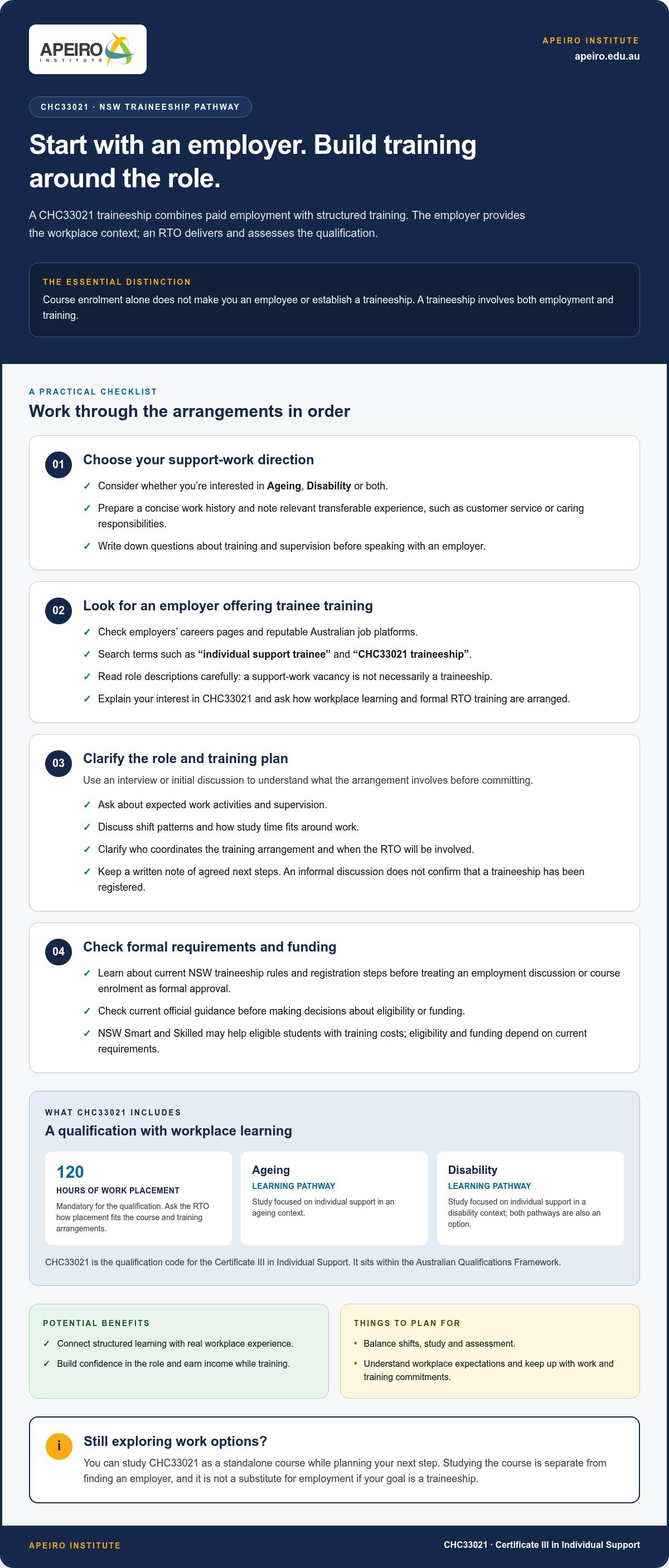
The course develops knowledge and skills for providing individual support in ageing and disability contexts. Learning relates to supporting people in ways that respond to their needs and circumstances. The qualification includes a mandatory 120 hours of work placement. Your RTO can explain how placement, course units and your chosen specialisation fit the training and delivery arrangements.
Apeiro Institute, RTO 45394, delivers the CHC33021 Certificate III in Individual Support (Ageing and Disability). You can explore the course whether you already have an employer or are still considering your options.
How is a traineeship different from a course enrolment?
A CHC33021 traineeship is paid employment combined with structured training through an RTO, leading towards the Certificate III in Individual Support. Enrolling in the course alone doesn’t make you an employee or establish a traineeship.
The roles are distinct. You take part in work and training, the employer provides the employment context, and the RTO delivers and assesses the formal training. Workplace learning connects with your role, while the RTO ensures training and assessment meet the qualification requirements. NSW traineeship arrangements and funding eligibility have their own conditions, so check current official guidance before assuming a course enrolment is a registered traineeship.
If you’re weighing up your options, consider whether you’re ready to seek a paid support-work role alongside study. The question “How can I get a CHC33021 traineeship in NSW?” starts with understanding the difference: you can study CHC33021 without an employer, but a traineeship involves employment as well as training.
Do you need an employer before starting a CHC33021 traineeship?
Yes. An employer is part of a traineeship because the arrangement combines paid work with structured training. Enrolling in CHC33021 on its own doesn’t secure a job or establish a registered traineeship. If you’re considering this pathway, learn about current NSW traineeship rules and registration steps before treating an employment discussion or course enrolment as formal approval.
You can prepare before applying. Think about whether you’re interested in ageing support, disability support or both, then look for relevant roles with care and support employers. The Australian Community Industry Alliance offers an industry-level perspective on community, aged care and disability services. Prepare a concise work history, note transferable experience such as customer service or caring responsibilities, and write down questions about training and supervision.
How can you find an employer offering traineeship training?
Search employers’ careers pages and reputable Australian job platforms using terms such as “individual support trainee” and “CHC33021 traineeship”. Read each role description carefully: a support-work vacancy isn’t necessarily a traineeship. In your application, explain your interest in CHC33021 and ask how the employer arranges workplace learning and formal training with an RTO.
What should you discuss with a prospective employer?
Use an interview or initial discussion to understand the role before committing. Ask about expected work activities, supervision, shift patterns and how study time fits around work. Clarify who coordinates the training arrangement and when the RTO will be involved. After the conversation, keep a written note of agreed next steps. An informal discussion is useful preparation, but it doesn’t by itself confirm that a traineeship has been registered.
Workplace learning can be valuable, but it comes with responsibilities. Consider both sides:
- Potential benefits: You can connect structured learning with real workplace experience, build confidence in the role and earn income while training.
- Things to plan for: Balancing shifts, study and assessment takes organisation. You’ll also need to understand the role’s expectations and keep up with workplace and training commitments.
If you’re still exploring, studying the course can be a separate way to begin learning about individual support. It isn’t a substitute for finding an employer if your goal is a traineeship. So, How can I get a CHC33021 traineeship in NSW? Start by identifying suitable roles, then discuss employment and training arrangements with a prospective employer and learn about current NSW requirements. You can also explore Apeiro Institute’s CHC33021 Certificate III in Individual Support.
How do CHC33021 training, an RTO and Smart and Skilled fit together?
A traineeship brings together a learner, an employer and a Registered Training Organisation (RTO). NSW Smart and Skilled may help fund eligible training, but funding isn’t automatic. Each part has a different role, so understanding who does what can make the arrangements easier to follow.
| Part of the arrangement | Role |
|---|---|
| Learner | Completes training and assessments, and participates in work and workplace learning as agreed. |
| Employer | Employs the trainee and provides the workplace context for learning and support at work. |
| RTO | Delivers and assesses the formal training required for the qualification, and communicates with the learner and employer about progress and training. |
| NSW funding and administration | Smart and Skilled sets funding conditions and subsidises training through contracted providers for eligible learners. Applicable arrangements depend on current programme rules. |
Workplace learning and formal training connect, but they aren’t the same thing. Your employer provides the employment setting; the RTO is responsible for delivering and assessing the qualification. Funding sits alongside these arrangements and doesn’t replace the need to meet traineeship, enrolment or eligibility requirements.
What does the RTO do during the traineeship?
The RTO organises the formal learning and assessment needed for CHC33021 and works with you and your employer on training progress. Apeiro Institute is an RTO, RTO 45394, and offers the CHC33021 Certificate III in Individual Support (Ageing and Disability). The course information outlines the qualification for people exploring individual support training.
Could Smart and Skilled help fund CHC33021 training?
It may. NSW Smart and Skilled subsidises training for eligible students, but eligibility, fees, course scope and provider arrangements depend on current rules and individual circumstances. Check the latest NSW Government Smart and Skilled guidance before relying on a subsidy or estimating your costs. An RTO must also have the relevant NSW Government contract to deliver funded training.
As you work out, “How can I get a CHC33021 traineeship in NSW?”, keep the employment, training and funding questions distinct. Confirm current requirements through official NSW information, then discuss how the employer and RTO will coordinate your training. This helps you understand the full arrangement before making decisions about enrolment or costs.
How can you start a CHC33021 traineeship in NSW?
A clear sequence can help you move from exploring support work to discussing a formal training arrangement. These are practical actions, not a substitute for current NSW requirements. Confirm the official traineeship process, documentation and eligibility rules before you commence.
- Explore roles and decide if a traineeship suits you. Look at support-work positions and consider the responsibilities, work settings and study commitments involved. Think about your availability and whether combining paid work with structured learning fits your circumstances. This first step is about finding a pathway that makes sense for you.
- Apply to employers and discuss training. Prepare a tailored application for suitable roles. If an employer offers you a position, ask whether it can be arranged as a CHC33021 traineeship, how workplace learning will be supported and what the next steps are. A job offer and course enrolment don’t, by themselves, confirm formal traineeship registration.
- Confirm arrangements with the employer and RTO. Work through the training plan, enrolment details and required documentation with the relevant people. Check current NSW guidance on registration and eligibility, including any funding conditions that may apply. Make sure you understand which parts are formal requirements and which are arrangements agreed with your employer or RTO.
- Agree on what happens before training begins. Confirm your commencement date, study expectations, assessment arrangements and who to contact for support. Keep a written record of key details so you can refer back to them as work and study get underway.
What documents and information might you prepare?
Have an up-to-date résumé ready, with relevant work history, transferable skills and experience that could help demonstrate your interest in support work. Employers may request identification or other employment documents, but requirements can vary. Prepare questions about the role, training schedule, assessment and workplace support so you can discuss expectations clearly before starting.
How can you prepare for work and study together?
Map out your likely shifts and set aside realistic time for study and assessment tasks. Training schedules vary, so discuss how learning activities will fit alongside work rather than assuming a fixed timetable. Ask how you and your employer will communicate with the RTO, and find out who to approach if you need help understanding a learning task or managing competing commitments.
Use these steps as a planning guide, then verify the formal NSW requirements that apply to your circumstances. Apeiro Institute offers CHC33021 Certificate III in Individual Support (Ageing and Disability) for people exploring the qualification.
Where can you pursue CHC33021 training and take your next step?
Your next step depends on whether you’re aiming for a traineeship or exploring the qualification independently. For a traineeship, the pathway generally moves from identifying a suitable support-work role to discussing training with an employer, then arranging RTO involvement and checking current eligibility requirements. Course enrolment alone doesn’t establish an employment-based traineeship.
Take it one decision at a time. Clarify the role and workplace expectations with a prospective employer, understand how training will be arranged, and verify any NSW traineeship and funding requirements through current official guidance. Smart and Skilled may subsidise training for eligible learners, but funding approval and costs depend on current programme conditions and individual circumstances.
What does Apeiro Institute offer for CHC33021?
Apeiro Institute is a Registered Training Organisation, RTO 45394, and offers the CHC33021 Certificate III in Individual Support (Ageing and Disability). As a vocational training provider, it delivers and assesses training towards the qualification. Reviewing the course information can help you understand what you’ll study and prepare questions about how learning may fit your goals.
What should you do next if you are ready to explore?
Review the qualification details and note anything you’d like to understand about course content, assessment, study expectations or your training pathway. If you’re pursuing a traineeship, keep your employer discussion and RTO arrangements connected. Use current NSW Smart and Skilled guidance to investigate funding eligibility and applicable costs, and consult NSW Government information about funded courses.
You may be asking, “How can I get a CHC33021 traineeship in NSW?” Start with a suitable role, then work through the employer, training and eligibility arrangements before commencing. If you’re still weighing up your direction, exploring CHC33021 can help you learn more about individual support and consider how the qualification could support your career development. Training can build relevant skills, but it doesn’t guarantee a job or traineeship placement.
Explore CHC33021 Certificate III in Individual Support
Take your next step towards individual support training
A CHC33021 traineeship brings together paid employment and structured training, so finding a suitable role is an important first step. From there, discuss training arrangements with the employer and RTO, and check current NSW requirements and any Smart and Skilled eligibility before making plans.
If you’re still asking, “How can I get a CHC33021 traineeship in NSW?”, begin by exploring the qualification and preparing questions about study, workplace learning and your goals. A traineeship isn’t the only way to study CHC33021, but it does require an employment arrangement.
Apeiro Institute is RTO 45394 and offers CHC33021 Certificate III in Individual Support (Ageing and Disability). Apeiro Institute also supports apprenticeships, traineeships and NSW Smart and Skilled funded training. Funding and traineeship access depend on applicable arrangements and eligibility, so take time to understand the pathway that fits your circumstances.
Explore CHC33021 training with Apeiro Institute
Explore the CHC33021 course and take your next step towards individual support training.
Frequently Asked Questions
How do I get a CHC33021 traineeship in NSW?
If you’re asking, “How can I get a CHC33021 traineeship in NSW?”, start by exploring support-work roles and applying to employers that take on trainees. If an employer is interested, discuss the qualification and how an RTO will deliver the training. You, the employer and RTO then need to work through the applicable arrangements. Check current NSW guidance for registration steps, eligibility and funding rules before relying on them.
Do I need a job before enrolling in a CHC33021 traineeship?
A suitable employer is central to a traineeship because it combines employment with structured training. Enrolling in CHC33021 alone isn’t the same as starting a traineeship, and it doesn’t secure a job. If you’re aiming for the work-based pathway, speak with prospective employers about the role and workplace training. Then work through the training and administrative steps with the employer and RTO under current NSW requirements.
Can I study CHC33021 without a traineeship?
Yes. Apeiro Institute offers CHC33021 as a course, subject to applicable enrolment requirements. You don’t need an employer simply to explore this study pathway, but course enrolment doesn’t create an employment relationship or registered traineeship. Compare the options with your goals: a traineeship links paid work with training, while standalone study is a separate route. Check current course details and any funding conditions before deciding.
Is CHC33021 available through Smart and Skilled in NSW?
Smart and Skilled subsidises vocational training in NSW, and CHC33021 may be funded for eligible students through a contracted provider. Funding isn’t automatic: eligibility and applicable fees depend on current programme rules, the training arrangement and your circumstances. NSW eligibility generally includes being at least 15, no longer at school, living or working in NSW, and meeting the relevant residency or citizenship criteria. Verify current requirements with official NSW guidance before making plans.
What does an RTO do in a CHC33021 traineeship?
An RTO delivers and assesses the formal training towards CHC33021, while the employer provides the employment and workplace context. As the learner, you participate in both parts. The training plan and communication arrangements should make clear how assessment, study and workplace learning fit together. Before training starts, get clear information about your expectations, how progress will be discussed and who to approach if you need support.
How long does a CHC33021 traineeship take?
There isn’t one timeframe that applies to every learner. Duration depends on the training arrangement, work and study circumstances, assessment progress and relevant requirements. Published course durations also vary, so a standalone course estimate may not match a traineeship schedule. Ask the employer and RTO to explain the planned training period and completion requirements for your situation, and check current NSW guidance if a formal timeframe applies.
Can I get a CHC33021 traineeship without experience in aged care or disability support?
Previous experience isn’t a formal academic prerequisite for CHC33021, though a reasonable level of language, literacy and numeracy is needed. Employers may set their own recruitment criteria, so requirements for a particular role can differ. Highlight transferable skills, reliability and your interest in supporting people when applying. Be prepared to discuss the role’s expectations, and remember that meeting course requirements doesn’t guarantee an employer will offer you a position or traineeship.
What should I check before accepting a CHC33021 traineeship?
Before accepting, make sure you understand the role, employment arrangements, training plan, assessment expectations and workplace support. Clarify how shifts will fit with study and who your contacts are at work and with the RTO. Check any fees and funding conditions using current, reliable information rather than assuming training will be fee-free. Keep copies of relevant agreements and training details. Ask how any required screening checks or placement arrangements apply to your pathway.

Disclaimer
The information provided on this blog is for general informational and educational purposes only. While every effort is made to ensure the accuracy and reliability of the content, the author makes no representations or warranties of any kind, express or implied, about the completeness, accuracy, suitability, or availability of the information contained on this blog.
The views and opinions expressed in blog posts are those of the individual author and do not necessarily reflect the official policy or position of any organization, company, or employer.
This blog may contain links to external websites or third-party content. These links are provided for convenience only, and the author has no control over and assumes no responsibility for the content, privacy policies, or practices of any third-party sites.
Nothing on this blog constitutes professional advice (legal, financial, medical, or otherwise). Readers are encouraged to seek appropriate professional guidance before making any decisions based on the information provided here.
By using this blog, you acknowledge that any reliance on the information is at your own risk.


