

Where can I find an Individual Support traineeship in NSW? Start by searching for an employer and a training pathway together. A traineeship combines paid employment with structured training, while enrolling in a course on its own doesn’t secure a job.
Search job platforms and care employers’ career pages, then compare each listing with current NSW traineeship and Smart and Skilled information. This guide explains useful search terms, how employers and registered training organisations (RTOs) fit into a traineeship, and what to check before applying. Apeiro Institute offers CHC33021 Certificate III in Individual Support (Ageing and Disability), a qualification relevant to this pathway.
Key Takeaways
- Search job platforms, care employers’ career pages and official NSW channels for Individual Support traineeships.
- Understand the separate roles of an employer and an RTO, and check how work and training are connected.
- Compare traineeship, entry-level job and training-only listings to find the pathway that matches your goal.
- Prepare a current résumé with concise examples that show communication, reliability and relevant experience.
- Explore how CHC33021 Certificate III in Individual Support (Ageing and Disability) fits into your training pathway.
Where to find an Individual Support traineeship in NSW
Search employer vacancies and training information side by side. A traineeship might appear on a job platform or an employer’s careers page, while course information can help you identify the qualification connected with the role. Checking both makes it easier to distinguish a work-and-training opportunity from a course that doesn’t include employment.
Start with job platforms, aged care, disability support and community care employers, then review current NSW Government information about traineeships and Smart and Skilled. Vacancies, locations and application windows change, so check each listing for the role details and closing date.
Which places should you search first?
Job platforms are a useful starting point, but they may not show every opportunity. Also search the careers pages of organisations providing aged care, disability support or community care. Employers may describe a role as a trainee position rather than use the exact phrase “Individual Support traineeship”.
For the training and funding side, refer to current NSW Government information on traineeships and Smart and Skilled. Apeiro Institute offers CHC33021 Certificate III in Individual Support (Ageing and Disability), which can help you understand the qualification associated with this career pathway. A general overview of the apprenticeship system explains the broader model of combining workplace learning with study.
What search terms can make results more relevant?
Try several variations because employers and job platforms may label similar opportunities differently. Search “Individual Support traineeship NSW”, “aged care traineeship”, “disability support trainee” and “CHC33021 traineeship”. You could also try “Certificate III in Individual Support trainee” or combine the qualification with “employer vacancy”.
Use filters to narrow results to NSW and the employment type you want. Revisit searches regularly and check closing dates, as listings can change. If a result is for a course rather than an employed traineeship, treat it as training information, not evidence of an employer vacancy.
Keep a brief record of useful searches and the employers or official pages you’ve reviewed. This makes it easier to revisit relevant listings and compare new opportunities.
How an Individual Support traineeship connects work and CHC33021 training
An Individual Support traineeship brings employment and structured training together. The trainee works in a role while completing formal learning connected with that role. The Australian Apprenticeships system includes both apprenticeships and traineeships, with arrangements shaped by the occupation and training pathway.
For NSW-specific details, including traineeship registration and training-contract requirements, use the latest NSW Government guidance. Requirements and arrangements can change. A job advertisement for a support role isn’t automatically a traineeship, so look for clear information about both employment and training.
What does the employer do, and what does the training provider do?
The employer provides the job and practical workplace context. An RTO delivers and assesses the formal training within the requirements that apply to the traineeship. The employer and RTO have different responsibilities, even though their parts of the pathway connect.
Before accepting an opportunity, identify the employing organisation and the RTO delivering the training. Read how the training schedule and contract arrangements fit alongside the work, as these details depend on the specific traineeship and current NSW requirements.
What does CHC33021 cover as a training pathway?
CHC33021 Certificate III in Individual Support (Ageing and Disability) is Apeiro Institute’s qualification for people exploring support work. Its title identifies the Ageing and Disability areas. Review the qualification information to understand the formal learning pathway and its current training requirements.
Course information can help you understand the learning component while you search for an employer opportunity. Enrolling in a course isn’t the same as securing a traineeship, and completing a qualification doesn’t guarantee a particular job. Keep these pathways distinct as you compare options.
Understanding the training side can help you recognise what to look for in a listing. Explore Apeiro’s Individual Support qualification to learn about the formal study pathway.
How to assess an Individual Support traineeship listing in NSW
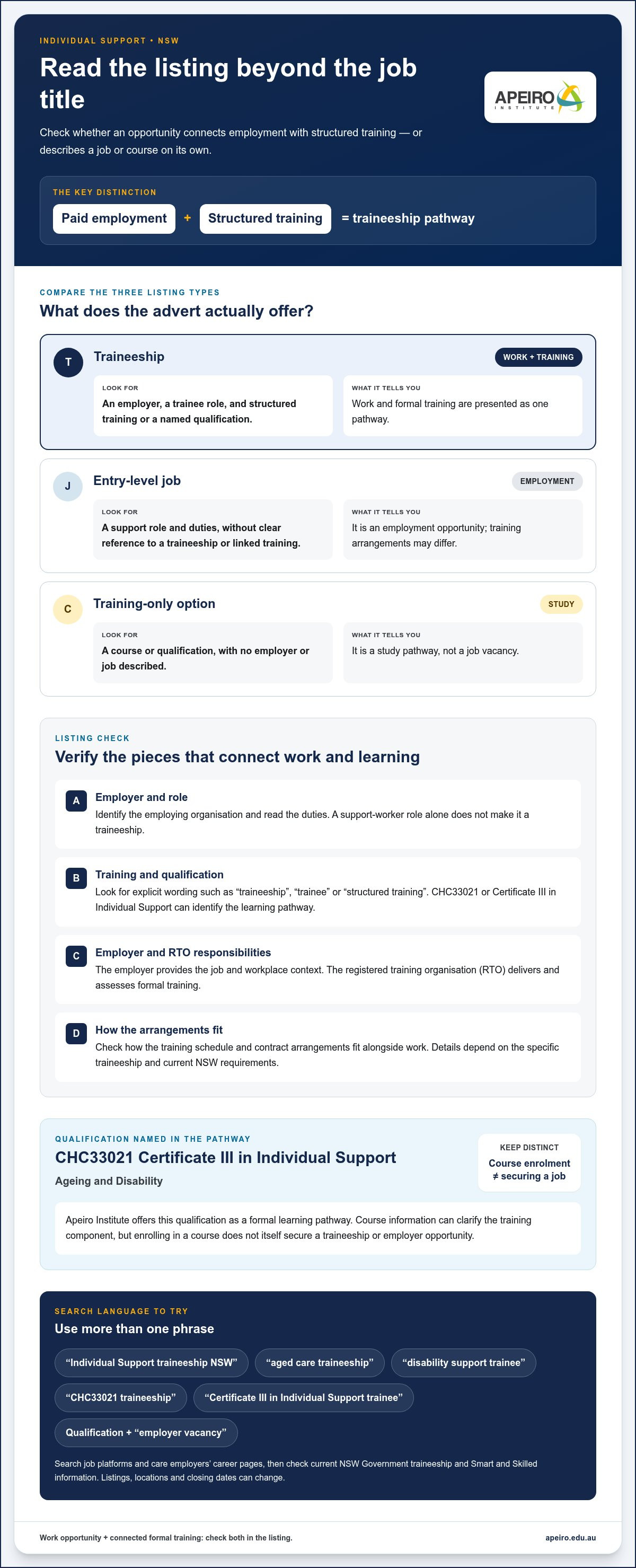
A listing may describe a standard support-worker job or a course without employment, even if it looks relevant at first. Read beyond the job title. Check the employer, the duties, whether structured training is included and which qualification is named. These details help you compare opportunities before applying.
Does the advert describe a traineeship or a general support role?
Look for explicit wording such as “traineeship”, “trainee” or “structured training”. A qualification code such as CHC33021, or the title Certificate III in Individual Support, can help identify the learning pathway. A support-worker role may provide workplace experience, but that alone doesn’t make it a traineeship. A course-only enrolment describes study, not an employed position.
| Option | What to look for | What it tells you |
|---|---|---|
| Traineeship | An employer, a trainee role and structured training or a named qualification. | Work and formal training are presented as one pathway. |
| Entry-level job | A support role and duties, without clear reference to a traineeship or linked training. | It’s an employment opportunity; training arrangements may differ. |
| Training-only option | A course or qualification, with no employer or job described. | It’s a study pathway, not a job vacancy. |
Before applying, note the organisation offering the role, its duties, the qualification and the application requirements. Check the closing date and whether the advert explains how work and training are arranged. Use the published programme information to understand any details the listing doesn’t explain.
What eligibility and funding details should you understand?
Smart and Skilled eligibility depends on current NSW programme rules and your circumstances. Don’t assume a course or traineeship will be funded, or that every applicant will pay the same amount. Review current NSW Government information about eligibility, fees and programme conditions. Apeiro Institute delivers NSW Smart and Skilled funded training, subject to applicable requirements.
Use a consistent checklist when comparing listings: employer, duties, CHC33021 or another stated qualification, training arrangement, application requirements and funding information. This helps you distinguish a work-and-training pathway from a job or a course.
A practical application plan for an NSW Individual Support traineeship
A clear application process makes it easier to act when a suitable opportunity appears. First identify whether you’re applying for an employed traineeship, a support role or training on its own. Then tailor your documents to the advert, submit them as instructed and understand how work and training are arranged.
How can you prepare a strong application?
Use a current résumé and match your examples to the duties in the advert. You might describe a time you communicated clearly, followed through on a responsibility or worked respectfully with someone who needed support. Examples can come from paid work, study, volunteering or other responsibilities. Be accurate about your experience and don’t imply care experience you don’t have.
Keep referee details and records of relevant experience ready if requested. Use respectful, person-centred language to explain your interest in supporting people. Before submitting, check that you’ve included every requested document and followed the stated application method.
What should you understand before accepting a pathway?
Read the information provided about the role, training and assessment. Make sure you understand the qualification, who will employ you, who will deliver the training and how the two parts fit together. Consider whether the work and the Ageing and Disability focus of CHC33021 align with your goals.
Funding is a separate consideration. Smart and Skilled eligibility, fees and any learner contribution depend on current programme rules and individual circumstances. Use current official information rather than making assumptions. If a listing doesn’t explain the employment or training arrangement, review the published programme details before deciding if the pathway suits you.
Before you apply, use this simple sequence:
- Identify the pathway: confirm whether the opportunity combines employment and training.
- Prepare your evidence: update your résumé and choose concise, truthful examples relevant to the role.
- Apply carefully: follow the advert’s document requirements, instructions and closing date.
- Understand the arrangement: review the role, qualification, training and funding information before accepting.
Keep your documents ready and adapt each application to the opportunity. Clear, relevant examples can show how your existing strengths relate to the work, even if you’re new to the sector.
Explore Individual Support training
Start your Individual Support training pathway with Apeiro
You can learn about the qualification while continuing to look for an employer opportunity. Apeiro Institute is a Registered Training Organisation (RTO 45394) offering CHC33021 Certificate III in Individual Support (Ageing and Disability). Review the course information to understand the training pathway and consider whether Apeiro Institute’s Ageing and Disability focus fits your goals.
How can CHC33021 support your next career step?
Certificate III in Individual Support is nationally recognised training relevant to people exploring support work. It offers a structured way to develop knowledge and skills for relevant roles, and helps you recognise the qualification named in some traineeship listings.
Training and employment are related, but they’re separate steps. Learning about CHC33021 can help you assess whether the qualification aligns with your interests while you search for an employer offering a suitable role. Course enrolment alone doesn’t secure a job or traineeship, and funding depends on applicable programme requirements and your circumstances.
What can you do next?
Review the qualification details and reflect on the type of support work you’d like to pursue. Then return to your vacancy search with a clearer understanding of the training component. If you find a suitable opportunity, tailor your résumé, prepare relevant examples and referees if requested, follow the advert’s instructions, and review the work and training arrangements.
Keep both parts of the pathway in view: the employer opportunity and the qualification. You can learn about the training while looking for a role that matches your directionavourite.
Explore CHC33021 Certificate III in Individual Support
Take your next step towards Individual Support work
Finding a traineeship means looking beyond the job title. Check that the opportunity combines employment with structured training, then review the qualification, employer and application requirements. A current résumé with clear examples of communication, reliability and relevant experience can help you make a focused application.
Search employer vacancies alongside training information, and keep the two pathways distinct. Apeiro Institute, RTO 45394, offers CHC33021 Certificate III in Individual Support (Ageing and Disability) to help you understand the qualification as you explore care work. NSW Smart and Skilled funded training is subject to eligibility and programme requirements, so funding isn’t automatic.
Explore the qualification and consider how it fits your goals as you assess suitable opportunities.
With a clear plan and relevant information, you can move towards support work one step at a time.
Frequently Asked Questions
Where can I find an Individual Support traineeship in NSW?
Search job platforms, aged care, disability support and community care employers’ career pages, and current NSW Government traineeship information. Try terms such as “aged care traineeship” and “CHC33021 trainee” as well as “Individual Support traineeship”. Listings and closing dates change, so check each advert for the employer, qualification, training arrangement and application requirements.
Is CHC33021 the qualification for an Individual Support traineeship?
CHC33021 Certificate III in Individual Support is the qualification relevant to this training pathway, with Ageing and Disability specialisations. Apeiro Institute offers CHC33021 Certificate III in Individual Support (Ageing and Disability). Look for the qualification code or title in a vacancy to understand the training attached to the role. A course listing alone doesn’t mean an employer has a traineeship vacancy or guarantee employment.
Can I do an Individual Support traineeship without experience?
Possibly. Previous paid care work isn’t necessarily the only relevant experience, but requirements depend on the employer and the vacancy. If you’re new to the sector, use examples from work, study or volunteering to show communication, reliability and respect for others. Be honest about your experience, read the advert carefully and make sure you meet its application requirements.
How does a traineeship differ from studying Certificate III in Individual Support?
A traineeship combines employment with structured training, so it involves an employer as well as formal study delivered by an RTO. Studying Certificate III in Individual Support on its own is a training pathway and doesn’t automatically include a job. Check that a listing clearly describes both employment and training, and review the arrangements for that opportunity before applying.
Am I eligible for Smart and Skilled funding for an Individual Support traineeship?
Eligibility depends on current NSW Smart and Skilled rules and your circumstances. General funding requirements include being at least 15, no longer at school, living or working in NSW, and meeting citizenship or residency criteria. Fee-free traineeship funding has additional conditions, including being enrolled in a funded course and meeting traineeship requirements. Check current NSW Government information, as funding and any learner contribution aren’t automatic.
What should I include when applying for an Individual Support traineeship?
Follow the advert’s instructions and include the documents it requests, usually a tailored, up-to-date résumé. Add concise, truthful examples showing communication, reliability and relevant care-related or transferable experience from work, study or volunteering. Prepare referee details if requested. Before submitting, check the role duties, qualification, application method and closing date, and make sure your examples reflect respectful, person-centred support.

Disclaimer
The information provided on this blog is for general informational and educational purposes only. While every effort is made to ensure the accuracy and reliability of the content, the author makes no representations or warranties of any kind, express or implied, about the completeness, accuracy, suitability, or availability of the information contained on this blog.
The views and opinions expressed in blog posts are those of the individual author and do not necessarily reflect the official policy or position of any organization, company, or employer.
This blog may contain links to external websites or third-party content. These links are provided for convenience only, and the author has no control over and assumes no responsibility for the content, privacy policies, or practices of any third-party sites.
Nothing on this blog constitutes professional advice (legal, financial, medical, or otherwise). Readers are encouraged to seek appropriate professional guidance before making any decisions based on the information provided here.
By using this blog, you acknowledge that any reliance on the information is at your own risk.


