

Could the same CHC33021 qualification be funded for one learner but not another? Are CHC33021 traineeships funded in NSW? They may be, when the traineeship and everyone involved meet current NSW Smart and Skilled requirements. The course title alone doesn’t determine funding.
A traineeship combines employment with structured training. Enrolling in CHC33021 without a traineeship is a different pathway, with its own funding conditions. Eligibility and fees can depend on the trainee, employer, training provider and current program rules, so funding isn’t automatic.
This guide explains the key conditions to review, how a workplace traineeship differs from standalone CHC33021 study, and what to clarify about fees before training begins. Apeiro Institute, RTO 45394, delivers the CHC33021 Certificate III in Individual Support (Ageing and Disability), as well as NSW Smart and Skilled training, apprenticeships and traineeships. Use the steps below to understand the qualification and plan your next move.
Key Takeaways
- Are CHC33021 traineeships funded in NSW? Funding may be available when the traineeship and everyone involved meet current program requirements.
- A qualification appearing in a course catalogue doesn’t guarantee funded traineeship status. The training arrangement and current funding rules matter.
- Review the trainee’s eligibility, employer arrangements and provider requirements against current NSW Smart and Skilled information.
- Before training begins, check the qualification pathway, eligibility rules, registration requirements and fees.
- Apeiro Institute, RTO 45394, delivers CHC33021 training and assessment, including through workplace training pathways.
Are CHC33021 traineeships funded in NSW? The short answer
Funding may be available for a CHC33021 traineeship in NSW when current program requirements are met. However, seeing CHC33021 in a course catalogue doesn’t mean every enrolment, or every traineeship using the qualification, attracts NSW funding. Check the current Smart and Skilled rules and qualification information for the specific pathway.
So, are CHC33021 traineeships funded in NSW? Treat funding as a possibility to verify, not an automatic entitlement. A course subsidy, an employer contribution and other funding arrangements are different things, each with its own conditions. A training subsidy doesn’t necessarily cover wages, workplace supervision or every learner cost. Review the current 2026 qualification status, eligibility criteria and fee arrangements using official NSW information before deciding.
What does “funded traineeship” mean in NSW?
A public training subsidy may contribute to the cost of eligible training under a government program such as Smart and Skilled. It isn’t payment for the trainee’s work. Wages and workplace supervision relate to the employment arrangement, while any learner contribution depends on the applicable funding and fee rules.
Other subsidies or employer support shouldn’t be assumed to be Smart and Skilled funding. Identify which arrangement applies, what it covers and whether a learner contribution remains. A general claim that training is “funded” or “fee-free” isn’t enough: confirm that it applies to the specific trainee, provider and training arrangement under current rules.
Is CHC33021 the same as a CHC33021 traineeship?
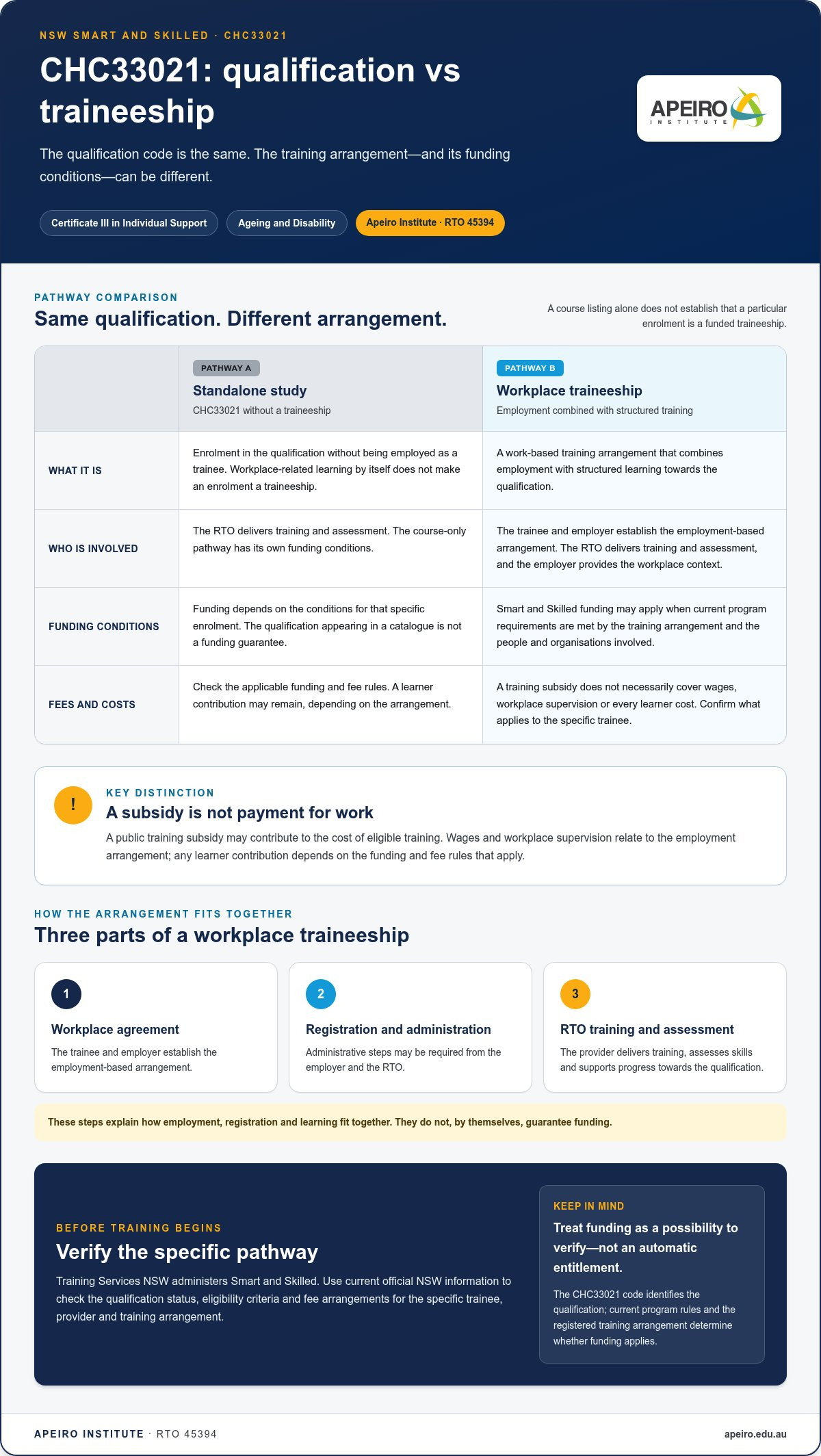
No. CHC33021 is the qualification code for the Certificate III in Individual Support (Ageing and Disability). A traineeship is a work-based training arrangement that combines employment with structured learning. A person can also enrol in the qualification without being employed as a trainee. These pathways can have different funding conditions.
CHC33021 names the qualification; a traineeship is the employment-based arrangement through which a person may complete it. They don’t automatically receive identical funding treatment.
An RTO supports the training and assessment component, while the employer provides the workplace context. This sits within Australia’s vocational education and training system, which includes Technical and Further Education (TAFE) in Australia as well as registered training organisations. Apeiro Institute is RTO 45394 and delivers CHC33021 training. Explore the CHC33021 Certificate III in Individual Support to learn about the qualification, and keep course-only enrolment distinct from a funded traineeship.
How NSW Smart and Skilled funding can apply to a CHC33021 traineeship
A CHC33021 traineeship involves more than choosing a course. The trainee, employer and registered training organisation (RTO) each have a role in the work-based arrangement, while funding depends on current NSW program rules. Training Services NSW administers Smart and Skilled, but the qualification code alone doesn’t establish that a particular traineeship is funded.
Smart and Skilled funding may apply when the training arrangement and the people and organisations involved meet the relevant requirements. The trainee and employer establish the employment-based arrangement, the RTO delivers training and assessment, and the NSW program rules determine whether subsidised training applies. Administrative steps may be required from both the employer and RTO.
What makes a traineeship different from standalone study?
A formal traineeship combines paid employment with structured training. The learner develops skills in a workplace while completing the qualification through an RTO. The provider plans and delivers training, assesses the learner’s skills and supports progress towards the qualification. The employer provides the employment context, but that doesn’t make every course enrolment a traineeship.
Enrolling in CHC33021 without a traineeship arrangement is standalone study, even if some learning relates to a workplace. Funding conditions may differ between these pathways, so make sure the enrolment type is clear.
Who administers funding and training arrangements?
Smart and Skilled is the NSW Government’s vocational training funding program, administered by Training Services NSW. Funding decisions and fee arrangements depend on the applicable rules and the individual training arrangement. The employer and RTO may also need to complete administrative steps related to the traineeship and training.
The CHC33021 code identifies the qualification, but only current program rules and a registered training arrangement can establish whether funding applies. Conditions or a learner contribution may apply even when training is subsidised. Use current official NSW information rather than assuming that a course listing means training is funded or fee-free.
A typical pathway can be represented like this:
Workplace agreement → Traineeship registration and administration → RTO training and assessment
These steps show how employment, registration and learning fit together, but they don’t guarantee funding. Explore Apeiro Institute’s CHC33021 course information alongside current Smart and Skilled guidance. This helps you understand the qualification while keeping course enrolment separate from a workplace traineeship.
Who may qualify for a funded CHC33021 traineeship in NSW?
The qualification alone doesn’t establish eligibility. Funding depends on current NSW Smart and Skilled rules, whether CHC33021 is funded for the relevant traineeship pathway, and whether the learner, employer and training arrangement meet the applicable conditions. Treat the points below as checks to make, not a guarantee of funding.
Start with the current NSW Smart and Skilled learner eligibility information and qualification list. Review the rules for your circumstances, including any NSW residency or other learner criteria. Funding requirements can differ from course entry requirements, so meeting the admission conditions doesn’t automatically mean you qualify for government-funded training.
What should a prospective trainee check?
Before enrolling, work through these checks with your employer and training provider:
- Funding status: Look up CHC33021 in the current NSW funded qualification information and check that the relevant traineeship pathway is covered.
- Learner eligibility: Review the current Smart and Skilled rules for your circumstances rather than relying on a general summary.
- Traineeship arrangement: Confirm that your employment and training are being set up as a traineeship, including any required contract registration and related steps with the relevant authority.
- Fees: Get a clear explanation of the applicable fee, any available concession and whether you may need to make a learner contribution. Check the details for your specific training arrangement.
These checks help distinguish a subsidised traineeship from standalone course study. Funding can come with conditions, and fees depend on the applicable rules and circumstances. Don’t assume an advertised course price, subsidy or fee-free outcome applies to every learner.
What does the employer need to be involved in?
A traineeship is employment-based, so the employer is part of the training arrangement. The employer provides the workplace setting and supports the learner’s development in their role, while the RTO delivers training and assessment. The employer and RTO may each have administrative steps to complete. Current official NSW traineeship guidance explains contract, supervision and registration requirements.
Already working in aged care or disability support? That experience may be relevant to your learning, but having a care job by itself doesn’t establish eligibility for funded training. The employment arrangement, required registration and current funding rules still need to align.
They may be, but the relevant learner, employer, qualification and funding conditions must be met. Checking these details early helps you understand the pathway and any fees before you commit.
How to check CHC33021 traineeship funding before you start
Checking a few details before training begins can help you distinguish a funded traineeship from standard course enrolment and understand the costs and responsibilities involved. Work through the steps with your employer and training provider, using current NSW Government information as your reference. Funding and fees depend on the specific arrangement, so keep a written record of the details that apply to you.
A practical funding-check sequence
- Step 1: Check the qualification and pathway. Look up CHC33021 in the current NSW Smart and Skilled qualification information. Confirm that it applies to the intended traineeship pathway. A general course listing doesn’t establish that the traineeship is funded.
- Step 2: Review eligibility and traineeship conditions. Use current official NSW guidance to check the learner criteria, employer participation requirements and any traineeship registration steps. Apply the rules for a work-based traineeship, not just course entry requirements.
- Step 3: Clarify training and fees before commencement. Review the training plan, delivery and assessment arrangements, administrative steps and applicable fees with your employer and RTO. Confirm what the trainee needs to do and whether a learner contribution or other conditions apply.
For a broader explanation of subsidised vocational training in NSW, read Apeiro Institute’s Smart and Skilled funding guide. Use it alongside current official NSW information, particularly if rules or qualification listings have changed since publication.
Questions to resolve before training begins
Before you commit, make sure you and your employer have clear answers to these questions:
- Which funding arrangement applies to this specific traineeship and training plan?
- What contribution, if any, is the trainee expected to pay, and what circumstances could change that amount?
- What eligibility evidence, registration or other steps must be completed before training starts?
- What are the trainee’s, employer’s and RTO’s responsibilities during training?
Keep written information about eligibility, fees, responsibilities and commencement requirements. A clear record makes it easier to understand what has been agreed and resolve questions before training gets underway.
Explore CHC33021 course information
Complete CHC33021 with supportive, workplace-relevant training
Choosing a training pathway is easier when you separate what the qualification covers from the requirements of a traineeship and its funding arrangement. Apeiro Institute is a Registered Training Organisation (RTO 45394) delivering CHC33021 Certificate III in Individual Support (Ageing and Disability), as well as NSW Smart and Skilled funded training, apprenticeships and traineeships.
What the CHC33021 qualification prepares learners to study
CHC33021 focuses on individual support in ageing and disability settings. It’s nationally recognised vocational training that provides a structured course of study. The qualification itself doesn’t confirm funding eligibility, establish a traineeship or guarantee a job outcome. Consider these as separate matters when choosing your training pathway.
In a workplace traineeship, an RTO supports the training and assessment component while learning connects with the trainee’s employment. This distinction can help you discuss the qualification, workplace arrangement and funding pathway as related but separate parts of your decision.
Take your next step with Apeiro Institute
Apeiro Institute delivers CHC33021 training and assessment, alongside apprenticeships and traineeships. If you’re considering a workplace traineeship, clarify the pathway, applicable funding conditions and fees before making training decisions. Funding isn’t automatic, so understanding the relevant requirements is an important part of planning.
Funding may depend on current program requirements and the specific training arrangement. Start with the course details to understand the qualification and the points to clarify about a traineeship.
Explore CHC33021 training options
Take your next step towards CHC33021
Funding may be available, depending on current Smart and Skilled requirements and the specific training arrangement. A course listing alone doesn’t establish eligibility. Before training begins, review the qualification pathway, learner and employer conditions, traineeship registration requirements and any fees.
Keep the two pathways clear: CHC33021 can be studied as a course or completed through a workplace traineeship. The qualification is the same, but funding conditions may differ. Get the arrangements and learner responsibilities in writing so you can make an informed decision.
Apeiro Institute, RTO 45394, delivers the CHC33021 Certificate III in Individual Support (Ageing and Disability), along with NSW Smart and Skilled funded training, apprenticeships and traineeships. Explore the course information to understand the qualification and your training options.
Explore CHC33021 training options with Apeiro Institute to take the next step towards a pathway that fits your goals.
Frequently Asked Questions
Are CHC33021 traineeships funded in NSW?
They may be, if current NSW Smart and Skilled requirements and the specific traineeship arrangement are met. The qualification code alone doesn’t guarantee funding. The learner, employer and training provider must meet applicable conditions, and fees may still apply. Check the current funding pathway and fee arrangements for your circumstances before starting.
Is CHC33021 on the NSW Smart and Skilled funded list in 2026?
Review the current 2026 NSW Smart and Skilled qualification information to confirm whether CHC33021 is funded for your intended traineeship pathway. A course catalogue entry or general qualification listing doesn’t necessarily confirm traineeship funding. Check the pathway details as well as the qualification code, using current official NSW information because funded lists and program conditions can change.
Who can do a funded CHC33021 traineeship in NSW?
Eligibility depends on current Smart and Skilled learner rules, the traineeship arrangement and whether the employer and training provider meet applicable requirements. Check the official criteria for your circumstances, including any NSW residency or other learner conditions. Course entry requirements are separate: meeting them doesn’t automatically make you eligible for government-funded training or establish that your traineeship qualifies for a subsidy.
Do I need an employer to start a CHC33021 traineeship?
Yes. A traineeship is an employment-based training arrangement, so you need an employer participating in the traineeship. The employer provides the workplace context, while an RTO delivers training and assessment. If you enrol in CHC33021 without a traineeship arrangement, that’s course study rather than a traineeship. Funding conditions may differ between these pathways, so make sure the arrangement is clear before training begins.
Is a funded CHC33021 traineeship fee-free?
Not automatically. A subsidy may reduce training costs, but whether the trainee pays a contribution depends on current program rules and their circumstances. Some eligible trainees may have course costs covered under applicable funding arrangements, but don’t assume that applies to every enrolment. Get a written explanation of the fees, any concessions and what the funding covers before agreeing to start.
Can I get Smart and Skilled funding for CHC33021 without a traineeship?
Possibly, but course-only study is assessed under its own funding pathway and isn’t automatically covered because a traineeship may be funded. Check whether CHC33021 is currently listed for the standalone course pathway and review the Smart and Skilled learner criteria that apply to you. Clarify the funding arrangement and fees for that specific enrolment before you commit.
How do I check whether my CHC33021 traineeship is approved for funding?
Start with the current NSW Smart and Skilled qualification list and learner eligibility guidance. Then clarify the employer’s traineeship arrangements, any registration steps and the RTO’s role in delivering training and assessment. Keep written information about the funding pathway, your eligibility, fees and responsibilities before commencement. Apeiro Institute, RTO 45394, delivers CHC33021 and NSW Smart and Skilled training pathways, including apprenticeships and traineeships.

Disclaimer
The information provided on this blog is for general informational and educational purposes only. While every effort is made to ensure the accuracy and reliability of the content, the author makes no representations or warranties of any kind, express or implied, about the completeness, accuracy, suitability, or availability of the information contained on this blog.
The views and opinions expressed in blog posts are those of the individual author and do not necessarily reflect the official policy or position of any organization, company, or employer.
This blog may contain links to external websites or third-party content. These links are provided for convenience only, and the author has no control over and assumes no responsibility for the content, privacy policies, or practices of any third-party sites.
Nothing on this blog constitutes professional advice (legal, financial, medical, or otherwise). Readers are encouraged to seek appropriate professional guidance before making any decisions based on the information provided here.
By using this blog, you acknowledge that any reliance on the information is at your own risk.


