
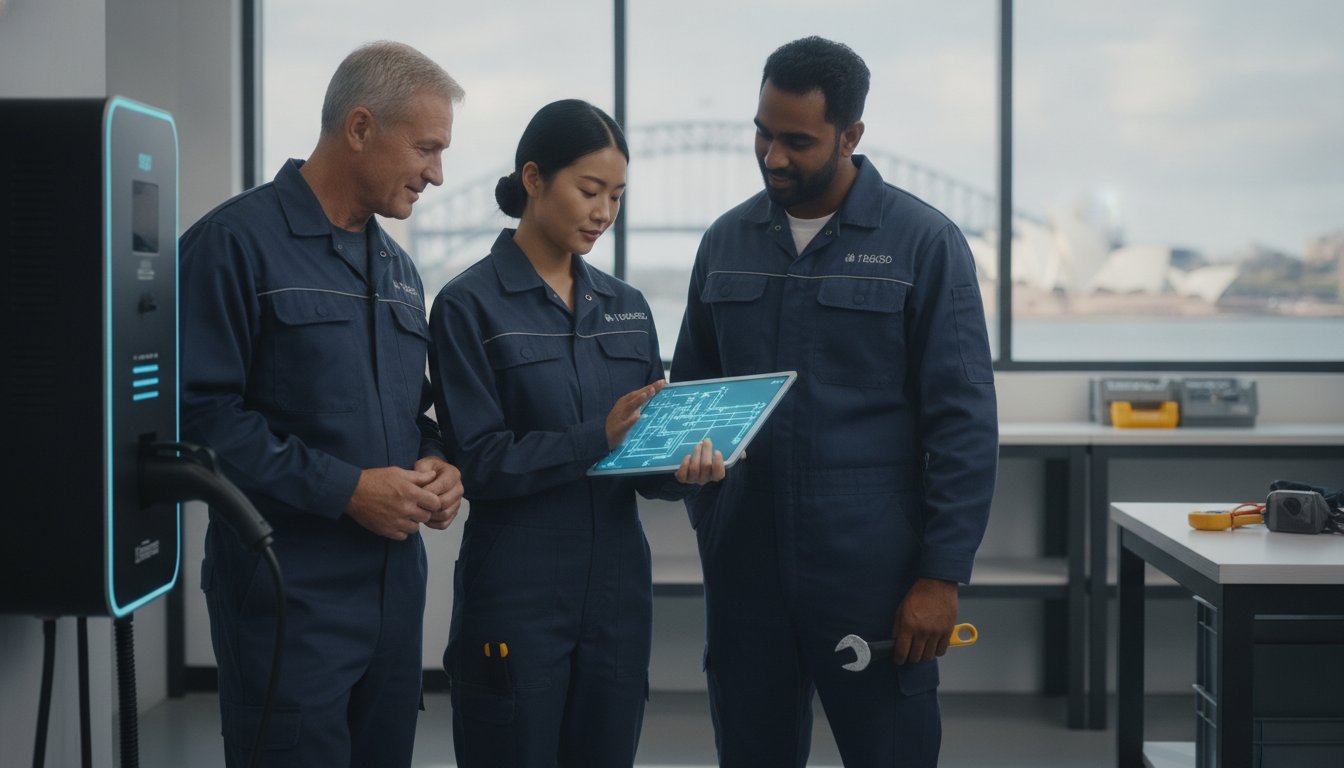
Nearly 1 in 2 trade occupations across Australia are currently facing acute shortages, making it harder than ever to build a sustainable trade talent pipeline in NSW. It's a frustrating cycle to constantly search for qualified staff while facing the high costs and long timelines of traditional four-year apprenticeships. You likely feel the pressure of a competitive market where retaining your best people is just as hard as finding them in the first place, but you aren't alone in looking for a better way forward.
You can secure your workforce future by leveraging NSW government funding and formalising the existing skills of your experienced workers through Recognition of Prior Learning (RPL). This article explores how to use fee-free initiatives like the Trade Pathways for Experienced Workers (TPEW) program and Smart and Skilled subsidies to create a fully certified workforce. We'll show you how partnering with the right training provider can help you reduce recruitment costs and ensure your team has the nationally recognised qualifications they need to succeed. By turning hidden expertise into formal credentials, you can build a loyal team that's ready for the future.
Key Takeaways
- Understand how the 2026 skill shortages and the transition to Net Zero are driving an urgent demand for qualified electronics technicians across metro and regional NSW.
- Learn how to fast-track certifications for your experienced staff by using Recognition of Prior Learning (RPL) through the fee-free Trade Pathways for Experienced Workers program.
- Maximise your training budget by leveraging the latest Smart and Skilled funding and eligibility criteria to significantly reduce recruitment and upskilling costs.
- Discover the essential steps to build a sustainable trade talent pipeline in NSW by formalising existing expertise and securing a future-ready, certified workforce.
- Identify why electronics and communications qualifications are the vital link for businesses looking to stay competitive in the modern construction and automotive industries.
The Evolving Landscape of Trade Skills in NSW
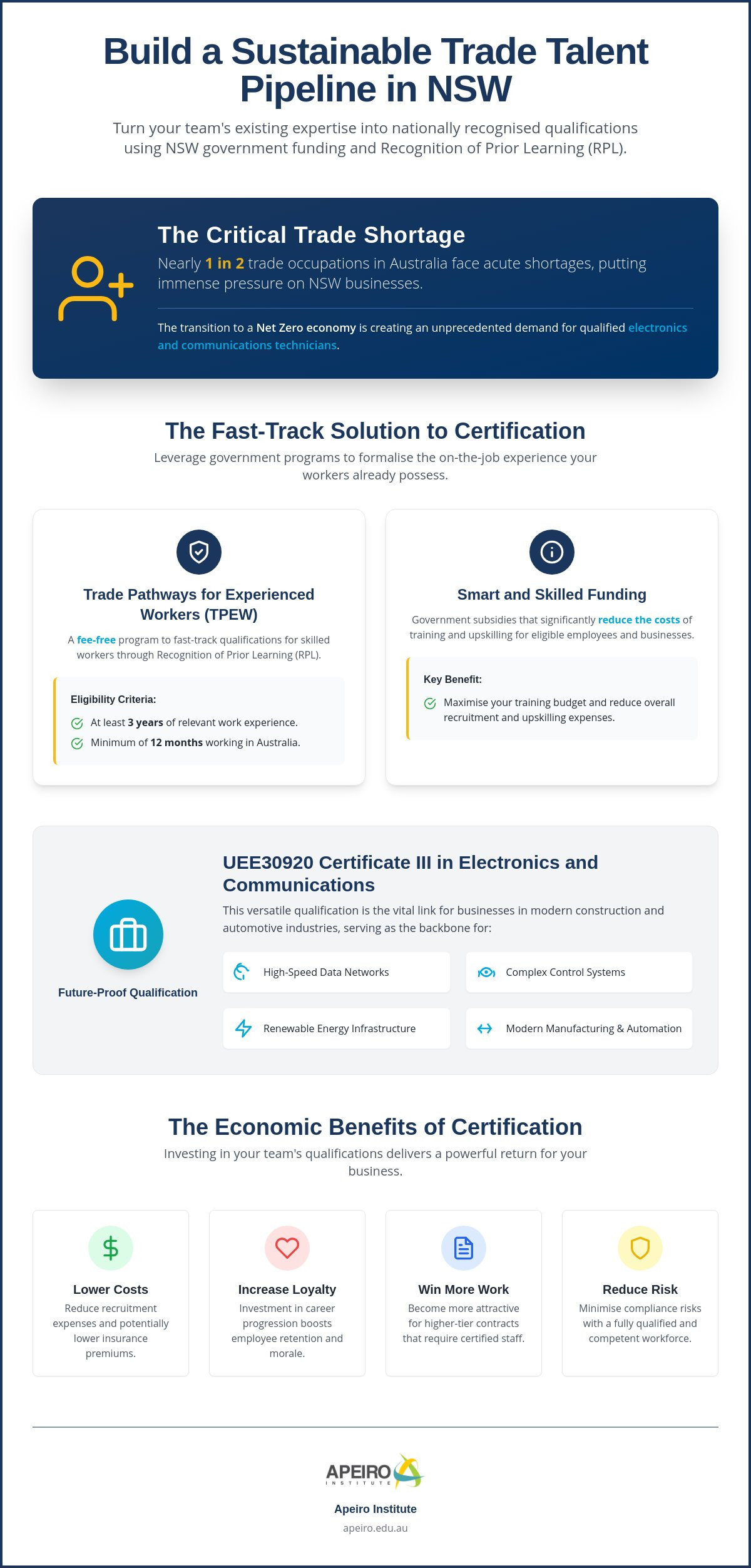
Trade shortages in 2026 are reaching a critical tipping point for businesses across the state. With nearly 1 in 2 trade occupations in Australia currently experiencing shortages, the pressure to find and keep skilled workers has never been higher. In regional hubs and metro centres alike, the struggle isn't just about finding warm bodies; it's about finding people with the right certifications to meet modern standards. The NSW government has responded by prioritising "sovereign capability," a strategy designed to ensure our local industries have the home-grown expertise needed to remain self-sufficient and resilient.
A major driver of this shift is the transition toward a Net Zero economy. This isn't just about environmental policy; it's a massive industrial transformation that is creating an unprecedented demand for electronics technicians. As we move toward renewable energy and smarter infrastructure, the traditional four-year apprenticeship model is often too slow to keep up. Employers now need more flexible, skills-based pathways to build a sustainable trade talent pipeline in NSW. While Technical and Further Education (TAFE) continues to play a vital role in our vocational system, many businesses are now looking for agile training partners who can help them certify their existing workforce quickly and effectively.
The Critical Shortage in Electronics and Communications
The UEE30920 Certificate III in Electronics and Communications has emerged as one of the most versatile qualifications in the current market. It serves as the backbone for everything from high-speed data networks to the complex control systems used in modern manufacturing. Many businesses currently rely on "unqualified hands" who have years of practical experience but lack the formal papers. This gap creates a bottleneck for growth. By turning those experienced workers into certified technicians, you don't just fill a role; you strengthen the communications infrastructure that supports your entire operation.
Economic Benefits of a Certified Workforce
Beyond just filling gaps, having a fully certified team makes excellent business sense. Formal qualifications are often a prerequisite for lower insurance premiums and reduced compliance risks. When your staff are recognised as professionals, your business becomes more attractive to higher-tier contracts that require a verified talent pipeline. Furthermore, there's a clear link between staff certification and employee retention. When you invest in a worker's career progression, they're much more likely to stay loyal to your business. It's a practical, solution-oriented approach that protects your bottom line while empowering your people to grow.
Formalising Expertise through Trade Pathways for Experienced Workers (TPEW)
The Trade Pathways for Experienced Workers (TPEW) program is a game-changer for businesses trying to build a sustainable trade talent pipeline in NSW. Many workers have spent years on the tools, mastering their craft through daily practice, yet they lack the formal certificate required to sign off on complex jobs or move into management. TPEW acts as a fast-track mechanism that bridges this gap. Instead of forcing a seasoned professional into a traditional four-year apprenticeship, this pathway recognises that the skills are already there. It's a practical solution that respects the time and effort your staff have already invested in their careers.
To be eligible for this pathway in NSW, a worker generally needs at least three years of relevant work experience. This must include a minimum of 12 months spent working within Australia. By meeting these criteria, workers can often move through the assessment process in months rather than years. It turns the traditional "time-served" model on its head by focusing entirely on what a person can actually do today. For an employer, this means getting a fully qualified tradesperson on the books much faster, without the productivity dip associated with long-term training absences.
The Mechanics of Recognition of Prior Learning
Recognition of Prior Learning (RPL) is the engine that makes TPEW possible. It's the process of converting years of on-the-job experience into a nationally recognised qualification. This process isn't about sitting in a classroom for hours; it's about providing concrete evidence of competency. An expert RTO assessor validates these practical industry skills, ensuring the individual meets the high standards required for a trade certificate. Assessors look for various proof points, such as:
- Work site photos showing the quality and complexity of completed tasks.
- Detailed logbooks or job cards documenting daily activities and projects.
- Third-party testimonials from licensed supervisors, contractors, or clients.
Benefits for NSW Employers and Tradies
Formalising these skills does wonders for business growth and workplace culture. When you help senior staff gain their papers, you empower them to take on supervisory roles and mentor younger team members. It's an incredible way to boost morale. There's a deep sense of pride that comes from having "street-smarts" officially acknowledged by the government and industry bodies.
Smart employers are now integrating Trade Pathways for Experienced Workers into their recruitment strategy. It allows you to hire talent based on their potential and existing ability, knowing you can get them certified quickly. If you're looking to strengthen your team, you might want to explore how our TPEW specialists can help your staff reach that next level through a supportive and streamlined assessment process.
Maximising NSW Smart and Skilled Funding for Workforce Growth
Investing in your team doesn't have to break the bank. The Smart and Skilled funded courses NSW program is a vital tool for employers who want to build a sustainable trade talent pipeline in NSW without bearing the full financial weight of training. As of 1 July 2026, the NSW government has updated its qualification prices and fees to focus heavily on high-demand sectors. By understanding how these subsidies work, you can strategically upskill your staff while keeping your overheads manageable. It's a practical, solution-oriented way to ensure your business remains competitive and compliant.
Eligibility for these subsidies is surprisingly broad. Generally, if your workers are Australian citizens or permanent residents, aged 15 or over, and live or work in NSW, they can access government-subsidised training. The "NSW Skills List" is the key document here; it identifies the specific qualifications the state is willing to fund. By aligning your workforce development with these high-priority trades, you can often access fee-free training for eligible participants. This allows you to offset training costs significantly while building a team that's ready for 2026 and beyond.
Funded Apprenticeships and Traineeships
NSW offers different funding streams for new-entrant and existing-worker traineeships. New-entrant programs focus on bringing fresh talent into the industry, while existing-worker pathways allow you to certify long-term staff who have been with you for more than three months. Applying for these subsidies is a methodical process. You'll need to partner with an approved Smart and Skilled provider who can guide you through the enrolment and eligibility checks. Choosing a flexible, approved RTO is essential for maintaining a steady training rhythm and ensuring you don't miss out on available state support.
Incentives for Regional NSW Businesses
Operating outside the major metro centres of Sydney, Newcastle, or Wollongong often comes with unique logistical challenges. To support these businesses, the NSW government provides specific regional loading. This extra support helps cover the costs of delivering training in more remote areas. Your staff may also be eligible for travel and accommodation allowances if they need to travel for block-release training. We recommend looking into how these state-wide funds can be combined with local community grants. It's a powerful way to support your local economy while you build a sustainable trade talent pipeline in NSW that isn't dependent on city-based recruitment.
Future-Proofing with Electronics and Communications Certifications
Modern construction and automotive industries are no longer just about brick, mortar, and steel. Electronics and communications have become the "glue" that holds these sectors together. If you want to build a sustainable trade talent pipeline in NSW, you need a team that understands the digital heartbeat of every project. From smart homes to advanced vehicle diagnostics, the demand for electronic literacy is skyrocketing. By diversifying your team's skill set, you ensure your business isn't left behind as technology evolves.
The integration of smart technology is now standard in NSW residential and commercial builds. Clients expect integrated security, climate control, and high-speed data as part of the package. A multi-skilled team that can handle both hardware and software is a massive competitive advantage. It allows you to offer more comprehensive services. It also reduces your reliance on external contractors for the technical parts of a job. This internal capability is what separates a standard trade business from an industry leader.
The Versatility of Certificate III in Electronics
The UEE30920 qualification is incredibly broad. It requires the successful completion of 1060 weighting points, which includes 680 core and 380 specialty units. These modules cover essential areas like data cabling, security systems, and renewable energy. This versatility makes it a magnet for top-tier NSW talent who want a career with longevity. It's not just a trade; it's a career path. It offers clear progression from a Certificate III into Advanced Diplomas as workers move into senior design or management roles. For a business, this means your staff can grow with you over many years.
Upskilling Your Current Automotive or Construction Team
You don't always need to hire new people to find these skills. Cross-training your existing Light Vehicle Mechanics in electronic diagnosis is a brilliant way to handle the influx of electric and hybrid vehicles. Similarly, having an on-site electronics specialist for civil projects can prevent costly delays in communications infrastructure. This proactive approach is the best way to build a sustainable trade talent pipeline in NSW while preparing for the 2027-2030 technology roadmap. If you're ready to get started, contact Apeiro Institute today to discuss how we can help upskill your workforce through flexible, nationally recognised training.
Strategic Partnerships: Scaling Your Trade Business with Apeiro Institute
Scaling a trade business in a competitive market requires more than just luck. It demands a deliberate strategy to build a sustainable trade talent pipeline in NSW. As an RTO (45394), Apeiro Institute understands that your time is best spent on-site, not buried in training paperwork. We act as your strategic partner. We handle the heavy lifting of Smart and Skilled administration so you can focus on growth. Our approach is designed to be seamless, ensuring that your workforce development aligns with your commercial objectives without disrupting your daily operations.
We don't believe in a one-size-fits-all model. We recognise that every trade business has unique demands, which is why we offer customised training delivery. Whether your team needs on-site assessments or flexible classroom hours that suit your specific operating schedule, we work with you to find a solution. This student-centred support extends beyond the classroom. We provide expert guidance through every step of the journey, ensuring your staff feel confident and supported as they gain their formal qualifications. It's a partnership built on mutual success.
A Community of Excellence
At Apeiro, we are proud to foster a community of excellence. Our diverse student body represents over 38 nationalities, bringing a wealth of global perspectives to the local NSW trade scene. This diversity helps foster an inclusive workplace culture within your own business as your team trains alongside a wide range of peers. Our trainers are industry veterans with years of real-world NSW experience. They don't just teach theory; they share practical insights that your staff can apply on the tools immediately. This combination of local reliability and global awareness creates a superior learning environment for your future leaders.
Taking the Next Step
Ready to secure your workforce's future? The first step is a comprehensive workforce skills audit. Our specialist team will help you identify existing expertise that can be formalised through Trade Pathways for Experienced Workers or standard apprenticeship pathways. We’ve simplified the onboarding process for new candidates and RPL applicants to ensure a smooth transition into training. If you're ready to build a sustainable trade talent pipeline in NSW, Contact Apeiro Institute today to discuss how we can scale your business together. We are here to act as the bridge between your current team and your future goals.
Securing Your Workforce for 2026 and Beyond
Building a resilient team requires a shift from traditional hiring to strategic upskilling. By formalising the "street-smarts" of your experienced workers through TPEW and maximising the latest Smart and Skilled subsidies, you can turn existing talent into a fully certified powerhouse. Focusing on high-demand certifications in electronics and communications ensures your business stays relevant as the industry moves toward smarter, greener technology. It's a clear path to reducing recruitment costs while boosting staff loyalty and pride.
To build a sustainable trade talent pipeline in NSW, you don't have to navigate the complex funding landscape alone. Apeiro Institute (RTO Code 45394; CRICOS Provider 03703M) acts as your expert guide. We are specialists in Trade Pathways for Experienced Workers and are ready to help you audit your team's skills to secure the funding they deserve. Your journey toward a more qualified and confident workforce starts with a simple, supportive conversation.
Enrol your team in NSW Smart and Skilled funded training today and take the first step toward a more secure professional future. We're excited to partner with you in your success.
Frequently Asked Questions
What is the NSW Smart and Skilled program?
The NSW Smart and Skilled program is a government initiative that provides subsidies for vocational education and training to help people gain the skills needed for high-demand jobs. It allows eligible individuals to access government-funded training for qualifications ranging from Certificate I through to Advanced Diplomas. The program is designed to ensure the NSW workforce remains competitive and skilled in priority industries like electronics, automotive, and community services.
How much does it cost to get trade certified through RPL?
The cost of gaining a trade certificate through Recognition of Prior Learning (RPL) depends on the specific qualification and the amount of evidence you need to provide. While we don't provide fixed prices here, many students find that government subsidies like Smart and Skilled or the fee-free TPEW program can significantly reduce or even eliminate out-of-pocket costs. It's best to contact our team for a personalised assessment of your eligibility.
Can I get a trade qualification if I have years of experience but no papers?
Yes, you can certainly gain a nationally recognised qualification by formalising your on-the-job skills through Recognition of Prior Learning (RPL). This process allows an assessor to map your existing expertise against the requirements of a specific trade certificate. It is one of the most effective ways to build a sustainable trade talent pipeline in NSW by turning your experienced staff into fully qualified professionals without the need for a four-year apprenticeship.
Are there fee-free trade courses available in NSW in 2026?
Yes, several fee-free options are available in 2026 for eligible participants, most notably through the Trade Pathways for Experienced Workers (TPEW) program. This initiative is specifically designed to address acute skill shortages by providing a fully subsidised pathway for experienced but unqualified workers. To qualify, workers typically need at least three years of relevant experience, including 12 months of work within Australia. These programs help businesses upskill their teams at zero tuition cost.
How long does a Certificate III in Electronics and Communications take?
A traditional apprenticeship for this qualification usually takes four years to complete. However, for those with significant industry experience, the timeline can be shortened to just a few months through RPL or the TPEW program. The UEE30920 qualification involves 1060 weighting points, and the duration depends on how quickly you can demonstrate your competency in the required units. We work with you to ensure the assessment process fits around your work schedule.
What is the difference between an apprenticeship and a traineeship in NSW?
Apprenticeships generally focus on traditional skilled trades like electronics or automotive and usually take three to four years to complete. Traineeships are typically shorter, often lasting one to two years, and cover a wider range of vocational areas like business or individual support. Both pathways offer government-subsidised training options under the Smart and Skilled framework, helping you provide structured career progression for both new and existing staff members.
How do I check if my business is eligible for training subsidies?
You can check your eligibility by consulting the current NSW Skills List or by speaking with an approved training provider like Apeiro Institute. Generally, your business is eligible if your employees are Australian citizens or permanent residents who live or work in NSW. Our team can conduct a workforce skills audit to identify the best funding streams to help you build a sustainable trade talent pipeline in NSW while minimising your training expenses.
Why should I choose an RTO like Apeiro over a traditional TAFE?
Apeiro Institute offers a flexible, student-centred approach that is specifically designed to meet the needs of busy trade businesses. We specialise in fast-track pathways like RPL and TPEW, providing a level of personalised support that larger institutions often cannot match. Our trainers have real-world industry experience, and we can customise our delivery to suit your operating hours. This ensures your staff get the certification they need without the traditional hurdles of institutional learning.

Disclaimer
The information provided on this blog is for general informational and educational purposes only. While every effort is made to ensure the accuracy and reliability of the content, the author makes no representations or warranties of any kind, express or implied, about the completeness, accuracy, suitability, or availability of the information contained on this blog.
The views and opinions expressed in blog posts are those of the individual author and do not necessarily reflect the official policy or position of any organization, company, or employer.
This blog may contain links to external websites or third-party content. These links are provided for convenience only, and the author has no control over and assumes no responsibility for the content, privacy policies, or practices of any third-party sites.
Nothing on this blog constitutes professional advice (legal, financial, medical, or otherwise). Readers are encouraged to seek appropriate professional guidance before making any decisions based on the information provided here.
By using this blog, you acknowledge that any reliance on the information is at your own risk.


