

Have you ever wondered why some talented backyard tuners can't legally charge for their work while others build thriving careers in professional workshops? It isn't just about knowing your way around a turbocharger; it's about holding the right legal credentials. Learning how to become a mechanic in NSW involves more than a passion for cars. It's a journey through specific licensing laws and training requirements that can often feel like a maze of confusing acronyms.
We understand that terms like RTO, RPL, and TPEW can make the process seem far more complicated than it needs to be. You might be worried about the long-term commitment of an apprenticeship or the rising costs of education. This is a common concern for many aspiring tradespeople who just want a clear path forward. This 2026 guide is designed to remove that uncertainty and provide you with a straightforward roadmap to your new career.
You'll discover the exact steps to earn your Motor Vehicle Tradesperson Certificate, including how to navigate the AUR30620 qualification. We'll also explain how to access government-funded training through the Smart and Skilled program and explore flexible study pathways that respect your existing experience. By the end of this article, you'll have the confidence to turn your mechanical skills into a fully licensed profession.
Key Takeaways
- Understand why a Motor Vehicle Tradesperson Certificate from NSW Fair Trading is legally mandatory for anyone performing unsupervised repair work in a workshop.
- Master the industry-standard AUR30620 Certificate III in Light Vehicle Mechanical Technology to gain essential skills in diagnostics, engines, and transmissions.
- Learn how to become a mechanic in NSW through fee-free apprenticeship pathways supported by the NSW Smart and Skilled funding program.
- Explore flexible options like Recognition of Prior Learning (RPL) and Trade Pathways for Experienced Workers (TPEW) to fast-track your qualification if you already have trade experience.
- Get a clear roadmap for your final licence application, including a breakdown of the 2026 fees and required documentation for NSW Fair Trading.
Understanding the Legal Requirements for Mechanics in NSW
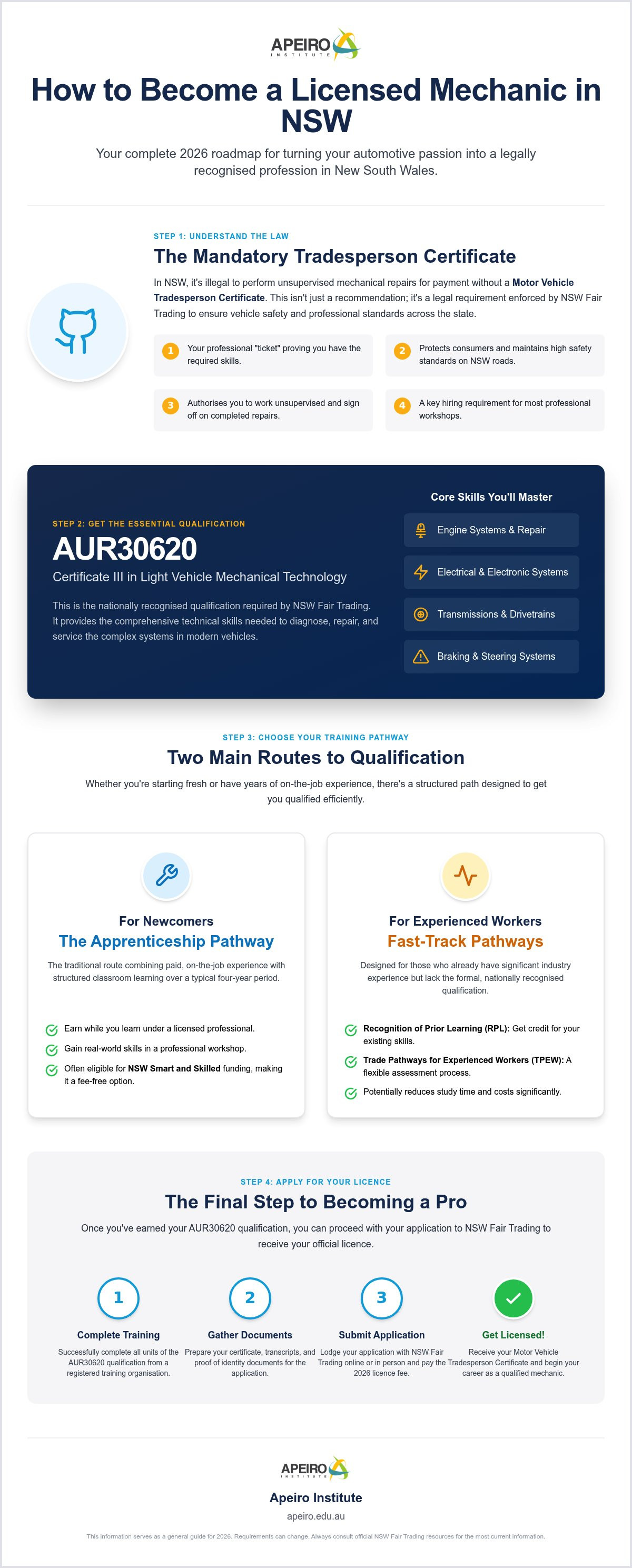
In New South Wales, the automotive industry is strictly regulated to ensure every vehicle on our roads meets high safety standards. This regulation is overseen by NSW Fair Trading. If you are researching how to become a mechanic in NSW, you must understand that you cannot simply pick up a spanner and start charging for repairs. To work as a lead mechanic or perform unsupervised repair work, you are legally required to hold a Motor Vehicle Tradesperson Certificate. This certificate acts as your professional "ticket," proving to the government, your employer, and your customers that you have the necessary skills to work safely.
The law makes a clear distinction between an apprentice and a fully qualified tradesperson. While an apprentice is a learner who must work under the direct supervision of a licensed professional, a tradesperson has the authority to sign off on work and mentor others. An Auto mechanic in NSW must also meet the "fit and proper person" requirement. This involves a background check by Fair Trading to ensure you are honest and reliable, which helps maintain the integrity of the trade across the state.
The Motor Vehicle Tradesperson Certificate
This certificate isn't a one size fits all document. It specifies the "classes of repair" you are qualified to perform, such as light vehicle mechanics, electrical, or panel beating. Holding the correct class is vital. If you perform work outside your licensed category, you risk heavy fines and legal issues. Most workshop owners in NSW will not hire a lead mechanic without this credential because their business insurance and safety compliance depend on it. It provides peace of mind that the person working on a car's braking system or engine truly knows what they're doing.
The Path from Student to Licensed Professional
Transitioning from an aspiring student to a licensed professional takes dedication. Most people follow one of three pathways: a traditional four year apprenticeship, intensive institutional training, or Recognition of Prior Learning (RPL) for those who already have years of experience. You should expect a significant time commitment, as mastering modern vehicle diagnostics requires both theoretical knowledge and hands on practice. Choosing a nationally recognised training partner is a critical first step. It ensures your qualification will be accepted by Fair Trading when you finally submit your licence application. By selecting a partner that understands the local landscape, you can navigate the 2026 requirements with much more confidence.
The Essential Qualification: AUR30620 Certificate III in Light Vehicle Mechanical Technology
The AUR30620 is the backbone of the automotive trade in Australia. If you're figuring out how to become a mechanic in NSW, this is the specific qualification code you'll see on every job board and training site. It isn't just a piece of paper; it's a comprehensive training package that ensures you can handle the complexity of modern cars. From hybrid systems to traditional internal combustion engines, this qualification covers the full spectrum of light vehicle technology. It's designed to turn your passion for cars into a technical profession.
NSW Fair Trading requires this specific qualification before they will issue your Motor Vehicle Tradesperson Certificate. This ensures that every licensed professional on the workshop floor has spent hundreds of hours mastering both the theory in the classroom and the practical application on the hoist. It's about safety, precision, and staying ahead of rapid industry changes. You'll spend a significant amount of time in a workshop environment, balancing bookwork with real world repairs to ensure you're job ready from day one.
Core Units and Skills You Will Master
Modern vehicles are essentially computers on wheels. You'll learn to diagnose complex faults in electronic engine management systems using high tech scan tools. The Certificate III in Light Vehicle Mechanical Technology also covers the essential "bread and butter" of the trade. You will master servicing braking, steering, and suspension components to strict Australian standards. You'll also study environmental and safety regulations, ensuring you can manage workshop waste and workplace health and safety (WHS) protocols correctly. This holistic approach prepares you for the high standards expected in Australian workshops.
Entry Requirements and Prerequisites
You don't need a university degree to start, but you do need a solid foundation. Most RTOs require a Language, Literacy, and Numeracy (LLN) assessment to ensure you can handle technical manuals and complex calculations. You'll also need a Unique Student Identifier (USI). This is a mandatory reference number for all Australian VET students that keeps your training records in one place throughout your career.
Mechanics work in a physically demanding environment. You'll need a "can-do" attitude and a reasonable level of physical fitness to handle the daily tasks of a busy workshop. If you're ready to get your hands dirty and start your journey, you can explore our light vehicle programme today to begin building your professional future. We're here to help you navigate these requirements and get you into the workshop as quickly as possible.
Starting as an Apprentice: NSW Smart and Skilled Funding
The traditional apprenticeship remains the most popular way to learn the trade. It allows you to earn a wage while completing your studies, ensuring you don't end up with a massive debt at the end of your training. If you are looking at how to become a mechanic in NSW, the apprenticeship pathway offers a unique blend of "grease under the fingernails" experience and structured classroom learning. You aren't just reading about engines; you're pulling them apart under the guidance of a seasoned mentor in a real workshop.
Workplace based training is invaluable. It teaches you the pace of a professional environment and the reality of customer deadlines. While textbooks provide the theory, the workshop floor provides the context. You'll learn how to handle tools correctly, manage workshop safety, and interact with a team of experienced tradespeople. This hands on immersion is what truly builds a competent mechanic.
Accessing Fee-Free Training in NSW
Cost is often a major hurdle for students. However, the NSW Government's Smart and Skilled program has transformed accessibility. For 2026, eligible apprenticeships in NSW are fee-free. This means government subsidies cover the full cost of your Certificate III, allowing you to focus on your skills rather than your bank balance. To be eligible, you generally need to be an Australian citizen or permanent resident, living or working in NSW, and aged 15 years or older. Your Registered Training Organisation (RTO) works alongside the government to manage this funding, delivering the "off the job" training component while you remain employed.
The Apprentice Journey: What to Expect
A typical week involves balancing four days on the tools with one day of dedicated study. This rhythm ensures that what you learn in the classroom on Monday can be applied in the workshop on Tuesday. This structured approach is the gold standard for anyone learning how to become a mechanic in NSW because it builds muscle memory alongside technical theory. A training plan is created at the start, acting as a formal agreement between you, your employer, and your RTO. This document outlines exactly what skills you will learn and when you'll learn them.
Finding a place to start can be done by contacting local workshops directly or through a Group Training Organisation (GTO). GTOs act as your legal employer and "host" you out to different workshops, providing extra support if a business's circumstances change. Once you complete this journey and hold your qualification, you can finally apply for a motor vehicle tradesperson certificate through Fair Trading. This final step officially recognises your hard work and allows you to work as a fully qualified professional in the NSW automotive industry.
Trade Pathways for Experienced Workers: Fast-Tracking Your Career
Many skilled individuals have spent years under car bonnets without ever receiving a formal qualification. If you're one of them, you're likely looking for how to become a mechanic in NSW without starting a four year apprenticeship from scratch. Your existing expertise has significant value. Through the Trade Pathways for Experienced Workers (TPEW) initiative, you can transform your years of "on the tools" experience into a nationally recognised Certificate III. This pathway is specifically designed for those who have the skills but lack the paperwork.
Formalising your skills isn't just about getting a certificate. It's about securing your future. In the current NSW market, uncertified workers often face a pay ceiling and lack the legal standing to sign off on their own work. By achieving your qualification, you unlock higher award rates and meet the mandatory requirements for a Fair Trading licence. It's a strategic move for any experienced worker looking to stabilise their career and gain the professional respect they've earned through years of hard work.
The RPL Assessment Process
Recognition of Prior Learning (RPL) is a rigorous but rewarding process. Instead of sitting in a classroom learning things you already do every day, you provide evidence of your competency. This involves gathering work logs, references from previous employers, and even photos or videos of you performing specific tasks. You aren't just telling an assessor you can do the job; you're proving it through documented history. It's a practical way to show you've mastered the trade.
An industry expert will usually conduct a "challenge test" or practical observation to verify your skills. If the assessment reveals a few gaps in your knowledge, such as the latest electronic diagnostic protocols, you don't have to redo the whole course. You simply bridge the gap by studying those specific units. This targeted approach respects your time and your existing talent, ensuring you only study what you actually need to learn.
Benefits of TPEW for NSW Mechanics
The primary advantage of the TPEW framework is speed. You can often reduce the time to qualification from several years down to just a few months. This is the most efficient method for how to become a mechanic in NSW if you've already put in the hard yards in a workshop. It allows you to move into a lead role or even start your own mobile repair business much sooner than a traditional pathway would allow. You gain the freedom to grow your career on your own terms.
Read more: Trade Pathways for Experienced Workers Australia Guide.
Apply for a TPEW skill assessment today
Applying for Your NSW Motor Vehicle Tradesperson Certificate
Applying for your licence is the rewarding final hurdle. It's the moment you transition from a dedicated student to a professional tradesperson. If you've been following the path of how to become a mechanic in NSW, you'll know that your hard work in the workshop is about to pay off. This certificate is your legal right to work without supervision. It's issued by NSW Fair Trading and proves you've met the state's rigorous safety and skill standards. Holding this document means you're no longer just a learner; you're a qualified expert.
Documentation is the key to a smooth process. You'll need your graduation certificate and a full transcript from your RTO. These documents prove you've mastered the AUR30620 units. You'll also need to prove your identity, usually with a driver's licence and Medicare card. When you apply, you must select the correct "class of repair." For most, this will be "Light Vehicle Mechanic." Choosing the wrong class can limit the work you're legally allowed to perform, so double check your qualification details before submitting your paperwork.
Step-by-Step Application Guide
- Complete your AUR30620 qualification with an approved RTO.
- Gather your transcripts and graduation certificate.
- Lodge your application through the Service NSW portal.
- Pay the relevant fee for a 1, 3, or 5-year certificate.
As of late 2026, the fees for a tradesperson certificate are structured to encourage online applications. A one year certificate costs $33 if lodged online, while a three year option is $78. For those committed to the long term, a five year certificate is available for $131. You'll need to keep track of your renewal dates to ensure your licence remains current. Engaging in continuing professional development is also a great way to stay updated with the latest hybrid and electric vehicle technologies, ensuring your skills never become outdated.
Next Steps: Career Progression and Specialisation
Getting your licence is just the beginning. Many qualified mechanics choose to specialise further to increase their earning potential. You might consider moving into advanced diagnostics with a Certificate IV in Automotive Mechanical Diagnosis. This higher level training focuses on complex electronic faults and high level performance tuning. It's the perfect next step for those who enjoy the technical "detective work" of the trade.
A nationally recognised qualification also provides the foundation for workshop management or even starting your own mobile mechanic business. Once you have your tradesperson certificate, you can eventually apply for a Motor Vehicle Repairer Licence if you decide to work for yourself. This allows you to open your own premises or operate a mobile service. The journey of how to become a mechanic in NSW is a doorway to a lifetime of professional independence and technical mastery.
Drive Your Career Forward in the Automotive Trade
Becoming a qualified tradesperson is a rewarding journey that offers professional freedom, technical mastery, and long-term job security. You now have a comprehensive roadmap for how to become a mechanic in NSW, covering everything from the mandatory AUR30620 qualification to the final Fair Trading licensing steps. Whether you choose to earn while you learn through a fee-free apprenticeship or fast-track your years of workshop experience via Recognition of Prior Learning, the path to success is clearer than ever.
We are dedicated to supporting your growth as a nationally recognised training provider (RTO 45394). Our expert industry trainers bring years of real-world experience to the workshop, ensuring you gain practical skills that meet modern standards. With our flexible RPL and Trade Pathway options, we help you bridge the gap between where you are and where you want to be in the automotive industry.
Start your journey to becoming a qualified mechanic with Apeiro Institute today
Your future as a licensed professional is within reach. Take that first step today and join a community of skilled tradespeople driving the industry forward across New South Wales. We are here to guide you through every stage of your professional development.
Frequently Asked Questions
How long does it take to become a qualified mechanic in NSW?
A standard apprenticeship typically takes four years to complete. However, if you are looking at how to become a mechanic in NSW and already have industry experience, you can significantly reduce this timeframe. Through Recognition of Prior Learning (RPL) or the Trade Pathways for Experienced Workers (TPEW) program, you can formalise your skills in as little as a few months. The duration ultimately depends on your existing knowledge and the intensity of your training plan.
Can I become a mechanic without an apprenticeship in NSW?
Yes, you can become a qualified mechanic without a traditional four year apprenticeship. While apprenticeships are common, you can also complete the AUR30620 qualification through full time institutional study at an RTO. If you've already worked in a workshop for several years, you might be eligible for the Trade Pathways for Experienced Workers (TPEW) initiative. This allows you to formalise your expertise through a skills assessment rather than starting as a junior learner.
What is the difference between a mechanic and a motor vehicle tradesperson?
While people often use these terms interchangeably, there is a legal distinction in New South Wales. A "mechanic" is a general job title for someone who repairs vehicles. A "Motor Vehicle Tradesperson" is the specific legal title given to an individual who holds a certificate from NSW Fair Trading. You must hold this certificate to work unsupervised or sign off on repairs. Holding the AUR30620 qualification is the primary requirement for gaining this professional title.
How much does it cost to get a mechanic qualification in NSW?
The cost depends on your eligibility for government subsidies. Under the NSW Smart and Skilled program, many apprenticeships are fee-free, meaning the government covers the training costs. For those not eligible for funding, commercial rates for the AUR30620 Certificate III in Light Vehicle Mechanical Technology generally range between $18,300 and $22,200 across the industry. You should always check your eligibility for subsidies with your RTO before enrolling to minimise your out of pocket expenses.
Do I need a separate licence to work on air conditioning or LPG systems?
Yes, specific types of automotive work require additional endorsements or separate licences. For example, to work on automotive air conditioning systems, you must hold a refrigerant handling licence from the Australian Refrigeration Council (ARC). Similarly, working on LPG or CNG systems requires specific units of competency and a specialised endorsement on your tradesperson certificate. These extra qualifications ensure you can safely handle hazardous materials and comply with strict environmental and safety regulations.
Is the Certificate III in Light Vehicle Mechanical Technology recognised in other states?
Yes, the AUR30620 Certificate III in Light Vehicle Mechanical Technology is a nationally recognised qualification. Because it is part of the Australian Qualifications Framework (AQF), your training is valid in every state and territory across Australia. This provides excellent career mobility, allowing you to move interstate without needing to retrain. While licensing requirements like the tradesperson certificate are state specific to NSW, the underlying technical qualification remains the industry standard nationwide.
What is Smart and Skilled funding and am I eligible?
Smart and Skilled is a NSW Government program that provides subsidised vocational training to help people gain new skills. You are generally eligible if you live or work in NSW, are an Australian citizen, permanent resident, or humanitarian visa holder, and are aged 15 years or older. This funding can significantly reduce or even eliminate the cost of your Certificate III. It's a fantastic way to access high quality, industry focused training without financial stress.
Can international students become mechanics in NSW?
International students can certainly learn how to become a mechanic in NSW by enrolling in CRICOS registered vocational programs. These courses are specifically designed to meet Australian industry standards while fulfilling student visa requirements. At Apeiro Institute, we welcome students from over 38 nationalities into our automotive programs. Upon graduation, international students hold a nationally recognised qualification that can serve as a foundation for a global career in the automotive technology sector.

Disclaimer
The information provided on this blog is for general informational and educational purposes only. While every effort is made to ensure the accuracy and reliability of the content, the author makes no representations or warranties of any kind, express or implied, about the completeness, accuracy, suitability, or availability of the information contained on this blog.
The views and opinions expressed in blog posts are those of the individual author and do not necessarily reflect the official policy or position of any organization, company, or employer.
This blog may contain links to external websites or third-party content. These links are provided for convenience only, and the author has no control over and assumes no responsibility for the content, privacy policies, or practices of any third-party sites.
Nothing on this blog constitutes professional advice (legal, financial, medical, or otherwise). Readers are encouraged to seek appropriate professional guidance before making any decisions based on the information provided here.
By using this blog, you acknowledge that any reliance on the information is at your own risk.


