
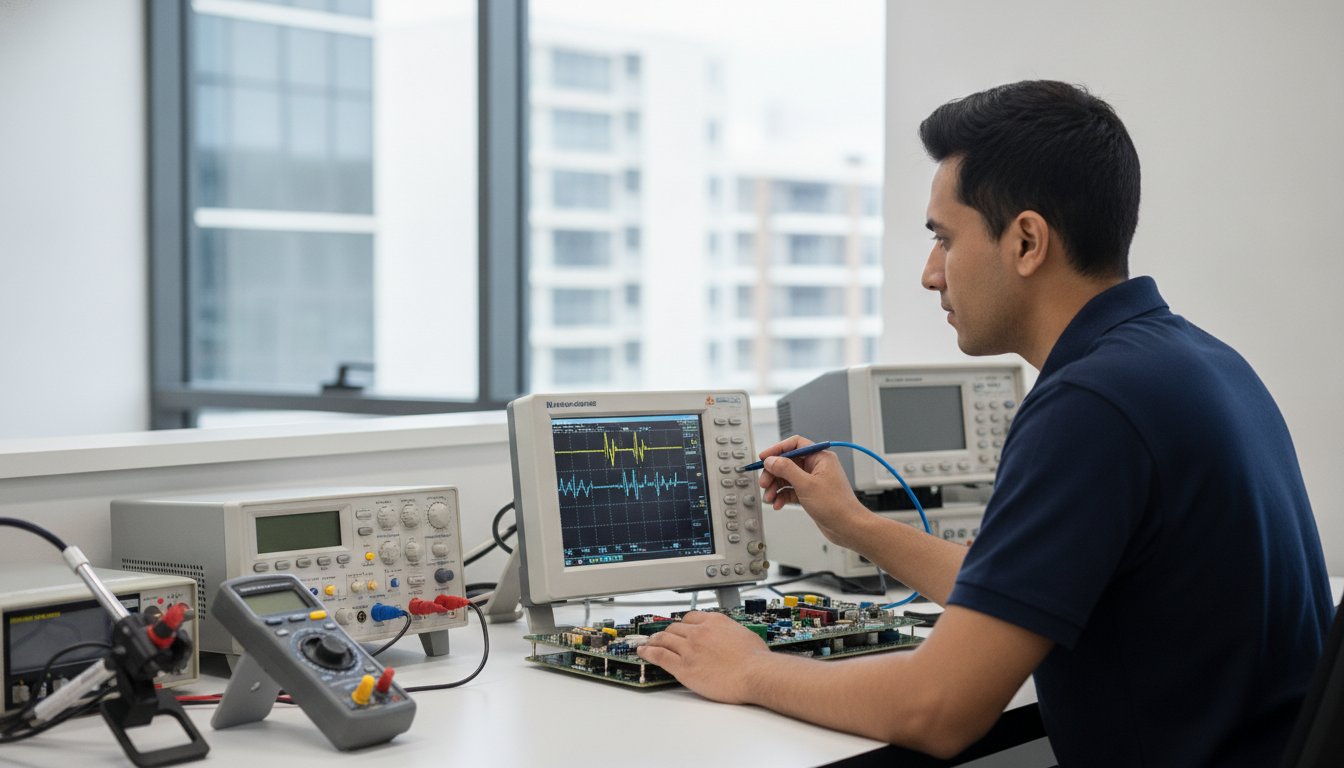
What if you could master complex circuit diagnostics and fault finding without losing a single day’s pay to a classroom? For many aspiring technicians, the biggest hurdle to career growth is the thought of sitting through theory-heavy lectures while their income stalls. It's a common frustration to feel like you're falling behind in a tech industry that moves faster than a textbook can be printed. We understand that you need practical skills that translate directly to the workbench. Exploring the benefits of workplace based training - UUE30920 allows you to bridge that gap by learning in the thick of the action.
This article shows you how the UEE30920 Certificate III in Electronics and Communications transforms your career by turning your daily job into a high-performance laboratory. You'll discover how to gain a nationally recognised qualification while earning a full wage and building technical mastery that classroom-only students often miss. We will explore how this pathway provides a competitive edge in the Australian industry, helps you master real-world electronics repair, and sets you on a path for faster career progression.
Key Takeaways
- Stay ahead of the curve by training with industry-standard equipment that evolves faster than any static textbook or classroom manual.
- Build a well-rounded professional profile by developing essential soft skills, such as client communication and on-site time management, alongside your technical tasks.
- Explore the benefits of workplace based training - UUE30920 for businesses, including reduced recruitment costs and the ability to tailor a student’s skills to specific operational needs.
- Navigate the different pathways to qualification, from traditional apprenticeships to modern Trade Pathways for Experienced Workers (TPEW).
- Learn how Recognition of Prior Learning (RPL) can be used to fast-track your journey by acknowledging the technical expertise you already possess.
Beyond the Classroom: Why Workplace Training is Vital for Electronics
Electronics is moving at lightning speed. A textbook printed last year might already miss the latest advancements in 5G integration or smart circuitry. This is why staying confined to a classroom can actually hinder your professional growth. On-the-job training isn't just a supplement to your studies; it's a necessity. It ensures you are working with the exact gear that top-tier Australian firms use every day. Static theory is important, but it quickly becomes outdated if it isn't tested against current industry standards.
The transition from a student to a professional technician is about more than just passing exams. It's about reliability and precision. When you're on-site, the "mark" you receive is a satisfied client and a system that functions perfectly. One of the primary benefits of workplace based training - UUE30920 is that it forces you to think like a tradesperson from day one. You aren't just memorising diagrams. You're solving problems that have real-world consequences, which builds a level of confidence that a simulated lab environment cannot offer.
Bridging the Theory-Practice Gap in Telecommunications
Complex circuit theory can feel abstract when it's just lines on a whiteboard. In a live telecommunications environment, those lines become tangible components, cables, and connections. Seeing a fault in a live data rack makes the theory "click" in a way a lab simulation simply can't. Troubleshooting communication faults requires a sharp eye and a logical mind. Workplace mentors provide the context that a lecturer in a lab might miss, offering insights that come from years of actual field experience. They help you see the logic behind the fault, making you a more effective technician.
The Shift Toward Industry-Integrated Learning
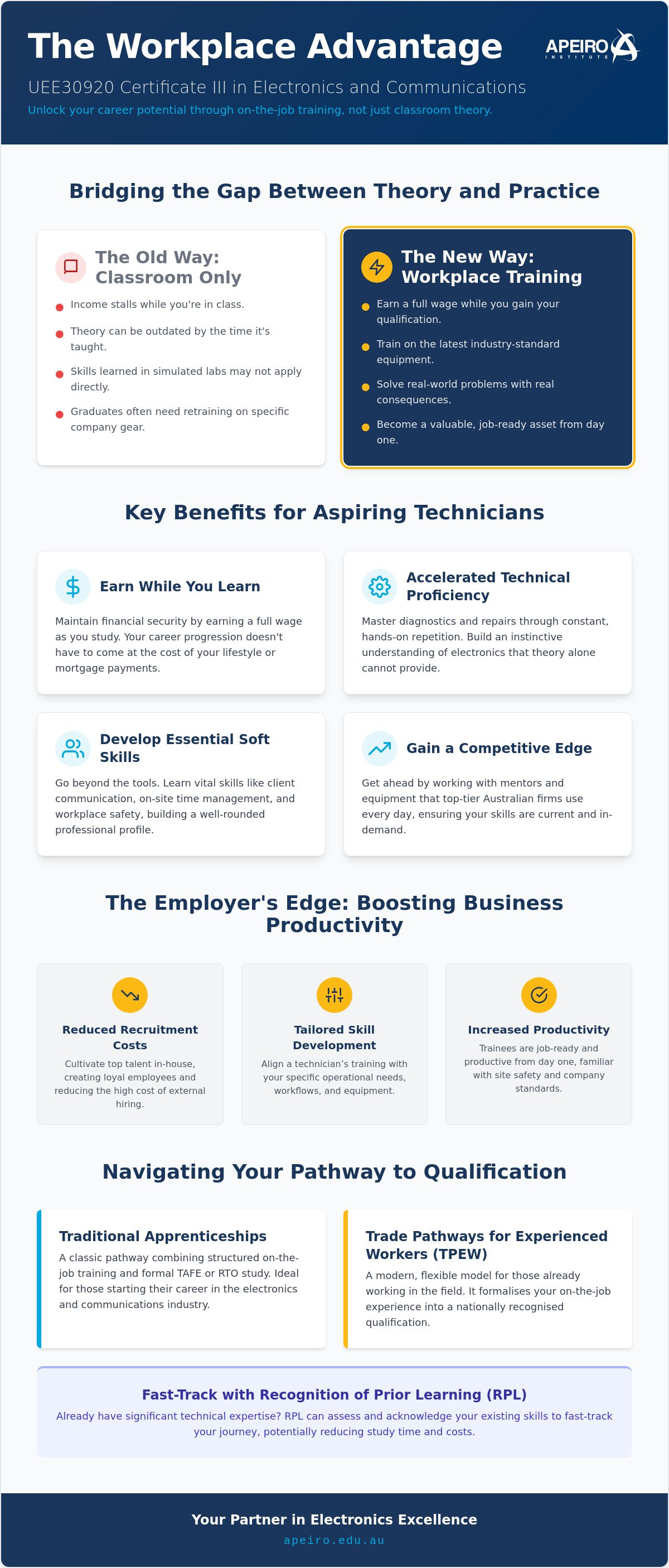
Australia is seeing a massive push toward Vocational Education and Training (VET) that happens where the work happens. Employers no longer want to spend months retraining a graduate on how to actually use a multimeter or navigate a busy job site. They want people who are job-ready and familiar with site safety and workflow. Programmes like the Trade Pathways for Experienced Workers (TPEW) reflect this shift. This model acknowledges that the best classroom is often the one with a "Staff Only" sign on the door. RTOs like Apeiro Institute act as your partner, ensuring your on-site experience meets strict national standards while you continue to earn a wage.
Key Benefits of Workplace-Based Training for UEE30920 Students
Choosing a pathway that integrates with your daily job isn't just about convenience. It's about immersion. One of the most significant benefits of workplace based training - UUE30920 is the sheer speed at which you develop technical competence. In a classroom, you might wire a circuit once or twice. On the job, you do it dozens of times under the guidance of experts. This repetition builds muscle memory and a deep, instinctive understanding of electronics that theory alone can't touch. You aren't just learning to pass a test; you're learning to master a trade that demands precision.
Beyond the tools, you also develop the professional soft skills that define a successful career. Learning how to explain a technical fault to a frustrated client or how to manage your time across multiple sites are lessons best learned on the ground. Perhaps most importantly, workplace-based training through Australian Apprenticeships provides financial security. You don't have to choose between your education and your mortgage. You earn a full wage while you work toward your qualification, ensuring your career progression doesn't come at the cost of your lifestyle.
Accelerated Technical Proficiency and Troubleshooting
The UEE30920 qualification focuses heavily on diagnostic expertise. In a live environment, the pressure to find a fault is real. This pressure hones your ability to think clearly and act decisively. Whether you're working on security systems or complex telecommunications networks, the variety of diverse sites ensures you aren't just a one-trick pony. Another of the benefits of workplace based training - UUE30920 is that it exposes you to equipment and scenarios that a lab environment simply cannot replicate, making you a far more versatile technician.
Building a Professional Network in Real-Time
Think of your training period as a long-term job interview. You aren't just a student; you're a colleague. By working alongside seasoned Australian technicians, you pick up the unspoken rules of the trade. You learn how to carry yourself, how to coordinate with other trades, and how to build a reputation for reliability. These relationships often lead to permanent roles or niche opportunities that never appear on a job board. If you already have significant experience in the field, you might find that Trade Pathways for Experienced Workers is a faster way to get your existing skills formally recognised while staying connected to your professional network.
The Employer’s Edge: How On-the-Job Training Boosts Productivity
For a business owner, training isn't just a line item in the budget. It's a strategic investment in the company's future. One of the most overlooked benefits of workplace based training - UUE30920 is the ability to mould a student’s skills to fit your specific operational needs. Unlike a graduate who has only seen a generic lab, a workplace-trained technician learns your company’s unique protocols, safety standards, and preferred equipment from day one. This customisation ensures that when they finish their qualification, they aren't just a qualified technician; they're a perfect fit for your team.
Recruitment in the electronics sector is notoriously difficult and expensive. Developing talent from within significantly reduces these costs. By investing in an employee’s professional development, you build a culture of loyalty. Technicians who feel their employer is invested in their growth are far more likely to stay long-term. This investment creates a "transfer effect" where the latest theoretical knowledge from the RTO is brought directly back into your workshop. It keeps your business at the cutting edge without requiring every senior staff member to head back to school.
Developing "Work-Ready" Recruits for the Electronics Sector
The Australian electronics industry currently faces a significant skill gap. There simply aren't enough "job-ready" technicians to meet demand. Workplace-based training solves this by ensuring trainees understand the practical realities of a busy job site. They learn the importance of site-specific safety protocols and administrative workflows early on. This familiarity drastically reduces onboarding time. Instead of spending months teaching a new hire where the tools are and how you document a fault, you have a trainee who is already a productive part of the machine.
Transferring Skills to Complex Tasks and New Technologies
Younger trainees often bring a fresh perspective on emerging technologies like 5G, the NBN, and the Internet of Things (IoT). When these students return from their RTO sessions, they often share new diagnostic techniques or software insights with the rest of the team. The workplace supervisor plays a vital role here, guiding the student to apply these new concepts to the company’s specific projects. This structured exchange of technical expertise ensures that skill transfer creates a circular economy of knowledge in a workshop, benefiting both the veteran mentor and the developing trainee. If you have experienced staff who need to formalise these skills, exploring Trade Pathways for Experienced Workers can be an excellent way to boost your team's credentials quickly.
Navigating the Path: Apprenticeships vs. Trade Pathways for Experienced Workers
Choosing the right entry point for your qualification is just as important as the training itself. While school leavers often thrive in a traditional apprenticeship, many adults already working in electronics need a different approach. One of the primary benefits of workplace based training - UUE30920 is the flexibility it offers to different life stages. Whether you're just starting out or have been repairing circuits for a decade, there's a specific pathway designed to get you qualified without hitting pause on your life. With the Australian Government providing $2.9 billion in 2026–27 to support state skills and workforce development, these pathways are more accessible than ever.
Recognising Your Existing Skills (RPL)
If you've spent years in the field without a formal piece of paper, you don't necessarily need to start from scratch. Trade Pathways for Experienced Workers (TPEW) allows you to use your existing knowledge to fast-track your Certificate III. This process, known as Recognition of Prior Learning (RPL), is the secret weapon for mature-age workers in the electronics sector. It turns your documented work history and hands-on experience into credits toward your qualification. It's a respectful way to acknowledge your expertise while filling any remaining gaps in your technical knowledge. Instead of sitting through basics you mastered years ago, you focus only on the new skills you need to reach industry standards.
Balancing Work Commitments and Study
Managing a full-time job alongside study requires a bit of strategy, but it's entirely achievable. The best approach is to treat your daily work tasks as part of your learning evidence. Take photos of your diagnostic work, keep logs of the complex faults you solve, and use these as part of your course portfolio. A supportive RTO understands that site work is unpredictable and will help you organise your assessments around your busy schedule. This collaborative approach ensures you stay on track without feeling overwhelmed by the workload. By integrating your study into your professional life, you ensure that every hour spent on the tools is also an hour spent moving closer to your qualification.
Ready to see which pathway fits your experience? Explore our Trade Pathways for Experienced Workers to find your starting point today.
Get Qualified with Apeiro Institute: Your Partner in Electronics Excellence
Becoming a master technician requires more than just a certificate. It requires a learning environment that respects your time, your income, and your existing expertise. At Apeiro Institute, we specialise in unlocking the benefits of workplace based training - UUE30920 for students across Australia. We act as the bridge between your current professional circumstances and your future career goals. Our role is to be an empowering mentor, providing the authoritative guidance you need while remaining accessible and supportive throughout your entire educational journey.
We don't just support students; we are a dedicated partner for employers too. We understand that a busy workshop or site has its own rhythm. Our team manages the logistics and compliance of the training, allowing you to focus on your core business. By fostering a community-focused and globally aware mentoring style, we ensure that every trainee develops a mindset of excellence. This collaborative approach creates a stronger, more reliable workforce for the Australian electronics industry, ensuring that technical mastery is passed down through practical, hands-on experience.
Flexible Learning that Fits Your Life
Our approach to workplace-based assessment is designed to be as unobtrusive as possible. We focus on practical vocational outcomes that matter to you and your employer. By using your daily tasks as evidence, we ensure that your study enhances your work rather than competing with it. This flexible model is ideal for our diverse student body, providing a clear path to success. For a detailed breakdown of the course requirements, visit our UEE30920 Certificate III in Electronics and Communications pillar page.
Nationally Recognised Excellence
Apeiro Institute is a reputable Registered Training Organisation (RTO 45394) committed to high-standard qualifications. We take pride in seeing our graduates make their mark across the national electronics industry, from telecommunications to security systems. When you train with us, you are gaining a qualification that is respected by employers and industry bodies alike. We ensure that the benefits of workplace based training - UUE30920 result in tangible career progression and increased confidence on the tools. Our enrolment options are steady and organised, guiding you toward your professional objectives with precision.
Enquire today about starting your UEE30920 journey with Apeiro Institute and take the next step in your electronics career.
Take the Next Step Toward Technical Mastery
The path to technical mastery in electronics doesn't have to be a choice between your career and your education. By choosing an industry-integrated model, you ensure your skills are always aligned with the latest technological shifts while maintaining financial stability. We've explored how the benefits of workplace based training - UUE30920 extend far beyond the workbench, creating more productive workshops and clearer career pathways for both new apprentices and seasoned professionals.
Whether you're just starting out or looking to formalise years of on-site experience, the right support makes all the difference. As a Nationally Recognised RTO (45394), Apeiro Institute offers specialised Trade Pathways for Experienced Workers (TPEW) and industry-aligned mentoring from expert trainers who understand the Australian trade landscape. It's time to turn your daily tasks into a recognised qualification and take the next step in your professional growth.
Start your journey toward becoming a qualified electronics technician with Apeiro Institute. We're here to help you bridge the gap between where you are and where you want to be.
Frequently Asked Questions
What are the main benefits of workplace-based training for electronics?
The main benefits of workplace based training - UUE30920 include the ability to earn a full wage while you learn and the chance to work with the latest industry-standard equipment. You gain practical, hands-on experience that textbooks simply cannot match. This model ensures you develop technical mastery and professional soft skills simultaneously, making you highly valuable to Australian employers who prioritise job-ready graduates.
How long does it take to complete the UEE30920 via workplace-based training?
A standard apprenticeship for the UEE30920 typically takes three to four years to complete. However, the duration can be significantly shorter for those with existing skills. If you use a pathway like Recognition of Prior Learning or the Trade Pathways for Experienced Workers, you could finish much sooner. Your actual timeline depends on your current experience level and how quickly you can demonstrate technical competence in the required units.
Can I get a trade qualification if I already have years of experience?
You can definitely obtain a trade qualification if you have years of unrecognised experience in the electronics field. The Trade Pathways for Experienced Workers (TPEW) is specifically designed for professionals who need to formalise their skills. It acknowledges your existing expertise, allowing you to bypass basic training. This ensures you don't waste time relearning what you already know while still meeting the national standards for a Certificate III.
Is workplace-based training as good as a university degree for electronics?
Workplace-based training is not necessarily "better" than a degree, but it is far more practical for those wanting to work on the tools. While a university degree focuses on theoretical engineering and design, a Certificate III is designed for diagnostic, repair, and installation tasks. If your goal is to be a hands-on technician in the Australian telecommunications or security sectors, the vocational pathway offers more direct industry integration.
How does RPL (Recognition of Prior Learning) work for the UEE30920?
Recognition of Prior Learning (RPL) works by assessing your previous work history against the specific units of the UEE30920 qualification. You provide evidence such as job logs, photos of your work, and references from employers to prove your competence. Our trainers then review this evidence to see which units you have already mastered. This is one of the key benefits of workplace based training - UUE30920 for mature-age workers looking to fast-track their careers.
What kind of support does Apeiro Institute provide for workplace students?
Apeiro Institute provides comprehensive support through specialised mentoring and flexible workplace-based assessments. Our expert trainers visit you on-site to observe your skills in a real-world environment. We also provide a dedicated point of contact to help you and your employer manage the training plan. This ensures that your study remains steady and organised, fitting seamlessly around your professional commitments and life stages.
Do I need to be employed to start workplace-based training?
Yes, you generally need to be employed in a relevant role to undertake workplace-based training for this qualification. This is because the assessment relies on you performing actual tasks on a job site under supervision. If you aren't currently employed, we can discuss other vocational pathways or help you understand the requirements for starting an apprenticeship or traineeship with a local Australian business.
Are there government-funded options for electronics training in Australia?
There are several government-funded options available to help reduce the cost of your electronics training. For example, the Smart & Skilled program in New South Wales provides subsidies for eligible students. Additionally, the Australian Government is providing $2.6 billion for the National Skills Agreement in 2026-27 to support workforce development. You should check your eligibility for these subsidies when you enquire about your enrolment.

Disclaimer
The information provided on this blog is for general informational and educational purposes only. While every effort is made to ensure the accuracy and reliability of the content, the author makes no representations or warranties of any kind, express or implied, about the completeness, accuracy, suitability, or availability of the information contained on this blog.
The views and opinions expressed in blog posts are those of the individual author and do not necessarily reflect the official policy or position of any organization, company, or employer.
This blog may contain links to external websites or third-party content. These links are provided for convenience only, and the author has no control over and assumes no responsibility for the content, privacy policies, or practices of any third-party sites.
Nothing on this blog constitutes professional advice (legal, financial, medical, or otherwise). Readers are encouraged to seek appropriate professional guidance before making any decisions based on the information provided here.
By using this blog, you acknowledge that any reliance on the information is at your own risk.


