

What if you could turn your payroll tax into a professional development fund while keeping your best people exactly where you need them: on the job? Most Australian business owners understand that constant recruitment is far more expensive than development, yet the high cost of external courses often puts professional growth on the back burner. It's a common struggle to balance the need for compliance with the reality of a tight budget. By accessing funding for upskilling existing staff via traineeships, you can bridge this gap while keeping your operations running smoothly.
You've likely felt the pressure of navigating complex government portals or feared the productivity loss that comes with traditional study. We understand these hurdles, and we're here to help you clear them. In this guide, you'll discover how to unlock government subsidies like the 2026 Priority Hiring Incentive, which offers up to $2,500 per employee, or the Key Apprenticeship Program for critical sectors. We will walk you through the latest NSW payroll tax rebates and explain how flexible, workplace-based training can improve staff retention without disrupting your daily workflow.
Key Takeaways
- Define eligibility criteria for 'existing workers' to ensure your team qualifies for the most relevant subsidised training pathways.
- Navigate the 2026 federal incentives and state-based funding for upskilling existing staff via traineeships to significantly reduce your training expenditure.
- Maximise your business budget by leveraging payroll tax rebates and comparing the cost-effectiveness of subsidised models against private training.
- Fast-track the certification process through Recognition of Prior Learning (RPL) and the specialised Trade Pathways for Experienced Workers (TPEW) initiative.
- Streamline the administrative process by partnering with an expert RTO that manages government portal complexity and compliance on your behalf.
What is an Existing Worker Traineeship in Australia?
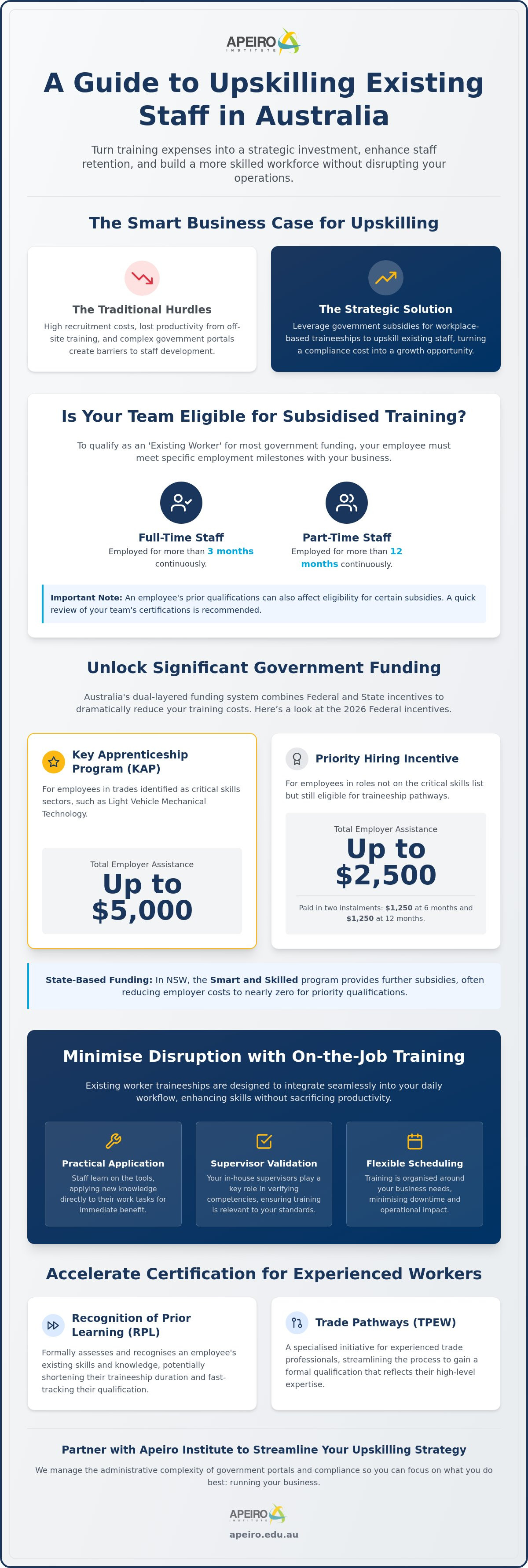
In the Australian Vocational Education and Training (VET) system, an 'existing worker' isn't just anyone on your books. It's a specific legal classification for employees who have already built a history with your business. Generally, if a staff member has been employed full-time for more than three months, or part-time for more than twelve months, they're considered an existing worker. This distinction is crucial because it changes how the government allocates training dollars compared to 'new entrant' programmes, which focus on fresh recruits.
While people often use the terms interchangeably, there's a clear line between an apprenticeship and a traineeship. Apprenticeships usually focus on traditional trade vocations, such as light vehicle mechanical technology. Traineeships, however, tend to cover service-oriented or technical roles, like electronics and communications or community services. The Australian Government prioritises funding for upskilling existing staff via traineeships to address critical skill shortages. By formalising the expertise of people who already understand your company culture, the government helps businesses institutionalise knowledge without the risks associated with external hiring.
In highly regulated industries such as civil construction, technical training from providers like Acquired Awareness Traffic Management is equally essential for maintaining safety standards and meeting site-specific compliance requirements.
Eligibility Criteria for Your Current Team
To access subsidised training, your staff must meet specific time-based milestones. As mentioned, the three-month full-time or twelve-month part-time rule is the standard benchmark. However, previous qualifications also play a massive role. If an employee already holds a high-level qualification in the same field, it might impact their eligibility for certain subsidies. We recommend a quick audit of your team's current certifications to identify who is a 'fair dinkum' candidate for a funded pathway. It's about finding the balance between their career goals and your business's compliance requirements.
Workplace-Based Training vs. Classroom Learning
One of the biggest concerns for any manager is losing productivity while staff are away studying. Existing worker traineeships solve this through a workplace-based model. This means the majority of the learning happens 'on-the-job' rather than in a distant classroom. Your staff stay on the tools, applying new theories directly to their daily tasks. In this setup, a supervisor within your business plays a vital role in signing off on practical competencies, ensuring the training meets your specific industry standards.
Apeiro Institute organises flexible delivery schedules that respect your operational needs. Whether your team is working through the Trade Pathways for Experienced Workers (TPEW) initiative or a standard traineeship, we act as your partner. We ensure the training is supportive and attainable, providing expert guidance so that both the employer and the employee feel secure in their progress. This collaborative approach minimises downtime while maximising the tangible skills your business gains.
Navigating Funding: Smart and Skilled and Federal Incentives
Securing the right financial support often feels like trying to solve a puzzle with missing pieces. In Australia, the funding landscape is dual-layered, consisting of state-based programmes and federal incentives that can often be "stacked" to maximise your savings. When looking at funding for upskilling existing staff via traineeships, it's essential to understand how these two systems work together to lower your training costs. For many businesses, this combination can reduce the financial burden to nearly zero, allowing you to focus on growth rather than invoices.
The Australian Apprenticeships Incentive System (AAIS) for 2026 provides clear pathways for employers. If your staff are working in roles not listed in the Key Apprenticeship Program, you may still access the Priority Hiring Incentive. For a full-time trainee, this provides up to $2,500 in assistance, paid in two instalments at the six and twelve-month marks. If your team members are pursuing trades in critical sectors, such as light vehicle mechanical technology, the incentives are even more substantial. Under the Key Apprenticeship Program (KAP), employers can access up to $5,000 in total assistance throughout 2026.
Smart and Skilled NSW: Subsidised Training Explained
For businesses operating in New South Wales, the Smart and Skilled programme is a game-changer. This initiative prioritises specific industries that are vital to the state's economy, ensuring that training is either heavily subsidised or, in some cases, fee-free. Apeiro Institute acts as your expert guide here. We help you identify which of your current team members qualify for NSW-funded places, ensuring you don't miss out on available budget. You can find a detailed breakdown in our Smart and Skilled funded courses NSW guide, which outlines the 2026 requirements for subsidised training.
Federal Wage Subsidies and Hiring Incentives
Federal support in 2026 remains highly targeted toward the National Skills Priority List. This list dictates which occupations receive the highest levels of support based on current national shortages. Sectors like Aged Care and Disability Support are currently high priorities, reflecting the government's commitment to strengthening the care economy. By aligning your team's development with these priority areas, you unlock higher tiers of funding for upskilling existing staff via traineeships.
It's worth acting sooner rather than later. The government has already flagged changes for January 2027, where employer incentives for the Key Apprenticeship Program will be lowered to $4,000 for smaller businesses and removed entirely for those with over 200 staff. If you want to secure the current higher rates, starting the process now is a smart financial move. If you're unsure where your business fits on the priority list, we can help you explore your eligibility for these pathways today.
The Financial Case: Why Upskilling Pays for Itself
Investing in your team is often viewed as a competing priority against the daily operational budget. However, the true cost of stagnant skills is far higher than the investment required to update them. When you compare the price of private, full-fee training against the strategic use of funding for upskilling existing staff via traineeships, the financial advantage is clear. Subsidised pathways allow you to access the same nationally recognised qualifications at a fraction of the market rate, protecting your cash flow while building institutional expertise.
Payroll Tax Rebates and Workers Compensation Savings
One of the most overlooked financial benefits of formal traineeships is the direct impact on your tax obligations. In many Australian states, registering an existing worker as a trainee can trigger significant payroll tax rebates or even full exemptions for that employee's wages. Additionally, a more qualified and safety-conscious workforce can lead to fewer workplace incidents, potentially lowering your workers' compensation premiums over time. These rebates and exemptions often effectively cover the small remaining gap in training costs, making the programme virtually cost-neutral for many businesses.
Boosting Productivity in Electronics and Automotive Sectors
The return on investment becomes even more visible when looking at technical efficiency. In a workshop environment, a staff member completing a Certificate III in Light Vehicle Mechanical Technology gains the theoretical depth needed to increase throughput. They move from simply following instructions to identifying complex issues independently. This autonomy directly translates to more billable hours and fewer "comebacks" for rework.
Similarly, formalising skills in Electronics and Communications empowers your technicians to handle sophisticated fault diagnosis with greater precision. As your team transitions from unqualified experience to certified expertise, your business gains the ability to take on more complex, higher-margin projects. Funding for upskilling existing staff via traineeships ensures that this transition happens without breaking the business budget, creating a more competent and profitable team.
The RPL Shortcut: Reducing Traineeship Duration
While the financial incentives we've discussed are compelling, the time commitment is often the final hurdle for busy employers. This is where Recognition of Prior Learning (RPL) becomes your most valuable tool. RPL isn't about teaching your staff what they already do every day; it's about formally acknowledging the skills they've already mastered on the job. When combined with funding for upskilling existing staff via traineeships, RPL can significantly shorten the path to a qualification, sometimes by months or even years. It's a pragmatic approach that respects their experience and keeps them focused on the work that keeps your business moving.
By mapping an employee's current skills against the national training package, we can 'credit' them for units they can already perform. This means they only need to study the specific gaps in their knowledge. This process drastically reduces the number of units a staff member needs to complete through traditional study. It minimises workplace disruption because your team doesn't have to sit through lessons on topics they've already mastered. Instead, they prove their competence through evidence, keeping their time away from the tools to an absolute minimum.
Formalising Trade Experience into a Qualification
Gathering evidence shouldn't feel like a mountain of paperwork. We guide your team through a straightforward process of collecting photos, videos, references, and work logs that demonstrate their competence in real-time. Our trainers then conduct workplace assessments to verify these skills on-site, ensuring the certification is robust and meets all industry standards. This hands-on verification means your staff can stay in their natural work environment while we tick off their competencies. You can read more about how this works in our Trade Pathways for Experienced Workers Australia guide.
TPEW: A Fast-Track for Skilled Staff
The Trade Pathways for Experienced Workers (TPEW) initiative is a game-changer for staff who have been in the industry for years but lack the formal "piece of paper." Typically, if a staff member has between two and four years of industry experience, they may be eligible for this pathway. It's particularly effective in the Automotive and Construction sectors, where practical experience is often more advanced than what a textbook can offer. Apeiro Institute manages the entire TPEW assessment process, acting as the bridge between your staff's practical talent and their formal qualification.
If you're ready to see how much time your team could save, enquire about an RPL assessment today and let's get your experienced staff certified faster.
Partnering with Apeiro Institute for Your Upskilling Strategy
Finding the right training partner is just as important as finding the right funding. At Apeiro Institute, we act as a bridge between your business and the complex landscape of government funding bodies. We know that as a business owner or manager, your time is your most precious resource. Our role is to handle the administrative heavy lifting, ensuring you can access funding for upskilling existing staff via traineeships without getting bogged down in red tape. We take a student-centred approach that supports both the employer's operational goals and the employee's career growth.
Our expertise spans across diverse sectors, including Automotive, Electronics, and Community Services. Whether you are looking to certify a mechanic through AUR30620 Certificate III in Light Vehicle Mechanical Technology or formalise the skills of a technician in electronics and communications, we bring industry-aligned expertise to every assessment. We understand the 'real world' of your trade because our trainers have lived it. This practical perspective ensures that the training we deliver isn't just a compliance exercise; it's a genuine boost to your team's daily capability.
Tailored Training Plans for Your Business
Every business has its own rhythm. We customise training schedules to avoid your peak busy periods, ensuring that learning happens at a pace that suits your workflow. With a national reach and local expertise in both Perth and Sydney, we provide the security of a large RTO with the personal touch of a local partner. This flexibility is a core part of our mission to make professional development attainable. We focus on building a sense of security through expert guidance, making the educational journey feel like a partnership rather than a burden.
Getting Started: The 3-Step Enrolment Process
We've designed our enrolment process to be as straightforward as possible, moving you from inquiry to implementation with clarity and precision.
- Step 1: Initial Consultation. We meet with you to identify staff eligibility and determine which funding pools are available for your specific industry and location.
- Step 2: Skills Gap Analysis. We conduct a thorough RPL assessment to see what your staff already know, significantly shortening their journey to a formal qualification.
- Step 3: Implementation. We roll out the training plan with ongoing support from our team, ensuring your staff feel confident and your business remains compliant.
Securing funding for upskilling existing staff via traineeships is a strategic investment in your business's future. It protects your budget while institutionalising the expertise you've worked hard to build. Ready to upskill your team? Contact Apeiro Institute today for a funding assessment and let's start building your team's professional future together.
Build a Certified Future for Your Business
Building a certified team doesn't have to be a financial burden or an administrative nightmare. You can formalise the years of expertise your staff already possess while tapping into substantial government incentives. By combining the efficiency of Recognition of Prior Learning with the latest 2026 federal subsidies, you're investing in both loyalty and long-term productivity. Accessing funding for upskilling existing staff via traineeships is the smartest way to bridge the skills gap without disrupting your daily operations.
As a NSW Smart and Skilled provider and specialists in Trade Pathways for Experienced Workers (TPEW), Apeiro Institute (RTO 45394) provides the nationally recognised training your business needs to thrive. We're here to handle the paperwork and navigate the funding portals so you can focus on leading your team. Our expert guidance ensures that every step of the journey is clear, supportive, and tailored to your specific industry needs.
Secure Government Funding for Your Team - Enquire with Apeiro Institute
Taking the first step toward a more qualified workforce is a powerful investment in your company's future. We look forward to being your partner in success and helping your team reach their full potential.
Frequently Asked Questions
Is there a limit to how many existing staff I can put through a funded traineeship?
No fixed limit exists on the number of staff you can enrol, but each individual must meet specific state and federal eligibility criteria. Funding for upskilling existing staff via traineeships is often subject to the training provider's contract capacity with bodies like Smart and Skilled. We work with you to audit your team and determine how many people can be supported under current budget allocations.
Do I have to pay my staff while they are doing their traineeship training?
Yes, you must pay your staff their usual wages for all time spent engaging in training and assessment activities. Since our model focuses on workplace-based learning, your team members are usually learning while performing their daily duties. This ensures they remain productive and on-site while gaining the formal qualifications required for your business compliance and growth.
What happens if a staff member leaves the business before finishing their traineeship?
If an employee leaves your business, the training contract is terminated with the relevant state training authority. You will generally receive pro-rata incentive payments up to their final date of employment. You aren't penalised for their departure; however, the remaining funding for upskilling existing staff via traineeships for that specific individual will simply cease once the contract is cancelled.
Can I get funding for a staff member who already has a university degree?
Having a university degree doesn't automatically disqualify a staff member, but it can limit access to certain state-based funding pools. Programs like NSW Smart and Skilled often prioritise individuals who don't already hold a high-level qualification. However, if the traineeship is in a high-priority trade or a sector with critical shortages, we can often identify alternative funded pathways for your degree-qualified staff.
How much of the training is done away from the workplace?
Very little time is spent away from your business under our flexible, workplace-based model. We prioritise on-the-job assessments where our trainers visit your site to verify competencies in a real-world environment. This approach significantly reduces downtime and ensures the skills being formalised are directly relevant to your specific workshop equipment, electronics laboratory, or community service facility.
What are the specific payroll tax benefits for NSW employers in 2026?
In 2026, NSW employers can generally claim a full payroll tax exemption or a significant rebate on wages paid to registered trainees. This financial benefit applies for the entire duration of the traineeship. It serves as a powerful tool to offset training costs, effectively making the professional development of your team a budget-neutral or even profitable strategy for your business.
Can I use Recognition of Prior Learning (RPL) for the entire qualification?
While RPL can cover a vast majority of a certificate, it's rare to complete a full qualification without some form of gap training. Most experienced staff have mastered practical tasks but may need to formalise their knowledge of current Australian Standards or theoretical concepts. We use the Trade Pathways for Experienced Workers initiative to bridge these specific gaps as quickly as possible.
Which industries are currently on the National Skills Priority List?
The 2026 National Skills Priority List includes critical sectors such as Electronics and Communications, Light Vehicle Mechanical Technology, Civil Construction, and Individual Support for Ageing and Disability. Occupations in these fields receive the highest levels of federal incentive support due to significant national shortages. Aligning your team's upskilling with these priority sectors ensures you maximise your access to available government subsidies.

Disclaimer
The information provided on this blog is for general informational and educational purposes only. While every effort is made to ensure the accuracy and reliability of the content, the author makes no representations or warranties of any kind, express or implied, about the completeness, accuracy, suitability, or availability of the information contained on this blog.
The views and opinions expressed in blog posts are those of the individual author and do not necessarily reflect the official policy or position of any organization, company, or employer.
This blog may contain links to external websites or third-party content. These links are provided for convenience only, and the author has no control over and assumes no responsibility for the content, privacy policies, or practices of any third-party sites.
Nothing on this blog constitutes professional advice (legal, financial, medical, or otherwise). Readers are encouraged to seek appropriate professional guidance before making any decisions based on the information provided here.
By using this blog, you acknowledge that any reliance on the information is at your own risk.


