

Experience alone doesn’t award a trade qualification, but it can count towards one. For eligible NSW workers, the Trade Pathways for Experienced Workers - AUR30620 pathway uses recognition of prior learning (RPL) to assess existing skills, with gap training for units still needed. Applicants need at least 3 years’ experience in their trade and 12 months’ work experience in Australia; the current application round is closed.
If you’ve spent years working on light vehicles, it’s reasonable to want your practical skills recognised rather than start from scratch. This article explains how RPL can contribute to AUR30620, what eligibility evidence matters and how targeted training can address skills gaps. You’ll also find the key dates: enrolment for the current round was due by 31 August 2026, and approved participants had to commence training by 30 September 2026. We’ll clarify what those dates mean now, so you can understand the pathway and plan your next steps with confidence.
Key Takeaways
- Use RPL to have relevant skills and experience assessed against the qualification’s units.
- Identify any units still to complete so targeted gap training can focus on remaining learning needs.
- Organise evidence of your work history, practical skills and NSW connection to support the eligibility assessment.
- Understand how AUR30620 can provide a formal qualification pathway for eligible light vehicle workers.
- Learn how Apeiro Institute’s Trade Pathways for Experienced Workers offering can support your next step towards a qualification.
Gap training for remaining units
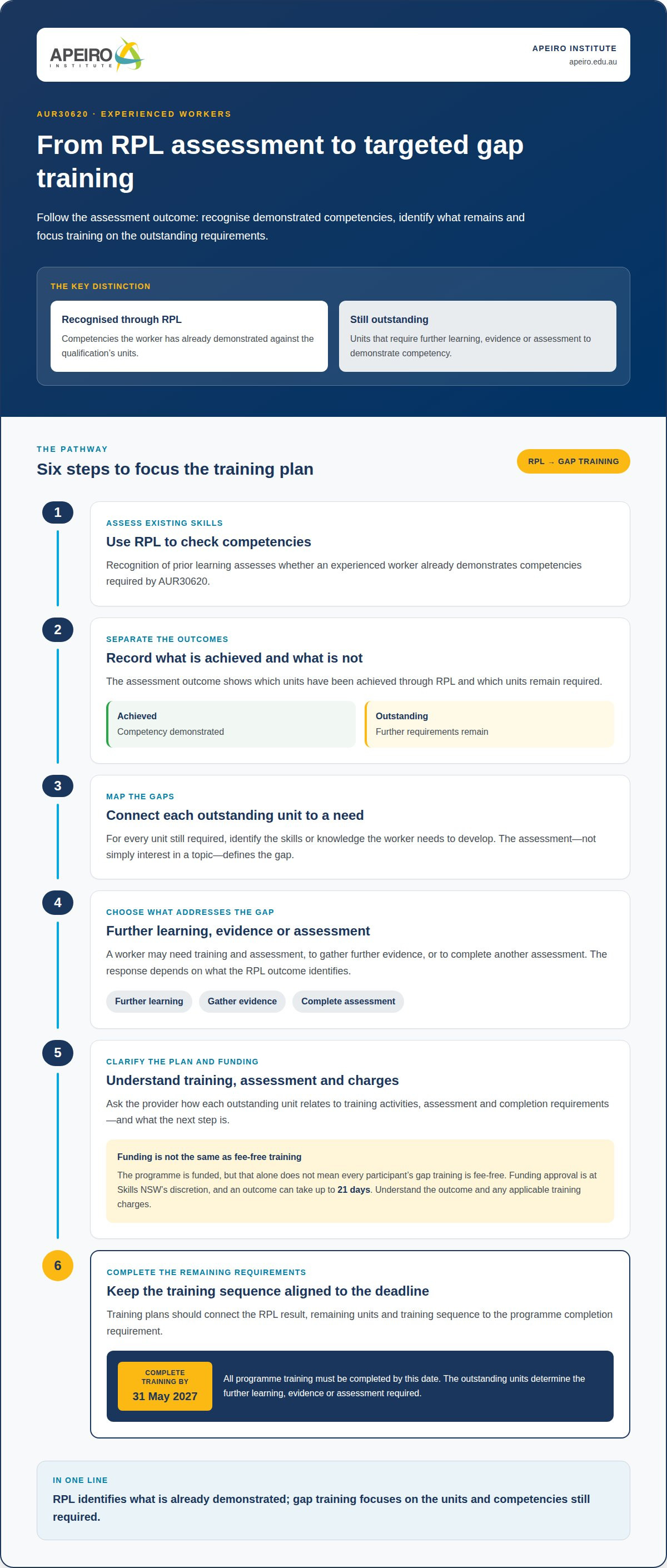
Recognition of prior learning can show which AUR30620 competencies an experienced worker already demonstrates. Any units not achieved through assessment become the focus for further training. This is the purpose of gap training: address identified learning needs, rather than repeat every part of a qualification. For example, an automotive worker may have evidence for some outcomes but still need training and assessment for others.
The training plan follows the assessment outcome. Start by mapping each outstanding unit to the skills or knowledge the worker still needs to develop. The provider can then explain how training and assessment will address those gaps. This helps distinguish a skill already demonstrated from a competency that still requires learning or further evidence.
Gap training focuses on the units still required, not simply on a topic an apprentice is interested in. A worker might be confident with a familiar task, for example, but still need to demonstrate the full competency described by the relevant unit. The assessment identifies the gap, and training addresses the remaining requirements before further assessment.
Provider guidance also helps with practical planning. Ask how the identified units relate to training activities, assessment and completion requirements. The explanation should distinguish what has been recognised through RPL from what remains outstanding, and clarify the next step, whether that is further learning, gathering evidence or completing an assessment. This keeps the pathway focused on the qualification’s actual requirements.
Funding and fee-free training are related, but they are not interchangeable terms. The NSW Trade Pathways for Experienced Workers program is funded, yet that fact alone does not establish that every participant’s gap training is fee-free. Funding approval is at Skills NSW’s discretion, and an outcome can take up to 21 days. Understand the funding outcome and any applicable training charges before making enrolment decisions.
Timing shapes the training plan too. All program training must be completed by 31 May 2027. A provider’s guidance should therefore connect the RPL result, remaining units and training sequence to that completion deadline. If an assessment identifies several gaps, knowing which units remain helps clarify the scope of training required. It also gives the worker a practical basis for discussing the pathway with the training provider.
For experienced workers, gap training is the step between demonstrated competency and qualification completion. Begin with the RPL outcome, identify each outstanding unit, then understand how its training and assessment will be addressed. This keeps the focus on the skills still required, while funding and completion conditions shape the available pathway.
The required units are those not achieved through RPL assessment. The worker must complete any further learning, gather evidence or undertake assessment needed to demonstrate competency in those units.
Program application and enrolment dates
The pathway proceeds from eligibility assessment and application to a funding decision, enrolment, training and completion. Applications for the current NSW round are closed, and its enrolment and commencement deadlines have passed.
Eligibility and initial application
The initial stage establishes whether an applicant meets the program’s entry criteria. Applicants must be at least 21 years old, live or work in NSW, and be Australian or New Zealand citizens, humanitarian visa holders, or Australian permanent residents.
Applicants also need at least 3 years’ trade experience and at least 12 months’ work experience in Australia. These criteria apply at enrolment. An experienced workers program application should present the applicant’s eligibility and relevant trade background clearly, so the application can be considered against the program requirements.
Application and enrolment steps
For the current round, students had to enrol by 31 August 2026. Approved participants had to commence training by 30 September 2026. Since both dates have passed and applications are closed, those deadlines cannot be treated as open for new enrolments in this round.
For a future application opportunity, first establish eligibility and submit an application. Then await the funding outcome, complete enrolment and commence training within the dates set for that round. Meeting the entry criteria does not itself mean funding has been approved or enrolment completed.
Funding is assessed separately from eligibility. A funding outcome can take up to 21 days, and approval is at the discretion of Skills NSW. Allowing for that decision period helps applicants understand why application timing matters, particularly when a round has set enrolment and commencement deadlines.
Training plans connect approval and enrolment with the qualification requirements. They should set out how the participant will progress through training and assessment, including any units still to complete. The program requires all training to be completed by 31 May 2027. That completion date applied alongside the current round’s earlier enrolment and commencement dates.
The program expansion is funded until June 2029, but that is not the closing date for a particular application round. Round-specific dates determine when applications, enrolment and training commencement must occur. Keep those milestones distinct when planning: a broader funding period does not reopen a round whose applications have closed.
For a future round, follow its application timeline and allow time for the funding decision before enrolment deadlines. The Trade Pathways program details explain the training pathway and its application stages.
Recognition of Prior Learning (RPL)
Recognition of Prior Learning (RPL) assesses whether skills gained through work and experience match the competencies required for a qualification. Within the Trade Pathways for Experienced Workers - AUR30620 pathway, it helps identify which outcomes an automotive worker can demonstrate through practical evidence. The focus is on what the evidence shows against each competency, not simply the length of time spent working in the trade.
Assessment connects work examples with specific training outcomes. A useful record explains what task was performed and how it relates to the competency being assessed. A job card might describe the work completed, while a photograph provides visual context. The assessor considers whether the evidence as a whole demonstrates the required outcome, rather than treating every document as proof of competence.
Patrick’s example shows how to organise evidence around outcomes. He provided his case manager with job cards and photos for each training outcome, giving the assessor practical examples to consider. It also shows why “I do this work regularly” is less informative than records that describe specific tasks and connect them to the qualification requirements.
Evidence should be relevant and clear. A record that describes a task but not the worker’s role may leave important details uncertain. A photograph can provide context, but may not explain the process or decisions involved. Matching different types of evidence to an outcome can give a fuller account of the work being assessed.
For TPEW applicants, the RPL assessment must find them capable of achieving at least three Units of Competency through recognition of prior learning. This is an assessment threshold, not an automatic award of three units. Each outcome is considered against its requirements and must be supported by evidence demonstrating the relevant capability.
Applicants must be capable of achieving at least 3 units of competency through recognition of prior learning by 30 June 2028. This milestone relates to the program’s RPL requirement. It does not replace the assessment of individual evidence. The assessor’s findings establish which competencies have been demonstrated and which outcomes remain unachieved.
For someone pursuing Trade Pathways for Experienced Workers - AUR30620, the assessment result provides a practical record of recognised competencies and outstanding requirements. Keep evidence grouped by the work outcome it supports, rather than submitting an unstructured collection of records. That organisation makes it easier to see how each example relates to the qualification and where further evidence may be needed.
RPL is a formal assessment of prior learning, not a simple conversion of work experience into a certificate. Patrick’s job cards and photographs show one way workplace experience can be presented. The key question is whether the evidence demonstrates the required competency. Linking work examples clearly to outcomes helps make the assessment meaningful for an experienced automotive worker.
Eligibility evidence and documentation
NSW Trade Pathways eligibility combines personal criteria with trade experience and location. Applicants must be at least 21 years old, live or work in NSW, and be Australian or New Zealand citizens, humanitarian visa holders, or Australian permanent residents. These requirements apply at enrolment, so evidence should clearly support each relevant part of the application.
Organise supporting records by eligibility criterion. For age and identity, use documents showing the applicant’s details and date of birth. Records showing a current residential address or NSW workplace can help demonstrate the NSW connection. Citizenship or residency evidence should match the relevant category in the program requirements.
Trade history also needs a clear account. Applicants need at least 3 years’ experience in their trade and at least 12 months’ work experience in Australia. Employment records, work histories and examples of completed tasks can help explain the applicant’s experience. Present dates, employers and duties in a consistent timeline, so the information is easy to follow.
Skills evidence serves a different purpose from eligibility documents. It supports assessment of practical competency against qualification outcomes, while age, location and citizenship evidence address program entry criteria. A work record may explain trade experience, while a job card or task example may show work relevant to a particular competency. Keep these evidence purposes separate.
Smart and Skilled is a separate NSW funding context from the specific TPEW eligibility criteria. The phrase “funded course” alone does not establish that an applicant meets every program’s requirements. Identify the funding pathway being considered, then organise evidence against that pathway’s criteria. For AUR30620, the NSW TPEW criteria include the stated age, location, citizenship or residency, and work experience requirements.
Applicants working in another industry should note the additional rule for some qualifications. Applicants for Manufacturing and Engineering or Electrotechnology qualifications must currently work in the related industry. This condition applies to those qualification areas and is separate from the automotive experience criteria for a Certificate III in Light Vehicle Mechanical Technology.
A useful preparation step is to group documents into identity and age, NSW connection, citizenship or residency, and trade history. Keep records of practical skills separate for competency assessment. This makes application gaps easier to spot before submission, such as missing employment dates or work examples that do not clearly relate to the qualification.
Eligibility evidence supports an application, but funding is a separate decision. Skills NSW has discretion over funding approval. Well-organised records can make the applicant’s circumstances and experience clearer, while the program criteria determine how that evidence is considered.
AUR30620 Light Vehicle Mechanical qualification
AUR30620 is the Certificate III in Light Vehicle Mechanical Technology, available to eligible workers through the NSW Trade Pathways for Experienced Workers program. The pathway assesses existing skills through RPL and addresses remaining requirements through training; it differs from an apprenticeship or standard course in how prior experience is considered.
Comparing trade pathway options
The experienced worker pathway is for people with substantial trade experience who want their capability assessed towards a qualification. An apprenticeship or standard course is another route to a trade qualification. The key question is whether existing skills can be formally recognised through RPL. Consider your work history, available evidence and any competencies you still need to develop.
For example, an automotive worker who already performs relevant tasks may have skills assessed against AUR30620 outcomes. An applicant still building those skills may need more training before demonstrating competency. The pathway’s assessment helps distinguish these situations. It doesn’t mean experience alone completes the certificate; the required competencies still need to be achieved.
Required units and competencies
To complete AUR30620, a learner must achieve the qualification’s required units and demonstrate the competencies they cover. The unit requirements define the learning and assessment outcomes, while RPL can recognise competencies already demonstrated through work. Any remaining outcomes require further training or assessment before the qualification can be completed.
The relevant unit list should guide the assessment and training plan. One familiar workshop task does not necessarily cover an entire unit: assessors consider whether the evidence demonstrates the required outcomes. Mapping job experience to competency requirements shows what has been achieved and what remains.
Jobs, licensing and career outcomes
AUR30620 provides a formal Certificate III qualification in light vehicle mechanical technology. It can support experienced workers seeking formal recognition of their trade skills. The qualification relates to light vehicle mechanical work, but the available program facts don’t identify specific job titles or guarantee a particular employment outcome.
A qualification and a licence are different outcomes. Completing AUR30620 does not, by itself, establish a licensing requirement or grant a separate licence. Workers should understand the distinction when planning their next career step, especially if a particular role involves requirements beyond the qualification itself.
Compare your existing capability with the qualification’s competency requirements. For an experienced automotive worker, an assessment-led route can show where RPL applies and where further training is needed. The NSW Government program allows eligible workers to work towards a Certificate III in their trade area, including light vehicle mechanical technology.
Explore the AUR30620 qualification
Apeiro Institute: Trade Pathways for Experienced Workers (TPEW)
Apeiro Institute offers Trade Pathways for Experienced Workers (TPEW) for eligible workers seeking formal recognition of their trade skills. For automotive workers, the pathway can support progress towards AUR30620 through assessment of existing competencies and training for remaining requirements. The current NSW application round is closed, so its enrolment dates have passed.
If you’re considering this qualification, explore the Trade Pathways for Experienced Workers program to understand how the pathway relates to your experience and goals. Apeiro Institute also offers Apprenticeships and Traineeships, Smart & Skilled Funded Courses, and UEE30920 Certificate III in Electronics and Communications.
For guidance on the TPEW pathway and your next steps, contact Apeiro Institute.
Shape your next step in automotive
A formal qualification can be a useful milestone, but your work goals matter too. Consider the tasks you want to take on, the skills you want to strengthen and how formal recognition could support your direction. This reflection can help you make purposeful training decisions and connect study with your day-to-day work.
For experienced automotive mechanics, the Trade Pathways for Experienced Workers - AUR30620 route connects existing hands-on experience with a nationally recognised qualification pathway. Your next step is to discuss how your background and career aims relate to the available training options. Apeiro Institute can help you consider its vocational pathways and identify what to explore next.
Planning your direction is a positive step towards building on the skills you already use. Start the conversation when you’re ready, and keep moving towards a future that reflects your experience and ambitions.
Frequently Asked Questions
How does RPL help me get a trade qualification faster?
RPL may reduce repeated training by assessing your skills against qualification requirements. For example, an automotive worker who demonstrates a task to the required standard may have that competency recognised rather than repeating the learning. The assessor determines what the evidence demonstrates, and any unmet requirements still need training or assessment. RPL can streamline a pathway, but every required competency must still be achieved.
What are the benefits?
RPL can connect practical work experience with a nationally recognised qualification and identify any learning that remains. This gives experienced workers a clearer picture of how their skills relate to formal training outcomes. It can focus study on areas needing development rather than revisiting demonstrated skills. For someone formalising automotive experience, the key benefit is an assessment-based route that recognises demonstrated competence towards a qualification.
What evidence can be used for RPL?
Evidence may include workplace records, job cards, photographs of completed work and examples linked to relevant training outcomes. A strong submission clearly connects each item to the skill being assessed. A job card may describe a task performed, while a photograph provides supporting context. The assessor considers what the evidence demonstrates, so a general employment history alone may not establish every required competency.
What happens if I don’t meet all the requirements through RPL?
Any competency not demonstrated through RPL remains to be achieved through further learning and assessment. The outcome identifies what has been recognised and what still needs attention. If evidence supports some qualification outcomes but not others, for example, training can focus on the remaining units. Complete the required learning and assessment for those gaps as part of the qualification pathway.
Who can apply for Trade Pathways for Experienced Workers in NSW?
Applicants must be at least 21, live or work in NSW, and meet the program’s citizenship or residency criteria. They also need at least 3 years’ experience in their trade and 12 months’ work experience in Australia. These requirements apply at enrolment. A cancelled apprentice can apply only if the cancellation occurred more than 6 months before enrolment.
Who is eligible for the Trade Pathways for Experienced Workers program in Australia?
This is a NSW program, not a general pathway with identical rules across Australia. Applicants must meet the NSW residence or work, age, citizenship or residency, and trade-experience criteria. Australian and New Zealand citizens, humanitarian visa holders, and Australian permanent residents may qualify if they meet the other requirements. Applicants for Manufacturing and Engineering or Electrotechnology qualifications must also currently work in the related industry.
What prior work experience and evidence are required for AUR30620 recognition of prior learning?
For the NSW pathway, applicants need at least 3 years’ trade experience and 12 months’ work experience in Australia. For RPL, they must be currently working in the relevant industry or have worked in it within the previous 5 years at enrolment. Evidence should connect practical work to qualification outcomes, using relevant records or task examples. TPEW applicants must be assessed as capable of achieving at least three Units of Competency through RPL.
How long does AUR30620 take through the experienced worker pathway?
Completion time depends on the competencies recognised through RPL and the training and assessment still required. The pathway therefore follows the individual assessment and resulting training plan, rather than a single duration applying to every worker. For participants in the current NSW round, all training must be completed by 31 May 2027. That round’s applications are closed, and its enrolment and commencement deadlines have passed.

Disclaimer
The information provided on this blog is for general informational and educational purposes only. While every effort is made to ensure the accuracy and reliability of the content, the author makes no representations or warranties of any kind, express or implied, about the completeness, accuracy, suitability, or availability of the information contained on this blog.
The views and opinions expressed in blog posts are those of the individual author and do not necessarily reflect the official policy or position of any organization, company, or employer.
This blog may contain links to external websites or third-party content. These links are provided for convenience only, and the author has no control over and assumes no responsibility for the content, privacy policies, or practices of any third-party sites.
Nothing on this blog constitutes professional advice (legal, financial, medical, or otherwise). Readers are encouraged to seek appropriate professional guidance before making any decisions based on the information provided here.
By using this blog, you acknowledge that any reliance on the information is at your own risk.


