

Your experience on the tools may count towards an AUR30620 qualification. Through the NSW Trade Pathways for Experienced Workers program for AUR30620, Recognition of Prior Learning (RPL) can recognise skills you’ve already gained, with gap training to address what you still need to learn. To qualify for the pathway, you must be assessed as capable of achieving at least three units of competency through RPL.
If you’ve built your automotive skills through work, it makes sense to want that experience recognised rather than repeat learning you already know. This guide explains who can apply in NSW, how the RPL and training process works, and what to understand about program costs and possible employment benefits. You’ll also see how to take the next step towards a nationally recognised light vehicle mechanical technology qualification.
Key Takeaways
- Learn how RPL can recognise trade skills you’ve already demonstrated, while gap training focuses on the competencies you still need to develop.
- Use the NSW eligibility criteria to assess whether your age, trade experience, Australian work history and circumstances align with the pathway.
- See how an initial application, eligibility assessment, evidence review and competency assessment fit into the qualification process.
- Understand how funding decisions and any required training can affect the costs and practical benefits of pursuing the qualification.
- Find out what to consider when choosing a pathway and how to take a clear next step towards AUR30620.
Recognition of Prior Learning (RPL)
Yes. In NSW, the Trade Pathways for Experienced Workers program can support experienced workers seeking the AUR30620 Certificate III in Light Vehicle Mechanical Technology. It combines recognition of prior learning with gap training, so your existing trade skills can count towards a nationally recognised qualification.
RPL assesses skills and knowledge gained through work and other relevant learning against a qualification’s competency requirements. If your evidence demonstrates a competency, you may not need to repeat that training. If the assessment identifies gaps, gap training helps you develop the remaining skills and knowledge.
Evidence needs to show what you can do, not simply how long you’ve worked. For automotive work, relevant examples may include completed job cards, photographs of tasks, and workplace references. Patrick, an automotive mechanic with approximately 4.5 years of experience before qualifying, submitted job cards and photos for each training outcome. He also provided references from his supervisor, co-workers and employer.
To prepare, organise your evidence around the relevant training outcomes. For each outcome, identify examples that show your practical work and knowledge. Job cards can document completed tasks, photographs can illustrate specific work, and references can describe your responsibilities and skills. The assessor considers whether your evidence demonstrates competency or whether further assessment or training is needed.
Recognition of prior learning can help eligible students have relevant existing skills assessed against a qualification’s requirements. The policy applies to training from 1 July 2022. This requirement is a minimum for full qualification pathways, not a promise that every applicant will receive the same credit. The outcome depends on the evidence and the competencies demonstrated.
RPL is practical assessment, not simply a review of documents. NSW trade-related qualification assessments must take place in a functioning workplace or a sufficiently rigorous simulated environment that reflects one. This lets an assessor observe skills in conditions relevant to the trade. For AUR30620, the assessment process considers evidence against automotive competency requirements, then identifies any remaining learning needs.
There is an important distinction for people with overseas trade experience. The TPEW program is not designed as a formal recognition process for overseas trade qualifications. Overseas experience may still form part of an applicant’s work history, but the program assesses competency for the Australian qualification through its RPL and training process. The AUR30620 qualification is the relevant outcome for workers pursuing light vehicle mechanical technology in this pathway.
NSW Trade Pathways for Experienced Workers: Who can apply?
The NSW Trade Pathways for Experienced Workers program recognises established trade skills through RPL and gap training. It is intended for experienced workers seeking a trade qualification, rather than people starting their training without relevant work experience. To enter the AUR30620 pathway, applicants must meet the program’s eligibility conditions and demonstrate capability through RPL.
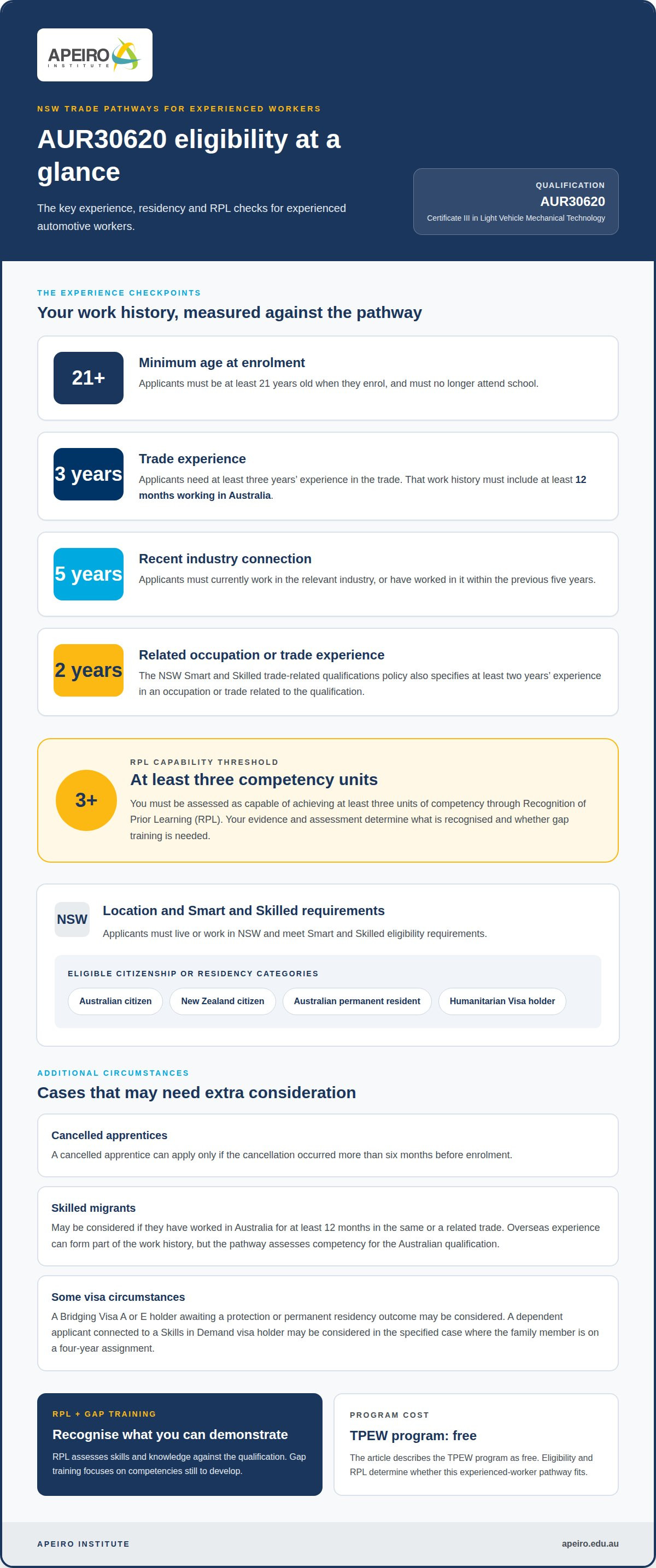
Applicants must be at least 21 years old at enrolment and live or work in NSW. They must no longer attend school and meet Smart and Skilled eligibility requirements. Applicants must also be Australian or New Zealand citizens, Australian permanent residents, or Humanitarian Visa holders. These conditions apply alongside the trade experience requirements, not instead of them.
Work history is a key part of eligibility. Applicants need at least three years’ experience in the trade, including at least 12 months working in Australia. They must currently work in the relevant industry or have worked in it within the previous five years. For the NSW Smart and Skilled trade-related qualifications policy, eligible students must also have at least two years’ experience in an occupation or trade related to their qualification.
Applicants must be assessed as capable of achieving at least three units of competency through RPL. This helps establish whether their existing skills align with the qualification before any remaining learning needs are addressed. A cancelled apprentice can apply only if the cancellation occurred more than six months before enrolment.
Skilled migrants may be considered if they have worked in Australia for at least 12 months in the same or a related trade. For example, a carpenter with more than 10 years’ overseas experience and 12 months as a trade assistant in Australia illustrates how overseas experience and Australian work history can form part of an application. A Bridging Visa A or E holder awaiting a protection or permanent residency outcome may also be considered. Applicants with a Skills in Demand visa connection may be considered in the specified case of a dependent applicant whose visa-holding family member is on a four-year assignment.
For AUR30620, the pathway differs from a standard apprenticeship or fee-for-service course because it recognises prior skills and uses gap training. It is aimed at experienced workers, while an apprenticeship is a separate training pathway. The TPEW program is free; eligibility and RPL determine whether the experienced-worker route fits.
AUR30620 is delivered through NSW training providers approved to deliver the relevant full qualification under the Smart and Skilled Entitlement Full Qualification or Targeted Priorities Program. Providers must obtain approval before delivery begins. An initial application can establish eligibility, followed by assessment of work history and RPL capability. Manufacturing and Engineering or Electrotechnology applicants must currently work in their related industry; automotive applicants still need to satisfy the relevant trade and program criteria.
Application and qualification process
The process moves from an initial application to eligibility and funding decisions, then assessment and any required training. For AUR30620, the qualification outcome depends on demonstrated competency and completion of remaining requirements.
Application and qualification steps
An online initial application helps establish whether an applicant meets the program’s eligibility requirements. For example, an automotive mechanic might submit an application to check eligibility. The subsequent assessment considers work history, existing skills and RPL capability. An application is an early step, not the qualification itself.
Funding approval is at the discretion of Skills NSW, and a funding outcome can take up to 21 days. Providers must obtain approval before starting delivery of full qualifications covered by the Trade-Related Policy through the Smart and Skilled Entitlement Full Qualification or Targeted Priorities Program. This approval process is separate from the applicant’s competency assessment.
Skills assessment and prior learning
The skills assessment compares evidence of practical ability with AUR30620 competency requirements. An assessor determines which outcomes the applicant has demonstrated and identifies any gaps requiring further learning. NSW trade-related assessments must occur in a functioning workplace or a sufficiently rigorous simulated environment reflecting one.
An automotive worker may, for example, be assessed while completing relevant tasks in a functioning workshop. The assessor evaluates demonstrated performance, not just a job title or time spent in the trade. Evidence review and practical assessment inform the recognition decision and identify any training still required.
Training and assessment requirements
The program has no single duration for every applicant. Training needs depend on which competencies are recognised through RPL and which gaps remain. Someone who demonstrates more of the required skills may need less gap training than someone whose assessment identifies additional learning needs.
Assessment must reflect workplace conditions, while gap training addresses competencies not yet demonstrated. The process can therefore include evidence review, practical assessment and training in identified areas. For students in the current NSW program round, training must be completed by 31 May 2027. That date applies to the current round, rather than setting a standard duration for every future applicant.
Qualification and licensing outcomes
Successful completion leads to the AUR30620 Certificate III in Light Vehicle Mechanical Technology, a nationally recognised vocational qualification. It records the competencies achieved through assessment and any required training. The certificate is a qualification outcome, not an automatic grant of every licence needed for automotive work.
In NSW, the Motor Dealers and Repairers Act 2013 requires people working in designated trade occupations to be licensed or apprenticed. The qualification and occupational licensing are distinct matters. Workers should understand that holding AUR30620 does not, by itself, replace any applicable licensing or apprenticeship requirement for a designated occupation.
Program costs and potential employment benefits
The NSW Trade Pathways for Experienced Workers program is free for eligible participants. It uses Recognition of Prior Learning and gap training to help experienced workers gain a nationally recognised trade qualification. For someone pursuing AUR30620, this means demonstrated competencies can contribute towards the qualification, while identified gaps guide further training.
Free participation doesn’t mean funding is automatic. Skills NSW decides whether to approve funding, and an outcome can take up to 21 days. That decision is separate from the skills assessment: meeting the program’s entry requirements does not itself establish competency or complete the qualification. Applicants should factor the funding decision into their plans before relying on a particular training start.
It also helps to distinguish the program from a fee-for-service course. The TPEW program is free, while a privately funded course has its own fee arrangements. This section doesn’t provide a price comparison, because the TPEW pathway’s funding model differs from individually purchased training. The practical distinction is whether an eligible applicant can access the NSW Government program and meet its assessment and training requirements.
Even when program fees are covered, work arrangements can affect the practical cost of taking part. An automotive worker may need to coordinate assessment or gap training with workshop duties. Assessment must take place in a functioning workplace or a sufficiently rigorous simulated environment that reflects one. Planning with your employer can help clarify how training fits alongside paid work.
The employment benefit is a formal qualification that records assessed competencies. AUR30620 can help a worker demonstrate light vehicle mechanical technology skills to an employer, or support conversations about responsibilities and progression. Its value depends on how the qualification relates to the worker’s role, experience and career plans. It doesn’t guarantee a job, promotion or particular wage.
For an apprentice or experienced mechanic, the pathway can recognise skills gained on the job rather than treating all learning as new. RPL identifies demonstrated competencies, while gap training addresses what remains. Completing the qualification gives you a nationally recognised outcome to discuss with current or prospective employers. The certificate records your achievement, but employers make their own recruitment and role decisions.
NSW licensing requirements remain a separate consideration for designated automotive occupations. The Motor Dealers and Repairers Act 2013 requires people working in designated trade occupations to be licensed or apprenticed. A qualification may support a worker’s professional record, but it does not replace applicable licensing requirements. Treat training, qualification completion and any relevant licence as distinct steps when planning the next career move.
Before committing time, map the likely practical demands: application, funding outcome, competency assessment and any gap training. Skills NSW funding can take up to 21 days to decide, and the assessment establishes what training remains. This sequence helps an automotive worker and employer plan workloads without assuming the qualification will be completed through RPL alone.
NSW Trade Pathways for Experienced Workers program
The NSW Trade Pathways for Experienced Workers program is a NSW Government pathway for experienced workers seeking a nationally recognised trade qualification. It combines recognition of prior learning with gap training, allowing assessed skills to count towards the qualification while addressing remaining learning needs. For AUR30620, the key point is that the pathway recognises existing automotive capability, but still requires applicants to meet eligibility and competency requirements.
Program timing matters. Approved students in the current round had to enrol by 11 September 2026 and commence training by 30 September 2026. Both dates have passed. Training in this round must be completed by 31 May 2027. These are current-round dates, not a general statement of how long every applicant’s training takes. An individual’s assessment results and remaining training needs shape the learning involved.
The program’s wider timeframe extends beyond this round. The NSW Department of Education and the Australian Government announced an expansion to support additional student places until June 2029. That expansion provides a broader program horizon, but it does not change the deadlines already set for approved students in the current round. Applicants should distinguish the expansion period from the enrolment, commencement and completion dates applying to a particular round.
The practical sequence is to establish eligibility, complete the application process and undertake a competency assessment. The assessment identifies what prior learning can be recognised and what gap training remains. Skills NSW decides whether to approve funding, so applying and completing an assessment do not guarantee approval for funded training. Keep this distinction in mind when planning work commitments around a potential training schedule.
The NSW pathway operates within trade qualification policy. Before delivering full qualification training covered by the Trade-Related Policy, a provider must have approval through the Smart and Skilled Entitlement Full Qualification or Targeted Priorities Program. Assessments must take place in a functioning workplace or a sufficiently rigorous simulated environment that reflects one. These requirements connect the certificate to demonstrated workplace competency, not experience alone.
AUR30620 applicants should therefore focus on three linked decisions: whether they meet the entry criteria, which competencies their evidence can demonstrate, and what training remains after assessment. The program is most relevant to experienced workers whose existing trade skills align with the qualification and who can complete the required assessment and gap training. Its expanded timeframe to June 2029 is not a substitute for meeting round-specific requirements.
Explore the Trade Pathways for Experienced Workers program
Apeiro Institute: Trade Pathways for Experienced Workers (TPEW)
Apeiro Institute delivers the Trade Pathways for Experienced Workers program - AUR30620 to help skilled mechanics and technicians convert their hands-on experience into a nationally recognised qualification through recognition of prior learning and targeted gap training. Whether you are looking to formalise your skills locally or interstate, our team can guide you through how your existing experience aligns with the national framework.
The next step is to discuss your work history, the specific automotive qualification you are aiming for, and the program's eligibility requirements. This initial consultation clarifies the entire assessment process, outlining how gathering competency evidence and completing any necessary gap training work hand in hand. Apeiro Institute also offers Smart and Skilled funded courses, apprenticeships, traineeships, and the UEE30920 Certificate III in Electronics and Communications.
Contact Apeiro Institute today to discuss whether this streamlined pathway suits your professional experience and career objectives.
Turn your trade experience into a next step
Your next move can start with a clear picture of where you want your automotive skills to take you. Consider the responsibilities you’re aiming for and how a formal qualification could support that direction. The NSW Trade Pathways for Experienced Workers program for AUR30620 may be a route to explore if you’re ready to have your experience assessed against the qualification.
Apeiro Institute offers Trade Pathways for Experienced Workers (TPEW), Apprenticeships and Traineeships, and UEE30920 Certificate III in Electronics and Communications. These options support different training goals, so choose the conversation that best matches your intended pathway.
Your experience is a strong starting point. Take your next step with confidence as you work towards your career goals.
Frequently Asked Questions
How does RPL help me get a trade qualification faster?
RPL can shorten the learning still required by recognising competencies you’ve already demonstrated against AUR30620. The assessor’s decision determines which parts of the qualification you don’t need to repeat; it doesn’t remove assessment or training for skills you haven’t yet demonstrated. For example, evidence of completed automotive tasks can help show practical capability. Any remaining gaps need to be addressed through training and assessment before qualification completion.
What are the benefits?
The main benefit is having relevant work skills assessed towards a nationally recognised qualification, rather than treating all learning as new. AUR30620 may help you document your automotive competencies when discussing your role or future opportunities with an employer. It can also identify specific skills to develop through gap training. The qualification itself doesn’t guarantee a job, promotion, wage increase or licensing outcome, so consider how it fits your career plans.
What evidence can be used for RPL?
Useful evidence can include job cards, photographs of work linked to training outcomes, and references from people familiar with your work. A job card, for example, may document a task you completed, while a supervisor’s reference can describe your responsibilities. Organising evidence by competency makes it easier to assess what each item demonstrates. The assessor compares your evidence with the qualification requirements rather than relying on your job title alone.
What happens if I don’t meet all the requirements through RPL?
Any competency you haven’t demonstrated through RPL becomes a learning need to address through gap training and further assessment. This helps you focus on areas requiring development instead of repeating competencies already recognised. To meet TPEW eligibility, applicants must be assessed as capable of achieving at least three units of competency through RPL. If you don’t meet this threshold, you don’t meet the program’s entry criterion.
What is the Trade Pathways for Experienced Workers program in Australia?
In New South Wales, the Trade Pathways for Experienced Workers program is a NSW Government pathway for eligible, experienced workers to gain a trade qualification through RPL and fee-free gap training. It assesses existing competency against the chosen qualification and addresses remaining gaps. The program isn’t designed to formally recognise overseas trade qualifications, although overseas work history may contribute to an applicant’s experience.
What is the cost of AUR30620 under the Trade Pathways for Experienced Workers program?
The Trade Pathways for Experienced Workers program is free for participants. This applies to the program, not automatically to every AUR30620 course or training arrangement outside it. Access to funded training depends on eligibility and Skills NSW funding approval, which is discretionary. The funding outcome can take up to 21 days. Applicants should distinguish the program’s funding arrangement from fee-for-service study, which is a separate enrolment option.
What evidence of prior work experience or skills must applicants provide?
Applicants need evidence that supports their trade work history and demonstrates relevant skills. Examples include job cards and photographs connected to training outcomes, alongside references from a supervisor, co-workers or employer. These materials serve different purposes: records and images illustrate work performed, while references can provide context about responsibilities. Evidence should make clear how the applicant’s actual tasks relate to AUR30620 competencies, rather than simply showing length of employment.
What are the application steps, key dates and funding rules for the program?
The process starts with an initial application, followed by eligibility and competency assessment. Funding approval is at Skills NSW’s discretion, and an outcome can take up to 21 days. For the current round, enrolment was due by 11 September 2026 and training had to commence by 30 September 2026, so both dates have passed. Current-round training must finish by 31 May 2027; the program expansion supports additional places until June 2029.

Disclaimer
The information provided on this blog is for general informational and educational purposes only. While every effort is made to ensure the accuracy and reliability of the content, the author makes no representations or warranties of any kind, express or implied, about the completeness, accuracy, suitability, or availability of the information contained on this blog.
The views and opinions expressed in blog posts are those of the individual author and do not necessarily reflect the official policy or position of any organization, company, or employer.
This blog may contain links to external websites or third-party content. These links are provided for convenience only, and the author has no control over and assumes no responsibility for the content, privacy policies, or practices of any third-party sites.
Nothing on this blog constitutes professional advice (legal, financial, medical, or otherwise). Readers are encouraged to seek appropriate professional guidance before making any decisions based on the information provided here.
By using this blog, you acknowledge that any reliance on the information is at your own risk.


