

You don’t have to choose between earning and training: an earn-while-you-learn mechanic apprenticeship combines paid work with formal study across Australia. Australian apprenticeships typically take 3 to 4 years, and your training develops alongside practical experience on the job with guidance from providers like Apeiro Institute.
It’s understandable to want clear answers before committing, particularly about when to apply and what you’ll earn. There is no single opening date for mechanic apprenticeship applications. Vacancies open as employers recruit, so timing depends on available roles in your area.
This guide explains what a mechanic apprenticeship involves, how applications and training fit together, and how apprentice pay is set and may increase over time. It also covers combining work with formal study, including options for adult and school-based apprentices. These details can help you decide whether the pathway suits your goals and what to explore next.
Key Takeaways
- Applications don’t follow one statewide opening date, so understand how employer recruitment and training commencement fit together.
- Compare your apprenticeship’s award or agreement and training stage to understand how pay can progress over time.
- Adult and school-based apprenticeships offer different ways to begin a trade pathway, depending on your circumstances.
- Apprentices combine paid work with formal training, building practical skills alongside study.
- Apprentices are generally entitled to superannuation at a superannuation guarantee rate of 12%, according to the Australian Taxation Office.
Application opening dates and program commencement
Mechanic apprenticeship applications depend on employment opportunities and the training arrangements linked to each role. Understanding how recruitment, commencement and progress milestones fit together can help you plan your next steps.
Application opening dates
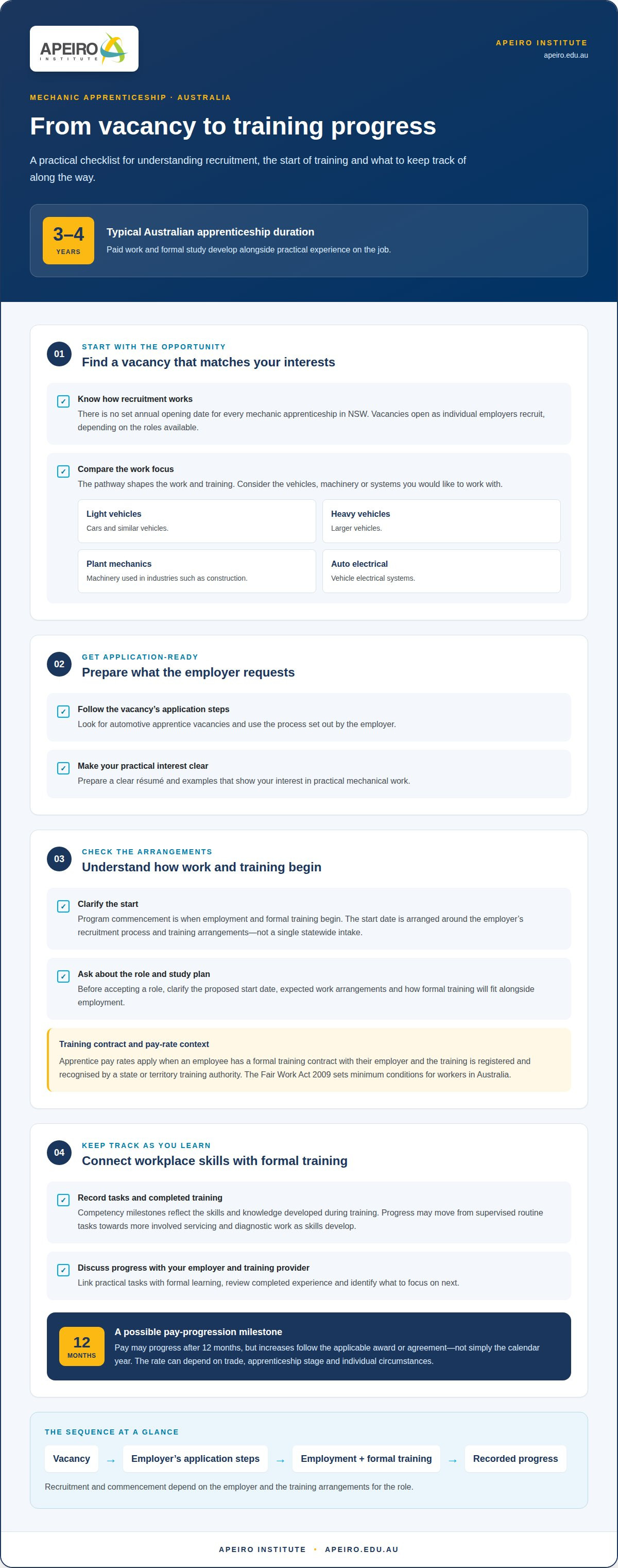
An application opening date is when an employer starts accepting candidates for an apprenticeship vacancy. There is no set annual date for every mechanic apprenticeship in NSW. Recruitment depends on individual employers and available roles. Look for automotive apprentice vacancies and follow the employer’s application steps. For an open position, prepare a clear résumé and examples that show your interest in practical mechanical work.
Program commencement
Program commencement is the point when the apprentice’s employment and formal training begin. The start date is arranged around the employer’s recruitment process and training arrangements, rather than a single statewide intake. Australian apprenticeships typically last 3 to 4 years. Before accepting a role, clarify the proposed start date, expected work arrangements and how formal training will fit alongside employment.
A mechanic apprenticeship combines employment with learning the trade, so the job offer and training contract are important parts of getting started. Apprentice pay rates apply when an employee has a formal training contract with their employer and the training is registered and recognised by a state or territory training authority. The Fair Work Act 2009 sets minimum conditions for workers in Australia, according to the Federal Register of Legislation.
Pay progression usually follows the applicable award or agreement and can reflect time served. For example, pay may progress after 12 months. The relevant rate depends on the apprentice’s circumstances and the employment terms that apply.
Competency milestones mark the skills and knowledge developed during training. For an automotive apprentice, progress may involve moving from supervised routine tasks to more involved servicing and diagnostic work as skills develop. Keep a record of completed training and workplace experience. Discuss your progress with your employer and training provider to connect practical tasks with formal learning and identify what to focus on next.
Plan your application in three steps: find suitable mechanic vacancies, prepare the information the employer requests, and clarify how training will begin if you receive an offer. Ask how pay progression applies to the role and which training arrangements accompany the job. These details give you a clearer picture of the work, study and milestones before you commit.
Do apprentice wages increase each year?
Apprentice wages can rise as you progress through training, but increases follow the applicable award or agreement, not simply the calendar year. Pay may progress by time served, such as after 12 months, and the rate depends on factors including your trade, apprenticeship stage and circumstances.
NSW mechanic apprenticeships may focus on light vehicles or heavy vehicles. The pathway shapes the work and training, so consider which vehicles and mechanical tasks interest you before applying.
The qualification depends on the apprenticeship pathway and its registered training. Entry arrangements are linked to employment and a formal training contract, with training registered and recognised by a state or territory training authority. Any additional role requirements depend on the position.
A mechanic apprenticeship typically takes 3 to 4 years in Australia. An employer may cover some or all training costs, depending on the apprentice’s award.
If an apprenticeship is cancelled or an employer goes out of business, both employment and training arrangements are disrupted. Contact Training Services NSW and your training provider to discuss your training, completed progress and next steps.
Mechanical trades as a career option
A mechanical trade develops practical skills in inspecting, maintaining and repairing vehicles or machinery. Light vehicle work focuses on cars and similar vehicles, while heavy vehicle work involves larger vehicles. Plant mechanics work with machinery used in industries such as construction, and auto electrical work focuses on vehicle electrical systems. These are distinct areas, so compare the tasks and training focus when choosing a pathway.
Plant mechanic or auto electrical training may suit someone building on mechanical experience or developing a more specialised skill set. Consider the vehicles or equipment you want to work with, then compare the role’s workplace tasks with its formal training. A trade upgrade should connect practical experience with relevant registered training, not rely on the job title alone.
Pay progression and completion
Pay progression is a change in an apprentice’s applicable wage as the apprenticeship advances. These estimates vary according to the award, trade and individual circumstances.
NSW award minimum wages increased by 4.75% from 1 July 2026. Award minimum rates are reviewed annually, with new rates applying from the first full pay period on or after 1 July each year. After completing an apprenticeship, an apprentice is paid the tradesperson’s pay rate.
Training and workplace experience
Trade training is structured learning that supports skills developed through workplace experience. Apprentices apply what they learn to practical tasks and build capability as they gain experience. Keep track of completed training and workplace tasks, then discuss your progress with your employer and training provider. This helps connect practical milestones with course requirements and identify the skills to develop next.
Adult and school-based apprentices
Age and study arrangements affect how a mechanic apprenticeship fits around work, school and other commitments. Adult and school-based apprentices in NSW have different starting points, so compare each pathway with your circumstances.
Adult apprentices
An adult apprentice in NSW is someone aged 21 years or older when their apprenticeship starts. Starting later doesn’t change the value of practical workplace learning, but it can affect how you plan training around existing responsibilities. Consider the expected work schedule, study requirements and the experience you already bring to a mechanical role.
If you have worked in a workshop or related trade, list the tasks you have handled before applying. Note experience with vehicle servicing, tools or workshop procedures, for example, and compare it with the apprenticeship’s training focus. This gives you a clearer starting point for discussing your skills and learning goals with an employer.
Experienced workers may also consider Trade Pathways for Experienced Workers (TPEW) to formalise relevant skills and experience. It is separate from starting an apprenticeship, so consider whether you need structured workplace training from the beginning or a pathway that recognises existing experience. The right option depends on your work history and the qualification you want to complete.
School-based apprentices
A school-based apprentice is a senior secondary student who combines school with apprenticeship training and workplace experience. In NSW, school-based apprentices are typically students from Year 10 or 11 onward. Most apprenticeship or traineeship programs for school students start after Year 10, making that a useful point to begin exploring options.
A school-based arrangement can help you gain trade experience while continuing secondary study. Before pursuing a mechanic role, map out how school, workplace hours and formal training could fit together. Discussing the schedule with your school and prospective employer can clarify how each part supports your progress.
School-based apprenticeships and traineeships can potentially shorten an apprenticeship by 1-2 years. This makes it useful to ask how school-based training applies to the intended trade and how its completed learning connects with later apprenticeship stages. The possible time reduction isn’t automatic; it depends on the training pathway and how the experience is recognised.
Choosing a pathway
Use your current stage of life to guide the comparison. If you’re 21 or older, consider adult apprenticeship arrangements and any relevant work experience. If you’re studying in Year 10 or 11, explore school-based options and how training could fit around secondary school.
For either route, identify the mechanical work you want to learn, then discuss employment and registered training arrangements with the relevant employer or training provider. This can help you understand the practical commitments before choosing an apprenticeship pathway.
Apprentice pay rates and the Pay and Conditions Tool
Apprentice pay is the wage set for your trade, apprenticeship stage and employment conditions. Compare the applicable award or agreement, then use the Pay and Conditions Tool to understand which rate applies.
Apprentice pay rates
For a NSW mechanic apprentice, weekly pay can vary by apprenticeship year and personal circumstances.
These are weekly estimates, not a guaranteed rate for every mechanic apprentice. The award, employment details and allowances affect the amount.
To assess your rate, enter the relevant employment details in the Pay and Conditions Tool, including the trade and apprenticeship stage. Compare the result with your pay information and the award or agreement that applies to your role. If your rate changes after a stage or time-served milestone, check the effective date on your payslip.
Apprentices are generally entitled to superannuation at a superannuation guarantee rate of 12%, according to the Australian Taxation Office. Treat super separately from take-home wages when comparing weekly figures. An amount described as pay before allowances also differs from the final amount received after deductions.
Hours, overtime and leave
Working hours, overtime and leave are employment conditions governed by the applicable award or agreement and the National Employment Standards. For a NSW mechanic apprenticeship, check the conditions for the specific job rather than assuming every workshop follows the same arrangements.
The Pay and Conditions Tool can help you identify conditions relevant to your employment. Use the job’s award or agreement details, then compare ordinary hours, overtime provisions and leave information with your employment records. The Fair Work Act 2009 sets minimum conditions for workers in Australia, according to the Federal Register of Legislation.
For a practical check, review a recent payslip alongside your written employment terms. Check how ordinary hours are recorded, how overtime is treated and how leave accrues or appears in your records. If you work extra hours on a busy service day, compare them with the overtime rules that apply to your role.
Pay rates and conditions work together: the apprenticeship year helps determine the wage, while the applicable employment instrument sets other entitlements. Consider both when assessing an offer or reviewing a pay change.
Apprenticeships combine paid work with formal study
A mechanic apprenticeship combines employment with structured learning towards a trade qualification. An earn-while-you-learn mechanic apprenticeship in NSW lets you build workplace skills while completing formal training for your chosen automotive pathway.
Paid work and formal study
An apprenticeship links paid work with vocational training, so practical tasks and formal study support each other. You develop skills in the workplace and complete the required learning through a registered training provider. In most cases, apprentices are paid for required off-the-job training, including time spent at TAFE or with a registered training provider.
For example, a workshop task can help you apply a concept introduced in training. Study provides structured learning, while workplace experience lets you practise relevant skills. The arrangement depends on the apprenticeship and its registered training requirements, so understand how these parts connect before starting.
Use these steps to make the arrangement clearer:
- Ask how formal training is scheduled alongside your workplace hours.
- Find out how training topics relate to tasks you’ll practise at work.
- Keep a record of completed learning and workplace experience.
A clear schedule can help you plan travel, work and study time. If training takes place away from your workshop, for example, include the travel in your weekly plan. Understanding how assessments, practical tasks and study sessions fit together can also help you stay organised as you progress.
Earning during Certificate III study
Yes. You can earn while completing a Certificate III in Light Vehicle Mechanical Technology in NSW if you are employed as an apprentice under a formal training contract. An earn-while-you-learn mechanic apprenticeship in NSW connects paid employment with training for the light vehicle trade.
AUR30620 Certificate III in Light Vehicle Mechanical Technology is the qualification for this pathway. The course is the formal training component; your wages come through the apprenticeship employment arrangement. This distinction matters when comparing a paid apprenticeship with study that isn’t linked to apprentice employment.
Before starting, make sure you understand how workplace learning and formal training fit the qualification. Clarify the training schedule, how practical experience is recorded and how required study time fits alongside work. Connecting course tasks with workshop experience can make learning more relevant. For instance, consider how a study topic relates to a supervised task at work.
Apeiro Institute: UEE30920 Certificate III in Electronics and Communications
Apeiro Institute offers the UEE30920 Certificate III in Electronics and Communications for learners interested in electronics and communications. It’s a different direction from automotive mechanics, so consider it if your career interests extend beyond vehicle servicing.
For a light vehicle mechanic pathway, Apeiro Institute also offers AUR30620 Certificate III in Light Vehicle Mechanical Technology and Apprenticeships and Traineeships. These options are more closely aligned with the automotive training discussed in this guide. If you already have relevant trade experience, Trade Pathways for Experienced Workers (TPEW) may also be worth exploring.
Choose the option that best matches the work you want to do and the training pathway you are pursuing. To explore your next step, visit apeiro.edu.au.
Take your next step towards a trade pathway
An earn-while-you-learn mechanic apprenticeship in NSW can be a practical way to build trade skills through employment and study. Start by identifying the kind of work you want to pursue, then compare that goal with the training pathway that suits your experience and plans.
Apeiro Institute offers Apprenticeships and Traineeships, Trade Pathways for Experienced Workers (TPEW), and the UEE30920 Certificate III in Electronics and Communications. These options serve different training interests, so consider which direction best matches your goals. If you’re looking towards automotive work, focus on the relevant mechanical training pathway; if your interests include electronics and communications, the UEE qualification may be more aligned.
A conversation about your training options can help you take a considered next step, whether you are beginning a trade journey or building on experience you already have.
Choose a direction that fits your ambitions, then move forward one informed step at a time.
Frequently Asked Questions
What is an apprenticeship?
An apprenticeship is paid employment combined with structured training towards a trade qualification. For a mechanic, that means learning through workshop tasks while completing related formal study. The work and training follow a registered arrangement, rather than being informal work experience alone. Before accepting a position, understand the employer’s expectations, the qualification pathway and how workplace learning will be recorded.
Do apprentices get allowances on top of their base wage?
Some apprentice pay estimates exclude applicable allowances, which may affect the amount received. Which allowances apply depends on the employment conditions and the award or agreement covering the role. Review your payslip and employment information to see how each payment is described. If an allowance seems relevant to your work, compare its description with the conditions that apply to your apprenticeship.
Do apprentices get paid while attending TAFE?
In most cases, apprentices are paid for time spent in required off-the-job training, including TAFE or registered training. Check how your training timetable is recorded against your work hours, especially when classes take place away from the workshop. Keep copies of your roster and payslips so you can compare the recorded hours with your scheduled training and employment arrangements.
Does it matter if I haven't had a job before?
You can show an employer your interest in automotive work even without previous employment. Use examples from school, volunteering or personal projects to demonstrate reliability, safe habits and willingness to learn. For instance, describe a practical task you completed and how you followed instructions. Tailor your application to the workshop role and be ready to explain what attracts you to mechanical work.
How do I apply, and how long does the Application-to-Offer process take?
There is no NSW-wide timeframe from application to offer; each employer manages recruitment for its vacancy. Find a mechanic apprentice role, follow its application instructions, attend any interview or assessment, and review the offer and training arrangements. The time involved depends on the employer’s recruitment steps and the vacancy. Keep your contact details current and respond promptly to requests for further information.
What are the 2026 NSW apprentice wage rates under relevant awards and agreements?
Rates vary by award or agreement and individual circumstances.
Do NSW mechanic apprentices receive pay rises as they progress through their apprenticeship?
Pay may rise as an apprentice advances, with the applicable rate linked to the award or agreement and apprenticeship stage. Time served may also affect progression, such as when you reach a service milestone. When reviewing a change, compare your current classification and pay period with your employment records. A change of calendar year alone does not show which rate applies to your position.
How do I find and apply for a mechanic apprenticeship in NSW?
Search for automotive apprentice vacancies and focus on roles matching your preferred work, such as light vehicle mechanics. Prepare a résumé that highlights practical interests, relevant school subjects or hands-on experience, even if it comes from personal projects. Follow the employer’s application process, then discuss how workplace duties connect with registered training. Training Services NSW is the state authority for apprenticeship matters in NSW.

Disclaimer
The information provided on this blog is for general informational and educational purposes only. While every effort is made to ensure the accuracy and reliability of the content, the author makes no representations or warranties of any kind, express or implied, about the completeness, accuracy, suitability, or availability of the information contained on this blog.
The views and opinions expressed in blog posts are those of the individual author and do not necessarily reflect the official policy or position of any organization, company, or employer.
This blog may contain links to external websites or third-party content. These links are provided for convenience only, and the author has no control over and assumes no responsibility for the content, privacy policies, or practices of any third-party sites.
Nothing on this blog constitutes professional advice (legal, financial, medical, or otherwise). Readers are encouraged to seek appropriate professional guidance before making any decisions based on the information provided here.
By using this blog, you acknowledge that any reliance on the information is at your own risk.


