

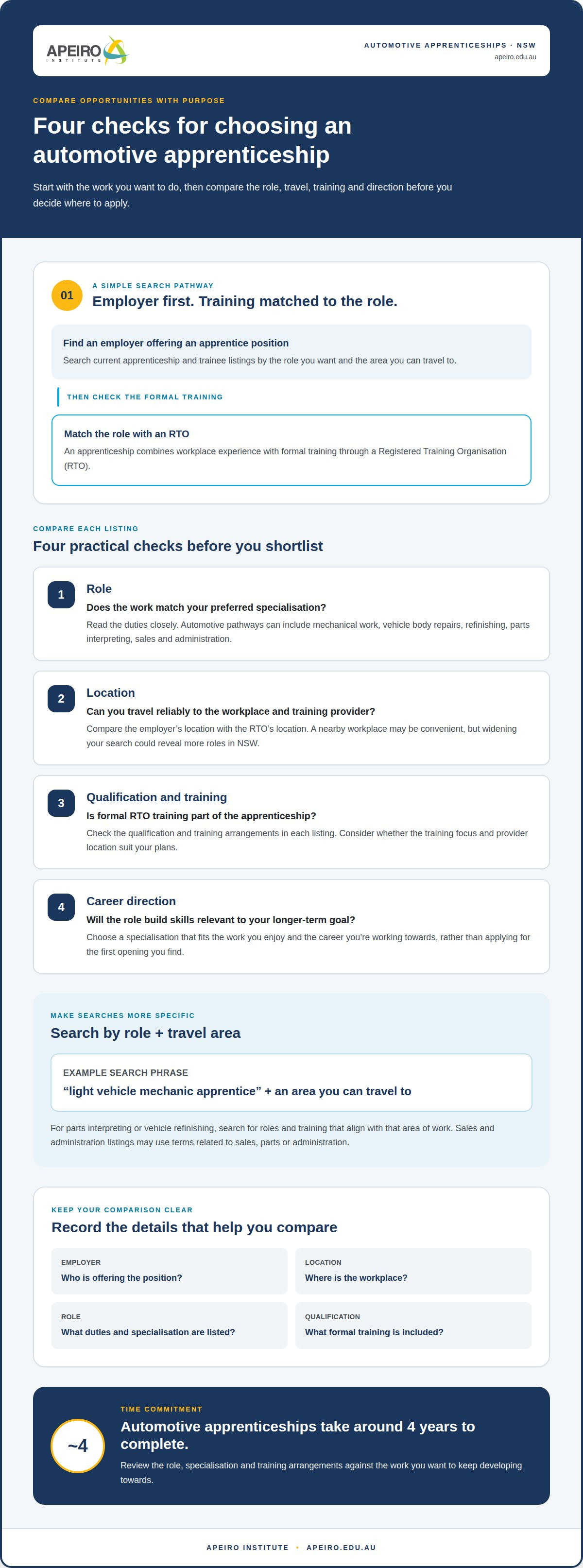
Where you can find automotive apprenticeships in NSW depends on the role and area you’re targeting. Start by looking for an employer offering an apprentice position, then match the role with formal training through a Registered Training Organisation (RTO). For light vehicle mechanics, training covers maintaining and repairing vehicle engines, transmissions, suspension and braking systems. Automotive apprenticeships take around 4 years to complete.
Choosing an automotive apprenticeship is a significant decision. Look for a specialisation that suits the work you enjoy and the career you’re working towards, rather than applying for the first opening you find.
This guide explains where to search for opportunities, how to compare automotive qualifications and how to focus on light vehicle mechanic apprenticeships. You’ll also find practical ways to assess training arrangements and apprenticeship pathways before deciding what to pursue.
Key Takeaways
- Compare apprenticeship locations with the automotive specialisation and local job opportunities you’re aiming for.
- Choose a qualification that matches your career direction, whether that’s light vehicle mechanics, heavy vehicles, or paint and panel work.
- Start your search with employers offering apprentice roles, then consider how formal training fits the position.
- Light vehicle mechanic training focuses on maintaining and repairing engines, transmissions, suspension and braking systems.
- Automotive apprenticeships take around 4 years to complete; review the role and its requirements before applying.
Considering training and apprenticeship locations
Start with the work you want to do, then compare employers and training options across NSW. Automotive pathways include mechanical work, vehicle body repairs, refinishing, parts interpreting, sales and administration. As each involves different day-to-day tasks, consider which specialisation best fits your interests before choosing where to train or apply.
Search current apprenticeship and trainee listings by role and preferred travel area, rather than using one broad term. Try phrases such as “light vehicle mechanic apprentice” alongside an area you can travel to. Check each listing for the employer’s location, duties, qualification and training arrangements. A nearby workplace may be convenient, but widening your search could reveal more roles.
Location matters beyond the daily commute. The location of training providers and apprenticeship opportunities can affect availability and job prospects in your chosen specialisation. Compare employers with training locations, and consider how you would travel to both the workplace and formal training. If you’re interested in parts interpreting or vehicle refinishing, look for roles and training that align with that area of work.
An apprenticeship combines workplace experience with formal training through a Registered Training Organisation (RTO). When reviewing a role, identify its qualification and consider whether the training arrangements suit your plans and circumstances. The RTO’s location is one factor to weigh alongside the specialisation and workplace experience the employer offers.
Automotive sales and administration are other pathways to consider. Training in these areas may cover customer service, vehicle sales, finance and insurance, inventory management, and administrative support. They suit people interested in dealership operations and customer-facing work rather than vehicle repairs. Search using terms related to sales, parts or administration, then compare the listed duties with the training focus.
Use this short comparison to narrow down the opportunities you want to pursue:
- Role: Does the work match your preferred automotive specialisation?
- Location: Can you travel reliably to the employer and training provider?
- Qualification: Is formal training through an RTO part of the apprenticeship?
- Direction: Does the role build skills relevant to your longer-term goal?
Keep a shortlist of active listings, recording the employer, location, role and qualification for each. This makes it easier to compare opportunities side by side and see which roles suit your travel plans. It can also help you decide whether to focus on your immediate area or widen your search to consider more opportunities in NSW.
Automotive qualifications
Choose an automotive qualification that matches the work you want to do. Light vehicle training focuses on cars and similar vehicles, while heavy vehicle mechanical training covers trucks and buses. Paint and panel training is suited to repairing damaged vehicle bodies. Compare the practical tasks in each area before choosing.
Heavy vehicle mechanical training covers maintaining and repairing engines, transmissions, suspension systems and braking systems. For example, a workshop role might involve diagnosing a truck’s braking issue or maintaining a bus transmission. If you’re more interested in these vehicles than cars, this specialisation may suit your goals. Consider the employers and roles in the area where you want to work, too.
Paint and panel training follows a different practical sequence. It covers repairing damaged body panels, preparing surfaces, applying and matching paint, and finishing the repair. A damaged door, for example, may need panel work before its surface is prepared and repainted. This pathway may suit you if you enjoy detailed restoration more than mechanical diagnosis.
Other automotive qualifications can lead towards sales, parts interpreting or administration. Sales and administration training may cover customer service, vehicle sales, finance and insurance, inventory management, and administrative support. Parts interpreting brings automotive knowledge together with identifying and supplying the right components. Consider whether you prefer repairs, customer interaction or supporting workshop operations.
Use these questions to compare qualification options:
- Work focus: Does the training cover the vehicles or tasks you want to work with?
- Practical skills: Will the learning develop relevant skills, such as paint matching or maintaining transmissions?
- Career direction: Does the specialisation support the role you want next?
- Local prospects: Are employers in your preferred area recruiting for that type of work?
Before enrolling, read the qualification information and compare its learning outcomes with the work you’re targeting. Look for specific tasks, such as repairing body panels or maintaining suspension systems, rather than relying on a broad course title. The RTO provides formal training linked to the apprenticeship, while the employer shapes the experience you gain at work.
Automotive apprenticeships take around 4 years to complete. That commitment makes it worth weighing the specialisation against your long-term plans. Someone aiming to diagnose light vehicle faults may prioritise mechanical training, while a learner interested in vehicle restoration may prefer paint and panel. Choose the qualification whose skills point towards the work you want to keep developing.
To take a practical next step, shortlist a qualification area, identify the roles it supports and compare its training focus with current employer opportunities. This makes it easier to choose between mechanical, heavy vehicle, paint and panel, sales, parts or administration pathways.
Finding available automotive apprenticeships
Search across several channels, using terms that match the role you want. Try “automotive apprentice”, “light vehicle mechanic apprentice” or “automotive trainee”, and add a NSW area you can travel to. Search separately for mechanical, parts, paint and panel, or dealership roles, as employers may describe similar work differently.
Check listings regularly and record useful details in a simple spreadsheet: employer, location, position title, duties, application instructions and the date you found the role. This helps you track new opportunities and avoid applying twice to the same advertisement. Check employer career pages as well as general job boards, since workshops and dealerships may publish vacancies directly.
Use a repeatable routine to keep your search organised:
- Set a location: Choose suburbs or towns you can travel to consistently.
- Try related terms: Search “workshop apprentice”, “automotive trainee” and “parts apprentice”.
- Review the duties: Note whether the role involves servicing, repairs, customer support or parts.
- Save suitable listings: Record closing dates and the documents each application requests.
- Follow up your search: Revisit employer pages and listings to find newly advertised roles.
Don’t rely on one job title. One workshop may advertise an entry-level role as a trainee, while another calls it an apprentice mechanic. A parts role may be based at a dealership rather than a repair workshop. Search using different terms to find relevant vacancies that a narrow search might miss.
Tailor a short application to each employer. Match your resume to the advertised duties and give practical examples, such as maintaining a car, helping with repairs or using tools safely. If you have customer service experience, explain how it could be useful in a dealership or parts counter role. Keep your examples accurate and be ready to discuss them.
You can also approach employers directly about opportunities that aren’t advertised online. Find workshops, dealerships or vehicle repair businesses in an area you can travel to, then send a concise enquiry with your resume. State the type of apprenticeship you’re seeking, why that workplace interests you and how to contact you. Keep a record of who you approach and when.
For every promising vacancy, compare the listed duties with the qualification and training arrangement. An apprenticeship combines employment with formal study through a Registered Training Organisation (RTO). Make sure you understand what the advertisement says about training, then prepare specific questions about the role for an interview. A clear search record and tailored applications make it easier to act promptly when a suitable NSW opportunity appears.
Light vehicle mechanic apprenticeships
A light vehicle mechanic apprenticeship combines workplace learning with formal training focused on cars and other light vehicles. Training covers maintaining and repairing engines, transmissions, suspension systems and braking systems, building practical skills across the main mechanical systems found in these vehicles.
First, consider whether this work interests you. A typical task might involve learning how a vehicle’s suspension works, then helping maintain or repair it under workplace supervision. You may also build knowledge of engines, transmissions and braking systems. Duties vary by employer, so compare each listing with the work you want to learn.
Search NSW vacancies using several related phrases, including “light vehicle mechanic apprentice”, “motor mechanic apprentice” and “automotive apprentice”. Add your preferred suburb or town to narrow the results. Read the duty descriptions closely: one vacancy may emphasise vehicle servicing, while another may refer broadly to workshop support. Match the advertised work to light vehicle mechanical training.
Before applying, make a short list of your skills and interests. Include practical experience, such as maintaining a family vehicle, completing a school workshop project or using tools in another setting. These examples don’t replace formal training, but they can help explain your interest. Be ready to describe what you did, the equipment you used and what you learned.
Compare apprenticeship opportunities using the same criteria each time:
- Vehicle focus: Does the role involve light vehicles?
- Mechanical systems: Do the duties connect with engines, transmissions, suspension or brakes?
- Training: Does the position explain how formal learning fits the work?
- Travel: Can you reach the workplace and training location reliably?
- Career fit: Would the tasks help you develop towards the mechanic role you want?
Keep the formal training component in mind. Apprentices complete qualifications through an RTO alongside workplace learning. For a light vehicle role, compare the qualification’s focus with the vehicle systems and tasks in the vacancy. This can help you assess whether the training aligns with the employer’s work.
Prepare for an interview by reviewing the listing and noting questions about day-to-day tasks, the vehicles you’ll work with and how training is organised. Use specific examples to explain your interest. For instance, say why learning about braking systems appeals to you rather than relying on a general statement about liking cars.
Consider your longer-term direction, too. Light vehicle mechanical training focuses on maintaining and repairing the systems described above. If that work suits your interests, look for roles with relevant workplace learning and formal study. Matching the vacancy and training to your career goal can help you decide which applications to prioritise.
What are the eligibility requirements for an automotive apprenticeship in NSW?
For an automotive apprenticeship, assess your suitability against the employer’s vacancy criteria and the qualification linked to the role. Requirements vary by employer and training pathway. Read the full advertisement, then compare its criteria with the qualification information before applying.
Start with the job listing. Check for requirements related to experience, education, licences, availability or location, and consider each separately. If the listing asks for workshop experience, describe relevant tasks you’ve done, such as helping with vehicle maintenance or using tools in a practical setting. Don’t present informal experience as a formal qualification.
Next, identify the qualification connected to the apprenticeship. The listing may name a specific automotive pathway or describe the study component more generally. Compare the course information with the role’s duties. For example, a light vehicle mechanic position should align with training focused on maintaining and repairing light vehicle systems. Note the qualification name and code if you need to ask about its entry process.
Make your suitability easy to assess with a focused application. Include a clear resume, accurate education details and examples related to the advertised work. If you’ve completed a school workshop project, explain the task and what you learned. If you have customer service experience, describe how it could help in a dealership. Use specific examples instead of claiming skills you haven’t developed.
Before applying, work through this practical checklist:
- Vacancy: Identify every requirement stated by the employer.
- Qualification: Note the named course and its training provider.
- Experience: Connect relevant work, study or practical projects to the duties.
- Application: Prepare a tailored resume and respond to each selection point.
- Interview: Be ready to discuss your interest in the role and examples from your experience.
Eligibility for funded training is separate from an employer’s hiring criteria. If funding is relevant to the position or course, read the conditions for that specific option. Eligibility depends on the qualification, your circumstances and current program availability, and requires an individual assessment. Consider funding separately from the employer’s assessment so you understand both parts of the pathway.
If you’re an experienced worker, your existing automotive skills may be relevant to another training pathway. Describe the tasks you’ve performed, the vehicles or systems involved and any formal learning you’ve completed. This can help inform a discussion about suitable study options. If you’re new to the industry, focus on the vacancy criteria and the qualification’s published entry information.
Use the employer’s criteria and the course entry information to prepare a focused application.
Explore light vehicle mechanic training
Apeiro Institute: UEE30920 Certificate III in Electronics and Communications
Apeiro Institute offers the UEE30920 Certificate III in Electronics and Communications for learners considering a technical pathway alongside automotive work. It is an electronics and communications qualification, not a light vehicle mechanic apprenticeship, so it suits a different training focus. If your goal is automotive mechanical work, prioritise a qualification aligned with that specialisation.
Apeiro Institute offers Apprenticeships and Traineeships, Smart & Skilled Funded Courses and Trade Pathways for Experienced Workers (TPEW). These may suit you if you’re exploring vocational training or have existing trade experience. Funding depends on an individual eligibility assessment and program availability. Compare the pathways with the work you want to do before choosing your next step.
For guidance on training pathways, contact Apeiro Institute or visit apeiro.edu.au.
Take your next step towards an automotive career
Turn your interest into a practical plan: decide which kind of workplace you want to approach and prepare a short introduction about your goals. If you’re still wondering where you can find automotive apprenticeships in NSW, use your preferred work area and career direction to guide your next conversations with employers and training providers.
Apeiro Institute offers Apprenticeships and Traineeships, Trade Pathways for Experienced Workers (TPEW), and the UEE30920 Certificate III in Electronics and Communications. The electronics qualification is a different pathway from light vehicle mechanical training, so consider which direction best matches your aims before taking action.
A focused conversation with Apeiro Institute can help you consider which training pathway fits your experience and plans. Bring your questions and details of the role or pathway you’re exploring.
Your next step can be simple. Start with the direction that feels right and build your plan through a conversation with Apeiro Institute.
Frequently Asked Questions
Where can I find automotive apprenticeships in NSW?
Find automotive apprenticeships through employer vacancy listings, workshop and dealership career pages, and direct enquiries to businesses that train apprentices. Search by specialisation, such as light vehicle mechanics or panel refinishing, then add an area you can travel to. Contacting employers directly may uncover roles not advertised publicly. For each suitable position, identify the RTO and qualification linked to its training.
Which NSW employers offer automotive apprenticeships?
Employers in vehicle repair, dealerships, body repair, heavy vehicle servicing and automotive parts may recruit apprentices. The work varies: a repair workshop may focus on mechanical servicing, while a panel business may offer experience repairing damaged vehicle bodies and refinishing them. Look for employers whose day-to-day work matches your preferred trade, and check each vacancy for its duties and formal training.
Where are automotive apprenticeship vacancies listed in NSW?
Look for vacancies on general job boards, employer career pages and automotive business recruitment pages. Search terms such as “automotive apprentice”, “motor mechanic apprentice” and “panel beating apprentice” can surface different role descriptions. Follow employers in your preferred trade and set up alerts using relevant terms. You can also enquire directly with workshops or dealerships, explaining the type of apprenticeship you’re seeking.
What automotive apprenticeship trades are available in NSW?
Automotive pathways include light and heavy vehicle mechanics, vehicle body repairs, refinishing, parts interpreting, sales and administration. The work varies by trade: heavy vehicle mechanics focus on trucks and buses, while refinishing involves preparing and painting vehicle surfaces. Parts interpreting and sales suit people interested in product knowledge and customer service. Compare the tasks with your interests and career direction before narrowing your search.
What qualifications and training providers are involved in NSW automotive apprenticeships?
Automotive apprentices complete a formal qualification through a Registered Training Organisation (RTO), alongside workplace learning with an employer. The qualification should match the apprenticeship trade and its tasks. For light vehicle mechanical training, Apeiro Institute offers AUR30620 Certificate III in Light Vehicle Mechanical Technology. Check the qualification title and code in the vacancy, then compare them with the training provider’s course information to understand how study relates to the role.
Are there government incentives or financial support for NSW automotive apprentices?
Eligible apprentices may receive support payments if their qualification is included on the Australian Government’s Apprenticeship Priority List.

Disclaimer
The information provided on this blog is for general informational and educational purposes only. While every effort is made to ensure the accuracy and reliability of the content, the author makes no representations or warranties of any kind, express or implied, about the completeness, accuracy, suitability, or availability of the information contained on this blog.
The views and opinions expressed in blog posts are those of the individual author and do not necessarily reflect the official policy or position of any organization, company, or employer.
This blog may contain links to external websites or third-party content. These links are provided for convenience only, and the author has no control over and assumes no responsibility for the content, privacy policies, or practices of any third-party sites.
Nothing on this blog constitutes professional advice (legal, financial, medical, or otherwise). Readers are encouraged to seek appropriate professional guidance before making any decisions based on the information provided here.
By using this blog, you acknowledge that any reliance on the information is at your own risk.


