

Your hands-on workshop experience may already cover some of the skills in the AUR30620 Certificate III in Light Vehicle Mechanical Technology. RPL for AUR30620 gives experienced workers a way to have their existing skills assessed against the qualification, with further training focused on any competencies they still need to develop. There are no formal academic entry requirements for the qualification.
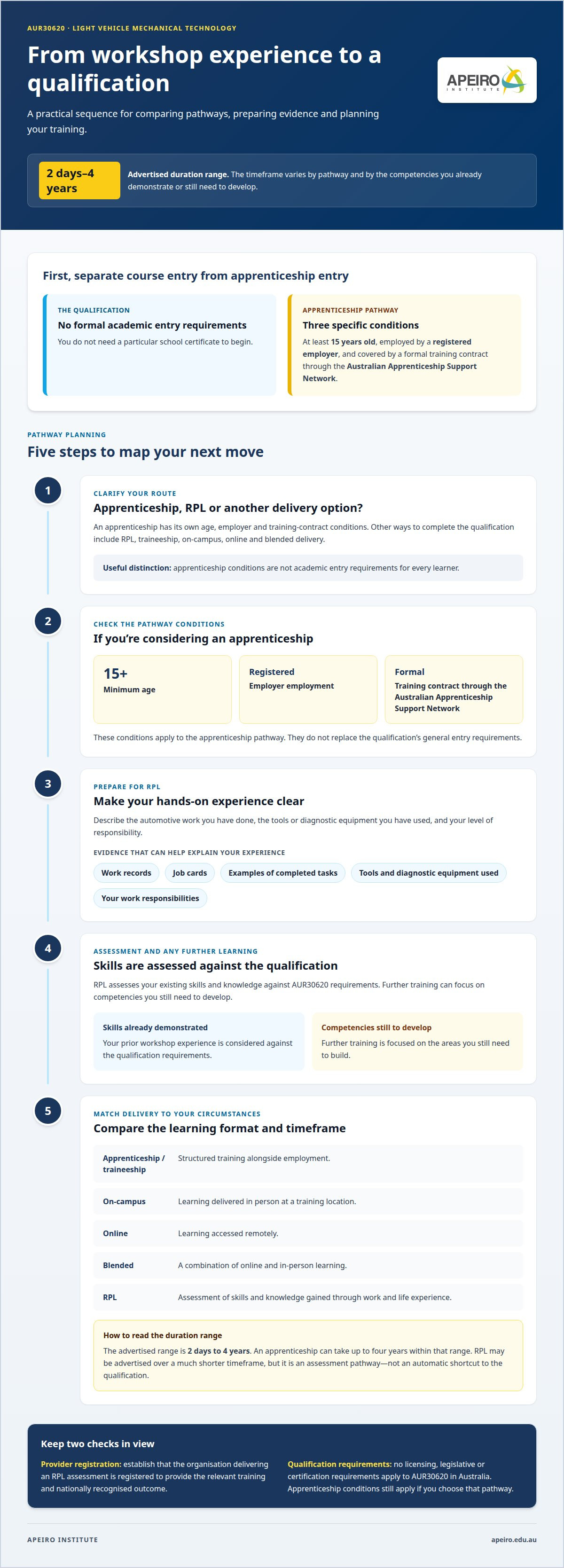
If you’re considering an apprenticeship, the pathway has different conditions: you must be at least 15 years old, employed by a registered employer and have a formal training contract through the Australian Apprenticeship Support Network. The qualification can also be completed through other delivery options, including RPL, so your next step depends on your experience and preferred route.
It’s reasonable to want a clear picture before committing to training. This guide explains how RPL assessment works, what evidence can help demonstrate your skills, how entry requirements differ from apprenticeship requirements, and what to expect from delivery, duration and training locations. You’ll be better placed to decide whether recognition of your experience or a structured apprenticeship pathway suits your goals.
Key Takeaways
- Prior workshop experience may be recognised through an assessment of your skills and knowledge against the qualification’s requirements.
- An apprenticeship has specific entry conditions, including a minimum age, employment with a registered employer and a formal training contract.
- Training duration and delivery vary by pathway, with options including apprenticeship, on-campus, online, blended learning and RPL.
- The qualification develops practical capability across vehicle inspections, servicing, fault diagnosis and repair work.
- Compare your experience and preferred learning approach to decide which pathway best supports your next step.
What are the entry requirements for the AUR30620 Certificate III in Light Vehicle Mechanical Technology?
The qualification has no formal academic entry requirements, so you don’t need a particular school certificate to begin. An apprenticeship has separate conditions, however. Knowing which pathway you’re considering helps you prepare the right information and avoid confusing apprenticeship requirements with general course entry requirements.
For an AUR30620 apprenticeship in Australia, you must be at least 15 years old. You also need employment with a registered employer and a formal training contract through the Australian Apprenticeship Support Network. These are apprenticeship entry conditions, not academic requirements for every way of completing the qualification.
Start by identifying your pathway. If you’re applying for an apprenticeship, confirm that you meet the age requirement and have an employer willing to enter into the formal training contract. If you’re seeking recognition of skills gained at work, an RPL assessment for AUR30620 provides a way to have your experience assessed against the qualification.
Before discussing RPL, prepare a clear account of your automotive work. Describe the vehicle tasks you’ve performed, the tools or diagnostic equipment you’ve used, and your level of responsibility. Work records, job cards and examples of completed tasks can help explain your experience. The assessment focuses on whether your skills match the qualification’s requirements.
What are the risks of using an unregistered provider for AUR30620 RPL? The practical risk is paying for an assessment that doesn’t lead to the nationally recognised outcome you expect. Before enrolling, establish that the organisation delivering the assessment is registered to provide the relevant training and outcome.
There are no licensing, legislative or certification requirements that apply to the AUR30620 qualification in Australia. That does not remove the apprenticeship conditions: the minimum age, registered employer and formal training contract still apply to that pathway. Keep these requirements distinct when comparing an apprenticeship with RPL or another delivery option.
Use this simple checklist to prepare:
- Choose whether you’re pursuing an apprenticeship or an RPL assessment.
- For an apprenticeship, confirm you’re at least 15 and have registered-employer employment.
- Make sure the apprenticeship has a formal training contract through the Australian Apprenticeship Support Network.
- For RPL, organise examples that show your automotive tasks and experience.
These distinctions clarify which pathway may suit you. Apprenticeship applicants need to meet the specific apprenticeship conditions. Other learners can consider the qualification’s lack of formal academic entry requirements and explore a suitable training pathway.
Apprenticeship duration and delivery
The advertised duration for AUR30620 ranges from 2 days to 4 years. That broad span reflects different ways of completing the Certificate III, rather than one set timeframe for every learner. An apprenticeship is a longer structured pathway, while recognition of prior learning assesses existing skills against the qualification. The appropriate timeframe depends on the pathway and the competencies demonstrated or still to be developed.
Delivery options include online study, on-campus learning, blended delivery, an apprenticeship, a traineeship or RPL. Each pathway involves a different learning arrangement. Online study offers a remote learning format, while on-campus delivery places learning at a training location. Blended delivery combines online and in-person learning. Apprenticeships and traineeships connect training with a workplace, while RPL assesses skills gained through work and life experience.
For an apprenticeship, consider the relationship between training and your day-to-day work. A learner developing automotive skills while employed follows a different route from an experienced mechanic seeking recognition. The apprenticeship pathway can take up to four years within the advertised range. RPL may be advertised over a much shorter timeframe, but it is an assessment pathway, not a shortcut that automatically grants the qualification.
Delivery also affects how you organise learning around work and personal commitments. For example, someone who needs face-to-face learning may prefer an on-campus or blended arrangement. A learner seeking flexibility around location may find online delivery more suitable. People already applying relevant automotive skills at work may consider RPL. The key is matching the learning format to both your circumstances and the skills you need to demonstrate.
Before choosing, compare the pathways by asking what learning activity each involves:
- Apprenticeship or traineeship: structured training alongside employment.
- On-campus: learning delivered in person at a training location.
- Online: learning accessed remotely.
- Blended: a combination of online and in-person delivery.
- RPL: assessment of existing skills and knowledge against AUR30620.
The two-day-to-four-year duration range is a useful planning guide, not a promise that every learner will finish in the same period. A short advertised duration may relate to an assessment-focused route, while an apprenticeship involves a more extended training pathway. Your experience, the delivery arrangement and the competencies requiring assessment or further learning all shape the process. Compare these elements before deciding which pathway fits your goal.
Where is the Training Program delivered?
AUR30620 training can be delivered online, on campus, through blended learning, an apprenticeship or traineeship, or RPL. The right location and format depend on how you’ll learn and demonstrate the required skills. For example, online study offers remote learning, while on-campus delivery places learning at a training site.
Australian RTOs that deliver AUR30620 can assess an RPL application. Choose an RTO registered to deliver the qualification if you want a nationally recognised outcome. RPL assesses whether your work and life experience match the qualification’s required skills and knowledge.
RPL assessment focuses on evidence, not simply time spent in a workshop. Start by mapping your experience to automotive tasks. Note the types of inspections, servicing or repair work you’ve carried out, the equipment you’ve used and your role in each task. Job records, work samples and explanations of your methods can help show what you know and can do.
Does AUR30620 RPL require practical demonstrations or workplace observation? An assessor may use a practical demonstration or workplace observation when they need to verify a skill directly. Evidence requirements depend on the competencies being assessed and the material you provide.
The qualification covers mechanical inspections, testing, fault diagnosis, repair work, servicing, battery charging and part replacement. Your RPL evidence should connect your actual experience to these areas. For example, describe how you identified a fault, tested a system and completed a repair. An assessor evaluates whether your evidence demonstrates the relevant competencies.
Some learners may need further training if their evidence doesn’t cover every requirement. That’s different from having all skills recognised through RPL. The assessment identifies what your experience demonstrates and where additional learning may be needed. Keep evidence organised by task, rather than sending unrelated documents without context.
AUR30620 also includes work placement under qualified supervision. This relates to the qualification’s training requirements, while RPL is an assessment route for skills and knowledge already gained through work or life experience. If you’re comparing delivery options, clarify how practical learning and assessment fit your chosen pathway.
- Online: remote learning activities.
- On campus: learning at a training location.
- Blended: a mix of online and in-person delivery.
- Workplace pathway: training through an apprenticeship or traineeship.
- RPL: assessment of existing evidence against AUR30620 requirements.
Before preparing an RPL application, group your examples under inspections, testing, diagnosis, servicing, repairs, battery charging and part replacement. This makes it easier to connect your experience to the qualification’s practical scope.
AUR30620 Certificate III in Light Vehicle Mechanical Technology
AUR30620 is the qualification code for the Certificate III in Light Vehicle Mechanical Technology. It focuses on practical work with light vehicles, from checking mechanical condition to identifying faults and completing repairs. The qualification suits people building automotive capability, as well as experienced workers seeking formal recognition of relevant skills. Its scope connects workshop tasks with the knowledge needed to carry them out.
Consider a typical workshop job. A vehicle arrives with a reported problem, so the mechanic begins with inspection and testing. They use the results to diagnose the fault, decide what repair work is needed, then service or replace parts as appropriate. The qualification brings these activities together rather than focusing on one task, such as servicing alone.
Battery charging is another named area within AUR30620. It sits alongside inspections, testing, diagnosis, repairs, servicing and part replacement. Taken together, these areas reflect varied light vehicle mechanical work. For example, a service task may involve checking vehicle condition, while a diagnostic task centres on locating the cause of a fault. Each calls for a different practical response.
For RPL, organise evidence around work you’ve actually performed. A job record might show a vehicle inspection, the tests completed, the fault identified and the repair carried out. Another example could document servicing or battery charging. Briefly explain your role, the steps you took and the outcome. This gives an assessor a clearer picture of your experience than a list of job titles alone.
Use the qualification’s work areas to spot gaps in your examples. If your records show servicing and part replacement but little diagnostic work, note that difference. This helps distinguish skills you can demonstrate from areas where further learning may be relevant. RPL recognises evidence of existing competence; experience in one task doesn’t prove competence in every other task.
Before selecting a pathway, map your experience against these AUR30620 work areas:
- Inspection and testing: examples of checking mechanical condition and carrying out tests.
- Fault diagnosis: records showing how you identified a vehicle problem.
- Repair and servicing: examples of the work completed and your part in it.
- Battery charging and part replacement: relevant tasks you’ve performed in a workshop.
This practical map helps you discuss the qualification with greater clarity. Apprentices and trainees develop skills through structured training, while experienced workers can consider whether their evidence supports RPL. In either case, the central question is how your experience or training relates to the mechanical work covered by AUR30620.
What are the eligibility requirements for RPL for AUR30620?
RPL eligibility centres on whether your existing skills and knowledge can be assessed against AUR30620 requirements. Relevant experience may come from paid work, informal work or life experience. A job title alone doesn’t show what you can do. Your evidence needs to relate to the qualification’s automotive tasks and demonstrate your own contribution. An RPL AUR30620 assessment is therefore based on relevant capability, not simply your employment history.
There isn’t one universal evidence pack that suits every applicant. Start with a clear record of what you’ve done, how you did it and what responsibility you held. For example, a mechanic might describe diagnosing a vehicle fault, carrying out tests and completing a repair. A supervisor’s statement or job record could help support that account. Choosing an RPL AUR30620 pathway begins with identifying examples that can be connected to the qualification.
Before applying, take these practical steps:
- List your automotive roles, informal experience and relevant life experience.
- Match each example to a skill area in AUR30620.
- Gather records that show your actions, decisions and completed work.
- Note areas where you have limited experience or little supporting evidence.
Evidence can take different forms, including work records, completed job cards, supervisor feedback and examples of tasks. Explain unfamiliar abbreviations and describe your role in team jobs. If a job card records a repair but not who performed it, add context about your contribution. This helps clarify what the document demonstrates.
An assessor considers your evidence against the qualification’s requirements. They may ask questions or request further evidence if an example doesn’t clearly demonstrate a skill. A practical demonstration or workplace observation may also help verify particular competencies. The assessment outcome reflects what your evidence demonstrates, not simply how long you’ve worked.
Recognition isn’t automatic for every competency. If your evidence shows some, but not all, required skills, the assessment can identify areas that need further learning. An honest review of your experience helps you decide whether to prepare an application or build skills first. Keep your examples factual and distinguish your own work from tasks completed by colleagues.
Strong applications connect specific examples to skills. Explain the fault symptoms, tests performed, diagnosis reached and repair completed. Consider whether your experience covers different aspects of light vehicle work instead of relying on one repeated task. Detailed examples of varied responsibilities give a broader picture of your capabilities and help you identify which records support each claim.
Explore AUR30620 Certificate III course details
Apeiro Institute: UEE30920 Certificate III in Electronics and Communications
Apeiro Institute offers the AUR30620 Certificate III in Light Vehicle Mechanical Technology and Recognition of Prior Learning. If you’re preparing an RPL AUR30620 application, your work examples can help show how your skills relate to the qualification. Apeiro Institute also offers Trade Pathways for Experienced Workers (TPEW), Apprenticeships and Traineeships, and the UEE30920 Certificate III in Electronics and Communications.
For an RPL AUR30620 pathway, consider whether assessing existing skills or undertaking structured training better suits your experience and goals. Contact Apeiro Institute to discuss your next step.
Make your next automotive career move
Your next step is to connect the qualification with a clear career goal. Consider what you want formal recognition to help you do and what kind of automotive work you’d like to take on. That direction can help you decide whether to have your existing experience assessed or build skills through a structured pathway.
If you’re considering RPL for AUR30620, prepare to discuss the work you’ve done and the capabilities you want recognised. A focused conversation can help you understand how your experience relates to the qualification and what pathway may suit your plans. You can also explore how your training goals align with Apeiro Institute’s automotive learning options.
Take the next step at your own pace. Your practical experience can be a strong starting point for continued learning and career development.
Frequently Asked Questions
Can I get recognition of prior learning experience?
Yes. Relevant skills gained through work or life experience can be assessed for recognition. For example, someone who has serviced vehicles informally or performed mechanical work without a formal qualification can organise examples of those tasks. The assessment considers whether the experience demonstrates the required competencies. Records of your responsibilities and decisions help distinguish your contribution from work completed by colleagues.
How will assessment work?
An assessor reviews your evidence against the qualification’s requirements and identifies what it demonstrates. They may discuss your work history, ask questions about a repair process or request further evidence to clarify a task. For example, you could explain how you investigated a reported vehicle fault. The assessment outcome informs which competencies are recognised and whether further learning is needed.
What are the fees and charges?
Fees vary between training providers and depend on location, delivery method and eligibility for financial support. For Apeiro Institute’s qualifications, fees are provided on request, with a written fee schedule for each qualification. Funding or fee-free places depend on an individual eligibility assessment and the qualification or program. Consider the assessment pathway and delivery arrangement alongside the fee information when planning your study.
What are the potential employment and education pathways?
AUR30620 can support a pathway into light vehicle mechanical work, such as workshop servicing, diagnosis and repair roles. It can also provide a foundation for further automotive study, including options such as AUR40216 Certificate IV in Automotive Mechanical Diagnosis or AUR50216 Diploma of Automotive Technology. Many technicians also choose to broaden their industrial skill set alongside trade qualifications; for example, completing forklift truck operator training can open up complementary opportunities in fleet maintenance, depot servicing, and warehouse environments. These are possible directions, not guaranteed job or enrolment outcomes. Your experience, interests and further training shape your next move.
What is the AUR30620 Certificate III in Light Vehicle Mechanical Technology?
It’s an Australian vocational qualification focused on practical light vehicle mechanical work. The code AUR30620 identifies the qualification, while the title describes its automotive field and level. It suits learners developing trade skills and experienced workers seeking formal recognition of relevant capability. For example, its scope connects workshop tasks such as vehicle testing and servicing with the knowledge needed to carry out mechanical work.
Can you get RPL for AUR30620 in Australia?
Yes, RPL is a pathway for having existing skills assessed against AUR30620 in Australia. The qualification can be completed through recognition of prior learning, as well as other delivery pathways. For a nationally recognised outcome, the assessment must be delivered by a registered training organisation authorised to deliver the qualification. The assessor evaluates your evidence against competency requirements rather than awarding recognition solely for years worked.
What evidence and documents are needed for AUR30620 RPL?
Useful evidence may include job cards, work records, supervisor statements and descriptions of completed automotive tasks. Organise each item by the skill it demonstrates, then explain your role, actions and decisions. For example, a repair record is more useful when accompanied by context about the tests you performed. Remove customer names, contact details and other identifying information unless an approved assessment process specifically requires it.
Which units of competency are included in AUR30620?
AUR30620’s competency areas cover mechanical inspections, testing, fault diagnosis, repair work, servicing, battery charging and part replacement. These areas describe the practical scope, rather than providing the official unit titles or codes. During RPL, evidence is assessed against the units that make up the qualification. Organise examples by task area so your experience can be mapped clearly to the relevant competency requirements.

Disclaimer
The information provided on this blog is for general informational and educational purposes only. While every effort is made to ensure the accuracy and reliability of the content, the author makes no representations or warranties of any kind, express or implied, about the completeness, accuracy, suitability, or availability of the information contained on this blog.
The views and opinions expressed in blog posts are those of the individual author and do not necessarily reflect the official policy or position of any organization, company, or employer.
This blog may contain links to external websites or third-party content. These links are provided for convenience only, and the author has no control over and assumes no responsibility for the content, privacy policies, or practices of any third-party sites.
Nothing on this blog constitutes professional advice (legal, financial, medical, or otherwise). Readers are encouraged to seek appropriate professional guidance before making any decisions based on the information provided here.
By using this blog, you acknowledge that any reliance on the information is at your own risk.


